Japanese Wedding Traditions, Customs & Rituals: Full Guide
Complete guide to Japanese wedding traditions: Shinto ceremony rituals, san-san-kudo, goshugi gift money, hiroen reception customs, and modern adaptations.

Illustrative image · Unsplash. Not a photo of the specific people, places or services discussed.
Check current prices, availability and venue rules with the relevant studio or venue before booking.
Japanese wedding traditions occupy a distinct place among world wedding cultures because they layer Shinto ritual, Buddhist undertones, family-centered etiquette, and an almost theatrical attention to material detail — kimono, lacquerware, sake cups, knotted gift envelopes — onto what is, at heart, the same human act of marriage. For couples planning a kimono photoshoot or a Shinto ceremony in Japan, understanding the underlying customs makes the difference between posing in beautiful clothing and actually participating in something meaningful. This guide walks through the full arc of Japanese wedding traditions, from the pre-engagement formalities of omiai and yuino, through the eight-stage Shinto ceremony, into the reception (hiroen) and its gift customs, and finally into how today's couples adapt these traditions for modern, often international, weddings. It is written for international couples but draws on the same factual baseline a Japanese wedding planner would use.
Why Japanese Wedding Traditions Are Distinct
Three features make wedding traditions in Japan unusual when compared with other cultures. First, the wedding is treated as a contract between two families (両家, ryouke) rather than only between two individuals — this shapes everything from the engagement gift exchange to the seating chart at the reception. Second, the ceremonial framework is religious in form (most commonly Shinto) but not in personal belief; the rituals are inherited as cultural choreography rather than as expressions of faith. Third, the material vocabulary of a Japanese wedding — shiromuku kimono, mizuhiki cords, lacquered sake cups, hikidemono gift bags — has been preserved in unusual detail, so a 21st-century wedding still uses objects and gestures that would be recognizable to a guest from the Meiji era.
These three features explain why Japanese marriage traditions feel both extremely formal and emotionally restrained to outside observers. They are not cold; they are calibrated. Every gesture has a name, an order, and a meaning, and that structure is itself the love language of the occasion.
Pre-Wedding Traditions: Omiai, Yuino, and Engagement Gifts
Long before the ceremony itself, traditional Japanese marriage customs governed how a couple was introduced, how the engagement was formalized, and how the two families exchanged commitments. Many of these pre-wedding customs survive today in modified form, especially among couples who want their wedding to feel rooted in Japanese tradition.
Omiai — The Structured Introduction
Omiai (見合い) is the formal, mediated introduction of two prospective marriage partners. Historically, a nakōdo (仲人, go-between) — often a relative, a respected community figure, or in the modern era a marriage agency — would propose a match based on family background, character, and prospects. The couple would meet in a structured setting, often with both sets of parents present at the first encounter, and decide whether to continue toward engagement.
The contemporary version of omiai is run almost entirely through professional marriage agencies, and a meaningful percentage of Japanese marriages still begin this way. The cultural reflex behind omiai — that marriage is a deliberate, family-aware decision rather than an accidental outcome of dating — remains influential. For a fuller explanation of the historical and modern forms, see our dedicated article on omiai and arranged marriage in Japan.
Yuino — The Engagement Gift Exchange
Once a couple decides to marry, the next traditional step is yuino (結納), the formal engagement gift exchange between the two families. In its full classical form, yuino involves nine symbolic items presented on a lacquered tray: dried bonito (katsuobushi), a folding fan (suehiro), hemp cords (tomoshiraga), seaweed (konbu), and several other items, each chosen for an auspicious meaning embedded in its name. The katsuobushi represents masculine strength, the konbu (a homophone of "yorokobu," to rejoice) represents joy, and the tomoshiraga — bundled white hemp — represents the wish that the couple will grow old together with hair turned white.
Modern families rarely perform the full nine-item yuino. Instead, most couples observe one of three patterns: (1) a simplified yuino with three or five symbolic items, (2) a yuinokin (結納金) cash gift presented in a decorative envelope, typically in the range of several hundred thousand to a million yen depending on family custom, or (3) a casual "ryōke kaoawase" (両家顔合わせ) family dinner where the two sides simply meet over a meal at a ryōtei or hotel restaurant, without any formal exchange. The cash-gift version is the most common among couples in their thirties today.
Engagement Rings and Kekkon Yubiwa
Engagement rings (婚約指輪, kon'yaku yubiwa) and wedding bands (結婚指輪, kekkon yubiwa) were introduced relatively recently — Japanese marriage rituals did not historically include rings — but they have become near-universal. Japanese jewelers such as Mikimoto, Tasaki, Tanzo, Niwaka, and Hoshi no Sunaba are the most commonly chosen domestic brands, and a typical engagement ring sits in the range of two to four months of the partner's salary, though this guideline has loosened considerably in recent years. Many couples now treat the ring as a personal aesthetic choice rather than a status statement.
The Shinto Ceremony — Eight Rituals in Order
The Shinto wedding ceremony (神前式, shinzen-shiki) is the most visible and most photographed of Japanese wedding rituals. It is held inside a shrine's haiden (worship hall) or in a hotel chapel that has been licensed to host a Shinto rite, and it lasts roughly thirty to forty minutes. The ceremony follows a fixed eight-stage choreography that has been standardized since the early 20th century, when Shinto-style weddings were modeled on the 1900 wedding of Crown Prince Yoshihito (later the Taishō Emperor).
If you are planning to attend or participate in a Shinto ceremony, knowing the order in advance dramatically changes the experience. Below is the canonical sequence; our standalone article on the Shinto wedding ceremony covers each stage in greater depth.
1. Sanshin-no-gi — The Procession
The ceremony opens with the sanshin-no-gi (参進の儀), a slow procession in which a Shinto priest (kannushi) and shrine maidens (miko) lead the bride, groom, and immediate family from the shrine office through the precincts to the worship hall. The bride typically walks under a vermilion-lacquered umbrella held by an attendant. This is the procession most international couples recognize from photographs of weddings at Meiji Jingu or Heian Jingu.
2. Shubatsu-no-gi — Purification
Inside the hall, the priest performs shubatsu (修祓), a brief purification rite in which a haraegushi (a wand of paper streamers on a wooden staff) is waved over the couple and their families. The gesture symbolically removes any spiritual impurity before the kami (deities) are invoked.
3. Norito Sōjō — Reading of the Ritual Prayer
The priest then reads the norito (祝詞), a formal Shinto prayer addressed to the enshrined kami. The norito announces the marriage, requests divine blessing, and names the couple. The text is in classical Japanese and is chanted in a distinctive intonation; even Japanese guests typically do not fully understand the wording, and that opacity is part of the gravity of the moment.
4. San-san-kudo — The Sake Sharing
The central ritual of the ceremony is san-san-kudo (三々九度), the three-three-nine-times sake exchange in which the couple drinks from three stacked lacquer cups. Because this ritual is so central, we treat it in its own section below.
5. Seishi Sōjō — The Pledge
The groom then reads aloud a seishi (誓詞), a written marriage vow, while the bride stands beside him; she usually speaks only her name at the end. Many couples now write their own seishi text in collaboration with the shrine, though the traditional template is brief and formal.
6. Tamagushi Hōten — The Sakaki Offering
The couple together offers a tamagushi (玉串), a small sakaki evergreen branch with paper streamers attached, to the altar. The gesture — bowing twice, clapping twice, bowing once more after placing the branch — is a standard form of Shinto respect, and many international couples find it the most physically engaging part of the ceremony.
7. Shinzoku-Hai-no-gi — The Family Cup
In shinzoku-hai (親族盃の儀), all members of both families share a sip of sake simultaneously, sealing the union not just of the two individuals but of the two families. This is the ritual moment in which Japanese wedding traditions most clearly express the family-to-family nature of marriage.
8. Taige — Recession
The ceremony closes with taige (退下), in which the priest, couple, and families withdraw from the hall in reverse procession order. Photographs are typically taken in the precincts immediately afterward; many shrines have a designated photo area, and some have permit rules about where external photographers may shoot. See our article on shrine etiquette for behavior expected of guests, and the Meiji Jingu permit guide if you are planning a shoot at that specific shrine.
San-san-kudo — The Sake Sharing Ritual
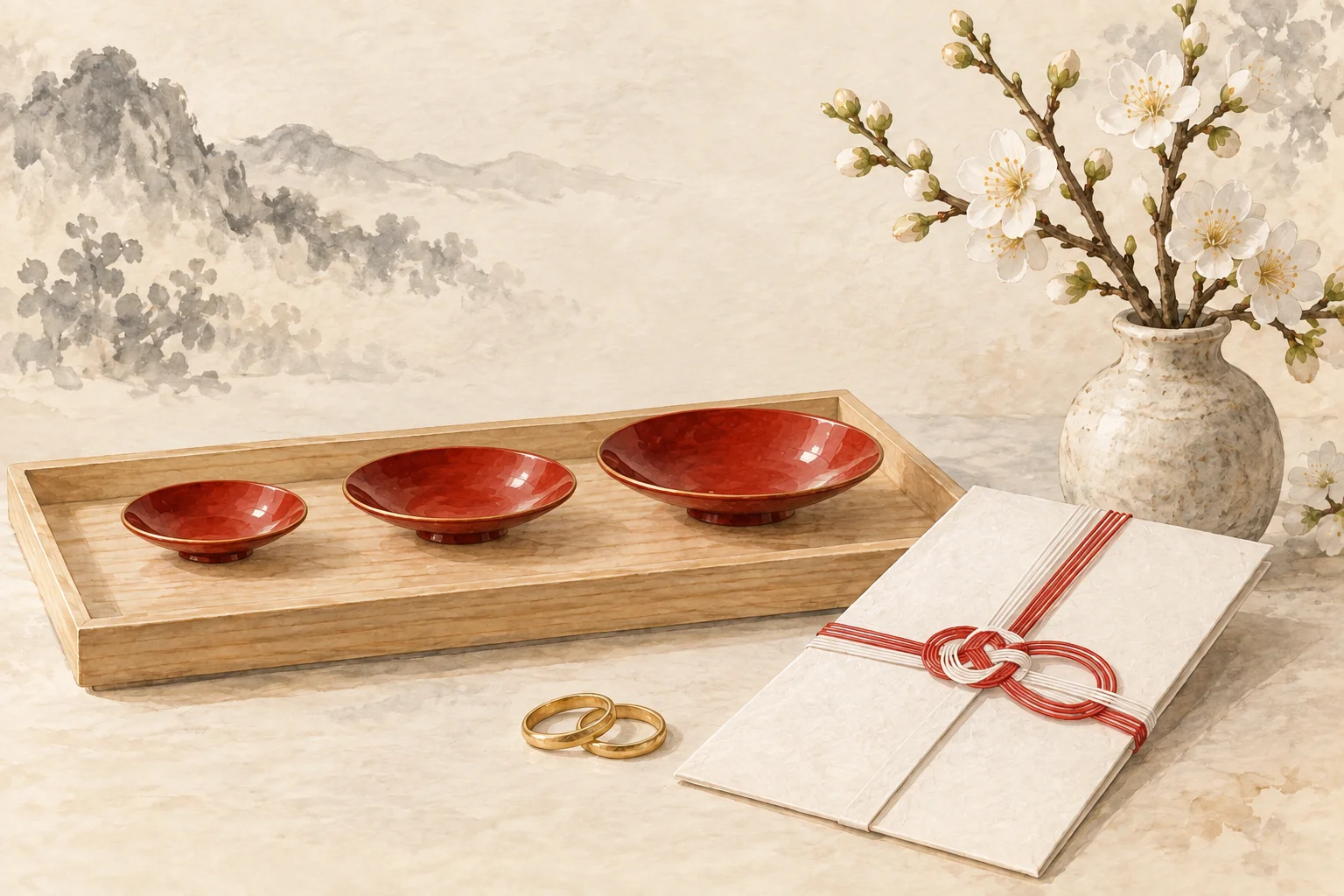
Of all Japanese wedding rituals, san-san-kudo is the one most often cited as the defining moment. The name itself — "three-three-nine-times" — describes the structure: three lacquered cups, stacked from small to large, are presented in sequence, and the couple takes three sips from each cup, totaling nine sips. The number three is auspicious in Japanese numerology (it cannot be cleanly divided, suggesting stability), and three threes amplify that meaning.
The bride and groom alternate who drinks first across the three cups, in a pattern set by the shrine. The first, smallest cup is traditionally said to honor the couple's ancestors; the second, middle cup represents the couple themselves; the third, largest cup expresses the wish for descendants and family continuity. Some shrines vary the symbolism (heaven-earth-humanity is another common interpretation), but the structural elements — three cups, nine sips, an alternating order — are universal.
For a deeper treatment of the symbolism, the choreography, and how the ritual differs across shrines, see our standalone article on the san-san-kudo sake ritual.
Buddhist Wedding Customs
While Shinto ceremonies dominate the photogenic image of Japanese weddings, Buddhist wedding ceremonies (仏前式, butsuzen-shiki) are also part of the tradition, though much less common — by most estimates fewer than one percent of weddings in Japan today. A Buddhist wedding is typically held at a temple of the family's sect, in front of the family altar, and is officiated by a priest who chants sutras and recites a marriage vow in front of the Buddha and the couple's ancestors.
The Buddhist ceremony shares some structural elements with the Shinto rite — including a form of sake exchange and a vow recitation — but it frames the marriage as a karmic bond (en, 縁) connecting the couple across past, present, and future lives, rather than as a contract witnessed by kami. The couple receives juzu (Buddhist prayer beads) in the ceremony, often in matching pairs, which they keep as a marital token.
Buddhist weddings are most common among families with a strong temple affiliation, particularly in regions where a specific sect (Jōdo Shinshū, Nichiren, or Sōtō Zen) has historic roots. For international couples, a Buddhist wedding is generally only available if you have a personal connection to a temple; most temples do not market wedding services to outside couples. If you are drawn to the aesthetic, a kimono photoshoot at a temple — for example in Kamakura — is a more accessible alternative than booking a Buddhist ceremony.
Reception (Hiroen) Customs
The reception, called hiroen (披露宴, literally "the banquet of announcement"), is the public, social half of a Japanese wedding. Where the ceremony is religious and family-only, the hiroen is secular and broad — guests typically number 50 to 100, and the event runs two to three hours in a hotel banquet hall or a dedicated wedding venue. Several distinctive rituals are layered into the meal, and understanding them helps explain the rhythm of a Japanese wedding reception.
Kagami-Biraki — Breaking the Sake Barrel
Many receptions open with kagami-biraki (鏡開き), in which the couple and their fathers use small wooden mallets to break open the lid of a ceremonial sake barrel (taru) in front of the guests. The lid is called a kagami (mirror) because of its round shape; "breaking the mirror" symbolizes opening the path to good fortune. The sake from the barrel is then served to guests in masu (small square wooden cups).
Iro-naoshi — The Outfit Change
One of the most distinctive customs in Japan wedding traditions is iro-naoshi (お色直し), the bride's mid-reception outfit change. Historically the bride changed from a pure-white shiromuku into a colored uchikake to signal her transformation into a member of her new family. Today, iro-naoshi is largely an aesthetic and theatrical custom; the bride may change two or even three times across the reception — for example shiromuku to iro-uchikake to an evening gown — with each appearance treated as a separate entrance.
If you are unsure which bridal kimono to wear (or whether to wear both), our comparison article on shiromuku versus iro-uchikake walks through the visual and symbolic differences.
Candle Service
The candle service (キャンドルサービス) is a post-war import — borrowed from Western wedding banquets in the 1960s and 70s — but it has become so embedded in Japanese receptions that it counts as a tradition in its own right. The couple walks from table to table lighting a candle at each one, then together lights a central "memorial candle" on the head table. Many modern couples replace candles with sake pouring (sake service) or with a tea ceremony, but the structural function — visiting each table to greet every guest — is the same.
Tegami-Roudoku — The Letter to Parents
Near the end of the reception, the bride reads aloud a letter to her parents (花嫁の手紙, hanayome no tegami; tegami-roudoku is the reading of it). The letter, written in advance, thanks her parents for raising her and acknowledges the family's new shape. This is the emotional peak of most Japanese receptions and the single moment where Japanese wedding restraint deliberately gives way. International couples sometimes adapt the custom by having both partners read letters, or by writing in two languages so foreign-born parents can follow.
Hikidemono — Gifts for Guests
At the end of the reception, every guest receives a hikidemono (引き出物), a substantial gift bag, as they leave. The standard hikidemono includes three items: a main gift (often a catalog gift, allowing the guest to choose an item online), a hikigashi (引き菓子, a packaged sweet such as Japanese baumkuchen), and a small "engimono" auspicious item. The combined value typically runs around five to seven thousand yen per guest, calibrated against the goshugi the guest is expected to give.
Money and Gift Customs — Goshugi and Shugi-bukuro
The money customs around Japanese weddings are precise enough that getting them wrong is one of the most visible faux pas a guest can make. The core custom is goshugi (御祝儀), a cash gift given by every adult guest to the couple, presented in a special envelope called a shugi-bukuro (祝儀袋).
Goshugi Amounts
The expected amount depends on the giver's relationship to the couple. Standard ranges are: friends ¥30,000, colleagues or seniors at work ¥30,000–¥50,000, bosses ¥50,000, and relatives ¥30,000–¥100,000 (with siblings typically giving ¥50,000 and aunts and uncles ¥30,000–¥50,000). Amounts ending in odd numbers are preferred because odd numbers cannot be divided in two — symbolically protecting the couple from separation. The amount ¥40,000 is avoided because four (shi) is a homophone of "death," and ¥90,000 is avoided because nine (ku) is a homophone of "suffering."
Shugi-bukuro Envelopes
The envelope itself signals respect through its material details. A proper shugi-bukuro has mizuhiki (decorative cords) in red and white or red and gold, knotted with one of two specific knots: musubi-kiri (a tight knot that cannot be untied) or awaji-musubi (a complex interwoven knot). Both knots symbolize that the event should happen only once. The casual cho-musubi (bow knot), which can be untied and retied, is never used for weddings because it implies the event could repeat.
The bills inside must be new (shinsatsu, 新札) — crisp, unfolded notes obtained from a bank in advance. Using used bills implies the gift was thrown together at the last minute. The bills are placed face-up with the printed portrait facing the envelope's front, and the envelope's outer wrapper is folded with the bottom flap overlapping the top flap (the opposite folding is used for funerals).
Our standalone article on goshugi and wedding gift money provides amount tables and a step-by-step on preparing a shugi-bukuro correctly.
Guest Customs — Dress Code, Speeches, and Toasts
Guest etiquette at Japanese weddings is highly codified, and dress code is the most visible layer. Formal kimono are still worn by a meaningful minority of guests, especially older relatives and women in their twenties from kimono-engaged families.
Kimono for Guests
Two formal kimono types appear at weddings, and which one is correct depends on the wearer's marital status. Tomesode (留袖) — typically black with a colored hem pattern — is the formal kimono for married women guests, especially close relatives. Furisode (振袖), with long swinging sleeves and bright patterns, is the formal kimono for unmarried young women guests. Wearing the wrong one signals either confusion about formality or — worse — confusion about one's own role at the event.
Western Dress
Most guests wear Western formalwear: a dark suit for men, a knee-length dress in a non-white, non-black color for women. White is reserved for the bride and is strictly avoided by guests; pure black is reserved for funerals and worn at weddings only in combination with bright accessories that signal celebration. Stockings are expected for women regardless of season. Our article on Japanese wedding guest attire covers the full dress code in detail.
Speeches and Toasts
The reception typically includes three to five speeches: an opening kanpai (toast) by a senior guest, a main speech by a representative from each side (often the groom's boss and the bride's friend group), and a closing toast. Speeches are expected to be brief — three to five minutes — and to follow a conventional structure: introduction of the speaker's relationship to the couple, a complimentary anecdote, advice for the marriage, and a closing well-wish. Off-color jokes, references to past relationships, and any words evoking separation ("kireru," "wakareru," "owaru") are strictly avoided as imikotoba (taboo words).
Modern Adaptations: How Today's Couples Blend Tradition and Modernity
For many Japanese couples today, the question is not whether to follow wedding traditions of Japan but which traditions to follow and in what proportion. Japan's marriage rate has been declining for three decades — it sat at roughly 4.1 per 1,000 people in 2023 — and the average first marriage age has risen to about 30 for women and 31 for men. Couples marrying later, with more disposable income and stronger preferences, naturally curate their weddings more selectively.
The Photo-Wedding Trend
One of the largest shifts in Japanese marriage customs is the rise of the "photo wedding" (フォトウェディング) — a kimono photoshoot, often shot at a shrine or in a studio, that replaces the full ceremony entirely. Couples who choose this route typically file the marriage paperwork at city hall, hold a small family meal, and devote their wedding budget to a professionally photographed kimono session. This is especially common among couples marrying later, couples with international partners, and couples whose families live far apart. Our overview of prewedding versus ceremony shoots walks through the trade-offs.
Two-Part Weddings
Another common pattern is the two-part wedding: a Shinto ceremony in the morning for immediate family, followed by a Western-style reception in the afternoon with friends and colleagues. This format lets the couple honor the traditional Japanese wedding rituals while running a more flexible, modern reception. The bride may wear shiromuku for the ceremony and an evening gown for the reception, with iro-uchikake as a middle outfit during the meal.
International Couples
For international couples, the dominant pattern is a kimono photoshoot rather than a full ceremony, often combined with a separate civil ceremony in the couple's home country. The photoshoot is treated as a way to honor the Japanese partner's heritage (or the couple's shared cultural interest) without the logistical complexity of a full Shinto wedding. If you are coming from abroad, our guides to booking from abroad, visa requirements, and a 7-day Japan itinerary are designed to make the logistics straightforward.
Regional Variations
Traditional Japanese wedding customs vary by region, sometimes dramatically. Okinawan weddings, for example, often include uchikabi (paper money burning) and Ryukyuan court music, and the bride may wear bingata or ryusou rather than shiromuku. Kanazawa and the Hokuriku region preserve a particularly elaborate yuino tradition. Kyoto weddings often incorporate maiko hospitality at the reception. If you are drawn to a specific region's variant, our location-specific guides — including Kanazawa, Okinawa, and Hokkaido — cover the regional details.
Frequently Asked Questions
What are the main Japanese wedding traditions?
The core Japanese wedding traditions include the pre-wedding yuino engagement gift exchange, the eight-stage Shinto ceremony (procession, purification, ritual prayer, san-san-kudo sake sharing, vow recitation, sakaki offering, family cup, and recession), and the hiroen reception with kagami-biraki, iro-naoshi outfit changes, the bride's letter to her parents, and hikidemono gifts for departing guests.
What is san-san-kudo in Japanese marriage rituals?
San-san-kudo (三々九度, "three-three-nine times") is the central sake-sharing ritual of a Shinto wedding. The couple drinks three sips each from three stacked lacquer cups, totaling nine sips, with the small, medium, and large cups symbolizing ancestors, the couple themselves, and future descendants respectively.
How much money should you give as goshugi at a Japanese wedding?
Friends typically give ¥30,000, colleagues and seniors at work ¥30,000–¥50,000, bosses ¥50,000, and relatives ¥30,000–¥100,000 (siblings around ¥50,000, aunts and uncles ¥30,000–¥50,000). Amounts should use odd numbers; ¥40,000 and ¥90,000 are avoided because their numerals are homophones for "death" and "suffering."
What are the differences between Shinto and Buddhist wedding ceremonies?
A Shinto ceremony (神前式) is held at a shrine, frames the marriage as a contract witnessed by kami, and follows an eight-stage choreography. A Buddhist ceremony (仏前式) is held at a temple, frames the marriage as a karmic bond across lifetimes, includes sutra recitation, and gives the couple matching juzu prayer beads. Shinto is far more common; Buddhist weddings represent under one percent of all Japanese weddings.
What is yuino in traditional Japanese wedding customs?
Yuino (結納) is the formal engagement gift exchange between the two families. The classical version uses nine symbolic items presented on a lacquered tray, while modern families typically perform a simplified three-item version, present yuinokin (a cash gift in a decorative envelope), or replace it with a casual ryōke kaoawase family dinner.
What kimono do guests wear to Japanese weddings?
Married women guests wear tomesode (formal kimono, typically black with a colored hem pattern), while unmarried young women guests wear furisode (long-sleeved formal kimono with bright patterns). Most other guests wear Western formalwear; white is reserved for the bride, and pure black without celebratory accessories is reserved for funerals.
What is iro-naoshi at a Japanese wedding reception?
Iro-naoshi (お色直し) is the bride's mid-reception outfit change, historically marking her transition into her new family. Today it is largely aesthetic and theatrical; brides often change one to three times during the reception, for example from shiromuku to iro-uchikake to an evening gown.
Are Japanese wedding traditions still practiced today?
Yes, though selectively. Most modern couples observe a curated subset of traditional Japanese wedding customs — typically a Shinto ceremony with full san-san-kudo, a hiroen reception with hikidemono and the bride's letter, and goshugi from guests — while skipping or simplifying other elements such as the full nine-item yuino. International couples and couples marrying later often choose a photo-wedding format that honors the visual and ritual heritage without a full ceremony.
Is the marriage age in Japan still 20?
No. As of the 2022 民法改正 (Civil Code revision), the legal marriage age in Japan is 18 for both genders, aligned with the new adult age. Previously the age was 18 for men and 16 for women with parental consent.
Experience These Traditions Yourself
The clearest way to understand wedding practices in Japan is to participate in them, even partially. A kimono photoshoot at a shrine in Kyoto, Tokyo, Kamakura, or Kanazawa lets you wear the formal bridal kimono, perform the same gestures used in a Shinto ceremony, and stand in the same precincts where Japanese couples have married for generations. Our curated directory of kimono wedding photographers features studios that work fluently with international couples and can guide you through the cultural details on the day of the shoot.
If you would like a fuller orientation before booking, our complete guide to Japanese weddings covers the planning timeline end-to-end, and our season-specific articles on cherry blossom shoots and autumn foliage shoots help you pick the right time of year. For couples weighing locations, the Tokyo versus Kyoto comparison is the most-read article on this site for a reason — the two cities offer genuinely different versions of the same tradition.
Related guides
 General guide
Jin-Zen vs Butsu-Zen vs Civil Wedding in Japan: Which Format
Illustrative image · Unsplash. Not a photo of the specific people, places or services discussed.
Jin-zen, Butsu-zen, civil jinzen-shiki, and Western chapel — the four wedding ceremony formats in Japan, how Japanese couples choose between them, and which fits foreign couples planning a kimono wedding.
Read the guide General guide
Buddhist Wedding Ceremony in Japan: Foreigner's Guide
Illustrative image · Unsplash. Not a photo of the specific people, places or services discussed.
Butsuzen-shiki explained for foreign couples: ritual order, juzu bead exchange, temple settings, sect-aware booking, and realistic planning lead time.
Read the guide General guide
Pre-Wedding vs Ceremony Kimono in Japan: Key Differences
Illustrative image · Unsplash. Not a photo of the specific people, places or services discussed.
Pre-wedding (maedori) vs wedding-day kimono shoot in Japan: cost, legal requirements, why foreign couples almost always book pre-wedding.
Read the guide