San-San-Kudo: The Sacred Sake Ritual at Shinto Weddings
San san kudo is the nine-sip sake ritual at the heart of a Shinto wedding. Cup meanings, step-by-step order, and what foreign brides should expect.

Illustrative image · Unsplash. Not a photo of the specific people, places or services discussed.
Check current prices, availability and venue rules with the relevant studio or venue before booking.
The san san kudo is the central ritual of a traditional Japanese Shinto wedding, the moment at which two people formally become a married couple under the gaze of the kami. Translated literally as "three-three-nine times," the san-san-kudo is a precise, choreographed exchange of sake between bride and groom from three lacquered cups of ascending size. For couples planning a Japanese wedding photoshoot, recreating or filming the san-san-kudo is often the single most requested image of the day. This guide explains what the ritual means, how it unfolds step by step, and what foreign brides and grooms should expect when they sit across from each other with the sakazuki in hand.
The Name — Why "Three-Three-Nine"
The ritual's full Japanese name is san-san-ku-do no gi (三々九度の儀). Broken down, san (three) appears twice, followed by ku (nine) and do (times). The bride and groom drink from three cups, three sips per cup, for nine sips total — hence "three-three-nine."
The choice of three is not arbitrary. In East Asian numerology, three is an auspicious odd number (indivisible, complete in itself) and was historically associated with heaven, earth, and humankind. Nine — three multiplied by three — is the highest single-digit odd number and the most yang of all numbers in classical cosmology. Pairing the two creates a sequence considered maximally fortunate for binding agreements, which is why the same san-san-kudo structure has appeared at samurai oath-takings, alliance ceremonies, and adoption rites across Japanese history.
You will sometimes see the ritual written as sansankudo or san kudo in English sources. All three refer to the same exchange. In wedding contexts, the formal program will list it as san-kon no gi (三献の儀) — literally "the three offerings" — which is the older liturgical name preserved in shrine paperwork.
The Three Cups and Their Meanings
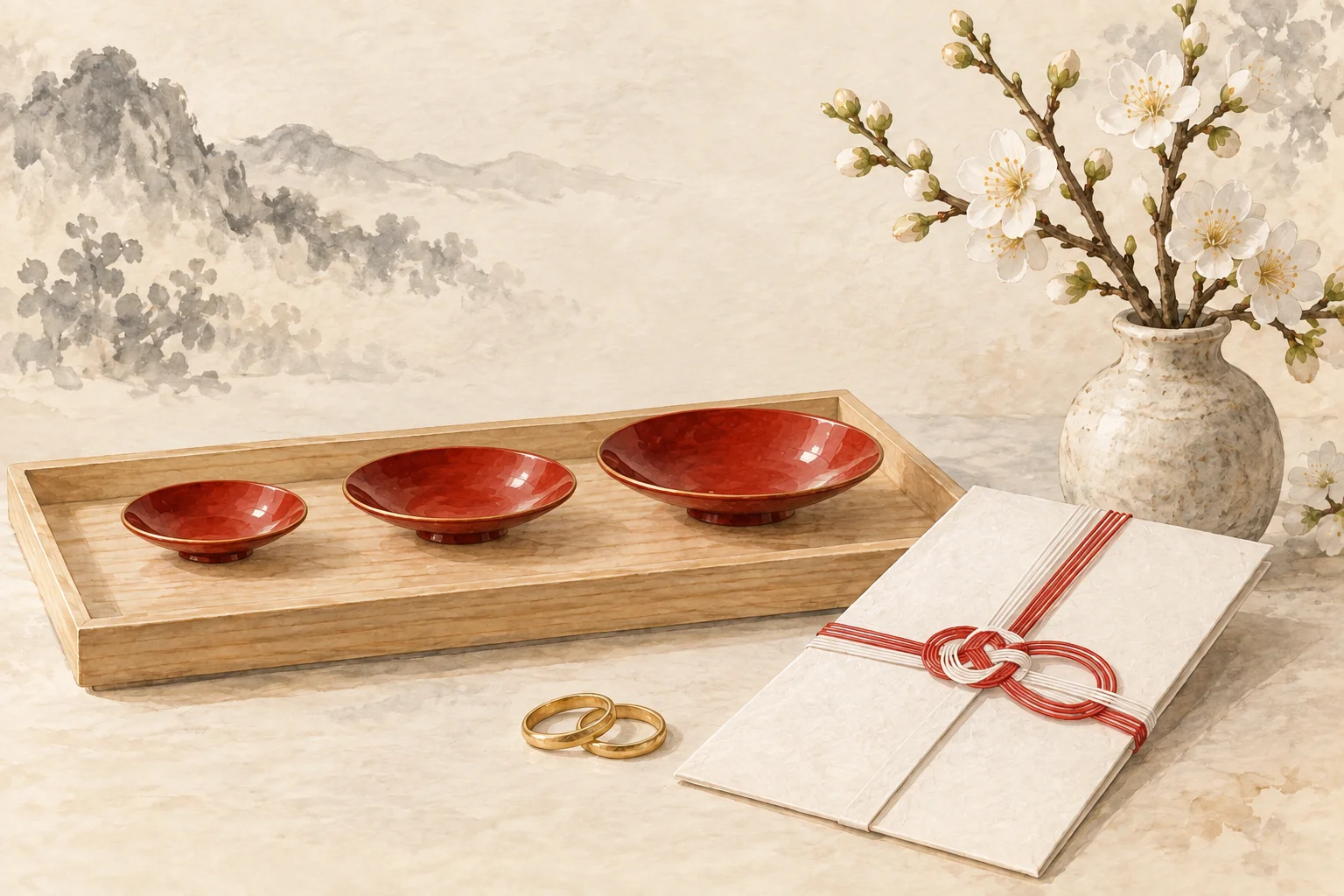
Three stacked lacquered cups — called sakazuki — sit on the offering table in front of the couple. They are nested smallest-on-top, painted vermilion red on the inside, and traditionally finished in black or gold lacquer outside. Each cup carries its own symbolic weight.
Cup | Size | Symbolism |
|---|---|---|
Small (ichi-no-sakazuki) | Top, smallest | The past — ancestors, gratitude for the lineage that brought the couple to this day |
Medium (ni-no-sakazuki) | Middle | The present — the couple themselves, their vow in this moment |
Large (san-no-sakazuki) | Bottom, largest | The future — descendants, the household yet to come |
An older Shinto reading frames the three cups as heaven, earth, and mankind (天・地・人) rather than past, present, and future. Both interpretations remain in active use; the shrine officiant or your planner will usually explain whichever framing the venue prefers. The takeaway is the same: by drinking from all three cups, the couple commits across all three planes — temporal and cosmic — at once.
How the Ritual Is Performed
The san-san-kudo sits in the middle of the Shinto ceremony program, after the purification (shubatsu) and the recitation of the Norito prayer, and before the seishi pledge and tamagushi offering. For the full ceremony order, see our guide to the Shinto wedding ceremony.
The pouring is performed by two miko (shrine maidens) holding long-handled sake vessels called choushi. The sake itself is omiki — sake first offered to the kami at the altar, then returned to the couple as a blessed share.
Step-by-step
- Small cup, first round. The miko pours into the small cup three times (two light, one full). The groom receives it first, takes two small sips, then drains it on the third sip. He returns the cup to the tray, and it is passed to the bride, who repeats the three-sip pattern.
- Medium cup, second round. The order reverses. The bride drinks first this time — two sips, then drain on the third — and passes the cup to the groom, who follows.
- Large cup, third round. The order returns to groom-first. He drinks three sips, hands the cup back, and the bride completes the final three sips.
That gives you the full nine-sip count: 3 + 3 + 3. The reversal in the middle round is deliberate — it means neither partner "leads" the entire exchange, and the binding is mutual rather than one-sided.
In many modern ceremonies the officiant will quietly cue each sip, and the miko will tip the choushi only lightly on the first two pours so the cup never holds more than a mouthful. The ritual is solemn but moves quickly — usually three to four minutes from first pour to final bow.
The Symbolism — Sealing a Bond of Three Generations
The san-san-kudo predates the modern Shinto wedding format by several centuries. It originated as a samurai-era oath ritual, in which two parties sealed an alliance or adoption by sharing sake from the same vessels. When Shinto-style weddings were formalized in the early twentieth century — broadly modelled on the 1900 wedding of the future Emperor Taisho at Hibiya Daijingu — the san-san-kudo was preserved as the binding moment.
Wedding Planner's Notes: The most-cited reading among officiants today is that the three cups bind not just the bride and groom, but their two families and the generation to come. Drinking from a single set of vessels means the two households now share one cup, one hearth, one line of descent. That is why, in many formal ceremonies, the shinzoku-hai no gi (family cup) follows immediately afterward — the symbolism of the shared cup is extended outward from the couple to the assembled relatives.
For couples drawn to the ritual specifically for its lineage symbolism, it pairs naturally with the bride wearing shiromuku, the pure-white kimono that signals readiness to enter the groom's family.
Foreign Brides and Sake — What to Expect
A practical question almost every international couple asks: do I actually have to drink the sake?
The honest answer is that the san-san-kudo is a symbolic exchange, not a drinking contest. The miko pours sparingly. The first two "sips" on each cup are traditionally performed as a touch of the lip to the rim — you can mime the motion without taking liquid — and only the third sip is a small actual mouthful. Across all three cups, the total volume is usually less than a single shot of sake.
If you do not drink alcohol at all — for religious, medical, pregnancy, or personal reasons — speak to your planner and the shrine in advance. Common accommodations include:
- Symbolic-only sipping: touching the cup to your lips for all nine counts without actually drinking. This is widely accepted and visually indistinguishable in photographs.
- Substitute liquid: some shrines will pour water or a small amount of sweet amazake (very low or non-alcoholic fermented rice drink) instead of standard omiki. This must be arranged ahead — do not assume it.
- Light pour only: the miko pours only a token amount into the third sip, so even a "drain" is no more than a teaspoon.
Tell your planner during the planning intake, not on the wedding morning. Shrines need a few days to brief the miko and prepare alternative liquid.
San-San-Kudo and Photography — Why It's the Most Captured Moment
If you ask any kimono wedding photographer in Japan to name the single most photographed beat of a Shinto ceremony, the san-san-kudo will almost always lead the list. The reasons are visual as much as ceremonial:
- The bride lifts both hands to the cup, exposing the inner sleeve linings of the uchikake — the most ornamented part of the garment.
- The vermilion lacquer of the sakazuki catches reflected light, anchoring the frame in a single saturated color point.
- The groom's posture mirrors the bride's, creating the cleanest symmetrical two-shot of the entire ceremony.
- The wataboshi or tsunokakushi headpiece is fully on-camera and unobstructed.
If you are commissioning a pre-wedding photoshoot rather than a live ceremony, the san-san-kudo is the prop sequence couples ask to recreate most often. Several studios keep a ceremonial sakazuki set on hand specifically for this purpose. For studios that offer this setup, see top Kyoto studios and our directory.
A note on actual ceremony coverage: many shrines restrict where photographers may stand during the sake ritual itself. The standard arrangement is one designated camera position behind or to the side of the officiant, with no flash. Confirm permitted positions when you book the shrine; this affects which photographers can realistically cover your ceremony. See our shrine etiquette guide for the broader photo-permission framework.
Modern Variations and Adaptations
While the core nine-sip structure is preserved at almost every Shinto shrine wedding, several modern adaptations have emerged.
Hotel and chapel-style "Shinto" ceremonies. Many Japanese hotels host abbreviated Shinto-style weddings in dedicated shrine rooms. The san-san-kudo is performed there too, but cup sizes may be smaller, the choushi is often a simple porcelain vessel rather than the long-handled ceremonial kind, and the miko role may be played by a hotel attendant.
Reception san-san-kudo. Couples who hold only a civil registration plus a Western-style reception sometimes stage a short san-san-kudo as a cultural opener during the hiroen (reception). This is no longer a binding rite — they are already legally married — but functions as a tribute to tradition and gives older guests a familiar visual cue.
Photoshoot-only san-san-kudo. For couples who marry abroad and travel to Japan only for a kimono photoshoot, the sakazuki and choushi appear as props rather than ritual objects. Studios in Kyoto, Kamakura, and Tokyo all offer this setup. There is no religious weight — it is a styled visual reference to the rite. See prewedding vs ceremony for the broader distinction.
Mixed-family adaptations. When one partner is non-Japanese, families occasionally swap in an additional vessel — for example, a small Western wine cup — to acknowledge both lineages. This is not standard and shrines vary on whether they permit it. Ask early.
For the broader context of how the san-san-kudo fits within the full landscape of Japanese wedding customs — yuino, omiai, hiroen, iro-naoshi — see our overview of Japanese wedding traditions and customs.
Frequently Asked Questions
What does "san san kudo" literally mean?
It means "three-three-nine times." The bride and groom drink from three lacquered cups, taking three sips from each, for nine sips total. The numbers three and nine are both considered highly auspicious in classical Japanese numerology.
Do I have to actually drink the sake during san-san-kudo?
No. The san-san-kudo is symbolic. The first two sips on each cup are traditionally performed as a touch of the lip to the rim, and only the third sip is a small mouthful. If you cannot drink alcohol at all, most shrines will accommodate symbolic-only sipping or substitute water — but tell your planner in advance, not on the day.
Who drinks first in san-san-kudo, the bride or the groom?
The groom drinks first from the small (top) cup and the large (bottom) cup. The bride drinks first from the medium (middle) cup. The reversal in the middle round signals that the binding is mutual rather than one-sided.
What kind of sake is used?
The sake is omiki — sake first offered to the kami at the shrine's main altar and then returned to the couple as a blessed share. The specific brand varies by shrine; many shrines use a regional sake associated with the local kami.
Why three cups instead of one?
The three cups stand for past, present, and future — or in older readings, heaven, earth, and mankind. By drinking from all three, the couple commits across all three planes at once. The cups' ascending size reinforces the temporal arc from ancestors to descendants.
Is the san-san-kudo only performed at Shinto weddings?
Historically, no. The same nine-sip structure was used in samurai oath-taking, adoption ceremonies, and inter-family alliances. Today it is most strongly associated with Shinto weddings, but the format also appears in some Buddhist wedding rites and is occasionally staged at receptions as a cultural reference.
How long does the san-san-kudo take?
The ritual itself takes about three to four minutes from the first pour to the final bow. The full Shinto ceremony, of which san-san-kudo is one element, typically runs 25 to 40 minutes.
See San-San-Kudo in Your Wedding
Whether you are planning a full Shinto ceremony at a shrine or commissioning a pre-wedding photoshoot that recreates the sakazuki exchange as a styled moment, the san-san-kudo is the single image most couples want from a Japanese wedding. Photographers and studios vary widely in whether they own ceremonial sakazuki sets, whether they have access to shrines that permit ceremony coverage, and how comfortable they are coaching the nine-sip sequence in English.
Browse the Wasou Wedding Japan photographer directory to find vetted teams who specialize in shrine ceremonies and kimono photography. For deeper reading, see our guides to the Shinto wedding ceremony, Japanese wedding traditions and customs, shiromuku vs iro-uchikake, and shrine etiquette.
Related guides
 General guide
Harae Shinto Purification Ritual Wedding: Shubatsu Guide
Illustrative image · Unsplash. Not a photo of the specific people, places or services discussed.
Harae shinto purification ritual wedding guide: shubatsu sequence, haraegushi wand, ōharai and misogi forms, photography rules, and where it sits in your ceremony.
Read the guide General guide
Tamagushi: Sacred Branch Ritual at Your Shrine Wedding
Illustrative image · Unsplash. Not a photo of the specific people, places or services discussed.
Tamagushi sacred branch shrine wedding guide: the five-step ritual, rotation direction, foreign couple rehearsal, photography rules, and presentation order.
Read the guide General guide
Norito Shinto Prayer at a Japanese Wedding: What the Priest Says
Illustrative image · Unsplash. Not a photo of the specific people, places or services discussed.
Norito shinto prayer japanese wedding explained: what the kannushi recites, the 3-5 minute structure, archaic Yamato-kotoba, and photography rules.
Read the guide