What to Wear to a Japanese Wedding: Guest Attire Guide
A planner's guide to what to wear to a Japanese wedding as a foreign guest — dress codes, color rules, and traditional options for ceremony and reception.

Illustrative image · Unsplash. Not a photo of the specific people, places or services discussed.
Check current prices, availability and venue rules with the relevant studio or venue before booking.
If you've been invited to a Japanese wedding and you're wondering what to wear to a Japanese wedding, the short answer is: dress like you would for a formal European wedding, then strip out anything white, anything that bares your shoulders, and anything that even hints at fur. Japanese wedding guest attire follows a quieter, more codified logic than most Western dress codes — it rewards restraint, finished tailoring, and a careful eye for what your hosts are not wearing. This guide walks foreign guests through the rules planners actually enforce, from Shinto ceremony etiquette to reception jewellery, with notes on when a traditional kimono is appropriate (and when it would feel like cosplay).
The Two Main Settings — Shinto Ceremony vs Reception (Hiroen)
A Japanese wedding day typically has two distinct parts, and your outfit needs to work for both. The first is the Shinto ceremony (神前式 shinzenshiki), usually held at a shrine or in the shrine room of a hotel or wedding hall. The second is the reception, called hiroen (披露宴), held in a banquet hall.
The ceremony is short — often 20 to 30 minutes — and conservative. Guests sit on chairs or floor cushions, follow the procession, and may be asked to bow during the purification rite. Bare skin, loud colours, and noisy heels feel out of place here. The reception is warmer and more social, with speeches, sake, and a sit-down meal that can run two to three hours. Most guests wear the same outfit through both, so you should plan for the stricter setting (the ceremony) and let it serve you at the reception too.
Some weddings skip the Shinto ceremony entirely and hold a chapel or civil ceremony followed by hiroen. The dress code is essentially the same. The line that matters is "formal Japanese wedding", not "Shinto or not".
For Western Women Guests — Cocktail and Formal Dress Rules
For most international women, a knee-length or midi cocktail dress in a muted jewel tone is the safest choice. Think navy, deep teal, dusty rose, mauve, forest green, or dove grey. Avoid anything that reads as either bridal or attention-seeking; the bride may make three outfit changes during the reception, and you do not want to compete with any of them.
The Japanese wedding guest dress code has a few firm rules:
- No white, ivory, cream, or champagne. These are reserved for the bride's shiromuku and any Western gown she may change into. Even a white pattern on a coloured base can read wrong.
- No bare shoulders during the ceremony. A strapless or one-shoulder dress needs a bolero, shrug, or jacket. You can remove it at the reception, but most guests leave it on.
- Hemline at or below the knee when standing. Mini dresses are inappropriate at any Japanese wedding, regardless of how upscale the venue.
- Closed-toe heels. Open-toe sandals and slingbacks are considered too casual for formal Japanese wedding attire. A mid-height pump in a neutral colour is ideal.
- Stockings or sheer tights, even in summer. Bare legs at a formal Japanese event are read as underdressed.
If you're choosing between a dress and a tailored separates set, the dress wins. Japanese weddings skew formal, and a coordinated dress-and-jacket combination reads more polished than a blouse-and-skirt pairing. For accessories, a small clutch (not a tote, not a shoulder bag) and modest jewellery — pearl earrings, a thin necklace, a slim watch — complete the look.
For Western Men Guests — Suits, Ties, Pocket Squares
For men, the default is a dark business suit: navy, charcoal, or true black, in a single-breasted two-piece cut. A tuxedo is overkill unless the invitation specifically says "black tie" or "formal evening", which is rare for Japanese hiroen. A morning coat is reserved for the fathers of the bride and groom.
The shirt should be plain white with a turndown collar. French cuffs are fine but not required. Avoid button-down collars (read as American business casual) and avoid coloured or patterned shirts entirely.
The tie is where foreign guests most often get this wrong. The Japanese wedding guest outfit convention is:
- Silver-grey or white tie — traditional and always correct for guests.
- Pastel tones (pale blue, soft pink, light lavender) — modern and acceptable.
- Solid black tie — reserved for funerals. Do not wear it to a wedding under any circumstances.
- Bright red, gold, or heavily patterned ties — too loud for guests.
A folded white pocket square in the breast pocket is standard. Shoes should be black plain-toe or cap-toe oxfords with black socks long enough that no skin shows when you sit. Belts and shoes should match in colour. Skip the pocket watch chain and any visible tie clip; restraint is the whole point.
Japanese Traditional Options for Female Guests
Wearing a kimono as a guest at a Japanese wedding is welcomed but rare for foreign attendees, partly because rental, dressing, and hair take about three hours and ¥40,000–¥80,000 to organise. If you do choose to wear one, the rules are precise.
Tomesode (留袖) — Married Women
The kuro-tomesode is the most formal kimono for married women: black, with patterns only below the waistline, and five family crests (kamon) on the sleeves and back. It's traditionally worn by close relatives of the couple. A coloured version, iro-tomesode, can be worn by other married guests and is more common in modern receptions.
Furisode (振袖) — Unmarried Young Women
The furisode is the most formal kimono for unmarried women, identified by its long, swinging sleeves (the name literally means "swinging sleeves"). Patterns cover the entire garment in vibrant colours. It's appropriate for unmarried guests typically up to their late twenties; after marriage, the sleeves are shortened and it becomes a different garment.
Houmongi (訪問着) — Semi-formal for Either
The houmongi ("visiting wear") is a semi-formal kimono that flows across the seams in a single composition. It can be worn by married or unmarried women and works for guests who aren't immediate family. For foreign guests interested in traditional Japanese wedding guest attire without the weight of kuro-tomesode formality, houmongi is the most flexible choice.
Whatever style you choose, the obi (sash) should be a formal fukuro-obi tied in the standard nijuu-daiko (double drum) knot. Hair is worn up, with modest kanzashi ornaments if any. You should not wear a kimono that matches or echoes the bride's iro-uchikake in colour or motif — ask the wedding planner if you're unsure what she's chosen.
Japanese Traditional Options for Male Guests
The traditional formal Japanese wedding attire for male guests is montsuki haori hakama — a black silk kimono with five family crests, worn under a haori jacket with hakama trousers. In practice, this is almost never worn by guests today; it's reserved for the groom and, sometimes, his father.
If you're an unrelated guest considering it for cultural reasons, the answer is generally no. Wearing montsuki haori hakama as an unrelated guest can read as upstaging the groom. The dark business suit is the correct choice. If you'd like to feature traditional menswear in your own photoshoot rather than at someone else's wedding, our guide to men's kimono for Japanese wedding photos covers the options.
Strict No-Nos — What Never to Wear
These rules apply across every Japanese wedding guest dress decision, regardless of region, season, or how casual the couple claim the event will be:
- White, ivory, cream, champagne, or any near-white shade. This includes white lace overlays on a coloured base. The bride owns white.
- Head-to-toe black. Black is for mourning. A black dress is fine only if broken up with a coloured bolero, scarf, or statement accessories. A black suit is acceptable for men because the tie and pocket square add colour.
- Bare shoulders, plunging necklines, or exposed backs during the ceremony. Cover up. You can show more skin at an after-party, never at the hiroen itself.
- Real or faux fur, leather trim, animal prints, or feathers. These reference death and are read as inauspicious at a wedding. This is one of the strongest taboos in Japanese wedding attire for guests, and it's often missed by foreigners.
- Reptile-skin bags or shoes. Same reason — animal motifs.
- Pant suits for women in formal hiroen. Acceptable at casual restaurant receptions but generally avoided at hotel weddings.
- Loud logos or oversized branding. Bring restraint to the venue.
Accessories and Bag Recommendations
The Japanese wedding guest outfit is finished by what you carry, not what you display. Plan accessories with these guidelines:
Bags. A small fabric or satin clutch in a colour that complements your dress is standard. Leather is acceptable in dark muted tones (navy, deep burgundy) but should be matte rather than glossy patent. Avoid logo-heavy designer bags. If you need to carry an umbrella, gift, or extra layer, most venues have a coat check, and many guests bring a discreet secondary bag (a sub-bag) for that purpose only.
Jewellery. Pearls are the safest formal choice — they have a long association with Japanese weddings and are read as elegant rather than showy. Diamonds in modest settings are acceptable. Skip large coloured gemstones, layered pendants, and anything that catches light dramatically during the ceremony.
Hair and makeup. Hair worn up or in a structured down-style. Makeup understated. Strong red lipstick, glitter, and dramatic eye makeup are out of place at a Japanese hiroen.
Outerwear. A wool coat in navy, camel, or grey for cooler months. Check it at the coat counter before entering; you should never wear outerwear through the ceremony or hiroen.
Gift and Money Etiquette
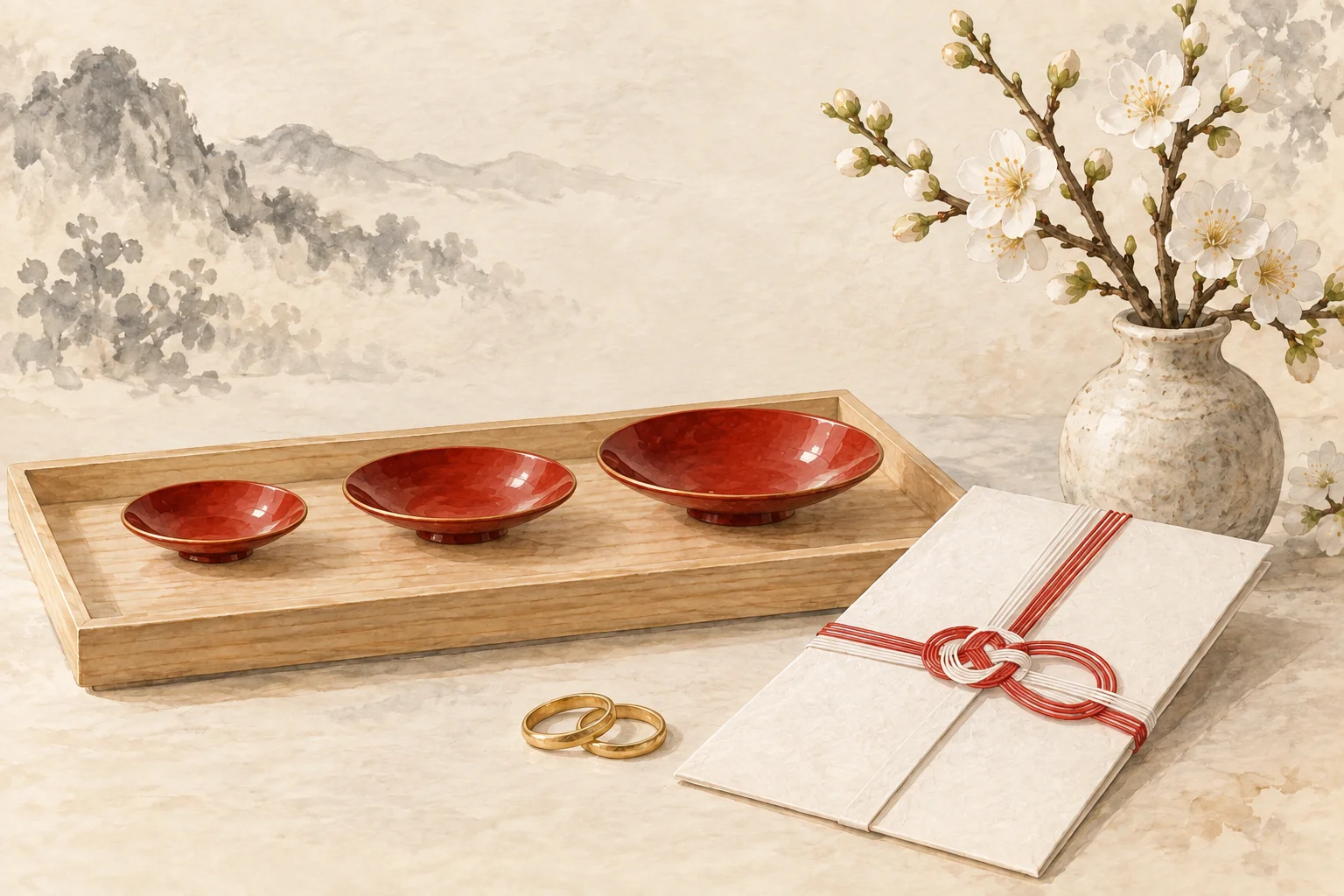
Your outfit is half the etiquette. The other half is the cash gift you bring, called goshugi. Guests are expected to present a sealed money envelope at the reception desk — typically ¥30,000 for friends, ¥30,000–¥50,000 for colleagues, ¥50,000 for senior bosses, and ¥30,000–¥100,000 for relatives. The envelope itself, called shugi-bukuro, must use the correct mizuhiki cord and knot. Crisp new bills are required.
This is detailed enough that we cover it in a separate guide. Read goshugi: the Japanese wedding gift money guide before the day. For more context on the rituals you'll witness — san-san-kudo, the procession, the family cup ceremony — see our overview of Japanese wedding traditions and customs.
Frequently Asked Questions
What should a foreign guest wear to a Japanese wedding?
For women, a knee-length or midi cocktail dress in a muted colour (navy, teal, dusty rose, grey) with covered shoulders, closed-toe heels, and sheer stockings. For men, a dark business suit (navy or charcoal), a plain white shirt, and a silver or pastel tie. Pearls and a small clutch finish the women's look; a folded white pocket square finishes the men's.
Can I wear black to a Japanese wedding as a guest?
Head-to-toe black for women reads as mourning attire and is avoided. A black dress is acceptable only when broken up with a coloured bolero, scarf, or statement jewellery. For men, a black or charcoal suit is standard — the tie and pocket square carry the colour. Never wear a solid black tie to a Japanese wedding; that's strictly funeral attire.
Can foreign guests wear kimono to a Japanese wedding?
Yes, but it's rare. A houmongi is the most flexible option for foreign guests because it works for married or unmarried women and isn't tied to family rank. Rental, dressing, and hair typically take three hours and cost ¥40,000–¥80,000. Check with the wedding planner first to make sure your kimono won't echo the bride's colours or motifs.
Is white really off-limits for guests?
Yes. White, ivory, cream, and champagne are reserved for the bride in both her shiromuku and any Western gown she may change into during the reception. Even pale-coloured dresses with white lace overlays can read wrong. Choose a clearly coloured fabric.
What about shoes and stockings?
Closed-toe pumps in a neutral colour with a mid-height heel are standard for women. Open-toe sandals, slingbacks, and stilettos over 8cm are too informal. Sheer skin-tone stockings are required even in summer — bare legs read as underdressed at a Japanese formal event.
How much cash gift should I bring with my outfit?
For most foreign guests attending a friend's wedding, ¥30,000 in crisp new ¥10,000 bills is standard, presented in a proper shugi-bukuro envelope with red-and-white or red-and-gold mizuhiki tied in an awaji-musubi or musubi-kiri knot. Never use a cho-musubi bow, which symbolises events that can repeat. Full details are in our goshugi guide.
Plan Your Own Kimono Photoshoot in Japan
If attending a Japanese wedding has inspired you to feature traditional dress in your own pre-wedding photoshoot, browse our curated directory of kimono photographers in Japan. For broader context on the culture you'll experience as a guest, read our overview of Japanese wedding traditions and customs and our practical guide to goshugi gift money etiquette. If you're choosing your own bridal kimono, start with our comparison of shiromuku vs iro-uchikake.
Related guides
 Style guide
Mother's Kimono at Japanese Weddings: Foreign Mother Guide
Illustrative image · Unsplash. Not a photo of the specific people, places or services discussed.
A planner's guide to mothers kimono japanese wedding: when foreign mothers wear kuro-tomesode, rental logistics, sizing, hair, and Western alternatives.
Read the guide Style guide
Tomesode Mother of the Bride: Kuro & Iro Tomesode Guide
Illustrative image · Unsplash. Not a photo of the specific people, places or services discussed.
Tomesode mother of the bride guide: kuro-tomesode vs iro-tomesode, the five kamon crests, motifs, foreign-family rentals, sizing, and what mothers wear.
Read the guideStyle guideFurisode Wedding Guide: The Unmarried Woman's Formal Kimono
Illustrative image · Unsplash. Not a photo of the specific people, places or services discussed.
A planner's guide to furisode wedding attire for unmarried guests in Japan — sleeve lengths, motifs, rental logistics, and advice for foreign guests.
Read the guide