Shinto Wedding Ceremony: Ritual Order & What to Expect
Shinto wedding ceremony explained: the eight rituals in order, dress, officiants, and what foreign couples should know about holding one in Japan.

Illustrative image · Unsplash. Not a photo of the specific people, places or services discussed.
Check current prices, availability and venue rules with the relevant studio or venue before booking.
A Shinto wedding (神前式, shinzen-shiki) is the indigenous Japanese marriage ceremony, performed before the kami (the deities of Shinto) at a shrine or a dedicated Shinto hall. The ritual is short — typically twenty to thirty minutes — but it is dense with symbolism: a procession under sacred trees, ritual purification, the famous nine sips of sake known as san-san-kudo, and the offering of a sakaki branch at the altar. Unlike a Western ceremony, the Shinto wedding is not built around vows exchanged between bride and groom; it is a formal report to the kami that two families are joining. This guide walks through what to expect at a traditional Japanese wedding ceremony — the order of rituals, the officiants, the dress, the role of family, and what foreign couples should know if they want to hold (or photograph) one in Japan.
The Setting — Shrine vs Hotel Shinto Hall
A Japanese Shinto wedding can take place in one of two settings, and the choice meaningfully shapes the experience.
The first is a working Shinto shrine (jinja). Major shrines such as Meiji Jingu, Heian Jingu, Tsurugaoka Hachimangu, Kasuga Taisha, and Yasaka Jinja have dedicated wedding programs and conduct ceremonies in their haiden (outer worship hall) or a purpose-built ceremonial pavilion within the precincts. The advantages are atmospheric and obvious: ancient cypress beams, the scent of incense and tatami, the procession through real torii gates rather than a stage set. The constraints are equally real — limited dates, strict guest counts (often capped at twenty to forty), and a reception that must be held elsewhere.
The second option is a Shinto altar room inside a hotel or wedding venue. Most major Japanese hotels operate a small in-house Shinto hall with a licensed kannushi (priest) on call. The ceremony, dress, and ritual order are identical to those at a shrine; only the surrounding architecture differs. For couples whose priority is convenience — ceremony, photography, and reception under one roof — this format is by far the more common modern choice. For couples whose priority is place, the working shrine wins easily.
Wedding Planner's Notes: If you are flying into Japan specifically for the wedding, a working shrine is almost always the better answer. The hotel format was designed for guests already familiar with Japanese settings; for travelers, the shrine's sense of place is the entire point.
The Ritual Order — Step by Step
Almost every Shinto wedding follows the same eight-part sequence. The order is essentially fixed; what varies between shrines is the length of the procession, the number of priests and miko in attendance, and whether live gagaku musicians are present.
1. Sanshin-no-gi (参進の儀) — The Bridal Procession
The ceremony opens with a slow procession from the shrine office to the worship hall. The kannushi leads, followed by miko, then the bride and groom under a red parasol, then both sets of parents, then siblings and other relatives. At larger shrines such as Meiji Jingu and Tsurugaoka Hachimangu, the procession passes through the main approach in full view of regular visitors — one of the most photographed moments in any Japanese ceremony. Live gagaku flute (ryuteki) and reed pipe (hichiriki) often accompany the walk. The procession is unhurried by design; it functions as a public statement that two families are entering sacred ground together.
2. Shubatsu-no-gi (修祓の儀) — Purification
Once inside the worship hall, everyone is seated and the kannushi performs shubatsu, a ritual purification using a haraegushi — a wand of white paper streamers waved over the heads of the couple and their guests. The kannushi recites a short purification prayer. Guests bow their heads while the wand passes. This step removes any spiritual impurity (kegare) the participants have brought from the outside world, preparing them to address the kami.
3. Norito Sojo (祝詞奏上) — The Prayer Reading
The kannushi then reads the norito, a formal Shinto prayer composed in classical Japanese. The norito reports the marriage to the kami enshrined at the venue, names the bride and groom, and asks for the deities' blessing on the couple, their two families, and their future descendants. The reading is chanted in a slow, archaic cadence — even native Japanese speakers rarely follow the full text. Guests sit silently with heads bowed; the couple sits directly facing the altar.
4. San-San-Kudo (三々九度) — The Sake Exchange
San-san-kudo, literally "three-three-nine times," is the most photographed ritual of any Japanese marriage ceremony. Three lacquered sake cups of ascending size are placed before the couple. The bride and groom each take three sips from each cup, for a total of nine sips — three cups times three sips, hence the name. A miko pours the sake from a long-necked vessel. The smallest cup represents heaven and the couple's ancestors; the middle, the couple themselves and their pledge; the largest, future children and descendants. The number three is auspicious in Shinto, and nine — the ultimate odd number — symbolizes a bond that cannot be broken into equal halves.
For a deeper look at the symbolism, cup order, and modern variations of this ritual, see our full guide to san-san-kudo.
5. Seishi Sojo (誓詞奏上) — The Pledge
The groom rises and reads the seishi, a short pledge addressed to the kami. The text is traditional and brief, ending with the date and the groom's name; at the close, the bride says only her given name. The pledge is read aloud from a scroll; couples are not expected to memorize it. This is the closest analogue to Western "vows," but the address is to the deities rather than to each other — a structural reflection of the Shinto worldview in which the marriage is witnessed and blessed by the kami first, and acknowledged by the families second.
6. Tamagushi Hairei (玉串拝礼) — The Sakaki Branch Offering
The couple, followed by representatives of both families, each receive a tamagushi — a small branch of sacred sakaki (Cleyera japonica) trimmed with white paper streamers. Each person walks to the altar, bows, rotates the branch clockwise so the cut stem points toward the kami, and places it on the offering stand. Two bows, two claps, one bow. This is the highest formal offering in Shinto practice. For most foreign guests it is the most physically participatory moment of the ceremony; the kannushi will quietly guide anyone who is unfamiliar with the form.
7. Yubiwa-no-gi (指輪の儀) — Ring Exchange
The ring exchange is a twentieth-century addition imported from Christian weddings, not a classical Shinto rite. It is now standard at almost every Japanese Shinto wedding, inserted between tamagushi and the family cup. Rings are presented on a small wooden tray by a miko; the groom places the ring on the bride first, then the bride on the groom. Couples who prefer a strictly traditional ceremony can omit this step, but most retain it — partly because the ring is what registers visually as "wedding" to family members raised on televised celebrity ceremonies.
8. Shinzoku-Hai-no-gi (親族盃の儀) — The Family Sake Cup
The final ritual binds the two families. Miko pour sake into small cups placed before every family member present — parents, siblings, grandparents, the couple. On a count from the kannushi, everyone drinks together, three sips each. With this shared cup the two families are formally united as shinzoku (kin). The kannushi then announces that the rites are complete, the couple bows once to the altar, and the procession exits in the same order it entered. The entire sequence — from the opening procession through the family cup — typically runs twenty to thirty minutes.
The Officiants — Kannushi, Miko, and Gagaku Musicians
A traditional Japanese wedding ceremony is staffed by three roles. The kannushi (神主) is the Shinto priest who officiates: he leads the procession, performs the purification, reads the norito, and directs the couple through each rite. He wears a white kariginu robe, a black eboshi cap, and carries a wooden tablet (shaku). At major shrines he is supported by one or two assistant priests.
The miko (巫女) are shrine maidens, traditionally unmarried young women who assist with offerings. At a wedding they pour the sake during san-san-kudo, present the tamagushi branches, and lead the bride to her seat. Their dress is iconic: a white hakui top and a vermilion hibakama divided skirt, with hair tied back in a long white-and-red ribbon. The miko's role is one of the most photogenic elements of a shrine wedding and is largely absent from hotel hall ceremonies.
At larger shrines and premium venues, two to four gagaku musicians perform live court music during the procession and select moments of the rite. The instruments — ryuteki transverse flute, hichiriki reed pipe, and sometimes the sho mouth organ — produce the distinctive sound of imperial court ceremonial music, a tradition unchanged since the Heian period. Live gagaku is a noticeable upgrade from recorded music; if you are choosing between venues, ask whether it is included or optional.
Dress and Hair for the Bride
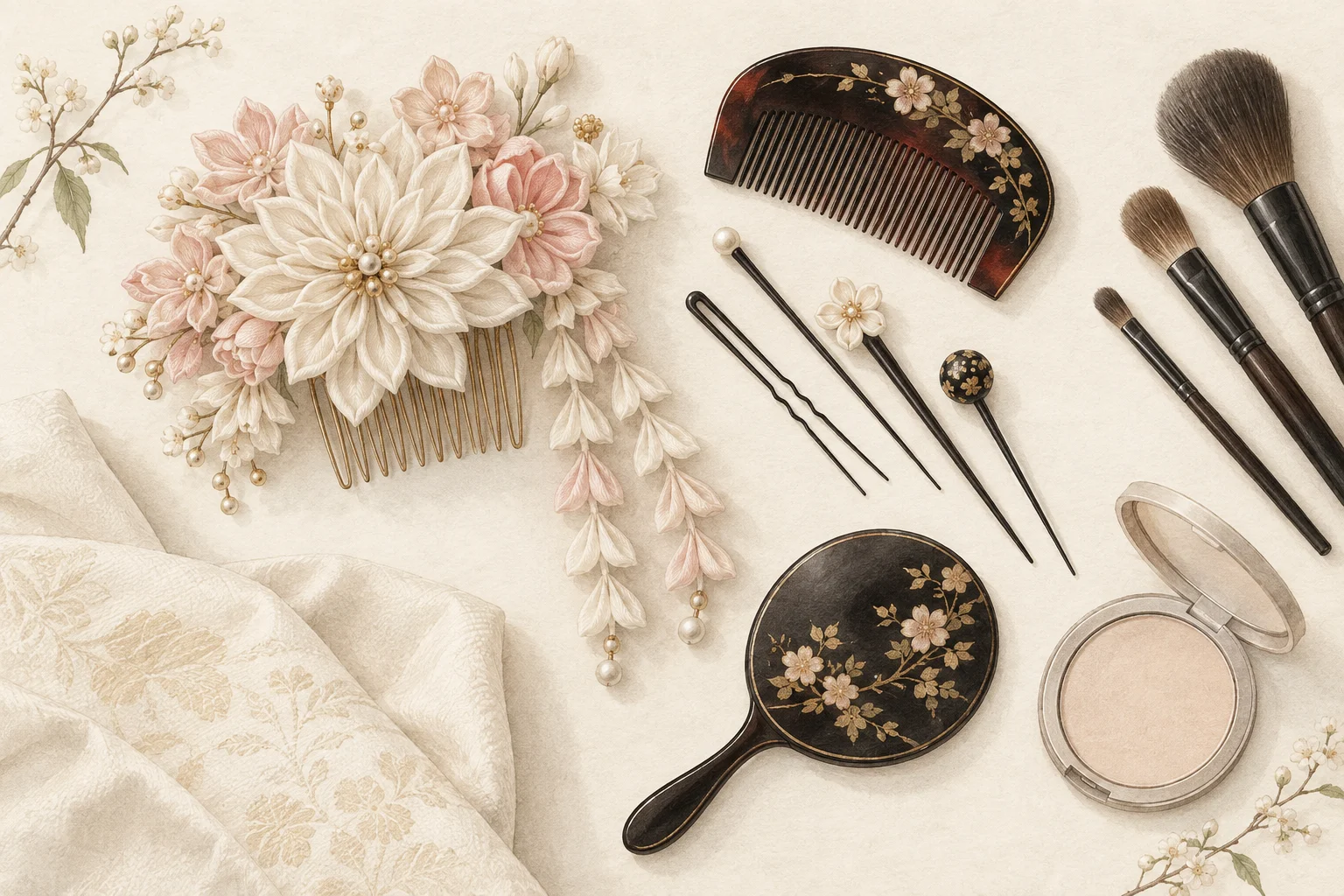
For a Shinto wedding, the bride almost always wears shiromuku — the all-white silk ensemble reserved for the ceremony itself. The white symbolizes purity and the bride's readiness to take on the colors of her new family. Over the shiromuku she wears either a wataboshi (a soft white silk hood worn outdoors during the procession) or a tsunokakushi (a flat white silk band worn during the indoor ceremony). The two are not interchangeable with iro-uchikake; both belong exclusively to shiromuku.
For full background on the bride's options — including the more colorful iro-uchikake often worn at the reception that follows — see our comparison of shiromuku vs iro-uchikake. For hair, the classical look is a bunkin-takashimada chignon built around the bride's own hair or a custom wig (katsura), finished with kanzashi ornaments and a delicate dusting of oshiroi white powder. A modern alternative is a Western-style updo with kanzashi accents — increasingly common for foreign brides who find the full katsura too heavy for a long day. Either is acceptable at any shrine. See our hair and makeup guide for shiromuku for both routes.
The groom wears montsuki-haori-hakama: a black silk kimono with five white family crests, a black haori jacket, and striped hakama trousers in gray and black. White tabi socks and zori sandals complete the look. The groom's outfit is sober, formal, and almost identical across every Japanese shinto wedding — there is little room for individual variation, which is the point. For groom styling details, see our guide to men's kimono for Japanese wedding photos.
Can Foreign Couples Have a Shinto Wedding?
Yes. Shrines do not require either partner to be Japanese, and most major wedding-program shrines now accommodate foreign couples routinely. A few practical points are worth knowing in advance.
First, a shrine ceremony is not a civil marriage. To be legally married in Japan, both partners must file a kon'in todoke (marriage registration) at a local ward office. Most foreign couples who hold a Japanese shinto wedding either complete their legal marriage in their home country first and treat the shrine ceremony as the cultural rite, or do the paperwork separately at a city office. The Shinto wedding itself produces a ceremonial certificate from the shrine but no civil record.
Second, language. The kannushi conducts the ceremony entirely in classical Japanese. Some shrines and many hotel halls now provide an English program or a quiet whispered interpretation; many do not. Most foreign couples find that not understanding the norito word-for-word does not diminish the experience — the structure of the rite is visual and gestural — but if you want a running translation, ask when booking.
Third, guest count. Working shrines typically cap weddings at twenty to forty guests. If you are bringing extended family from overseas, confirm the capacity early. Hotel halls are usually more flexible.
Finally, photography. Internal shrine policies vary. Most permit a single contracted photographer inside the worship hall under specific rules (no flash, no movement during norito and seishi, designated positions). Outside the hall, photography of the procession is almost always allowed and is the visual centerpiece of most foreign couples' final albums.
Photographing a Shinto Ceremony
A real Shinto wedding ceremony is one of the most photogenic events in Japan, but the photography rules are stricter than at any other shoot type, and they vary by shrine. The general pattern is this: procession (outdoors) and post-ceremony portraits (in the precincts) are unrestricted; the ceremony itself is tightly controlled.
If the actual wedding rite is what you want documented, work only with a photographer who has shot Shinto ceremonies at your specific venue before. Each shrine has its own rules about where the photographer may stand, when shutter sound is permitted, and whether a second shooter is allowed. Meiji Jingu in particular requires a formal permit for any commissioned photography on the grounds, even outside ceremonies — see our Meiji Jingu permit guide for the current process. For a broader list of shrines with active wedding programs and their characteristics, see our top 10 shrines guide and our overview of shrine etiquette.
Many foreign couples who want the imagery without the logistics of a real ceremony book a pre-wedding shrine shoot instead — full shiromuku and montsuki dress, a staged procession through the precincts, and posed portraits at the worship hall, without the actual rite. This is a separate product from a wedding ceremony and follows different rules; see prewedding vs ceremony for the trade-offs.
For couples curious about the broader context — engagement rituals, reception customs, gift-giving — our Japanese wedding traditions and customs guide covers what surrounds the ceremony, and our complete guide to Japanese weddings assembles every element in one place.
Frequently Asked Questions
How long does a Shinto wedding ceremony last?
The rite itself runs twenty to thirty minutes from the start of the procession to the close of the family sake cup. With dressing, hair, makeup, and post-ceremony portraits, plan for four to six hours on site.
What is the difference between a Shinto wedding and a Buddhist wedding?
Almost all traditional Japanese weddings are Shinto, not Buddhist. Buddhism in Japan is primarily associated with funerals and ancestral rites; marriage falls within the Shinto sphere of life-cycle ceremonies. Buddhist weddings exist but are rare and follow a different structure based on the couple's sect.
Do guests participate in the Shinto wedding ceremony?
Yes, more than at a Western ceremony. All guests are purified during shubatsu, family representatives offer their own tamagushi branches, and every guest drinks from the family sake cup at the close. There are no readings or speeches during the rite itself — those belong to the reception that follows.
Can a foreign couple have a traditional Japanese wedding ceremony?
Yes. Major wedding-program shrines and almost all hotel Shinto halls accept foreign couples. The ceremony is identical regardless of nationality. Note that the shrine rite is not a legal marriage in Japan — couples either marry legally in their home country or file separately at a city office.
What does the bride wear at a Japanese Shinto wedding?
Shiromuku — an all-white silk kimono ensemble — with either a wataboshi hood (outdoors, procession) or a tsunokakushi band (indoors, ceremony). Many brides change into a colored iro-uchikake for the reception, but the rite itself is white.
Is san-san-kudo the same as exchanging wedding vows?
Functionally yes, structurally no. San-san-kudo — the nine sips of sake across three cups — is the moment the couple's bond is sealed before the kami. There are no spoken vows exchanged between the bride and groom; the groom's seishi pledge is addressed to the deities, not to the bride.
Can we photograph the actual ceremony?
Usually yes, but under strict rules that vary by shrine. Most permit a single contracted photographer inside the hall with no flash and limited movement. The outdoor procession and post-ceremony portraits are far less restricted and produce most of the final album.
How many guests can attend a shrine wedding?
Working shrines typically cap weddings at twenty to forty guests due to the size of the worship hall. Hotel Shinto halls and dedicated wedding venues are more flexible, often accommodating sixty or more.
Book a Shinto Wedding Photoshoot
Whether you are planning a full Shinto ceremony at a shrine, a hotel hall wedding, or a pre-wedding shoot that captures the look and atmosphere of the rite without the formal program, the right photographer is one who has worked at your specific venue and understands which moments are permitted on which side of the precinct. Browse our curated directory of kimono wedding photographers to find specialists who shoot regularly at Meiji Jingu, Tsurugaoka Hachimangu, Heian Jingu, Kasuga Taisha, and other wedding-program shrines.
For related reading, see our complete guide to Japanese weddings, our deep dive into san-san-kudo, and our overview of Japanese wedding traditions and customs.
Locations in this guide


Related guides
 General guide
San-San-Kudo: The Sacred Sake Ritual at Shinto Weddings
Illustrative image · Unsplash. Not a photo of the specific people, places or services discussed.
San san kudo is the nine-sip sake ritual at the heart of a Shinto wedding. Cup meanings, step-by-step order, and what foreign brides should expect.
Read the guide General guide
Harae Shinto Purification Ritual Wedding: Shubatsu Guide
Illustrative image · Unsplash. Not a photo of the specific people, places or services discussed.
Harae shinto purification ritual wedding guide: shubatsu sequence, haraegushi wand, ōharai and misogi forms, photography rules, and where it sits in your ceremony.
Read the guide General guide
Tamagushi: Sacred Branch Ritual at Your Shrine Wedding
Illustrative image · Unsplash. Not a photo of the specific people, places or services discussed.
Tamagushi sacred branch shrine wedding guide: the five-step ritual, rotation direction, foreign couple rehearsal, photography rules, and presentation order.
Read the guide