Traditional Japanese Wedding Costumes: Who Wears What
Traditional Japanese wedding costumes for the bride, groom, family and guests: how formality ranks, what to avoid, and which garments you can actually rent.

Illustrative image · Unsplash. Not a photo of the specific people, places or services discussed.
Check current prices, availability and venue rules with the relevant studio or venue before booking.
There is no single traditional Japanese wedding costume. There is a set of them, and which one a person wears is decided less by taste than by their position: bride, groom, mother, unmarried relative, friend. The garments are different, the formality is ranked, and the ranking is legible to everyone in the room.
That is the part most English-language guides leave out. They explain the bride's white kimono beautifully and stop there, which is fine if you are the bride and unhelpful if you have been invited to one.
This guide covers the whole cast: the bride, the groom, mothers and close family, and guests. It then answers a question the cultural guides cannot — which of these garments you can actually rent in Japan today.
Using our directory of 176 studios, one answer stands out. Two of the three bridal kimono are stocked almost everywhere. The third is stocked by one studio in nine.
Two Wardrobes, Not One
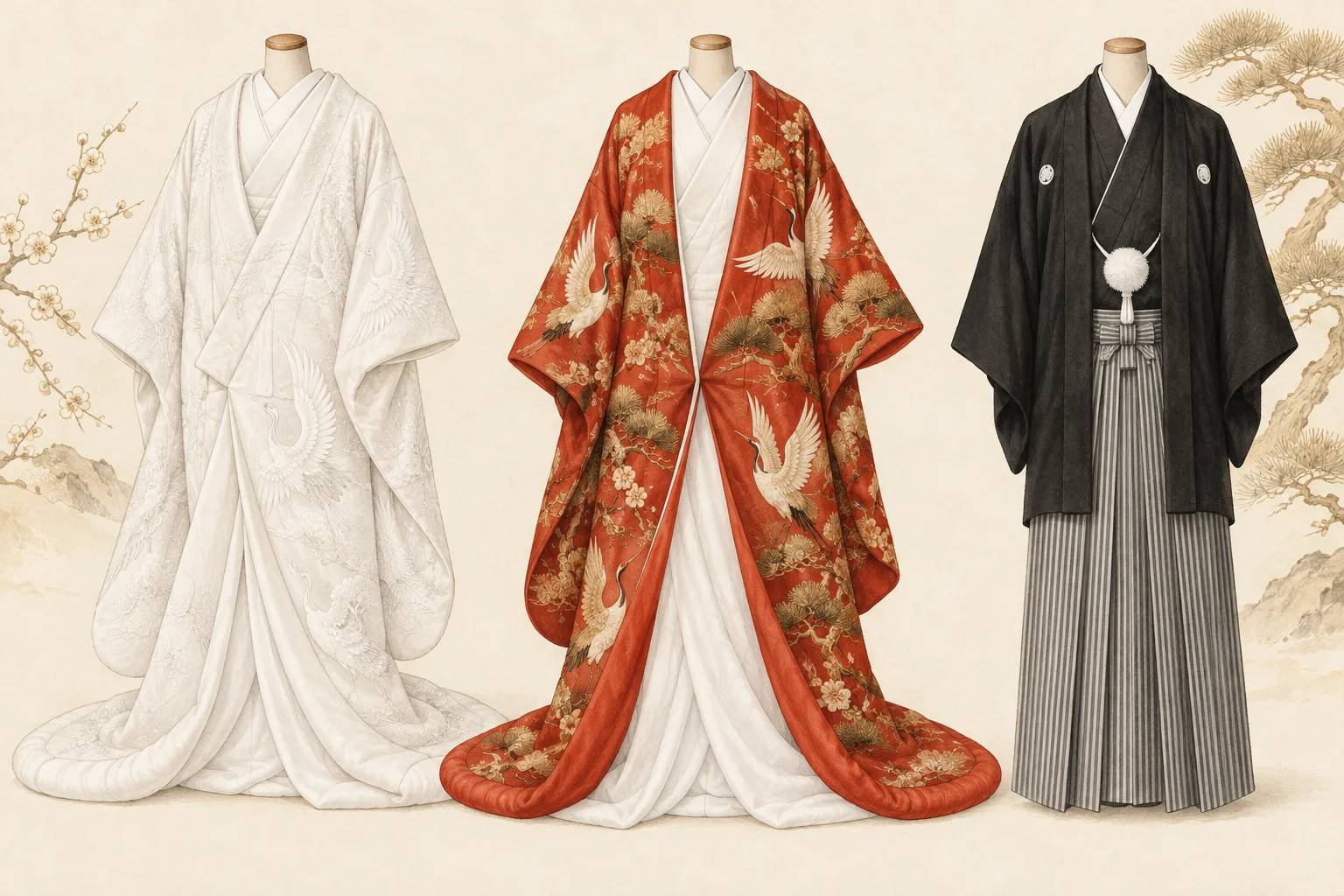
Before any individual garment makes sense, one split has to be clear. Japanese weddings draw on two wardrobes: wafuku, Japanese dress, and yofuku, Western dress. They are not rivals so much as two halves of the same day.
A couple commonly wears both. The ceremony is held in kimono, the reception opens in a second kimono, and the bride changes into a Western gown partway through. The outfit change has a name of its own, oironaoshi, and it is a scheduled part of the program rather than an indulgence.
It is worth knowing how the balance falls today. A 2022 survey by APOLLO11, a Japanese web consultancy, asked 500 women who had held a wedding what they wore for the ceremony itself.
A Western wedding dress was named by 80.6%. Shiromuku, the all-white bridal kimono, accounted for 14%; iro-uchikake, the colored outer robe worn over it, for 3.8%; and hikifurisode, the trailing long-sleeved kimono, for 0.6%.
Treat that as one survey rather than a national statistic. It is a single commissioned study, self-reported after the fact, and it covers the ceremony rather than every outfit worn across the day. That understates iro-uchikake in particular, since it is most often worn later.
Even allowing for that, the direction is clear. Traditional dress is now the minority choice at Japanese weddings.
That has a practical consequence for anyone reading this from abroad. A photoshoot is where the traditional garments get worn without the constraints of a wedding day.
There is no reception schedule to keep, no need to stay in several kilograms of silk from morning to night, and no venue dictating the choice. You wear the one you actually want.
What the Bride Wears: The Japanese Wedding Dress Explained
When English speakers search for "Japanese wedding dress," "Japanese wedding clothes" or "Japanese wedding gown," they almost always mean a kimono — there is no Japanese equivalent of the Western gown in the traditional wardrobe. Three garments account for almost every traditional bridal look, and they are not variations on one dress. They come from different places and do different jobs.
Garment | How to recognize it | Where it sits | When it is worn |
|---|---|---|---|
Shiromuku (白無垢) | White from head to hem — outer robe, under-kimono, sash, accessories, all white | Ranked above iro-uchikake by the sources we checked | The Shinto ceremony — the shrine rite at the center of a traditional Japanese wedding |
Iro-uchikake (色打掛) | A colored outer robe worn open over the kimono beneath. Red is the most traditional ground color, with green and black also common, and the embroidery typically worked in gold | Formal; the usual second look | The reception, or the outfit change |
Hikifurisode (引き振袖) | Long swinging sleeves and a trailing hem, worn without the outer robe | A bridal form of the furisode, at the formal end of that family | The reception, or a portrait session |
The first two share a structure. Underneath both sits the kakeshita, the foundation kimono of the whole ensemble, with the uchikake worn open over the top of it. Shiromuku and iro-uchikake are, in that sense, the same construction in different colors.
Hikifurisode is a different lineage. It is a furisode — the long-sleeved kimono of unmarried women — cut to trail along the floor. It came into use as formal wedding wear for women of samurai families in the later Edo period.
Sources treat it inconsistently. Some rank it against shiromuku and iro-uchikake as a third option; others place it outside that comparison because it belongs to a separate tradition. We have not found a source that establishes a clean order of precedence between the three, so we do not assert one.
Our full breakdown of each garment, layer by layer, is in the bridal kimono guide, and if the choice is between the first two, shiromuku versus iro-uchikake sets them side by side.
The Headpieces — Wataboshi and Tsunokakushi
Two head coverings go with these garments, and they look nothing alike. The wataboshi is a large white hood that frames the face and hides the hair entirely. The tsunokakushi is a narrow white band worn over an elaborate updo, leaving the face and hairstyle visible.
The traditional pairing puts wataboshi with shiromuku and tsunokakushi with iro-uchikake. That convention is real, but it is no longer treated as binding — several sources note that brides today generally choose whichever they prefer, and studios will show you both.
The practical difference is what they do to a photograph. A wataboshi is a strong shape that conceals; a tsunokakushi shows the hairstyle and the ornaments in it. Our comparison of tsunokakushi and wataboshi covers how each one behaves on camera.
What the Groom Wears: Traditional Japanese Wedding Attire for Men
The groom's side of the wardrobe is simpler, and it is settled by counting crests.
The formal outfit is kuro-montsuki haori hakama: a black kimono bearing five family crests, worn with a haori, a hip-length jacket, and hakama, wide pleated trousers in a striped silk. Five crests is the formal arrangement; three or one drops the outfit to semi-formal. A colored version, iro-montsuki, exists and is usually kept for the outfit change rather than the ceremony.
Black with five crests sits at the same rank as the bride's shiromuku, which is why the two are so often photographed together.
One thing to know before you assume both partners are covered: of the 176 studios in our directory, 58 do not stock men's traditional attire at all. Their collections are built around the bride. We go through the full outfit, the fabrics and the fitting questions in our guide to the montsuki kimono, and the hakama guide covers the trousers in detail.
What the Mothers and Close Family Wear
Here the logic becomes explicit. In Japanese formal dress, a married woman's kimono announces her relationship to the couple, and the announcement is made by the color of the fabric and the number of crests on it.
The kuro-tomesode is the top of that system: a black kimono, patterned only below the waist, carrying five crests. It is the most formal garment a married woman can wear, and at a wedding it is reserved for the close female relatives of the couple — mothers, grandmothers, sisters. Both mothers wearing it is the standard picture.
The iro-tomesode is the same cut in a color other than black. It is a step down in formality and correspondingly wider in who may wear it: married women outside the immediate family, and in modern practice unmarried women as well. Its rank is not fixed, because it moves with the crest count — five crests, three, or one, with five the most formal.
That detail is worth holding onto if you are being offered a rental. Two iro-tomesode that look equally elegant on the hanger can be a full step apart in formality, and the difference is visible to Japanese guests even if it is invisible to you.
Fathers have a choice that women mostly do not. A father may wear the same black five-crest montsuki as the groom, but at modern Japanese weddings the fathers of both families more commonly wear a morning coat. What is being matched is the level of formality, not the garment — which is why the two fathers usually agree on one or the other in advance.
For mothers specifically, our tomesode guide covers both versions in depth, and the guide for foreign mothers deals with sizing, rental and the question of which crest a non-Japanese family wears.
What Guests Wear
Most guests at a Japanese wedding are in Western formal dress. Kimono is the exception rather than the rule, and a suit or a dress is the normal choice for a guest.
But kimono may be on the table — because you own one, because you are family, or because the couple has asked for it. If so, the same ranking applies to you, and it is worth being able to read.
Who you are | What is worn | Formality |
|---|---|---|
Married close relative of the couple | Kuro-tomesode — black, five crests | Highest for a married woman |
Married guest outside the immediate family | Iro-tomesode — colored, one to five crests | Below kuro-tomesode; varies with crest count |
Unmarried woman | Furisode — long swinging sleeves | Highest for an unmarried woman |
Any woman guest, married or not | Homongi — pattern flows across the seams | Semi-formal; the safe general choice |
Any woman guest, less formal occasion | Tsukesage — pattern stops at the seams | One step below homongi |
Man | Black or dark suit; black five-crest montsuki if close family | Suit is standard; montsuki is for relatives |
Two of those rows repay a closer look, because they are the ones that confuse people.
Furisode and homongi are not ranked against each other in a simple way. Furisode is the formal kimono of an unmarried woman and outranks homongi for someone eligible to wear it — but eligibility is the catch.
The convention is that a woman stops wearing furisode once she marries, and it is strongly associated with youth. Where exactly the line falls for an unmarried woman is not fixed, and we have not found a source that sets one.
Homongi and tsukesage are easy to confuse on the rack, because the difference is in how the pattern was dyed rather than in the shape or the color. Homongi is the more formal of the two and the one to choose for a wedding.
A caveat on this table, since it matters. No single authoritative source sets out this hierarchy in one place. We assembled it from kimono specialist references and cross-checked each row, and we found genuine inconsistencies along the way — one otherwise useful reference appeared to confuse furisode and tomesode.
Treat it as a reliable orientation rather than a rulebook. If you are close enough to the couple for the distinction to matter, ask them.
If you are attending rather than marrying, our guest attire guide covers Western options in the same detail, and the furisode guide goes deeper on sleeves, age and when the garment stops being appropriate.
What Guests Should Not Wear
Three colors carry warnings, and only one of them will be familiar.
White is the bride's, for the same reason it is in the West. At a Japanese wedding that reason is more literal than usual: if she wears shiromuku, she is dressed in white from hood to sandals. A white dress in the guest seats competes with that directly.
All-black is the one that catches Western guests out. A plain black dress is the safe default at a European or American wedding. In Japan, unrelieved black reads as funeral dress.
It is workable if the garment is clearly formal and you break it up — colored accessories, a patterned wrap, something that separates the outfit from mourning wear.
Note the asymmetry. A black kuro-tomesode or a black montsuki is the most formal thing in the room, because the crests and the hem pattern mark it as celebratory. Black cloth is not the problem — undifferentiated black is.
Red is the least strict of the three. The caution is that red is the most traditional ground color for the bride's iro-uchikake, so a red guest outfit can end up echoing hers in photographs.
None of this is a rule anyone enforces. But these are the conventions Japanese guests are working from, and the cost of checking is low.
Formality varies a great deal between a shrine ceremony and a restaurant reception. If you are unsure, ask the couple or the venue directly — a normal question, and the answer will be more useful than any general rule.
Which of These You Can Actually Rent
Two of the three bridal garments are stocked by almost every studio in our directory. The third is stocked by one in nine. That gap should change how you search.
Cultural guides stop where this question begins — knowing that hikifurisode exists does not tell you whether you can put one on in Kyoto next spring. So we counted. Every studio in our directory lists the garments it holds.
Garment | Studios stocking it | Share of 176 |
|---|---|---|
Iro-uchikake | 174 | 99% |
Shiromuku | 172 | 98% |
Western dress | 121 | 69% |
Hakama (groom) | 118 | 67% |
Modern kimono | 25 | 14% |
Hikifurisode | 20 | 11% |
Counted across the 176 studios in our directory, August 2026.
Almost every studio stocks the two headline garments, so the garment itself is rarely what limits a shiromuku or iro-uchikake booking. You can search on location, price, language or photographer first. A specific date, a specific size or a studio already booked out can still stop you.
Hikifurisode is a different problem. One studio in nine stocks it, which means the garment has to lead the search rather than follow it. You find the studios that hold one, and then you see which cities they happen to be in.
That number lines up with demand from the other direction, though not perfectly. In the 2022 APOLLO11 survey mentioned earlier, 0.6% of the 500 women who had held a wedding named hikifurisode as what they wore for the ceremony.
Apply the same caveat we applied above: the survey covers the ceremony only, and hikifurisode is a garment usually worn later in the day, so 0.6% almost certainly understates it. What survives the caveat is the order of magnitude. Both the supply side and the demand side put hikifurisode far behind the other two, so the stock appears to follow demand rather than the other way round.
The standard collection is narrower than the list of garments suggests. The single most common line-up is hakama, iro-uchikake, shiromuku and Western dress together, held by 62 studios, with a further 36 holding the same three traditional garments and no Western dress.
Anything outside that set moves you into a much smaller field — hikifurisode, or modern kimono, meaning contemporary designs in non-traditional colors and prints rather than the classical bridal pieces.
You can browse studios by garment directly: shiromuku, iro-uchikake, hikifurisode and hakama each have their own listing.
One boundary worth stating. These 176 businesses are photography studios that dress the couple, so the counts above cover bridal and groom's attire only. Tomesode, furisode and homongi for family and guests come from general kimono rental shops instead.
Our guides to tomesode for mothers, renting as a foreign mother and furisode for guests cover how that side works.
What It Costs to Wear One
Traditional wedding garments are rented, not bought, and the rental almost never appears as its own line. It is folded into a studio's package alongside dressing, hair and makeup, and the photography itself.
That makes a single price impossible to quote. What we can show is how the studios in our directory are distributed.
Starting price | Studios |
|---|---|
Under ¥30,000 | 18 |
¥30,000 – ¥60,000 | 21 |
¥60,000 – ¥100,000 | 46 |
¥100,000 – ¥150,000 | 30 |
Over ¥150,000 | 29 |
Counts cover the 144 studios that publish a starting price. Figures from our directory, August 2026.
The middle band is the largest, but the tails are where the misunderstandings happen. The 18 studios starting under ¥30,000 and the 29 starting above ¥150,000 are not the same product at different quality levels.
At the low end you are typically buying a short dressing-and-photography experience with a limited number of images. At the high end you are buying a full day with multiple outfit changes, several locations and a large edited set.
Broken down by garment, the starting-price medians sit close together:
Garment | Median starting price | Studios counted |
|---|---|---|
Hakama (groom) | ¥98,000 | 99 |
Shiromuku | ¥89,000 | 140 |
Iro-uchikake | ¥89,000 | 142 |
Western dress | ¥80,000 | 97 |
Modern kimono | ¥80,000 | 23 |
Read these as a description of the studios that stock each garment, not as the price of the garment. A studio that dresses the groom prices from a higher floor because it runs a bigger operation, not because hakama costs ¥9,000 more than shiromuku.
Hikifurisode sits outside that table for a reason. Across the 16 studios that stock it and publish a starting price, the median is ¥61,890 — treat that as a reference figure only. Sixteen studios is too small a base to characterize the garment, and the figure says as much about which sixteen they are as about the kimono.
One structural point worth planning around. Of the 176 studios, 119 hold both Japanese and Western dress, 55 hold Japanese dress only, and the remaining two hold Western dress only. If wearing a kimono and a gown on the same day matters to you, that decision has to be made before you choose the studio, not after.
Every price on this page is a starting price, which is the floor of the cheapest plan rather than a likely total. Location permits, a second outfit, extra accessories and additional retouched images are commonly charged on top. Our breakdown of what a kimono photoshoot costs in Japan goes through those line items one by one.
Five Things to Settle Before You Book
Everything above collapses into a short list of questions. Most of them come from a number in our directory, and all of them are cheaper to ask now than to discover later.
- Does this studio stock the garment you want? For shiromuku or iro-uchikake the answer is almost always yes. For hikifurisode it is usually no — 20 of 176 — so search by garment first and by city second.
- Do they dress the groom? Fifty-eight of the 176 studios do not hold men's traditional attire. Check before you assume both of you are covered.
- Will you want a Western gown on the same day? If so, you need one of the 119 studios that hold both. The 55 that hold Japanese dress only cannot add it later.
- What does the starting price actually include? Dressing, hair and makeup, the number of retouched images and location fees vary widely between studios, and every figure published is a floor rather than a total.
- Will the garments fit you? Rental stock is cut for the Japanese size range. Send your height, and for a groom your shoulder width and arm length, with the first message rather than at the fitting.
One more thing that no amount of planning changes: the season. A full bridal ensemble runs to five layers or more, and Japanese summers are hot and humid enough that August outdoor sessions are often scheduled for early morning or late afternoon.
Winter brings the opposite problem at shrine locations, where the ceremony spaces can be unheated. If your dates are flexible, raise this with the studio before you fix one.
Frequently Asked Questions
What are traditional Japanese wedding costumes called?
Collectively they are wafuku, Japanese dress, as opposed to yofuku, Western dress. Individually they have separate names by wearer: the bride wears shiromuku, iro-uchikake or hikifurisode; the groom wears kuro-montsuki haori hakama; married close relatives wear kuro-tomesode; unmarried women wear furisode. There is no single word for the whole set.
What is the difference between shiromuku and iro-uchikake?
Color, and where in the day each is worn. Both are built the same way, with an outer robe worn open over a foundation kimono called the kakeshita. Shiromuku is white throughout and worn for the ceremony. Iro-uchikake is a colored, heavily embroidered robe usually worn for the reception or the outfit change, and it is the less formal of the two.
Can a foreigner wear traditional Japanese wedding attire?
Yes. There is no restriction on who may wear these garments, and studios that work with international couples handle it routinely. What is expected is that they are worn correctly and in a fitting setting. The practical limits are sizing and language, not permission — rental stock is cut for the Japanese size range, so send your measurements with your first inquiry.
What should I wear as a guest at a Japanese wedding?
Western formal dress is the normal choice and is entirely acceptable — most guests wear it. Avoid white, avoid unrelieved black, and be cautious with red. If you are wearing kimono, an unmarried woman wears furisode, a married close relative wears kuro-tomesode, and homongi is the safe general choice for other women guests.
Can guests wear a kimono if they are not Japanese?
Yes. The garment is chosen by your relationship to the couple and your marital status, not by nationality. The one thing worth doing is telling the rental shop your role at the wedding, so they put you in the right level of formality rather than simply the kimono you liked on the rack.
How heavy is a traditional Japanese wedding kimono?
Several kilograms, with the full shiromuku ensemble at the heavier end. The weight comes from layers rather than from any one piece — a complete outfit runs to five or more, from the skin layer through the foundation kimono to the outer robe and sash. Expect it to change how you walk and to make sitting down a considered action rather than a casual one.
Do most Japanese couples still wear traditional costumes?
No — Western dress is now the majority choice. A 2022 survey by APOLLO11, a Japanese web consultancy, asked 500 women who had held a wedding what they wore for the ceremony. A Western wedding dress was named by 80.6%, against 14% for shiromuku, 3.8% for iro-uchikake and 0.6% for hikifurisode. That is a single commissioned survey covering the ceremony only, not a national statistic. Traditional dress today is more often one part of a wedding day than the whole of it — or a dedicated photoshoot.
Finding the Japanese Wedding Outfit You Actually Want
The structure underneath all of this is simple enough to carry around. Formality is signaled by color and by crest count, and your position relative to the couple decides where you sit in that order. Once that clicks, the individual garment names stop being a list to memorize.
The part that needs planning is availability. Shiromuku and iro-uchikake are stocked almost everywhere, so those choices leave you free to pick a studio on location, price or language. The other two decisions narrow the field sharply: hikifurisode to 20 studios, and wanting a Western gown on the same day to the 119 that hold both.
Our directory lists 176 studios across Japan with the garments each one stocks and the languages each one works in. You can start from the garment — shiromuku, iro-uchikake, hikifurisode, hakama — or browse the full directory and filter from there.
Related guides
 Style guide
Kimono Fitting for Foreign Brides: Tall, Curvy & Petite
Illustrative image · Unsplash. Not a photo of the specific people, places or services discussed.
Kimono fitting for foreign bride body types: how tall, curvy, plus-size, and petite brides find studios with extended sizing and skilled kitsuke teams.
Read the guide Style guide
Antique & Vintage Bridal Kimono: Meiji-Era Silks Guide
Illustrative image · Unsplash. Not a photo of the specific people, places or services discussed.
A planner's guide to antique vintage kimono bridal options — Meiji and Taisho silks, where to rent in Kyoto and Tokyo, care, pricing, and heirloom basics.
Read the guide Style guide
Modern Color Bridal Kimono: Blush, Ivory & Pastel Guide
Illustrative image · Unsplash. Not a photo of the specific people, places or services discussed.
Modern color bridal kimono in blush, ivory, sage and dusty rose — a third option between shiromuku and iro-uchikake. Where to rent, how to style.
Read the guide