Kawaguchiko Kimono Photoshoot: Mt Fuji's Iconic Vista
Plan a kimono photoshoot at Lake Kawaguchi with honest clear-Fuji probability guidance, Chureito Pagoda and Oishi Park location logistics, seasonal trade-offs, and access from Tokyo via the Fujikyu Express.

Illustrative image · Unsplash. Not a photo of the specific people, places or services discussed.
Check current prices, availability and venue rules with the relevant studio or venue before booking.
Lake Kawaguchi is the most visited of the Fuji Five Lakes, sitting 100 kilometers west of Tokyo and reachable in two hours by the Fujikyu Express from Shinjuku. For a kimono photoshoot, the value proposition is concentrated: a single weekend itinerary can include the Chureito Pagoda five-tier silhouette against Mt Fuji, Oishi Park's lavender fields with the mountain rising behind them, and a lakeside hotel pier composition where the cone reflects in still water at dawn. The constraint is honest — Fuji shows itself clearly on a minority of days, and most of your planning energy goes into managing that single variable.
Why Kawaguchiko for a Kimono Photoshoot
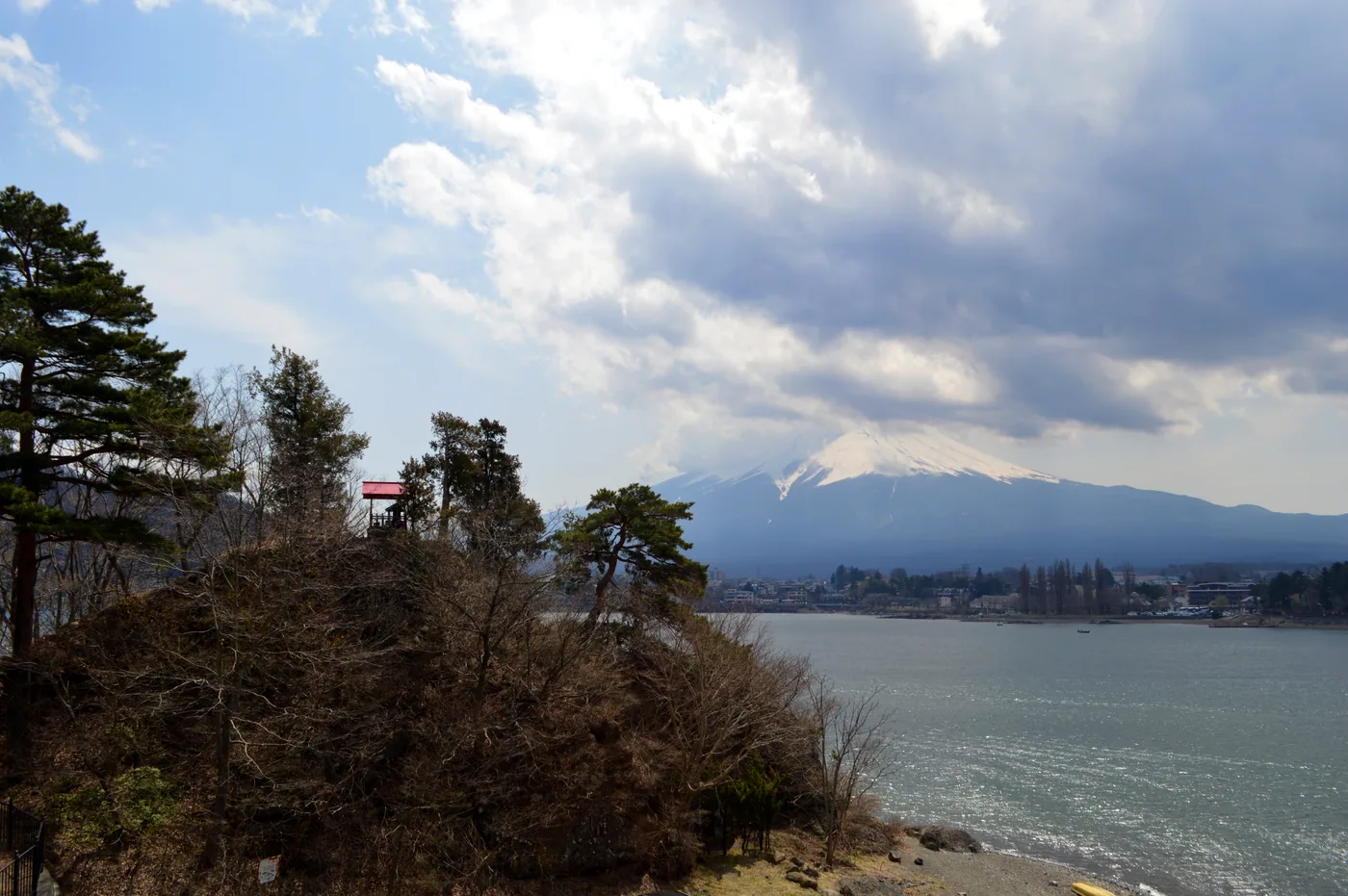
Among the Fuji Five Lakes (Fuji-Goko), Kawaguchiko has the most developed photo infrastructure: paved walking access to multiple shoreline vantage points, a dedicated express train terminal, and a cluster of hotels with garden frontage on the southern shore. The other four lakes — Yamanakako, Saiko, Shojiko, Motosuko — offer quieter compositions but require rental car logistics that complicate same-day kimono dressing and return.
The mountain is the subject. Everything else — the pagoda, the lavender, the lake itself — is a foreground element framing the cone. This is the opposite of the Kyoto-temple compositions where the kimono is the subject and the location is the backdrop. At Kawaguchiko the kimono works as a color element inside a landscape photograph, and you need to choose a kimono palette that holds up against the visual weight of a 3,776-meter snow-capped volcano.
Wedding Planner's Notes: Couples often arrive expecting Kawaguchiko to deliver the Chureito Pagoda composition by default. The pagoda is actually at Arakurayama Sengen Park, roughly an hour from Lake Kawaguchi itself by car or two trains, and requires a 400-step climb. Budget it as a separate half-day, not as something you can fit between breakfast and lunch.
The Mt Fuji Vista Photography Tradition
Mt Fuji has been a dominant subject in Japanese landscape art for more than 200 years. Hokusai's Thirty-Six Views of Mount Fuji series (1830s) established a compositional frame that wedding photographers still cite today: the cone in the upper half of the composition, foreground human or architectural element below, a deliberate scale relationship that makes the mountain feel monumental rather than backdrop.
Modern Kawaguchiko kimono compositions inherit this grammar. The pagoda + cherry + Fuji frame at Arakurayama Sengen Park is genuinely an Edo-era visual idea executed with a 21st-century 5-stage pagoda built in 1963. The lake reflection compositions trace back even further, to Hiroshige's lake views. Understanding this lineage matters because it explains why so many compositions look similar — photographers are working within an established visual tradition, not inventing fresh frames.
Top Locations
Chureito Pagoda (Arakurayama Sengen Park, 1hr Away)
A widely shared Mt Fuji composition: the five-story vermillion pagoda + cherry blossoms (early to mid April) or autumn maple (mid to late November) + snow-capped Fuji in the distance. The viewpoint is a wooden observation platform reached by 400 stone steps from the base of Arakurayama Sengen Park, roughly one hour from Kawaguchiko Station by car or by train via Shimo-Yoshida Station.
The realities: peak cherry weekends draw international photographer crowds of several hundred people on the platform, with queue waits often stretching to 30-90 minutes for a clear frame. Tripod restrictions apply during peak periods. For kimono shoots, weekday early morning (5:30-7:00) is the only practical window — by 9:00 the crowd density makes a clean composition very difficult. The 400-step climb in formal kimono and zōri sandals takes 20-30 minutes; budget recovery time at the top before shooting.
Oishi Park (Lavender + Fuji)
On the northern shore of Lake Kawaguchi, Oishi Park frames Mt Fuji across the water with foreground lavender (late June to mid July), kochia red bushes (October), or cosmos (September to October). The lavender season is the signature frame, but it overlaps with rainy season — clear-Fuji probability drops substantially during peak bloom.
Composition logic at Oishi Park: shoot south, with the lavender strip in the lower third, the lake middle, Mt Fuji in the upper third. The promenade is wheelchair-accessible flat path, making it the easiest formal-kimono location of the Kawaguchiko cluster. Crowds peak 10:00-14:00; early morning (5:30-7:30) clears the bulk of foot traffic.
Kawaguchiko Music Forest
European-style garden museum on the lake's north shore, with formal rose gardens, fountains, and a clock tower set against Mt Fuji in clear conditions. The aesthetic is more "Japanese-imagined Europe" than authentic Japanese landscape, which makes it a useful counter-composition when you've shot the lake-and-mountain frame at Oishi Park earlier the same morning. Commercial photography requires advance permit (¥10,000-¥20,000 range, studio handles).
Tenjoyama Park Mt Kachi-Kachi Ropeway
Three-minute ropeway from the lake's south shore to the Tenjoyama Park observation deck at 1,075 meters, with a panoramic view of Lake Kawaguchi below and Mt Fuji directly across. The composition flips the usual frame — instead of mountain-over-lake, you get lake-below + Fuji-across, with the kimono couple in the foreground. Best for wide-angle environmental portraits rather than close-up kimono detail.
The ropeway operates 9:00-17:00, so dawn shooting isn't possible here. Plan a late afternoon visit (15:30-16:30) when the light angles across Fuji's east face.
Kawaguchiko Hotel Pier
Several lakeside hotels (Konanso, Fuji Lake Hotel, Hotel New Century) maintain private piers extending into the lake, with Mt Fuji directly behind the dock line. Pier shoots require hotel-guest status or private permit arrangement (studio handles, ¥20,000-¥40,000 range depending on property). The composition is the familiar lake-reflection frame: still water at dawn, kimono couple at the pier's end, Mt Fuji and its inverted reflection forming a vertical symmetry.
Reflection conditions require wind below 3m/s, achievable on a meaningful share of mornings (highest probability November-February). After Chureito Pagoda, this is among the more heavily photographed Kawaguchiko frames.
Mt Fuji Clear-Day Visibility Realities
The hardest planning conversation. Mt Fuji is clearly visible from Kawaguchiko on a minority of days annually — local studio operators commonly cite roughly a third of the year as a working baseline. The remaining days the mountain is partially or fully obscured by cloud, haze, or summer humidity. This is not a studio fault, weather miscalculation, or rare misfortune — it is the baseline reality of shooting at the foot of a 3,776-meter peak that generates its own weather system.
Winter (Highest Clear-Day Probability)
December through February delivers the highest clear-Fuji probability of the year, paired with the most photogenic snow cap. Cold-air clarity, low humidity, frequent inversions that pin haze below the lake's elevation. The trade-off: temperatures of -5°C to 5°C at the lake, occasional snow at the higher viewpoints (Arakurayama, Tenjoyama), and a uchikake outer robe that becomes the only practical kimono format — full layered shiromuku silk over juban undergarments holds adequate warmth for 30-45 minute outdoor sessions.
Summer (Lowest Clear-Day Probability)
June through August is the worst window for Fuji visibility. Rainy season humidity (June to mid-July), summer convection cloud (July-August), monsoon air mass — clear-Fuji probability drops to its lowest annual range. Couples occasionally schedule June trips for the lavender bloom and accept Fuji-obscured frames; this is a legitimate creative choice but should be planned consciously, not as a surprise.
Spring/Autumn Mid-Range
April-May and October-November sit in a moderate clear-Fuji probability band, below winter but above summer. Spring brings cherry blossoms (early-mid April at lake elevation, late April-early May at Arakurayama) but also rising humidity. Autumn brings maple color (mid-late November) and post-typhoon clear-air days that can deliver exceptional visibility, though storm cycles complicate scheduling.
Wedding Planner's Notes: Build a two-day shoot buffer into any Kawaguchiko booking. If day one's Fuji visibility is zero, day two often improves dramatically — this is how clear-Fuji shots actually get captured in practice. Studios with three-day flexible windows charge a ¥30,000-¥80,000 buffer fee but it's the more reliable way to secure at least one Fuji-visible session.
Best Seasons
April (Cherry + Fuji)
Early-mid April at the lake elevation (830 meters) for shoreline cherry, late April-early May at Arakurayama (650 meters) and the higher Chureito Pagoda viewpoint. The pagoda + cherry + Fuji composition draws heavy international photographer attention; crowd density peaks accordingly. Hotel rates rise 40-80% during cherry weekends.
November (Autumn Maple)
Mid-late November delivers maple color at the Momiji Tunnel on the lake's north shore and at Arakurayama Sengen Park. Slightly lower international tourist density than April, sharper post-typhoon air, snow cap returning to Fuji. This is the photographer-preferred window if you're optimizing for image quality over peak-bloom symbolism.
Winter (Snow Fuji)
January-February for maximum snow coverage on Fuji's cone and highest atmospheric clarity. Trade-off: subdued landscape color (browns, grays at the lake level), challenging cold for kimono, limited Arakurayama 400-step climb safety after snowfall. A specialist choice for couples prioritizing the snow-capped Fuji frame.
Combining Kawaguchiko with Hakone
Hakone sits 70km southeast of Kawaguchiko via Route 138 and offers an entirely different Fuji frame: Lake Ashi (Ashinoko) with the floating torii of Hakone Shrine and Mt Fuji rising behind. A combined two-night itinerary — night one Kawaguchiko (dawn lake + lavender or pagoda shoots), night two Hakone (Ashinoko ryokan + torii + onsen culture) — covers two distinct Fuji-vista grammars in a single trip. Driving connection is 90 minutes, train connection requires Mishima transit and runs roughly 3 hours. See Hakone kimono photoshoot for the second leg's planning logic.
Combining with Mt Fuji-Shizuoka Trip
The Shizuoka Prefecture side of Fuji — Miho-no-Matsubara pine grove, Lake Tanuki, Shiraito Falls — provides the southern frames that complete a full Fuji-region exploration. Bullet train from Mishima or Shin-Fuji stations connects Tokyo to the Shizuoka frames in roughly an hour; combined Kawaguchiko + Shizuoka trips work as three- to four-night itineraries with rental car logistics. See Mt Fuji Shizuoka kimono photoshoot for the south-side compositions.
Access (Fujikyu Express 2hr from Shinjuku)

The Fujikyu Express bus runs 17 round trips daily from Shinjuku Station's expressway bus terminal (Busta Shinjuku) to Kawaguchiko Station in roughly 1 hour 45 minutes to 2 hours 15 minutes depending on traffic. Reserved seats ¥2,200 one-way. The train alternative — JR Chuo Line to Otsuki, transfer to Fujikyuko Line — runs 2 hours 30 minutes for ¥2,500-¥4,000 depending on limited express upgrades. Rental car from Tokyo is 90-120 minutes via Chuo Expressway, useful if you're combining Kawaguchiko with the Fuji Five Lakes or Hakone.
Within Kawaguchiko itself, the Sightseeing Bus (red, green, blue lines) loops the main photo locations for ¥1,500 day pass. Kawaguchiko Station is the central hub for all access; choose a hotel within a 10-minute taxi radius of the station to minimize kimono-dressing logistics on shoot mornings.
Photographer & Studio Availability
Kawaguchiko-resident photography studios are limited — most kimono shoots are run by Tokyo-based studios that travel with the couple, or by Yamanashi Prefecture studios in Kofu that drive 45 minutes to the lake. English-speaking photographer availability is reasonable but not abundant; book 4-6 months ahead for cherry season, 3-4 months for autumn, 2-3 months for winter and summer windows.
Kimono dressing (kitsuke) is the trickier logistic. Most Kawaguchiko hotels do not have on-site kitsuke specialists. Studios either send a Tokyo-based dresser with the photographer (adds ¥30,000-¥60,000 to the package) or arrange a Kofu-based kitsuke service who arrives at your hotel by 5:00 AM for dawn shoots. Confirm the dressing logistic explicitly during booking — this is a common surprise add-on at Kawaguchiko.
Browse studios offering Mt Fuji vista coverage in our photographer directory, filtering by "Yamanashi" or "Mt Fuji region" tags.
FAQ
Do I need a permit for kimono photography at Kawaguchiko?
The shoreline public paths and Oishi Park do not require commercial permits for small-team kimono shoots (couple + photographer + one assistant). Arakurayama Sengen Park (Chureito Pagoda) requires no specific commercial permit but enforces tripod restrictions during peak cherry weekends. Kawaguchiko Music Forest, hotel piers, and the Mt Kachi-Kachi Ropeway require advance commercial-photography arrangements that your studio handles.
What happens if Mt Fuji is completely obscured on shoot day?
Most Kawaguchiko studios offer a 50-80% rain-day cost share if visibility is zero and conditions prevent reasonable outdoor compositions. The common contingency is to shoot the Music Forest gardens, hotel interior compositions, or the lake at the elevation where Fuji-absence is least noticeable, then reschedule the Fuji-required frames for the next morning. Building a two-day buffer into your trip is the standard pre-emptive plan.
Should I prioritize Chureito Pagoda or Oishi Park if I only have one morning?
For first-time visitors aiming at the pagoda-cherry-Fuji frame, Chureito Pagoda is the higher-impact choice during cherry (early April) or autumn (mid-late November) windows. Oishi Park is more accessible (no 400-step climb) and runs the lavender-Fuji frame (late June to mid July) that Chureito cannot match. If your trip falls outside cherry, autumn, or lavender peak, Oishi Park's reliable shoreline composition is the safer single-morning choice.
Can I do a night or evening kimono shoot at Kawaguchiko?
Limited but possible. The Momiji Corridor light-up in November and the cherry blossom light-up in mid-April illuminate select lakeside walkways. Hotel pier evening shoots work in summer when sunset falls after 19:00. Mt Fuji is rarely visible at night due to lighting constraints, so evening Kawaguchiko shoots become foreground-focused (cherry tunnel, illuminated maple) rather than mountain compositions.
Is Kawaguchiko suitable for couples with elderly parents or young children?
Oishi Park, the lakeside hotel piers, and the Mt Kachi-Kachi Ropeway observation deck are accessible without stair-climbing and work for elderly or young guests. Chureito Pagoda's 400-step climb is unsuitable for elderly parents in formal attire, though base-level cherry frames (without the pagoda) are reachable. Plan multi-generational shoots around Oishi Park primarily.
Does Kawaguchiko work for shiromuku or only colored kimono?
Both work, but shiromuku (white wedding kimono) compositions against a snow-capped Mt Fuji in winter risk visual flatness — the bride's white silhouette merges into the white cone behind her. Color uchikake (red, gold, pattern-heavy) holds up much more strongly against the Fuji landscape. If shiromuku is non-negotiable, plan cherry-season or autumn-color shoots where the foreground delivers color contrast.
What is the typical full-package budget for a Kawaguchiko kimono shoot?
Mid-range packages including photographer (Tokyo-travel), kimono rental, kitsuke dressing, one shoot location, edited delivery: ¥350,000-¥600,000. Premium packages with multi-location coverage (Oishi Park + Chureito + lake pier), shiromuku + iro-uchikake change, and full album binding: ¥700,000-¥1,500,000. Hotel and transport costs sit outside studio packages.
Plan Your Kawaguchiko Kimono Photoshoot
Kawaguchiko earns its reputation as an accessible Mt Fuji vista, but the planning rewards couples who accept the clear-day probability honestly and build buffer flexibility into the schedule. A two-day window with kitsuke dressing logistics confirmed in advance, a kimono palette chosen against the mountain rather than the temple, and a primary location selected by season rather than reputation — these are the calls that separate a Kawaguchiko shoot that delivers the intended frame from one that delivers a substitute composition with weather-quoted disclaimers.
Browse Mt Fuji-region kimono photographers in our photographer directory, and continue your Fuji-vista planning with Hagi-Tsuwano kimono photoshoot for an alternative western-Japan castle-town composition, or Mt Aso Kumamoto kimono photoshoot for a volcanic-caldera landscape contrast.
Locations in this guide


Related guides
 Location deep dive
Kagoshima Sakurajima Kimono Photoshoot: Volcano & Garden
Illustrative image · Unsplash. Not a photo of the specific people, places or services discussed.
Kagoshima Sakurajima kimono photoshoot guide: active volcano backdrop, Sengan-en Shimazu garden, ash-day strategy, seasons, photographer access from Tokyo.
Read the guide Location deep dive
Hikone Castle Kimono Photoshoot: Original Castle & Lake Biwa
Illustrative image · Unsplash. Not a photo of the specific people, places or services discussed.
Hikone Castle kimono photoshoot guide: original 1622 National Treasure castle, Genkyuen tea-garden, Lake Biwa vista, cherry moat, and permit process from Kyoto.
Read the guide Location deep dive
Matsumoto Castle Kimono Photoshoot: Original Black Castle
Illustrative image · Unsplash. Not a photo of the specific people, places or services discussed.
Matsumoto Castle kimono photoshoot planning — National Treasure black "Crow Castle," Northern Alps backdrop, cherry blossom yozakura, permits, and access.
Read the guide