Goshugi: Japanese Wedding Gift Money & Envelope Etiquette
Complete guide to the japanese wedding gift (goshugi): how much to give, the shugi-bukuro envelope, new bills, fukusa wrapping, and reception presentation.

Illustrative image · Unsplash. Not a photo of the specific people, places or services discussed.
Check current prices, availability and venue rules with the relevant studio or venue before booking.
The standard japanese wedding gift is not a wrapped box or a registry purchase — it is cash, presented in a specially decorated envelope called a shugi-bukuro. Known as goshugi (御祝儀), this monetary gift covers the host couple's costs and serves as a formal blessing in a single transaction. The amounts, the bills, the envelope, the calligraphy, the wrapping cloth, and the bow at the reception desk all follow a precise etiquette that has remained largely unchanged for decades. This guide walks you through every step of presenting goshugi correctly, whether you are attending a Japanese friend's wedding for the first time or preparing as a foreign guest invited to a hotel reception in Tokyo or Kyoto.
What Goshugi Is and Why Cash Is the Default
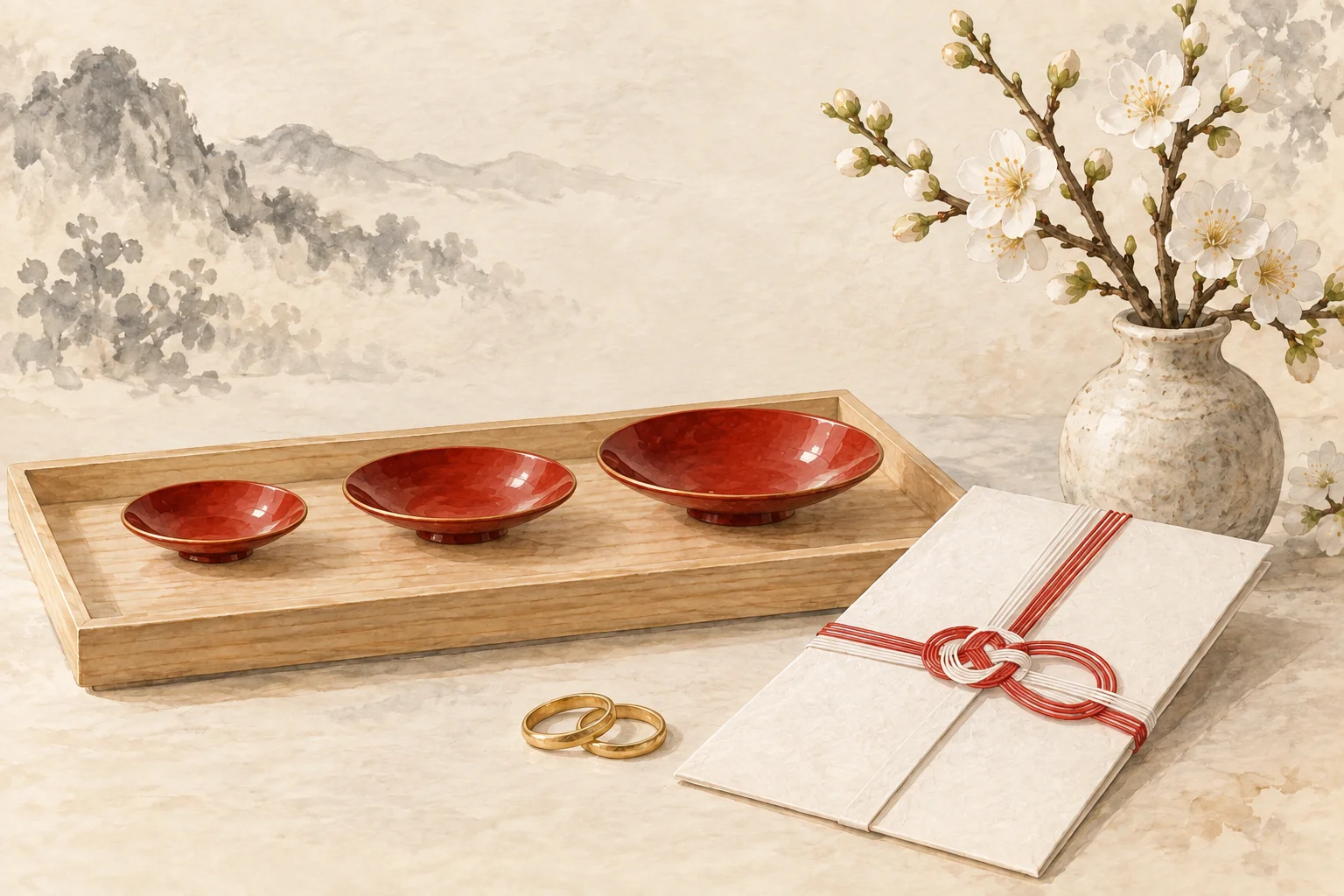
Goshugi (御祝儀) literally means "celebratory offering." In a wedding context it refers to the cash gift each guest brings to a Shinto ceremony or hotel reception (hiroen). Unlike Western traditions of registries, wrapped presents, or honeymoon funds, traditional japanese wedding gifts are almost always money — and the amount is calibrated to your relationship with the bride or groom. The logic is simple. A Japanese wedding reception costs the host couple roughly ¥30,000–¥40,000 per guest in food, drink, venue and return gifts. Cash goshugi offsets that cost while signalling your formal recognition of the marriage. A wrapped object, by contrast, creates ambiguity (did the guest spend enough? is it useful?) and inventory the couple must store. Cash removes both problems.
There are rare exceptions. If you genuinely cannot attend and want to send something meaningful, a wrapped gift (kitchenware, fine tableware, a household appliance) is acceptable — but for a guest who is physically attending, the expectation is goshugi in a shugi-bukuro. Foreign guests are sometimes told "no gift is required" by the couple as a courtesy; in practice, bringing prepared goshugi is always the safer and more respectful choice.
Standard Amounts by Relationship
How much money do you give at a japanese wedding? The answer depends on who is marrying. The table below shows the prevailing 2026 ranges. These figures are stable across most regions of Japan, with minor upward bias in Tokyo and downward bias in some rural areas.
Relationship to the couple | Typical goshugi (JPY) |
|---|---|
Friend | ¥30,000 |
Colleague (same level) | ¥30,000 |
Senior colleague / mentor at work | ¥30,000 – ¥50,000 |
Direct boss (joshi / 上司) | ¥50,000 |
Sibling | ¥50,000 |
Aunt or uncle | ¥30,000 – ¥50,000 |
Cousin | ¥30,000 |
Other relatives | ¥30,000 – ¥100,000 |
Couple attending together | ¥50,000 – ¥70,000 (combined) |
Child of the guest also attending | +¥10,000 (child under 12) / +¥20,000 (teen) |
Wedding Planner's Note: If you are attending as a couple, the joint goshugi is generally ¥50,000 (not ¥30,000 × 2 = ¥60,000), because ¥60,000 is an even number and discouraged. ¥70,000 is the next acceptable step up for two guests if your relationship to the couple warrants it. We explain the odd-number rule below.
The Odd-Number Rule — Why ¥30,000 and ¥50,000 (Not ¥40,000)
You will notice that every standard amount is an odd number: ¥30,000, ¥50,000, ¥70,000. Even numbers are avoided because they can be divided in half — and division symbolically suggests separation, which is unwelcome at a wedding. ¥20,000 and ¥40,000 are both especially avoided. ¥40,000 carries a double issue: the number four (shi) is a homophone for death (死), and ¥90,000 is similarly avoided because nine (ku) sounds like suffering (苦).
There is one modern exception. ¥20,000 is increasingly accepted when given as one ¥10,000 bill plus two ¥5,000 bills (totalling three bills — an odd count). Some younger guests use this when ¥30,000 is genuinely out of reach. However, the conservative default remains ¥30,000 minimum from any adult friend or colleague. For larger amounts, the pattern continues: ¥70,000 (seven bills of ¥10,000, or five ¥10,000 + four ¥5,000), then ¥100,000 — which is a permitted exception because, while even on paper, it is read as a single round unit and reserved for very close family.
New Bills (Shinsatsu) — Where to Get Them
Goshugi must be paid in crisp new bills, called shinsatsu (新札) or pi-satsu. Using folded or worn bills implies you grabbed cash hastily from your wallet — the opposite of the "I prepared for this happy occasion" message goshugi is meant to convey. There are three reliable ways to obtain new bills in Japan:
- Bank counter (窓口) at a major Japanese bank. Visit MUFG, SMBC, Mizuho, or Japan Post Bank during weekday business hours (typically 9:00–15:00) and ask for "shinsatsu ni ryougae shitai" (新札に両替したい — "I'd like to exchange for new bills"). Most banks offer this service free for small quantities; some charge a fee above 10 sheets.
- Bank ATM with a new-bill function. A small number of ATMs at branch lobbies can dispense new bills directly. The option is labelled shinsatsu on the screen. Availability is limited and unreliable on weekends.
- In emergencies — iron the bills. If you cannot reach a bank in time, the least-bad fallback is to take your cleanest existing bills, place them under a sheet of paper, and press lightly with a warm dry iron to flatten any creases. This is a known last-resort tactic and signals at least that you tried.
Plan ahead. New bills can be hard to obtain in the final 48 hours before a wedding, especially around Golden Week, year-end, or in cities with limited bank coverage.
The Shugi-Bukuro Envelope — Choosing the Right One
The japanese wedding envelope is called a shugi-bukuro (祝儀袋), and choosing the correct one is as important as the amount inside. Shugi-bukuro are sold at convenience stores, stationery shops (Tokyu Hands, Loft, Itoya), and supermarkets, with prices ranging from ¥150 for a simple paper sleeve to ¥2,000+ for elaborate decorated versions. The general rule: the envelope should match the amount inside. A ¥30,000 gift in a ¥1,500 ornate envelope looks awkward; a ¥100,000 gift in a ¥200 plain envelope looks stingy.
Mizuhiki — The Decorative Cord
The decorative cord on the front of the envelope is called mizuhiki (水引). For weddings, only two knot types are correct:
- Musubi-kiri (結び切り) — a tight knot that cannot easily be untied, symbolising "once is enough" (you only want this happy event to happen once, i.e. one marriage).
- Awaji-musubi (あわじ結び) — an interwoven loop with the same "tightly bound, once is enough" meaning, often more decorative.
Never use cho-musubi (蝶結び) — a bow-tie style knot that comes undone and re-tied easily. Bow-tie mizuhiki is for events you want to repeat (childbirth, promotions, longevity celebrations). Using it at a wedding implies you hope the couple will marry again — a serious faux pas.
Mizuhiki colours are red-and-white or red-and-gold. Black-and-white or silver-and-white mizuhiki are for funerals and condolence offerings; never confuse them. The number of cords is usually 5, 7, or 10 strands (odd-favoured, with 10 read as a paired round number for grand occasions).
How to Write the Envelope — Outer Cover, Inner Pouch, Calligraphy
A shugi-bukuro has two parts: the outer cover with mizuhiki, and an inner pouch (nakabukuro, 中袋) where the cash actually sits. Both require writing.
Outer Cover (Omote-gaki)
The top centre of the outer cover, above the mizuhiki, carries a printed or hand-written phrase. The most common and safest choice for a wedding is 寿 (kotobuki, "felicitations"). Other acceptable phrases include 御祝 (o-iwai) or 御結婚御祝 (go-kekkon o-iwai). Most pre-printed envelopes already have one of these phrases — choose 寿 or 御結婚御祝 for the simplest path.
Below the mizuhiki, write your own full name (family name + given name) centred vertically. Use a black fudepen (brush pen) or a thin calligraphy brush. Never use a ballpoint pen or pencil. Avoid grey or thin ink — that ink convention (usuzumi) is reserved for funerals. If two people are giving jointly, write the husband's full name in the centre and the wife's given name to the left.
Inner Pouch (Nakabukuro)
On the front of the inner pouch, write the amount enclosed in formal kanji numerals (called daiji) vertically: ¥30,000 is written as 金参萬円, ¥50,000 as 金伍萬円, ¥100,000 as 金壱拾萬円 or 金拾萬円. The 金 ("kin") prefix and the formal numerals (壱, 弐, 参, 伍, 拾) prevent later alteration of the figure. On the back, write your full address and name in the lower left so the couple can later send return gifts and thank-you notes.
Folding the Bills and Direction of the Portrait
Bills go inside the nakabukuro face-up, with the portrait at the top. The face side of a Japanese bill is the side with the historical figure (Fukuzawa Yukichi on the ¥10,000 note, until the 2024 redesign featuring Eiichi Shibusawa). Stack the bills with all portraits aligned the same direction. Insert them so that when the recipient opens the pouch from the top, the portrait is the first thing they see, right-side up.
This convention — face up, portrait first — communicates that the gift is being offered openly and with intent. For funeral envelopes (koden) the convention is reversed, with portraits face-down, to indicate sorrow and "averted gaze." Do not confuse the two.
Fukusa — The Outer Wrapping Cloth
You do not carry the shugi-bukuro in your hand or stuff it in a pocket. It is wrapped in a square ceremonial cloth called a fukusa (袱紗), and the wrapped bundle sits in your bag until you arrive at the reception desk. Fukusa for weddings should be in celebratory colours: red, pink, purple, gold, or warm orange. Purple is the most versatile and acceptable for both weddings and funerals. Avoid black, dark blue, or grey fukusa — those are funeral colours.
Two styles of fukusa are widely sold: the furoshiki-style (a square cloth you fold around the envelope by hand) and the kinchaku-style or kazaregata (a pre-stitched pouch with a flap that opens like a wallet). The pouch style is easier for first-timers and acceptable in all settings. A simple purple kinchaku fukusa from a department store costs ¥1,500–¥3,000 and will serve you for both happy and sad occasions over many years.
For folding the furoshiki style for a wedding: place the envelope face-up in the centre, fold left side over first, then top, then bottom, then right side last. (The right-last fold is the celebratory direction; right-first is the funeral direction.)
Presenting at the Reception — Uketsuke, Bow, What to Say
You arrive at the venue 10–15 minutes before the stated start time. A reception desk called the uketsuke (受付) is set up just inside the venue, staffed by friends or junior relatives of the couple. The handover sequence is:
- Approach the uketsuke and offer a small bow. Say "Honjitsu wa omedeto gozaimasu" (本日はおめでとうございます — "Congratulations on this happy day").
- Open your fukusa, remove the shugi-bukuro, and place the empty fukusa back in your bag.
- Hold the shugi-bukuro with both hands. Rotate it so the text faces the receptionist — they should be able to read your name without turning their head.
- Offer the envelope with a slight forward bow. Say "Sasayaka desu ga, omedeto gozaimasu" (ささやかですが、おめでとうございます — "It is a small thing, but congratulations") or simply "Omedeto gozaimasu."
- The receptionist will accept the envelope with both hands and ask you to sign the guest book (hokomeicho). Sign your name clearly in the indicated style (family name + given name).
- You will be handed a seating card and may be directed to the cloakroom or the reception hall.
Wedding Planner's Note: Do not hand the envelope while still wrapped in the fukusa. The fukusa is for transport only. Removing it at the uketsuke and presenting the clean envelope is the visible act of respect.
For Foreign Guests — Practical Tips
If you are flying in from abroad for a Japanese friend's or relative's wedding, the goshugi system can feel daunting. Here are the practical realities:
- Where to buy shugi-bukuro: Any convenience store (FamilyMart, Lawson, 7-Eleven) sells basic envelopes. For nicer designs, head to a stationery store or department store. Buy at least one day before — many envelope packages include a small instruction sheet but it is in Japanese only.
- Currency: Goshugi must be in Japanese yen, in crisp new bills. Bring your bank-issued home currency to a major Japanese bank or post office on arrival and exchange to JPY, then visit a counter to request new bills. Allow a full business day buffer.
- Late invitations: If the wedding is in 48 hours and you cannot obtain new bills, choose your cleanest existing bills, iron them lightly, and proceed. The amount and the envelope matter more than the bill condition in a pinch.
- You are told "no gift necessary": Bring goshugi anyway. Refusal is a Japanese courtesy formula; arriving with prepared goshugi is the safer interpretation.
- Calligraphy worry: If you cannot write in Japanese brush style, pre-printed envelopes are widely available where the front phrase (寿) is already printed and you only need to add your name in the centre. Print legibly in Roman letters if you do not write Japanese — your full Western name is acceptable and the couple will recognise it.
- Bringing a partner: If you are travelling as a couple and both attending, the joint goshugi convention applies — typically ¥50,000 or ¥70,000 in one envelope with both your names on the front.
For broader context on what to wear and what else to expect, see our companion guides to japanese wedding guest attire and japanese wedding traditions and customs.
After the Wedding — Hikidemono (Return Gifts) Explained
You will not leave a Japanese wedding empty-handed. The host couple traditionally prepare a hikidemono (引き出物) — a return gift — for every guest, typically waiting in a bag at the seat or handed out as guests depart. The value of the hikidemono is calibrated to the expected goshugi: roughly ¥3,000–¥5,000 retail per guest, occasionally higher for relatives.
A standard hikidemono set contains three components: a main gift (often a catalogue from which the guest later selects an item — useful because it travels home easily), a cake or sweet item (hikigashi, 引き菓子) such as baumkuchen or wagashi, and sometimes an "engimono" (縁起物) — a small symbolic item like dried bonito (katsuobushi) or red rice (sekihan) packets.
You are not expected to send a separate thank-you gift in return. The hikidemono closes the gift exchange. You may, however, send a short note or message to the couple after the wedding thanking them for the day. This is a thoughtful touch but not obligatory.
Frequently Asked Questions
How much money do you give at a japanese wedding as a friend?
The standard goshugi for a friend is ¥30,000 in new bills, placed inside a shugi-bukuro with red-and-white or red-and-gold mizuhiki tied in a musubi-kiri or awaji knot. This amount has held steady for decades and is the safest default if you are unsure of your relationship category.
What is goshugi and what is shugi-bukuro?
Goshugi (御祝儀) is the cash wedding gift itself. Shugi-bukuro (祝儀袋) is the decorated paper envelope used to present it. The two terms are often used together: you put goshugi inside a shugi-bukuro and present the package at the reception desk (uketsuke).
Why is ¥40,000 not acceptable as a japanese wedding gift?
Even-numbered amounts can be divided in half, which symbolically implies the couple separating — bad luck at a wedding. ¥40,000 has an additional problem: the number four (shi) is a homophone for death (死). Stick to odd amounts: ¥30,000, ¥50,000, ¥70,000, or ¥100,000 (a permitted exception for close family).
Can I give traditional japanese wedding gifts instead of money?
For guests physically attending, money is the strong expectation. Traditional japanese wedding gifts in object form (kitchenware, fine ceramics, household goods) are appropriate mainly when you cannot attend but want to send a substantial congratulatory present. Always check the couple's preferences before sending an object gift.
What if I cannot get new bills (shinsatsu) before the wedding?
Visit a major Japanese bank counter on a weekday and ask for shinsatsu exchange. If time has run out, iron your cleanest existing bills lightly under paper to flatten creases. The amount and the envelope etiquette matter more than pristine bill condition.
What does a japanese wedding envelope cost?
A simple shugi-bukuro at a convenience store costs around ¥150–¥300. A nicer department-store envelope with elaborate mizuhiki and decorative paper costs ¥800–¥2,000+. Match the envelope to the amount inside: a ¥30,000 gift suits a ¥300–¥500 envelope; ¥100,000 deserves an envelope of ¥1,000 or more.
What is japanese wedding gift etiquette for foreign guests?
Foreign guests follow the same rules as Japanese guests: cash in new bills, correct envelope with musubi-kiri mizuhiki, wrapped in fukusa, presented with a bow at the uketsuke. Pre-printed envelopes solve the calligraphy hurdle. If you are uncertain, default to ¥30,000 in a ¥500 convenience-store envelope with your name printed clearly on the front.
Do I sign my name in Japanese or English on the shugi-bukuro?
Either is acceptable for a foreign guest. Print your full Western name (family name first, then given name) clearly in block letters using a black brush pen if possible. The couple will recognise the name from the invitation. Avoid cursive — uketsuke staff need to read it to match against the guest list.
Continue Your Planning
Goshugi is one piece of the broader Japanese wedding experience. To round out your preparation, read our guide to japanese wedding guest attire for what to wear as a male or female guest, and japanese wedding traditions and customs for the ceremony order, ritual meanings, and reception flow. If you are the couple planning your own Japanese wedding photoshoot in traditional kimono, browse our curated directory of vetted kimono wedding photographers across Japan, or start with our overview of shrine etiquette if a Shinto ceremony is part of your plan.
Related guides
 General guide
Goshugi-Bukuro Gift Money Envelopes: Patterns & Etiquette
Illustrative image · Unsplash. Not a photo of the specific people, places or services discussed.
Goshugi-bukuro gift money envelope guide: shochikubai vs awabi-musubi knots, odd-number amounts, crisp bills, calligraphy rules, and foreign guest etiquette.
Read the guide General guide
Hikidemono: Japanese Wedding Return Gifts Explained
Illustrative image · Unsplash. Not a photo of the specific people, places or services discussed.
Hikidemono japanese return gifts explained: three-item structure, catalog gifts, budgets, logistics, and what international couples and guests need to know.
Read the guideGeneral guideTipping Etiquette Japan Wedding: Don't Tip Vendors
Illustrative image · Unsplash. Not a photo of the specific people, places or services discussed.
Tipping etiquette Japan wedding: a planner's honest guide. Why you should not tip photographers, hair stylists, or kitsuke dressers — and what to do instead.
Read the guide