Modern Color Bridal Kimono: Blush, Ivory & Pastel Guide
Modern color bridal kimono in blush, ivory, sage and dusty rose — a third option between shiromuku and iro-uchikake. Where to rent, how to style.

Illustrative image · Unsplash. Not a photo of the specific people, places or services discussed.
Check current prices, availability and venue rules with the relevant studio or venue before booking.
About a third of the foreign brides we consult arrive at the first fitting expecting a binary choice — white shiromuku or heavily patterned iro-uchikake — and leave choosing something neither of those traditions accounts for. Modern color bridal kimono is the catch-all term studios now use for blush, ivory, champagne, sage, and dusty rose pieces cut in bridal silhouettes but stripped of the dense gold-thread motifs that define classical iro-uchikake. It is genuinely a third category, not a compromise, and the inventory has expanded enough in Tokyo and Kyoto over the past three years that you can plan a shoot around it rather than hope a studio happens to stock one.
What "Modern Color Bridal Kimono" Actually Is
The phrase has no single textile-industry definition. In practice, when a studio lists a piece under "modern color" (sometimes "modern monochrome," sometimes simply "color shiromuku"), it means a bridal-weight kimono — uchikake length and uchikake construction — woven or dyed in a solid or near-solid pale color, with subtle tone-on-tone embroidery rather than the multi-color karaori brocade you see on classical iro-uchikake.
The cut is identical to a traditional uchikake: long trailing hem, padded interior to hold the silhouette, worn over a white kakeshita underkimono. What changes is the surface. A modern color uchikake in blush might carry only a faint cherry-branch embroidery in matching pink thread, visible at close range but reading as a solid tone in photographs. An ivory piece may have whitework on white — relief from texture and shadow rather than from color contrast.
Wedding Planner's Notes: the category exists partly because studios noticed couples were declining iro-uchikake on the grounds that "the patterns are too much for our taste." Rather than lose those bookings to Western dress, the industry built out solid-color uchikake inventory. The pieces are not antique — most are produced in the last decade specifically for this demand.
The Three Most Popular Modern Colors
Studios that carry a serious modern-color line typically stock 15-30 pieces. From those, three color families dominate foreign-bride bookings.
Blush / Sakura Pink
The most-requested color in this category. Blush ranges from very pale dusty pink — almost off-white with a warm undertone — through to a clearer sakura pink that reads pink at any distance. The pale end suits brides who want the visual softness of pink without committing to a color that will dominate the frame; the clearer pink reads more festive and works better outdoors in spring.
Blush pairs unexpectedly well with autumn foliage as well as cherry blossom; the warm undertone holds against red maple without clashing. Avoid pairing blush with bold red shrine architecture if you want the kimono to be the focal point — Fushimi Inari's torii will overpower a pale blush in wide shots. Cherry blossom shoots are the obvious match, but the color also works year-round indoors.
Ivory / Champagne
Ivory sits between shiromuku white and warm champagne. For brides who initially wanted shiromuku but felt the pure white was too stark against their skin tone, ivory is usually the answer. Champagne — slightly warmer, with a gold cast — reads as "white with a richness to it" in photographs and is particularly forgiving in mid-day light where pure white can blow out.
This is the modern color that translates best for couples who want one outfit change rather than two. An ivory uchikake can carry through a morning shrine visit and an afternoon outdoor session without feeling out of place in either setting. It also photographs cleanly indoors under tungsten studio lighting, which pure white sometimes does not.
Sage / Dusty Green
Sage is the dark-horse choice that has gained ground over the past two years. The color sits in a muted gray-green range — never bright green, never olive. It reads as a "neutral color" in the way that ivory does, but with cooler undertones that work better against bamboo, moss gardens, and rainy-day shoots.
Sage is the strongest performer for autumn shoots where the foliage itself is warm-toned. The complementary contrast — cool sage kimono against warm red-orange maple — produces images that hold up at small sizes and in printed albums. It is also a defensible choice for couples who want something unmistakably non-Western but also unmistakably contemporary. Dusty rose, a near-cousin, follows the same logic with a warmer cast.
How It Differs from Iro-Uchikake
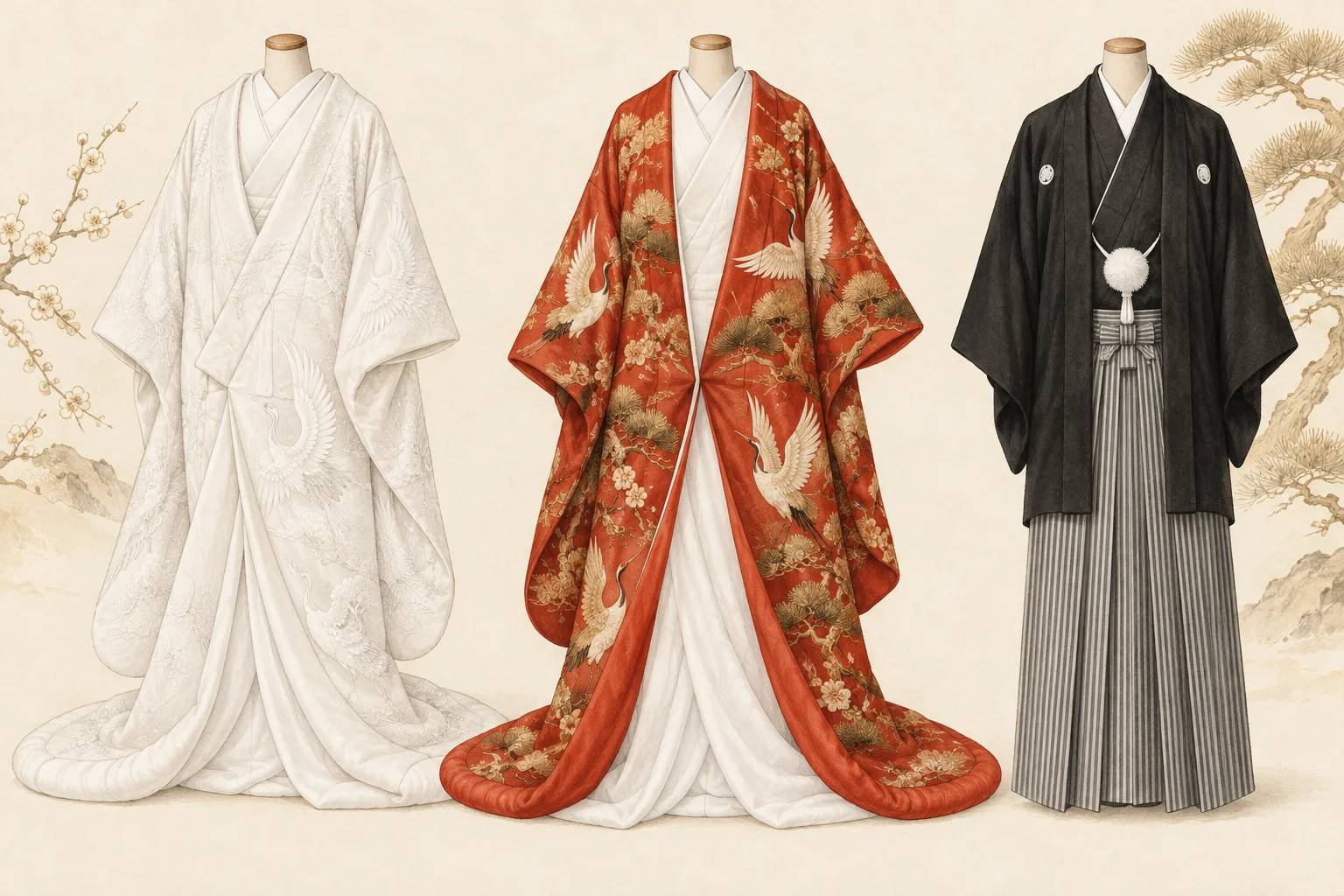
The structural difference between modern color bridal kimono and classical iro-uchikake is decoration density. Both are uchikake — the outer bridal robe — but where iro-uchikake carries dense motifs (cranes, pines, flowing water, gold karaori threadwork) across the entire surface, modern color pieces leave most of the surface as one color and reserve any decoration for restraint: a single embroidered branch, a subtle scattering of petals, or tone-on-tone whitework. Our shiromuku vs iro-uchikake guide breaks down the traditional pair in detail; modern color sits structurally with iro-uchikake but visually closer to shiromuku.
The practical implication is photographic. Iro-uchikake demands compositions that frame the kimono as a textile statement — closer shots, careful background choice so the motifs are not lost. Modern color uchikake behaves more like a wedding gown in compositions: the silhouette and color are the message, so wider shots, more environmental context, and more dynamic poses work without "wasting" the textile.
Cost differs as well. Modern color rentals frequently price below classical iro-uchikake at the same studio, because the production cost is lower without the dense brocade. Expect 60-80% of the iro-uchikake rate at the same vendor, though the headline package price often makes no distinction.
Styling — Hair, Headpiece, Accessories for Modern Color
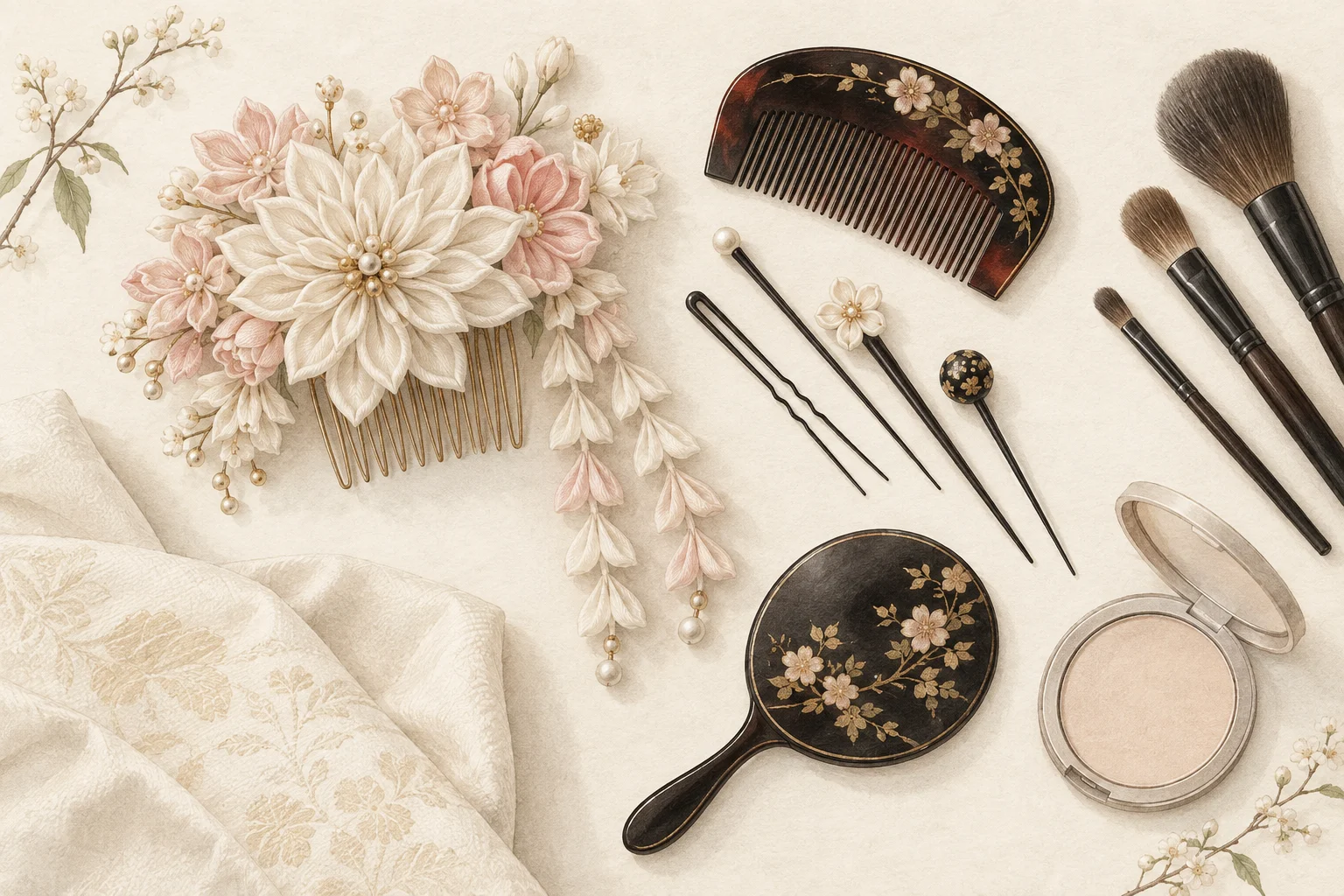
Modern color kimono changes the styling math. The two traditional bridal headpieces — wataboshi (white hood, paired with shiromuku) and tsunokakushi (white cloth headband, paired with classical iro-uchikake) — are both designed for white-on-color or color-on-white contrast. Wearing either over a modern color uchikake works, but it foregrounds the headpiece in a way that reads heavily formal. Most brides choosing modern color skip both.
What replaces them is a hair-down or low-bun styling with kanzashi (decorative hair ornaments) and small floral accents. The shimada hairstyle — the high-volume traditional bridal coif — also recedes; many modern color shoots use softer Western-influenced updos that match the color's contemporary feel. Our hair styling guide for foreign brides covers options that work without a wig, which is usually the right call for modern color.
For accessories: silver and pearl outperform gold against blush and ivory; matte-finish kanzashi rather than the lacquered black-and-gold pieces designed for classical bridal looks. Kanzashi options have widened as studios have responded to demand.
Element | Classical Iro-Uchikake | Modern Color Bridal |
|---|---|---|
Headpiece | Tsunokakushi or wataboshi | Usually none; soft hair ornament |
Hairstyle | Shimada (traditional/wig) | Soft updo or hair-down |
Hair ornament metal | Black-and-gold lacquer | Silver, pearl, matte finishes |
Underkimono | White kakeshita | White or matching pale kakeshita |
Obi color | Gold or contrasting | Often matched or close-tone |
Footwear | White zori | White or natural-tone zori |
Where to Rent — Tokyo and Kyoto Specialty Studios
Modern color inventory is concentrated in Tokyo (Asakusa, Aoyama, and Daikanyama area studios) and Kyoto (Higashiyama and Karasuma). Smaller regional studios in Kanazawa, Kobe, and Fukuoka have begun carrying a few pieces each, but the depth — meaning, more than two or three colors and a range of sizes — remains a Tokyo-Kyoto phenomenon.
When inquiring with a studio, ask three questions. First, how many pieces in the modern color range fit your size (a number, not "we have several"). Second, can you see studio photographs of real shoots in the specific piece you are considering, not just the catalog flat-shot. Third, what is the rental rate compared to their classical iro-uchikake — if the studio quotes the same flat rate, the modern color depth is probably shallow.
Wedding Planner's Notes: a useful filter is whether the studio's Instagram includes real shoots in the modern color pieces. Some studios stock one or two for show but rarely book them; the photographer's portfolio will tell you. Studios that genuinely work in this category produce 30-40% of their bridal output in modern colors and you will see it immediately in their feed.
Our 2026 Kyoto studios review flags which Kyoto vendors carry the deepest modern-color inventory, and the English-speaking photographers list notes which photographers shoot modern color regularly versus occasionally.
Photographing Modern Color Kimono — Light Considerations
The photographic challenge with pale colors is exposure latitude. A blush or ivory uchikake fills most of the frame; if the photographer exposes for the kimono, ambient details fall into shadow. If they expose for the surroundings, the kimono blows out and loses texture. Photographers who shoot modern color regularly meter for the kimono and accept slightly darker environmental tones, then balance in post — this is a deliberate technique.
Light direction matters more than for shiromuku. Pure white shiromuku reads as white in almost any light, including flat overcast skies. Modern color tones — particularly blush and champagne — change character depending on direction. Side-light shows tone-on-tone embroidery; backlight produces a luminous edge but mutes the color; flat overcast renders the color most accurately but flattens the dimensional embroidery.
For outdoor shoots, the optimal slot is the 90-minute window after sunrise or before sunset. Mid-day overhead sun is the hardest condition for modern color — the highlights blow out and the color shifts cool. Season choice intersects with this: spring and autumn give longer soft-light windows than summer.
Indoor studio shoots remove the lighting variable but introduce a different one — color cast. Pale kimonos read strongly the color of the room's bounce light. Studios that shoot modern color regularly will have neutral-walled bays specifically for this category.
Mixed Looks — Modern Color Plus Traditional Shiromuku Combination
A common booking pattern: morning shiromuku at a shrine, afternoon modern color outdoors. This gives the couple the ceremonial frame in white and the contemporary editorial frame in color, with one outfit change. The opposite order also works, with modern color in the early morning soft light and shiromuku for a late-morning indoor or shrine setting.
Logistically, this requires either two rental slots at the same studio or a studio that offers a multi-look package. Most premium studios in Tokyo and Kyoto build this into their bridal package as standard. Budget for an additional ¥30,000-¥80,000 over single-look pricing depending on city and studio tier.
Time-wise, plan 40-50 minutes between looks: dressing out of one kimono and into another, hair and makeup refresh, and transit if the second location is offsite. Shoot duration planning details realistic timelines.
For Foreign Brides Who Want "Kimono But Not Quite That Traditional"
Modern color is the answer to a specific request we hear constantly: "I want to wear a kimono in Japan, but I don't want to look like I'm wearing a costume." The cultural calculation behind that sentence varies — some brides have lived in Japan and want something less ceremonial; some have mixed heritage and want a piece that honors connection without overstating it; some simply prefer muted color palettes for their wedding aesthetic.
For all three, modern color resolves the discomfort. The piece is still unmistakably kimono — silhouette, construction, drape, the way it moves when you walk are all classical. What it removes is the visual code that reads "traditional Japanese ceremony" in photographs intended for an audience outside Japan. The resulting images sit comfortably alongside Western wedding photography rather than being filed separately as "cultural."
It also resolves a related concern about appropriation. Modern color bridal kimono is a Japanese textile industry product designed for the modern Japanese bridal market — Japanese brides represent the majority of customers for these pieces. Wearing one is not borrowing a ceremonial garment but participating in a current Japanese bridal trend.
If you are visiting Japan for the photoshoot itself, modern color also extends easily into solo bride shoots and anniversary kimono shoots, where the lighter visual register fits the more intimate occasion better than classical iro-uchikake.
Frequently Asked Questions
Is modern color bridal kimono considered authentic by Japanese standards?
Yes. The pieces are produced by the same kimono workshops that produce classical bridal pieces, using the same construction methods and uchikake silhouette. The Japanese bridal industry treats them as a current bridal category, not as a non-traditional alternative. The "modern" in the name refers to color choices, not to legitimacy.
Can I wear modern color kimono for a Shinto wedding ceremony at a shrine?
Most shrines will permit it, but several major shrines including some Kyoto venues prefer or require shiromuku for the ceremony itself. Modern color uchikake is generally accepted for the post-ceremony portraits and the reception. If you are planning a religious ceremony rather than a photo session, confirm color policy with the specific shrine well in advance.
What is the price range compared to shiromuku rental?
Modern color rentals price similarly to mid-tier shiromuku at most studios — typically ¥50,000-¥150,000 for the kimono alone, with package pricing including hair, makeup, and dressing in the ¥150,000-¥350,000 range. The pieces sit below the top-tier antique shiromuku and classical iro-uchikake in cost but above entry-level rentals.
Will the color work with my skin tone if I am very pale or very dark?
Modern color depth is broader than it appears in studio catalogs. For very pale skin, champagne and dusty rose carry more warmth than blush; for darker skin, sage and the deeper end of the dusty rose range hold contrast where pure blush can wash out. Studios will let you try several at the fitting — this is the point of the first appointment.
Can my partner wear something that coordinates without clashing with the modern color?
Yes. Men's montsuki haori hakama is traditionally black, gray, or dark navy and reads as a neutral against any modern color uchikake. Some studios offer charcoal or warm-gray haori specifically for pairing with blush and ivory, which avoids the heavy contrast of pure black-on-pale. See our men's kimono guide for the full picture.
How do modern color uchikake photograph in rainy weather?
Better than shiromuku, in our experience. Pale color holds tonal interest in overcast and rainy light, where pure white shiromuku can read flat. The vermillion umbrella often used as a styling tool in rainy-day shoots contrasts more cleanly against blush or sage than against white. Rainy season planning is covered in our seasonal guides.
If I rent modern color, can I still do the san-san-kudo ritual?
Yes — the ritual is independent of kimono color. Some shrines and ceremony venues will simply note the color choice without restriction; others will recommend changing into shiromuku for the ritual portion specifically. The san-san-kudo ritual itself is choreographed the same way in any case.
Book a Studio That Stocks Modern Color Bridal Kimono
The first question to ask any studio you are considering is the size of their modern color inventory in your fitting size — not the total range, the wearable range. Studios serious about this category will answer with a number; studios that have one or two display pieces will hedge. Our directory flags which studios carry deep modern color lines and which photographers shoot the category as a regular part of their portfolio.
Browse the curated photographer directory to find studios with modern color inventory in Tokyo, Kyoto, and select regional cities, or continue reading our solo bride kimono photoshoot guide and anniversary kimono photoshoot guide for occasions where modern color particularly suits the visual register.
Related guides
 Style guide
What Is a Shiromuku? Japan's White Wedding Kimono Explained
Illustrative image · Unsplash. Not a photo of the specific people, places or services discussed.
What shiromuku means, the pieces of Japan’s white bridal ensemble, and the questions to ask about clothing, styling, availability and a photo-session quote.
Read the guide Style guide
Shiromuku vs Iro-Uchikake: Which Kimono Suits Your Photos?
Illustrative image · Unsplash. Not a photo of the specific people, places or services discussed.
A deep comparison of shiromuku and iro-uchikake, Japan's two iconic bridal kimono, and how to choose the right one for your photoshoot vision.
Read the guide Style guide
Traditional Japanese Wedding Dress & Attire: Bridal Kimono Guide
Illustrative image · Unsplash. Not a photo of the specific people, places or services discussed.
A complete guide to traditional Japanese wedding attire: the shiromuku, iro-uchikake, and hikifurisode, plus headpieces, accessories, the groom's montsuki, rental costs, and how to choose.
Read the guide