Hair Styling for Foreign Brides in Kimono: Curly, Fine & Short
Practical hair styling for kimono foreign brides — curly, fine, pixie cut, extensions, and dyed hair. What to communicate before your shoot.

Illustrative image · Unsplash. Not a photo of the specific people, places or services discussed.
Check current prices, availability and venue rules with the relevant studio or venue before booking.
Foreign brides booking a kimono photoshoot in Japan often arrive at the styling chair with hair that looks very different from what the average Japanese bridal stylist trained on. Tight 4a–4c curls, very fine European hair, pixie cuts under five centimetres, tape-in extensions, platinum blonde, henna red — none of these are wrong, but each one changes the conversation about how to anchor the kazura (wig) and the kanzashi. This guide explains how the system actually works, what to flag at booking, and what to bring on the day so that hair styling for kimono foreign brides goes calmly rather than at speed in a quiet studio that has nobody with strong English to translate the panic. Read it together with our kimono photoshoot day timeline so you understand where hair sits in the overall morning.
How Japanese Bridal Hair Styling Works (kazura wig + base styling)
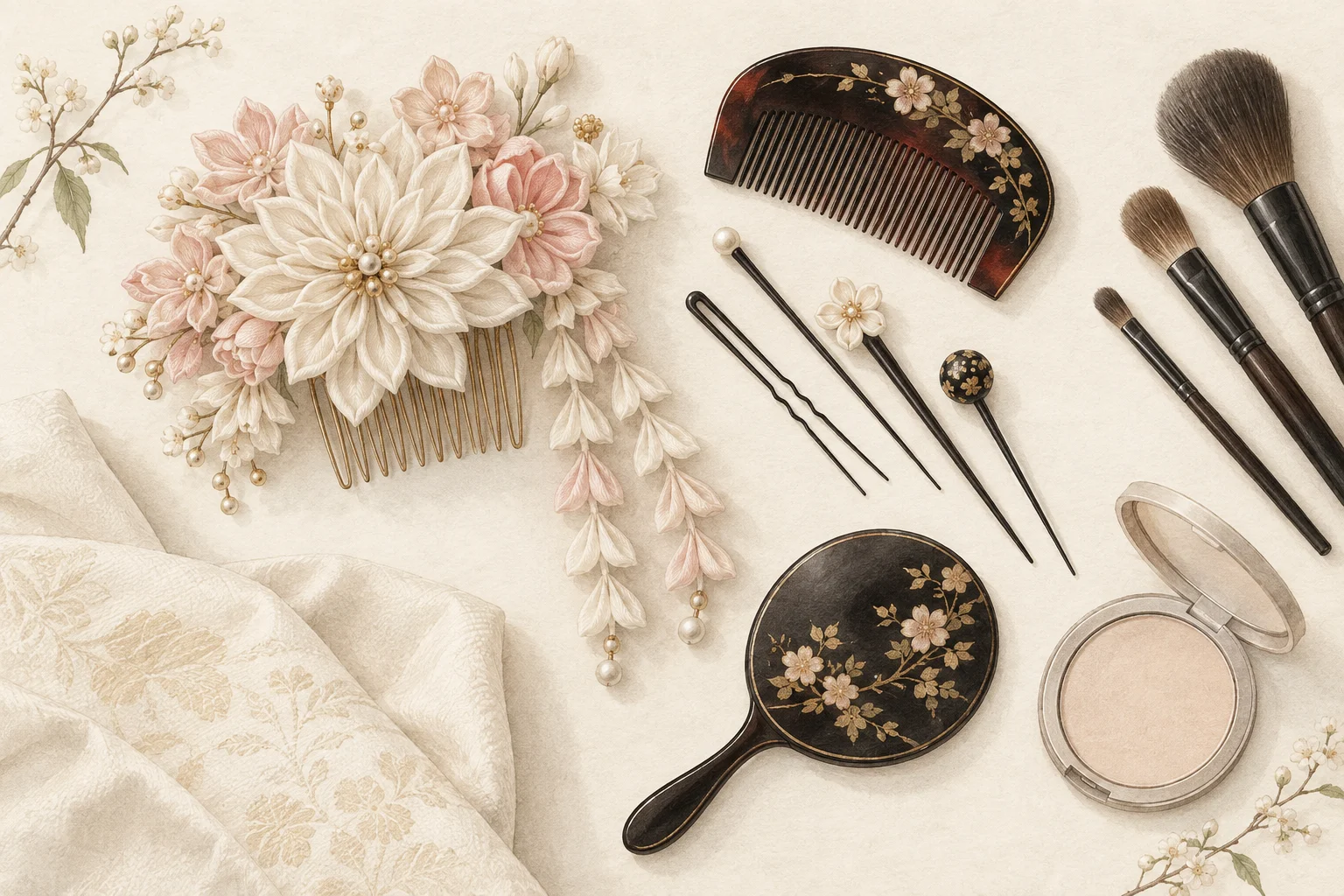
For shiromuku (the all-white bridal kimono) and the most formal iro-uchikake silhouettes, the traditional finish is bunkin takashimada (文金高島田) — a tall, sculpted bun shape held at the crown with a wide silhouette across the front. In modern bridal studios, almost no one styles bunkin takashimada from the bride's natural hair. Instead, the stylist fits a kazura (鬘) — a pre-shaped wig already styled into bunkin takashimada — over a tidy base of the bride's own hair.
The bride's natural hair is pulled back into a low, flat, smooth ponytail or bun against the nape. This base is what the kazura sits on and grips against. The smoother and more compact the base, the more securely the kazura sits, and the less it shifts during a four-hour outdoor shoot. Pins, a fine net, and sometimes a thin silicone cap are used to anchor it. The kazura itself is heavier than people expect — usually 800g to 1.2kg — and once it is on, the silhouette and balance no longer depend on your own hair at all.
This is the key insight for non-Asian brides considering non-asian hair bunkin takashimada: you are not asking the stylist to style your hair into a Japanese bridal shape. You are asking them to contain your hair under a wig that already has the shape. That changes which hair textures are easy and which are hard. Long, straight, fine, dark hair is the easiest because it lies flat. Tight curls, very thick hair, very short hair, and extensions are the four conversations worth having before the booking is locked in.
For Brides with Tight Curls — What Studios Need to Know
Tight curls — anything from 3b through 4c — are not a problem for wearing a kazura. They are a problem for the base. A stylist who has only worked on straight Japanese hair will not instinctively reach for a wide-tooth comb, leave-in moisture spray, or a satin-lined net. They will reach for a fine-tooth comb and water, and within two minutes you will be uncomfortable and the base will be uneven.
The practical solution is to do the base yourself, or to arrive with a base already set. The morning of the shoot, smooth your hair into a low, flat ponytail at the nape using your usual leave-in product, then pin it flat against your scalp in a small, dense bun. The stylist will put a fine net over that and fit the kazura. You may need to bring your own edge control or gel. Communicate at booking: "I have tight natural curls. I will arrive with my own low bun base. The stylist only needs to fit the kazura over the base I prepare." Most studios will appreciate the heads-up and adjust the schedule by ten or fifteen minutes.
For curly hair kimono shoots where the bride wants her natural hair visible — typically with an iro-uchikake in a softer modern shoot — the answer is different and is covered later in this guide.
For Brides with Very Fine or Thinning Hair
Very fine, slippery European or East Asian hair is the opposite problem to tight curls. The base ponytail does not hold pins well because there is not enough density for the pins to grip. Without a textured base, the kazura slides minutely with every head movement, and by the end of a long shoot it can rotate a few degrees forward, which is visible in side-profile photos.
The fix is texture spray and more pins. Tell the stylist at booking that your hair is fine. A skilled bridal stylist will use a tackifying spray, more bobby pins than they would on Japanese hair, and a slightly tighter net. They may also choose a kazura with a built-in silicone wig grip rather than a plain interior. If you have a known issue with bobby pins giving you a headache after a few hours, bring a soft cotton headband to wear under everything in transport, and ask the stylist to use larger U-pins rather than tight bobby pins where possible.
A note for brides who have noticed thinning along the part line or temples: the kazura covers the entire crown and front, so this is not visible in the final photographs. There is no need to mention it for cosmetic reasons. Mention it only if the thinning means certain pin positions are uncomfortable.
For Brides with Pixie Cuts and Very Short Hair
Pixie cuts, undercuts, and shaved-side styles are increasingly common and entirely workable. The mechanical requirement of the kazura is that it sits flat against the head and is anchored against something — that something does not have to be a bun. If your hair is under five centimetres all over, the stylist will skip the base ponytail and use a stocking-cap-style net flat against your scalp, with pins anchored into the net rather than into your hair. The kazura then sits on top.
For genuinely shaved or buzz-cut brides — under one centimetre — the studio may use a thin silicone wig grip directly against the scalp, with the net over that. The kazura is then secured with double-sided fashion tape at the temples and nape in addition to pins. This is not exotic; theatre and film stylists do it routinely. Flag it at booking with a phrase like "I have a pixie cut, the longest section is about three centimetres" so the studio knows to allocate a stylist who has handled short hair kimono bride bookings before.
If you have an undercut on one side and longer hair on the other, the longer side will form the base bun, and the undercut side is simply ignored — the kazura covers it entirely.
For Brides with Hair Extensions — Keep or Remove
Hair extensions are the single most common silent problem on the day. Tape-in, sew-in, microbead, and clip-in extensions all interact with the kazura base differently, and a stylist who has not been warned may discover them only after starting work.
The general principle: clip-in extensions should be removed in the morning before you arrive. They add weight and bulk to the base ponytail without adding any structural benefit, and they make the head feel hot under the kazura. Tape-in and microbead extensions can stay in — they lie close to the scalp and will not interfere — but tell the stylist at booking so they can plan around the tape lines when placing pins.
Sew-in extensions are more involved. The braided cornrow base underneath a sew-in can make a smooth flat ponytail impossible. If you are mid-sew-in cycle and cannot remove them before the trip, tell the studio in detail — "I have a partial sew-in, the braided base is along the crown" — and the studio will use a flatter, longer net and may forgo the base ponytail entirely. This is not a problem; it is just a conversation that needs to happen at booking, not on the morning.
For Brides with Blonde, Red, or Very Light Hair
Hair colour does not affect the mechanics of fitting a kazura at all — the wig fully covers the front, top, and crown of the head, so the only visible hair is the small amount along the nape and behind the ears. However, the kazura itself is almost universally jet black, which creates a hard visual line against blonde, platinum, or red hair at the nape if any of that hair is visible.
Two solutions exist. First, tuck more thoroughly: a careful stylist can hide essentially all of the nape hair under the net so the line is invisible. Most foreign brides do not need to think about this — communicate "I am blonde, please tuck the nape carefully" and a skilled stylist will handle it. Second, accept the line: in soft natural light, the contrast is much less visible than under studio strobes, and many wedding photographers consider it a non-issue. For a kazura wig kimono finish on very light hair, the nape question is the only real cosmetic decision.
If you have visible roots or recently bleached hair that is fragile, mention this at booking — the stylist will be gentler with pins along the part line.
Pre-Trip Hair Prep (do not dye 2 weeks before)
Three practical pre-trip rules apply to almost every foreign bride.
Do not dye in the two weeks before the shoot. Fresh dye — particularly bright reds, ash blondes, and demi-permanent fashion colours — can transfer onto the kazura net or onto the white silk collar of the shiromuku if your hair is at all damp. Two weeks of wash cycles fixes this entirely. If you must touch up roots, do it three weeks before the trip and wash thoroughly.
Do not get a haircut in the week before. Freshly cut hair has sharp ends that are slippery and harder to anchor than slightly grown-out hair. Schedule any trim for at least two weeks before departure.
Skip heavy conditioning treatments the night before. Silicone-heavy masks and oil treatments make hair too slippery for pins to grip. Wash and air-dry the day before the shoot using your normal shampoo and a light conditioner only. Do not use leave-in oil on the morning of the shoot. If you have very dry hair, a tiny amount of leave-in cream is fine — but apply only to mid-lengths and ends, never to the crown or the section that will form the base bun.
The Day Of — What to Communicate to the Stylist
Even with everything noted at booking, the stylist may be different from the person who took the booking, and English fluency in the styling room varies. Be ready to communicate three things in the first five minutes.
- Hair texture and any extensions. A short phrase printed on your phone in Japanese, e.g. "natural tight curls, no extensions" (天然のくせ毛、エクステなし) or "tape-in extensions along the sides" (サイドにテープエクステあり), prevents any confusion. Show it, do not try to pronounce it.
- Any allergies or sensitivities. Tackifying sprays and edge-anchoring gels often contain fragrance. If you have a known scalp allergy, mention it. Studios will swap to an unscented product if asked.
- Pain tolerance. If the kazura feels too tight in the first five minutes, say so. It is much easier to adjust before the kanzashi go in. A common mistake is to be polite about a too-tight fit, then need an emergency adjustment on location an hour later.
The stylist will then show you the front and side profile in the mirror before kanzashi are placed. This is the moment to flag the silhouette — too far forward, too far back, the line at the nape. After kanzashi are in, the styling is essentially locked.
Hair Styling for Iro-Uchikake (no kazura, natural hair styled)
For modern iro-uchikake shoots — particularly the colourful brocade outer robes paired with soft natural-light photography in autumn or sakura settings — many studios offer a no-kazura option where the bride's natural hair is styled into a soft updo and decorated with kanzashi and fresh flowers directly. This is increasingly the foreign bride's preferred option because it photographs as visibly you.
For this finish, all the textures that were challenges for the kazura base become advantages. Tight curls form beautiful soft volume against the brocade. Very fine hair takes a gentle wave well and looks airy. Pixie cuts can be styled with side-swept fringe and a row of kanzashi along the part. Hair extensions can stay in and add length. Blonde and red hair photograph as themselves rather than disappearing under black.
If you book iro-uchikake without kazura, your hair prep is the standard pre-wedding routine: a good trim three weeks out, fresh colour three to four weeks out, conditioning treatments as you would normally, arrival with clean dry hair on the morning. The stylist will work with what you have. See our shiromuku vs iro-uchikake guide for help choosing the silhouette, our kanzashi guide for how the hair ornaments sit on natural hair, and our hair and makeup for shiromuku overview for the traditional alternative.
Frequently Asked Questions
Can I wear bunkin takashimada with very curly hair?
Yes. The traditional bunkin takashimada is a kazura (wig) fitted over your hair, not styled from your hair. Tight curls are contained under a flat base bun with a net over it, and the kazura sits on top. The only adjustment needed is more time at the base stage, which you can speed up by arriving with your own bun already set.
Do I need to take out my extensions before the shoot?
Clip-ins: yes, remove the morning of. Tape-ins and microbeads: keep them in but tell the studio at booking so the stylist places pins around the tape lines. Sew-ins with a braided base: tell the studio in detail and they will adapt the base technique.
I have a pixie cut. Can I still wear a kazura?
Yes. The stylist will skip the base ponytail and use a flat stocking-cap net pinned into the net itself, with the kazura on top. Flag the cut length at booking so the studio assigns a stylist familiar with the technique.
Will my blonde hair show under the black kazura?
A small amount at the nape and behind the ears can be visible. A careful stylist will tuck it under the net so the line is essentially invisible. In natural light it is barely noticeable; under studio strobes it is more visible. Mention it at booking and the stylist will plan accordingly.
Should I dye my hair before the trip?
If you need a root touch-up, do it three or more weeks before departure and wash thoroughly. Avoid fresh dye in the two weeks immediately before the shoot — fresh colour can transfer onto the kazura net or the white silk collar of the shiromuku if hair is damp.
How heavy is the kazura?
Typically 800g to 1.2kg. It feels significant for the first ten minutes, then the neck adjusts. If it feels too tight after five minutes, say so before the kanzashi are placed — adjustments are easy at that stage and difficult after.
Can I do iro-uchikake without the wig?
Yes, and many foreign brides prefer it. The stylist works with your natural hair into a soft updo, decorated with kanzashi and fresh flowers. This is generally the easier option for curly, fine, short, or light-coloured hair and looks visibly like you in the final photographs.
What if my scalp is sensitive to tackifying spray?
Mention any known sensitivity at booking and again on the day. Studios will swap to unscented or low-fragrance products on request. If you have a serious fragrance allergy, ask whether the studio can confirm the exact product in advance.
Find a Foreign-Bride-Friendly Studio
Hair styling is one of the quiet differentiators between studios that handle foreign brides routinely and studios that handle them occasionally. Our directory flags the studios that have stylists experienced with curly, fine, short, and extension-bearing hair, and that offer detailed pre-booking consultations in English. Browse foreign-bride-friendly kimono photographers to start a conversation. If you want to understand where hair sits in the rest of the shoot day, see our kimono photoshoot day timeline, and for related styling decisions read our shiromuku vs iro-uchikake comparison, kanzashi guide, and hair and makeup for shiromuku.
Related guides
Style guideTsunokakushi vs Wataboshi: Japanese Bridal Headpieces Explained
Illustrative image · Unsplash. Not a photo of the specific people, places or services discussed.
Tsunokakushi vs wataboshi: the two traditional Japanese bridal headpieces worn with shiromuku — meaning, when to wear each, and photo tips.
Read the guide Style guide
Kanzashi Hair Ornaments: A Foreign Bride's Kimono Guide
Illustrative image · Unsplash. Not a photo of the specific people, places or services discussed.
Kanzashi are the elaborate hair ornaments worn with bridal kimono — types, materials, what fits which kimono style, and what foreign brides typically choose.
Read the guide Style guide
Tsumami-Zaiku Bridal Hair Ornaments: Folded-Silk Craft
Illustrative image · Unsplash. Not a photo of the specific people, places or services discussed.
Tsumami-zaiku bridal hair ornament guide: Edo-period folded-silk craft, petal technique, coordinated kanzashi sets, Tokyo and Kyoto workshops, costs ¥5K-¥200K+.
Read the guide