Solo Bride Kimono Photoshoot Japan: Self-Portrait Sessions
Solo bride kimono photoshoot in Japan: bride-only self-portrait sessions, outfit choices, costs, and where to book. Planner-led guide for 2026.

Illustrative image · Unsplash. Not a photo of the specific people, places or services discussed.
Check current prices, availability and venue rules with the relevant studio or venue before booking.
A solo bride kimono photoshoot is a bride-only session — shiromuku or iro-uchikake, full hair and makeup, professional photographer, no groom in the frame. It is one of the fastest-growing categories we book at Wasou Wedding Japan, and roughly a quarter of recent inquiries from foreign visitors fall into it. The format is well-established domestically (Japanese studios have offered "one-bride plans" for over a decade), and most senior studios in Kyoto, Tokyo, and Kanazawa now treat it as a standard package rather than a special request.
Why Solo Bride Shoots Are Growing
Three shifts drive the volume. First, single women in their late 20s and 30s in Japan have normalized self-commemorative portraiture — the "ohitori-sama (solo) bridal photo" is marketed alongside graduation and milestone-birthday shoots, with no expectation that a wedding follows. Second, foreign visitors increasingly travel solo or with friends rather than partners, and they want kimono portraits without the awkwardness of pretending a stranger is a groom. Third, social media has made the visual end-product the goal itself: the image is the deliverable, not a wedding artifact.
Studios have adapted. Where ten years ago a request to photograph a bride in shiromuku without a groom prompted confused questions, today the staff hand you a menu. Most senior studios in Kyoto carry dedicated solo-bride plans at 60–80% of the couple price, with the same wardrobe access and the same outdoor permit options.
Wedding Planner's Notes: We rarely have to "talk a studio into it" anymore. When we do encounter friction, it's almost always a small shrine-front studio that books couples back-to-back on Saturdays and prefers not to break the rhythm. Switching to a Tuesday or Wednesday morning slot solves it instantly.
Common Motivations
The intent matters because it shapes wardrobe, location, and pacing. We sort solo-bride inquiries into five buckets:
- Pure self-portrait / "I just want the photos": No wedding planned, no anniversary. The bride wants the image of herself in shiromuku before life moves on. Most common among foreign visitors aged 28–40.
- Pre-wedding without the partner: The couple is engaged but the partner cannot travel to Japan, or prefers not to wear a hakama. The bride shoots solo and the partner joins for a separate Western-attire session at home.
- Anniversary or milestone: 5th, 10th, or 25th wedding anniversary. The bride returns alone — or with children but no partner — for a commemorative shoot. See our dedicated guide on anniversary kimono photoshoots for format differences.
- Single mother / family portrait without partner: A growing segment, particularly among Japanese clients. The bride shoots in iro-uchikake with her children in matching kid kimono. Some studios specialize in this and quietly market it through word-of-mouth rather than the public website.
- Social media / content creation: The session is for Instagram or a YouTube channel. Different photographer brief — more wide angles, more behind-the-scenes B-roll permitted, often video add-on requested.
Be specific about your bucket when you inquire. A studio quoting for a pure-portrait session will price differently from a content-creation brief that needs raw files and BTS footage.
Differences from a Pre-Wedding Shoot
A pre-wedding shoot is built around two people in the frame. A solo-bride shoot reallocates that time and that staffing. The visible differences:
Element | Pre-wedding (couple) | Solo bride |
|---|---|---|
Hair & makeup time | 2.5 hours (bride + groom) | 1.5–2 hours (bride only) |
Wardrobe changes | 2 looks for bride, 1–2 for groom | 2–3 looks possible for bride |
Total session | 5–7 hours | 3–5 hours |
Photographer focus | Couple interaction shots | Portrait, detail, environmental |
Final deliverable | 40–80 retouched images | 30–60 retouched images |
Typical price | ¥180,000–¥450,000 | ¥120,000–¥320,000 |
The biggest practical difference is pacing. A solo session feels less rushed because the photographer is not chasing two subjects in a public outdoor setting. We often build in a 20-minute mid-shoot rest before the wardrobe change — solo brides notice the heat under shiromuku layers more without a partner alongside, and that pause prevents the second half from looking tired.
Wedding Planner's Notes: We tell solo clients to expect more direction from the photographer than couples receive. Couples can rely on natural interaction; solo brides are essentially modeling, and good photographers compensate with active posing guidance. If a portfolio shows mostly couples and few solo bridal frames, ask the photographer directly how they direct a single subject. The answer reveals their experience.
Outfit Options: Shiromuku Is Fine; Iro-Uchikake Suits Solo
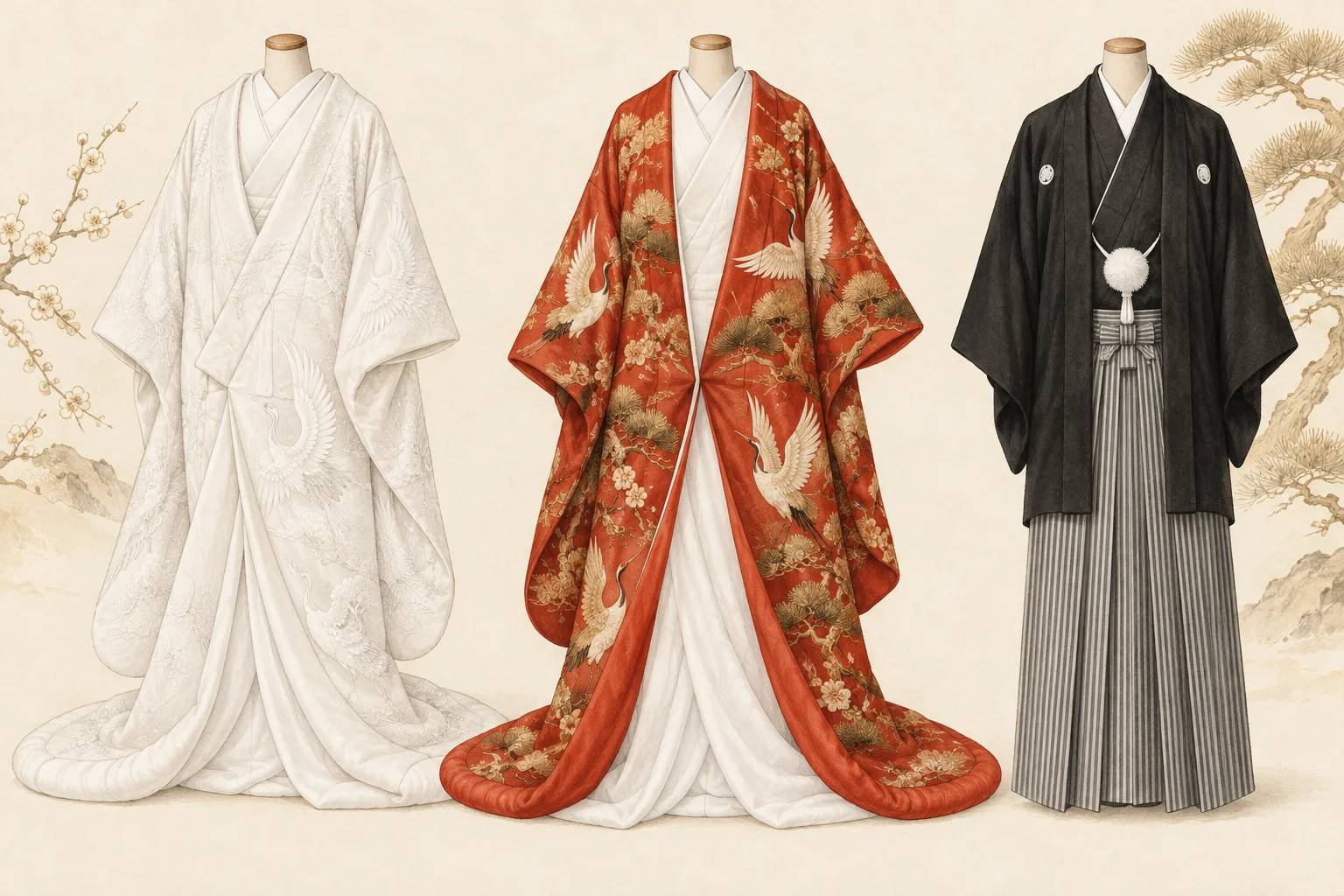
Every bridal kimono option is open to solo brides — there is no traditional rule against it. That said, our experience over hundreds of bookings points to a few patterns worth knowing.
Shiromuku photographs beautifully solo and remains the most-requested option for foreign visitors. The all-white silhouette reads cleanly in the frame without a contrasting partner. The main consideration is weight — shiromuku is the heaviest of bridal kimono (8–12 kg), and standing alone in it for extended outdoor sequences is more tiring than in a couple shoot where the groom shares the visual load. We build in seated frames every 15–20 minutes.
Iro-uchikake may be the strongest choice for solo brides photographically. The color and embroidery give the single figure more visual weight in wide environmental shots, which can otherwise feel sparse without a second subject. Red, gold, and deep green iro-uchikake all work well; blush and ivory are increasingly available — see our companion guide on modern color bridal kimono for the newer palette options.
Hikifurisode (long-sleeved bridal kimono without the outer uchikake) is the lightest option, ideal for solo brides planning outdoor sequences in summer heat or extensive walking shoots through Asakusa or Higashiyama. It also reads younger and more dynamic — appropriate for the social-media-driven booking.
Tsunokakushi vs. wataboshi headpieces: Either works solo. Wataboshi (the full white hood) is more dramatic in close portraits but limits side-angle photography. Tsunokakushi gives the photographer more angles to work with — useful when there's no second subject to direct the eye.
Photography Style for Solo Shoots
A solo session demands a different shot list than a couple session. The strong photographers we work with typically structure it as:
- Hero portrait sequence (15–20 frames): Front-facing, full-length, eye contact. These become the album cover and Instagram lead image.
- Environmental wides (10–15 frames): The bride small in a large scene — torii gate, garden, stone path. Strongest for solo because the scale adds the missing visual weight a partner would provide.
- Profile and three-quarter (10–15 frames): Side-light portraits that emphasize the kimono silhouette and headpiece.
- Detail close-ups (10–20 frames): Embroidery, kanzashi hair ornaments, obi knot, hand on fan, sandal-stepping. These become the album texture pages and the photographer's portfolio work.
- Movement frames (5–10 frames): Walking, turning, gathering the kimono hem. Modest movement only — full kimono restricts stride.
Couples sessions typically skip categories 2 and 4 in favor of interaction shots. Solo brides should expect the photographer to spend more time on details and environmental scale.
Wedding Planner's Notes: Ask your photographer to share three solo-bridal portfolios from past clients (faces blurred is fine). If they can only show couple work, they are perfectly capable but inexperienced at this format — which usually shows in over-reliance on hero portraits and underweighting of environmental wides. Booking is still fine; just brief them explicitly on the breakdown above.
Studio vs. Outdoor for Solo Brides
The studio-vs-outdoor decision shifts in solo bookings. We see roughly 65% of solo brides choose hybrid (some studio, some outdoor) vs. 50% of couples — likely because solo brides feel more self-conscious in busy outdoor settings without a partner alongside.
Pure studio works for solo brides who want controlled portraits without weather risk or onlooker attention. Kyoto and Tokyo both have dedicated wasou (Japanese-style) studios with built tatami sets, garden vignettes, and sliding-door backdrops. Price: ¥120,000–¥200,000 typical.
Outdoor at a shrine demands more confidence from a solo subject. Tsurugaoka Hachimangu in Kamakura, Meiji Jingu in Tokyo, and Yasaka Jinja in Kyoto are all accessible to solo bridal shoots through standard permit channels. The photographer's assistant becomes more important — they manage crowd flow that a partner might otherwise informally screen. See our location guides on Kamakura and Asakusa walking shoots for venue specifics.
Hybrid (studio + walking shoot) is our most-recommended format for solo brides. Start in studio with hair, makeup, and the first 60 frames, then move outdoors to a nearby shrine or garden for an additional 45–60 minutes. The studio anchors the session and the outdoor sequence adds the location story. Typical hybrid runs 4–5 hours total and costs ¥180,000–¥280,000.
Costs and Booking
Pricing for solo bride sessions tends to land in three tiers. Studio-only entry packages start around ¥120,000 including one outfit, basic hair/makeup, and 30 retouched images. Mid-tier hybrid packages — studio plus a nearby outdoor sequence, two outfit changes, professional hair and makeup, and 50–60 retouched images — run ¥200,000–¥280,000. Premium packages with named senior photographers, multiple location moves, three outfit changes, and 80+ images sit at ¥320,000–¥450,000.
Compared to couple packages, expect roughly 70–80% of the equivalent couple price for the same studio and similar deliverable count. You are paying for fewer outfit rentals (groom hakama removed) and slightly shorter hair-and-makeup time, but the photographer's day rate and the location fees are unchanged.
Booking lead time for solo sessions is typically 6–10 weeks in low season and 12–16 weeks in cherry blossom or autumn foliage peak. Mid-week solo bookings are easier to secure than weekend slots — studios prefer to hold weekends for full couple packages with higher revenue per day.
For booking from outside Japan, our detailed guide on booking from abroad covers deposits, contracts, and timezone-friendly studios. Foreign-payment-friendly studios are increasingly the norm, and most accept Wise or Stripe for the deposit.
Solo Photoshoots Across Cities — Where It's Most Common
Solo bride bookings concentrate in cities where the cultural context already supports solo-female activities and where studio infrastructure is mature.
Kyoto leads by volume. Roughly 40% of solo bride sessions we coordinate happen here. The combination of multiple shrine and garden options, deep studio infrastructure, and the cultural acceptance of solo women in traditional dress makes it the easiest market.
Tokyo is second, driven by Asakusa walking-shoot routes (Senso-ji area) and Meiji Jingu in Shibuya. Tokyo solo brides skew younger and more social-media-focused.
Kanazawa has a small but specialized solo-bride scene built around Kenrokuen Garden and the Higashi Chaya teahouse district. Quieter than Kyoto, often preferred by solo brides who want fewer onlookers.
Kamakura works well as a day-trip solo session from Tokyo. Tsurugaoka Hachimangu and Hokoku-ji bamboo grove both accommodate solo shoots, and the train ride back to Tokyo means no overnight stay required.
Kanazawa, Nara, and Okinawa all have studios offering solo packages but with fewer English-speaking options. We recommend booking through a coordinating service if your Japanese is limited.
Frequently Asked Questions
Will I feel awkward being the only person at the shoot?
Most solo brides report the opposite — the absence of a partner removes performance pressure, and the photographer's full attention makes the session feel collaborative rather than self-conscious. A pre-shoot 30-minute call with the photographer helps build rapport before the day.
Can I bring a friend or family member to watch?
Yes. Most studios accommodate one or two companions at no charge. They cannot appear in frames unless added as a paid second-subject add-on (typically ¥30,000–¥50,000 for an additional wardrobe).
Is it appropriate to wear shiromuku if I'm not getting married?
Yes. Modern Japanese studios treat shiromuku as a formalwear option for commemorative portraiture, not exclusively as a wedding garment. There is no cultural prohibition on wearing it for a solo photoshoot.
What if I want to do a solo shoot but worry about looking lonely in the photos?
Brief your photographer specifically. Strong solo portfolios emphasize environmental wides and detail close-ups over couple-style intimate framing. Asking for "editorial portraiture" rather than "wedding photography" often signals the shift in mood you want.
Can I do a solo shoot and add my partner later in the same session?
Some studios offer this as "split-day" booking — solo bride in the morning, couple session in the afternoon with the partner joining. Price is roughly 130% of a standard couple session. Useful when the partner has limited time in Japan.
Are there any shrines that don't allow solo bridal shoots?
Shrine policy is rarely about solo-vs-couple — it's about permit category, attire, and timing. Meiji Jingu's bridal-attire permit applies regardless of whether one or two people appear. Smaller community shrines occasionally refuse non-ceremonial bridal photography, but this affects couples equally.
What about pregnant brides who want a solo shoot?
Maternity solo shoots in bridal kimono are increasingly common. Most studios accommodate up to roughly 32 weeks with adjusted obi tying. See our dedicated guide on pregnant bride kimono photoshoots for specifics.
Can I book a solo session as a same-sex couple where only one partner wears kimono?
Yes. Several studios treat this as a hybrid solo-couple session — one subject in bridal kimono, one in casual or Western attire. See same-sex kimono wedding photography for studios specifically friendly to this format.
Find a Solo-Shoot-Friendly Studio
Solo brides need photographers experienced with single-subject direction, not just couple work translated. The studios we feature in our curated directory are filtered for this — each listing notes solo-package availability and recent solo-bridal portfolio links. Browse by city or by language support to shortlist three studios for your enquiry.
For deeper planning, the anniversary kimono photoshoot guide covers commemorative milestone shoots that share many of the same considerations, and the modern color bridal kimono guide walks through the blush, ivory, and sage palette options now widely available for solo bookings.
Locations in this guide


Related guides
 General guide
Maku Curtain at Japanese Wedding Altar: Kohaku-Maku Guide
Illustrative image · Unsplash. Not a photo of the specific people, places or services discussed.
The maku curtain at a Japanese wedding altar uses a coded color system. Learn why kohaku-maku red-white signals celebration and kuromaku is funeral-only.
Read the guide General guide
Post-Shoot Revision Rounds & Edit Policy: Japan Studio Rules
Illustrative image · Unsplash. Not a photo of the specific people, places or services discussed.
One round of color and exposure tweaks is included; further rounds run ¥10,000-¥30,000 each with a 5-10 photo cap; full re-grades are priced as new edit jobs (¥50,000-¥150,000). Lock your color grade at contract time to avoid expensive post-delivery revisions.
Read the guide General guide
Color Grading Styles in Kimono Photography: Choose Pre-Booking
Illustrative image · Unsplash. Not a photo of the specific people, places or services discussed.
Identify your photographer's color grade before booking — Japanese natural, film emulation, cinematic, editorial, or vintage — because re-grading after delivery costs ¥30,000-¥100,000 and some studios refuse entirely.
Read the guide