Men's Kimono Wedding Photoshoot: Montsuki & Hakama Guide
Men's wedding kimono in Japan: montsuki, haori, hakama components, color rules, accessories, and what foreign grooms typically wear.

Illustrative image · Unsplash. Not a photo of the specific people, places or services discussed.
Check current prices, availability and venue rules with the relevant studio or venue before booking.
While most articles about kimono wedding photoshoots in Japan focus on the bride's shiromuku or iro-uchikake, the groom's formal montsuki hakama is equally important visually and follows its own set of conventions. Foreign grooms often arrive in Japan with limited information about what they will actually wear, since the focus during planning typically falls on the bride's choices. This guide covers the formal men's wedding kimono in detail — what montsuki, haori, and hakama actually are, the color and crest conventions, accessory choices, and how foreign grooms should expect the dressing process to work.
Quick Overview of Formal Men's Wedding Attire
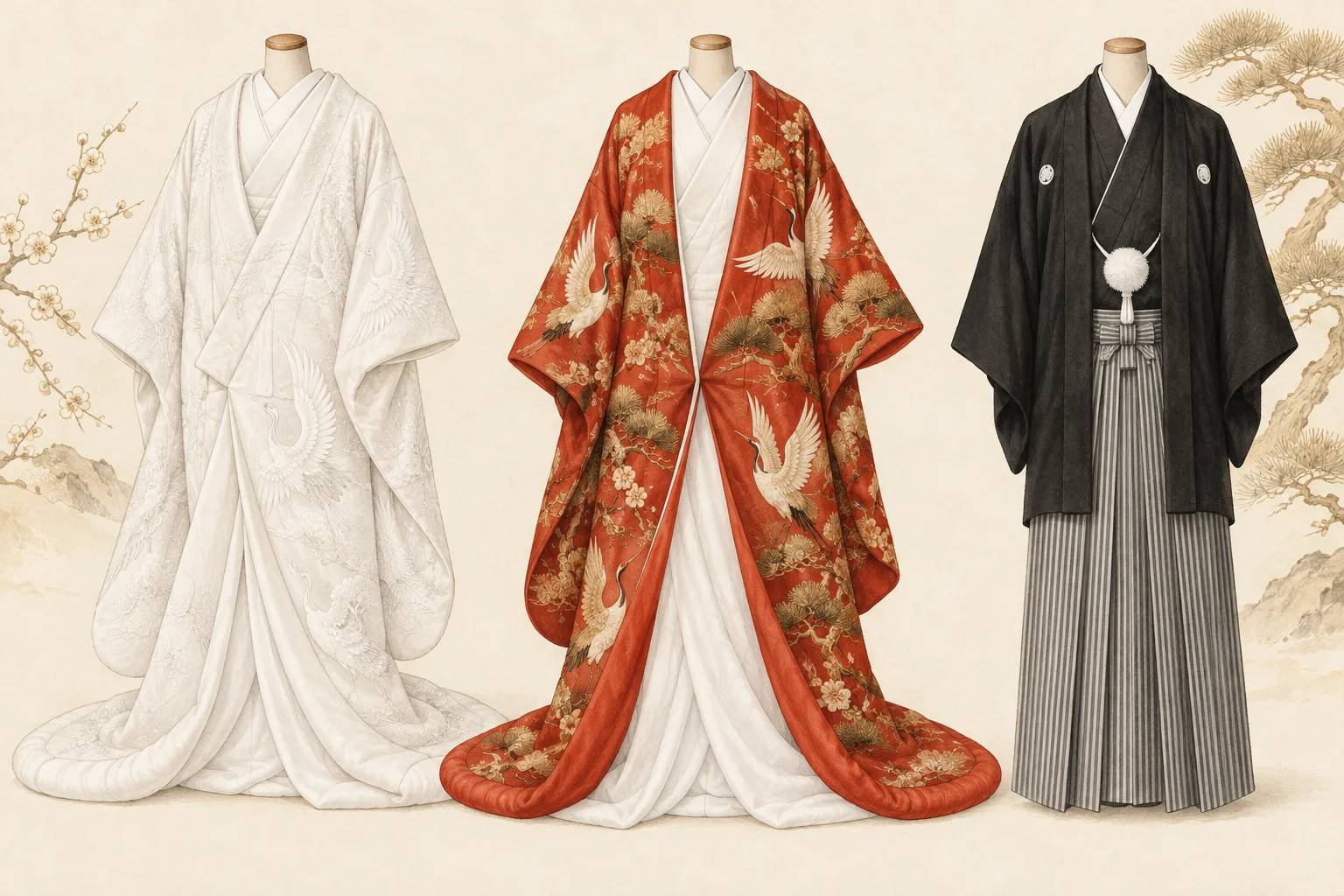
The standard formal Japanese wedding outfit for a groom is the montsuki haori hakama — a three-component ensemble: a black silk kimono (montsuki) marked with five family crests, a black silk overcoat (haori) of the same fabric, and pleated hakama trousers in a distinctive vertically-striped pattern. The three pieces are worn together as a unified formal set; wearing montsuki without haori, or hakama without the other two, is considered semi-formal and not appropriate for wedding photography. Studios universally provide the complete set.
The Three Main Components
Montsuki (紋付)
The montsuki is a black silk kimono whose name literally means "with crests." Five family crests (kamon) are dyed in white on specific positions: one on each shoulder, one on each sleeve, and one at the center back. The crests are the visual marker of formal status — semi-formal three-crest versions exist but are not used for weddings. The fabric is fine silk with a subtle weave; the construction is the same as everyday men's kimono but the materials and crest application are dramatically more elaborate.
Haori (羽織)
The haori is a hip-length overcoat worn over the montsuki, also in black silk with matching crests. It hangs open at the front and is secured at the chest with a decorative cord (haori-himo) tied in a simple knot. The haori's purpose is partly practical (warmth, formality marker) and partly aesthetic — the long lines of the haori opening frame the chest and create the silhouette that reads as formal Japanese male dress.
Hakama (袴)
The hakama is the pleated bottom garment, worn over the montsuki and under the haori. Formal wedding hakama are typically gray-and-black or gray-and-white vertical stripes in a specific pattern called sendai-hira. The pleats are deep and the cut sits at the natural waist with the kimono tucked inside. The bottom edge falls just above the floor — slightly higher than typical festival hakama, to preserve formality during the procession.
Color and Style Choices
Black is the universal color for the formal montsuki haori hakama and the only color worn at traditional weddings. The hakama stripes provide subtle variation but the overall impression is uniformly black-and-gray. This convention is strict — non-black versions exist (white, navy, dark brown) but are categorized as less formal and are not appropriate for wedding photography unless the couple specifically wants a less-traditional aesthetic. Foreign grooms who request "something colorful like the bride" will be steered firmly by reputable studios toward the standard black; this is not a flexibility area.
For very contemporary photoshoots where the bride is in a non-traditional color iro-uchikake (modern pink, lavender, or pastel), some studios will offer a coordinated grey or charcoal montsuki, but this is treated as a styled departure from convention rather than a normal option.
Essential Accessories
The full formal men's outfit includes several small accessories that studios provide as standard. Tabi (足袋): white split-toe socks worn with traditional sandals. Zori (草履) or setta (雪駄): formal sandals in white or natural straw; setta are slightly more casual but commonly used in modern weddings. Sensu (扇子): a folded fan tucked into the obi (waist sash) and held during specific moments of the shoot for traditional gestures. Haori-himo: the white or off-white cord that secures the haori at the chest. Date-jime and koshi-himo: under-sash ties that hold the layers in place; invisible in finished photos but essential to the silhouette.
Hair and Makeup for Grooms
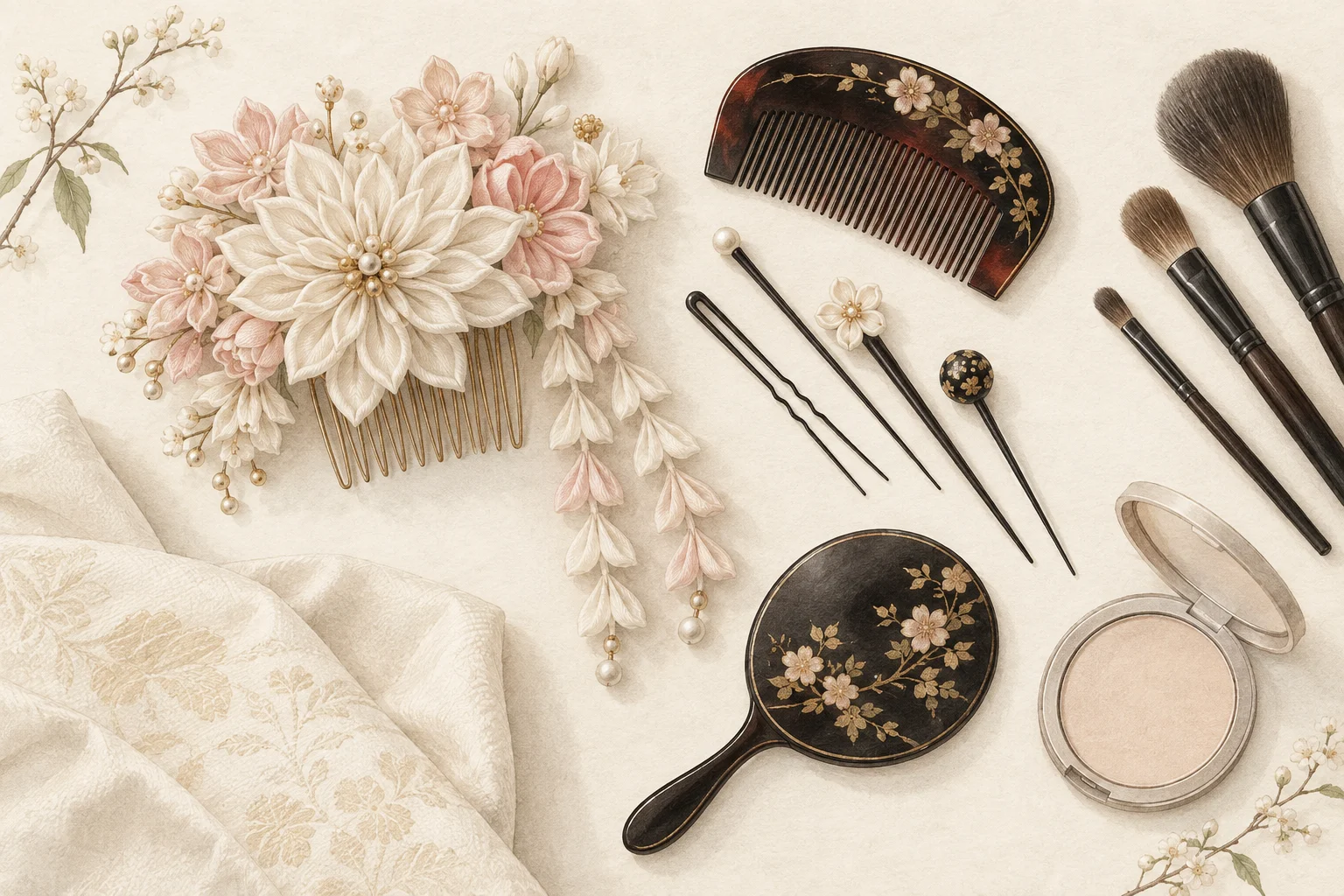
Formal Japanese male wedding styling is restrained. Hair is typically swept back with light pomade or sea-salt spray to create clean architectural lines; no elaborate styling is required. Makeup is minimal: a light powder to reduce shine for camera, possibly a barely-perceptible eyebrow touch-up. The intent is for the groom to look polished and present rather than transformed. Foreign grooms with longer hair styles can either keep the style or have it lightly trained; studios handle both. Beards are accepted in modern weddings and require only light grooming.
The Dressing Process
The groom's dressing takes twenty to thirty minutes, performed by a single dresser (typically male or female depending on the studio). The process involves layers — first the white undergarment (juban), then the montsuki, then the obi waist sash, then the hakama, finally the haori. The dresser ties multiple invisible inner cords (himo) to hold each layer in place and ensure the silhouette is correctly architected. The groom should arrive in clean cotton underwear; everything else is provided.
Most studios schedule the groom's call sixty to ninety minutes after the bride's because of the dressing-time differential — this prevents the groom from sitting idle for two hours while the bride's hair, makeup, and kimono are completed.
Moving in Formal Kimono
Foreign grooms unfamiliar with formal kimono should expect three movement constraints. First, the hakama pleats limit stride length — taking smaller steps is required to preserve the silhouette. Second, the haori's open front means quick gestures (reaching, picking things up) can disturb the drape — the photographer will coach you on which movements work for the camera. Third, the sandals (zori or setta) require slightly different walking technique than Western shoes; tipping forward slightly and stepping rather than striding produces the correct gait. Twenty minutes of warmup walking around the studio before the shoot is enough to acclimate.
Frequently Asked Questions
Can foreign grooms wear family crests they don't have?
Yes. Studios provide rental montsuki with generic crests (typically kiri / paulownia leaves) that are visually appropriate for any wedding. The crests are decorative markers of formality rather than identity proof; nobody at the shoot will check or comment on which family they represent.
Are tall or large-framed foreign grooms accommodated by Japanese studios?
Yes, but with caveats. Premium Tokyo and Kyoto studios stock larger sizing up to roughly 195cm height and 100kg weight; smaller studios may be limited. Confirm sizing at booking specifically — measurements should include height, chest circumference, and shoulder width. Grooms outside the standard range should ask whether the studio has a "large size" inventory or whether custom rental sourcing is needed (which adds ¥30,000 to ¥60,000).
Can the groom wear modern shoes for outdoor shoots?
No for formal kimono shoots. The zori or setta complete the silhouette and replacing them with modern shoes breaks the formal register that the entire outfit is designed to project. For very long outdoor walks, some studios allow a brief shoe change during transit between locations, but the camera-facing portions of the shoot use only traditional sandals.
Should the groom learn any specific gestures or poses?
No. Reputable photographers coach all poses on the day and the standard formal stance (slightly turned shoulder, hands at sides or holding the sensu fan, weight evenly distributed) is intuitive after one or two attempts. Pose memorization is unnecessary and would generally read as stiff in photos.
Can two grooms (same-sex couple) both wear montsuki haori hakama?
Yes. Studios that accommodate same-sex weddings provide two complete formal outfits and the resulting compositions of two grooms in matching black silk are striking. Confirm at booking that the studio is comfortable with same-sex wedding photography; not all are, though the major Tokyo and Kyoto studios increasingly are.
Is there a "casual" Japanese wedding outfit if we want a less formal look?
For the groom, the practical alternative is yukata (a single-layer cotton garment, more casual than formal kimono) or jinbei (a casual two-piece). Both are inappropriate for traditional wedding formality but work well for casual summer photoshoots or modern fusion aesthetics. For yukata specifics in summer, see our summer kimono guide.
More Style Guides
Find a Studio with Quality Men's Kimono
All studios in our directory provide formal men's kimono as part of standard package inclusions. For couples specifically concerned about sizing or quality, ask studios to confirm men's inventory range at booking. Browse English-speaking kimono photographers across Japan filtered by city, style, and budget. For the broader booking framework, see our ultimate guide to Japan pre-wedding photoshoots.
Related guides
 Style guide
Traditional Japanese Wedding Costumes: Who Wears What
Illustrative image · Unsplash. Not a photo of the specific people, places or services discussed.
Traditional Japanese wedding costumes for the bride, groom, family and guests: how formality ranks, what to avoid, and which garments you can actually rent.
Read the guide Style guide
Montsuki Kimono: The Japanese Groom's Formal Wedding Attire
Illustrative image · Unsplash. Not a photo of the specific people, places or services discussed.
Montsuki kimono explained for grooms: what the crests signal, kuro- versus iro-montsuki, the full outfit, what studios charge, and what to check before booking.
Read the guide General guide
Hanayome Gyoretsu: The Bridal Procession Photographers Plan
Illustrative image · Unsplash. Not a photo of the specific people, places or services discussed.
Bridal procession hanayome gyoretsu japan explained: shrine routes, formation, photographer windows, and the Meiji Jingu 100-meter walk every album waits for.
Read the guide