Mt Fuji Kimono Photoshoot: Kawaguchiko & Chureito Guide
A wedding planner's guide to Mt Fuji kimono photoshoots: the five vantage areas (Chureito Pagoda, Lake Kawaguchi, Lake Yamanaka, Oshino Hakkai, Hakone), when Fuji is most visible across the year, and day-trip versus overnight logistics from Tokyo.

Illustrative image · Unsplash. Not a photo of the specific people, places or services discussed.
Check current prices, availability and venue rules with the relevant studio or venue before booking.
A Mt Fuji kimono photoshoot — the snowcapped peak rising behind a kimono-clad couple — is one of the most-photographed compositions in Japanese wedding photography, and one of the most logistically demanding. Fuji is famously camera-shy: even on a clear forecast day, the summit can hide behind a thin band of cloud from late morning onward, and the difference between a postcard frame and a grey wall of haze often comes down to a 30-minute window at dawn. Planning is everything. This guide walks through the five vantage areas serious wedding planners actually use — Chureito Pagoda, Lake Kawaguchi, Lake Yamanaka, Oshino Hakkai, and the Hakone side — explains when Fuji is statistically most visible across the year, and lays out realistic day-trip and overnight logistics for couples basing themselves in Tokyo.
Why Mt Fuji as a Backdrop
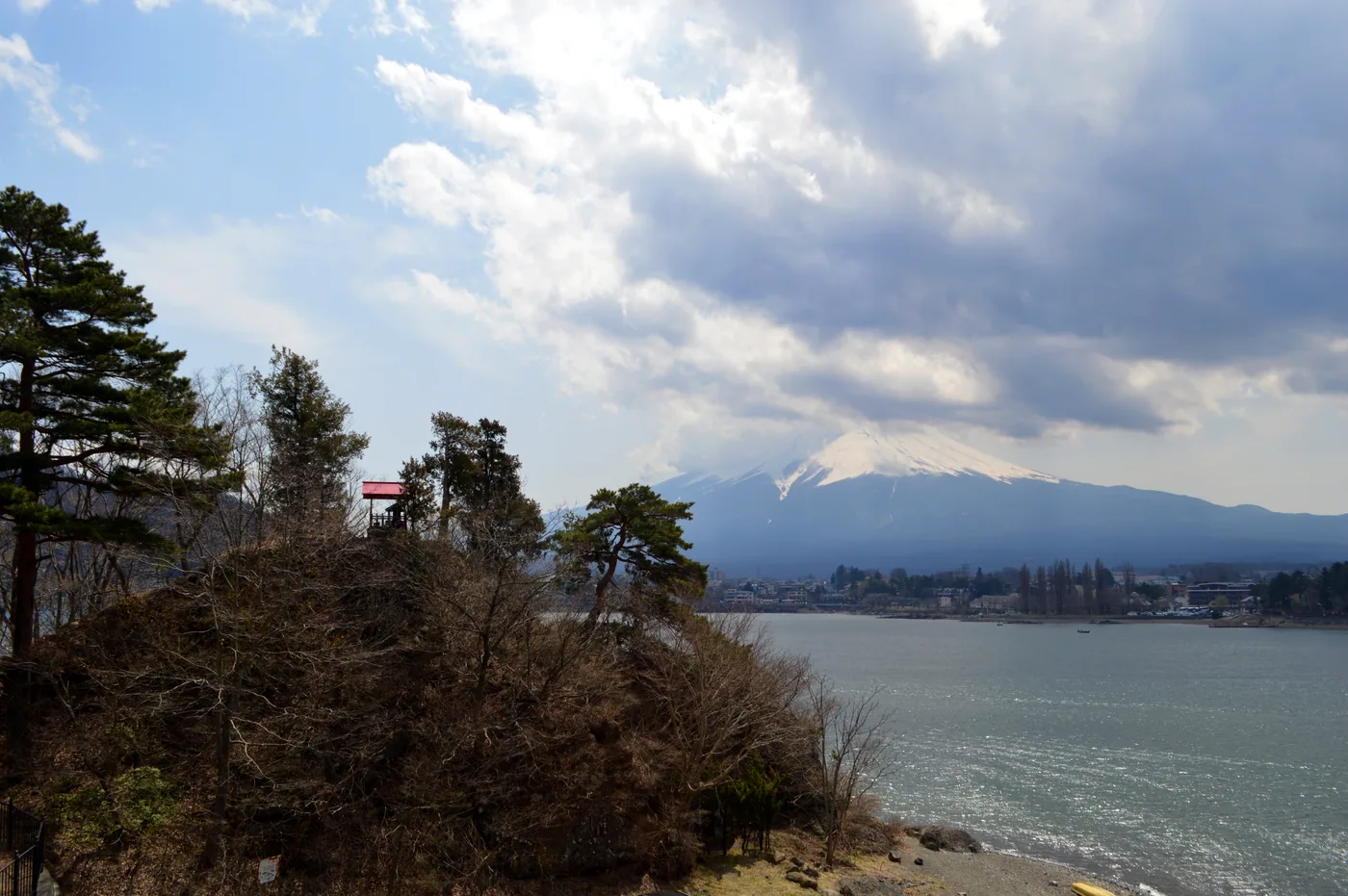
Mt Fuji (富士山) is a widely recognised landscape in Japan and a UNESCO World Heritage cultural site. For couples flying in from the US, UK, Australia, or Europe, a kimono frame against Fuji communicates "Japan" instantly to family at home — more so than a shrine that requires context to read. That visual shorthand is the practical reason it remains the most-requested backdrop in our planning briefs from international clients, even when other locations would be more convenient.
The mountain sits roughly 100km west-southwest of central Tokyo, straddling the Shizuoka and Yamanashi prefectures. Most of the well-known photo vantage points — Kawaguchiko, Yamanakako, Oshino Hakkai, Chureito Pagoda — are on the Yamanashi (northern) side, around 2 hours from Shinjuku by express bus or limited express train. The Shizuoka (southern) side, while geographically closer to the volcano, offers fewer of the foreground compositions wedding clients want and is generally used by hikers rather than photographers.
The other reason planners gravitate to Fuji is contrast. A shiromuku or iro-uchikake against a deep green Aokigahara forest, autumn maples, or a snow-dusted volcanic cone produces frames you cannot replicate in Kyoto or Tokyo. The compositional language is different — wide horizons rather than tight alleyway intimacy — and many couples shoot a Tokyo or Kyoto day plus a Fuji day for tonal range.
Top Vantage Locations
There is no single "Mt Fuji" location. There are five distinct areas, each with its own logistics, foreground composition, and best season. Choosing among them is the first conversation you should have with a Fuji-experienced photographer.
Chureito Pagoda — The Five-Story Pagoda Composition
Chureito Pagoda (忠霊塔), perched on a hillside in Arakurayama Sengen Park above Fujiyoshida City, is the source of a widely recognised Fuji photograph: a five-storey red pagoda in the foreground, Mt Fuji centred behind, framed by cherry blossom in spring or maple in autumn. This is the composition seen on Japan tourism posters worldwide.
The honest planner caveats: the pagoda sits at the top of roughly 400 stone steps, which is challenging in full uchikake bridal kimono with okobo or zori. Most professional shoots position the bride at a mid-level platform rather than the summit viewing deck, and use the pagoda from a slight side angle rather than the dead-centre tourist composition (which during cherry blossom and autumn weekends can have a 90-minute queue and 200+ people on the platform). Early morning starts — first light, before the tour buses arrive around 8:00 — are the only realistic window for a serene frame. Many of our most successful Chureito shoots have been at 5:30–6:30 in late March or early November.
See our cherry blossom wedding guide for the late-March/early-April bloom window at this altitude, which runs about a week later than central Tokyo.
Lake Kawaguchi (Kawaguchiko) — Reflection Shots
Lake Kawaguchi (河口湖), the most accessible of the Fuji Five Lakes, offers a well-known reflection composition: Fuji reflected in still water, a technique known locally as Sakasa Fuji (逆さ富士, "upside-down Fuji"). The northern shore is the working photographer's preferred side — the angle gives you the full symmetrical cone, and the foreground can include reeds, autumn-coloured trees, the red maple corridor (Momiji Tunnel) in November, or shibazakura pink moss in mid-April to late May.
A successful reflection shot requires near-zero wind. In practice that means first light (around 5:00–6:30 depending on season) and almost never afternoon. Skilled local photographers will scout the previous evening, check the wind forecast, and may reposition you between three or four sub-locations along the northern shore in the first 90 minutes of light. The lakefront also has paid parking, paved promenades suitable for okobo, and quick changing options at nearby ryokan.
Kawaguchiko is also the most flexible "anchor location" for an overnight Fuji shoot — multiple ryokan with Fuji-view rooms, plenty of restaurants, easy train access from Shinjuku via the Fuji Excursion limited express (around 2 hours).
Lake Yamanaka (Yamanakako) — Eastern Vista
Lake Yamanaka (山中湖), the largest of the Fuji Five Lakes, sits east of Fuji and offers a slightly different angle — the volcano appears more conical and slightly bulkier from this perspective. Yamanakako is quieter than Kawaguchiko, with broader grass lake-edge areas (Hananomiyako Park) ideal for wide compositions and movement-driven frames, and meaningful seasonal flower fields (poppies and zinnias in summer, kochia in autumn).
Yamanaka is also the area planners recommend for couples specifically pursuing a Diamond Fuji (ダイヤモンド富士) frame, where the sun aligns precisely with the summit at sunrise or sunset for a narrow window of dates around the winter solstice. This is a niche request — only attempt with a photographer who has shot it before and only on a clear-forecast day, because the alignment window is roughly two minutes.
The trade-off: fewer ryokan options than Kawaguchiko and less convenient public transit. Most couples reach Yamanakako via private hire or rental car from a Kawaguchiko base.
Oshino Hakkai — Traditional Village + Mt Fuji
Oshino Hakkai (忍野八海) is a small village known for eight crystalline spring-fed ponds, fed by snowmelt filtered through Fuji's volcanic substrata. The composition strength is the combination most international couples actually want: thatched-roof traditional buildings, mossy stone paths, koi-filled ponds, and Mt Fuji visible in the distance — a single frame that tells the whole "Japan" story.
The honest caveat: Oshino is a tourist village. Peak season (cherry blossom, summer, autumn maples) brings dense crowds from late morning, and serene frames require — as with Chureito — a dawn start before the tour buses arrive around 8:30. Wedding shoots at Oshino are technically permitted but must be respectful of the residential village character; tripods are restricted in some narrow paths. Walk with a photographer who has worked the village before and knows which angles do not require crossing private garden lines.
Combination day plans usually anchor at Oshino for first light, transition to Lake Kawaguchi mid-morning for the reflection, and finish at Chureito Pagoda before the noon crowds peak — geographically the three sit within a 15-minute drive of each other.
Hakone Side (alternative)
Hakone (箱根), south of Fuji, is the alternative for couples who want a Fuji-adjacent shoot with onsen ryokan staying and easier Tokyo access (Romancecar from Shinjuku, around 85 minutes). The classic Hakone Fuji frame is from the shore of Lake Ashi (芦ノ湖), with the famous Hakone Shrine vermilion torii rising directly from the water and Fuji peeking over the ridgeline behind.
The catch: Fuji visibility from Hakone is statistically lower than from Kawaguchiko (the volcano sits further away and lower-ridge cloud is more frequent), and the Hakone Shrine torii itself draws a 60–90 minute queue from late morning for the tourist photo. As a Fuji-focused shoot location it underperforms Kawaguchiko; as a Fuji-plus-onsen-honeymoon combination it's the strongest option in the region. We recommend Hakone primarily to couples who are already including an onsen stay in their Japan itinerary and want a half-day Fuji-side outdoor shoot bundled in.
When Fuji Is Visible — Weather Strategy
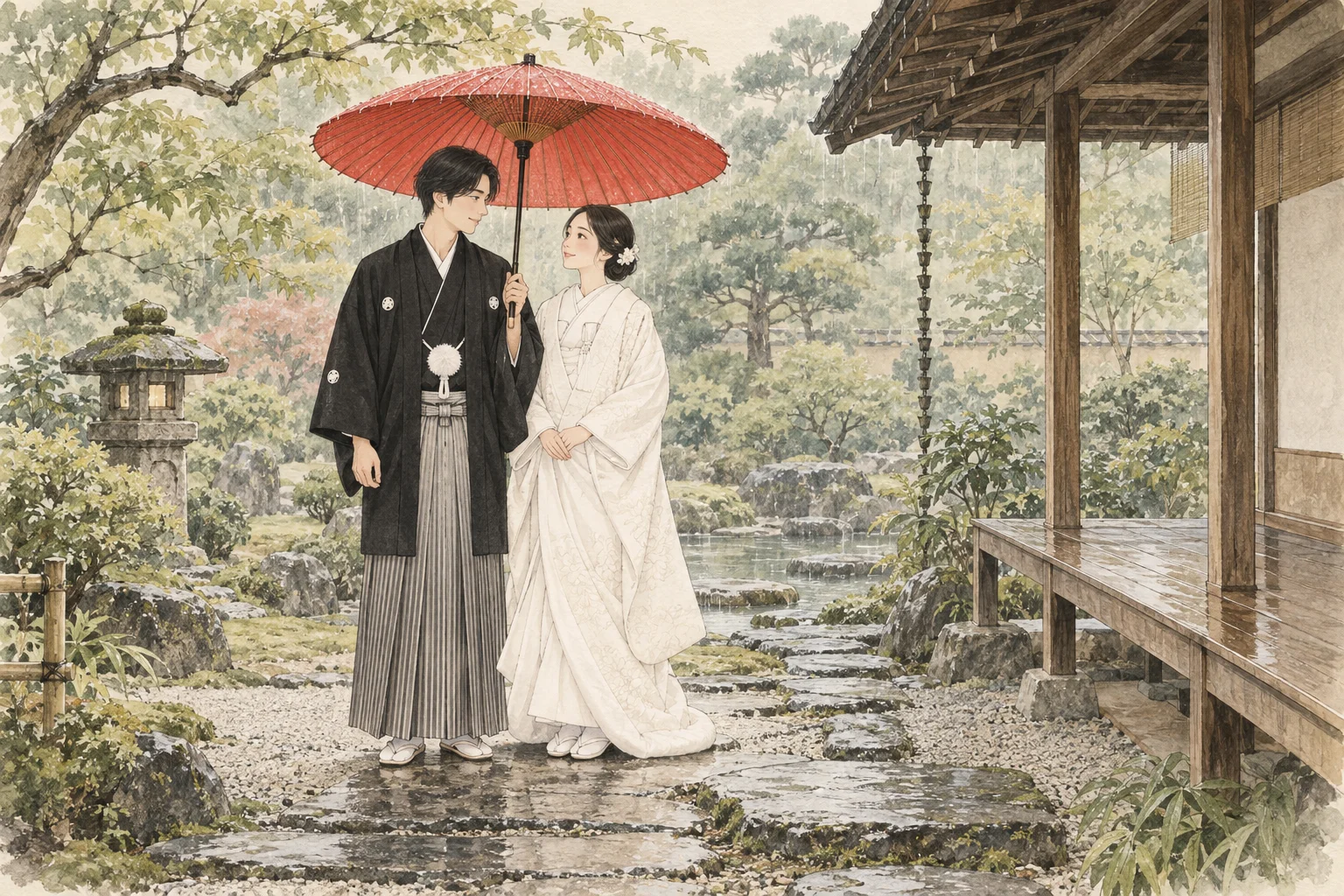
A key briefing for any couple booking a Fuji shoot: Fuji is hidden more often than it is visible, and the difference between a successful shoot and a wasted day is largely outside anyone's control. Plan accordingly.
Mt Fuji is most reliably visible in the cold months from late November through early March, when the air is dry, cold and stable. In these months a clear morning will typically show Fuji from sunrise to roughly 10:00, after which a thin cloud halo can develop around the summit. Summer months (June through early September) are statistically the worst — Fuji is often completely hidden behind cloud or haze, sometimes for entire weeks. The volcanic cone is, ironically, the cleanest in winter when it's snow-capped and the worst in summer when it's bare and brown.
Season | Visibility Rate (mornings) | Look |
|---|---|---|
Dec–Feb | ~70% | Snow-capped, dramatic, cold air clarity |
Mar–May | ~45% | Snow-capped early, cherry blossom mid-April at Chureito |
Jun–Aug | ~15–25% | Bare volcanic cone, frequent haze and cloud |
Sep–Nov | ~50% | Autumn foliage at lakes, first snow late October |
(These rates are working planner heuristics for early-morning visibility, not official meteorological data.)
Wedding Planner's Note: Any reputable Fuji-experienced photographer will build in a free reschedule clause for poor visibility — typically a one-time reschedule within the trip window if Fuji is invisible by 30 minutes after sunrise. If a studio does not offer this, push back. We've reshot Fuji days for clients 48 hours later when the original morning was a wall of cloud and the second morning was textbook clear.
Practical strategy: book Fuji as the first or second day of your Japan itinerary, not the last. This gives you reschedule flexibility. Also check the Mt Fuji live cameras (multiple public webcams operated by hotels and local government) the evening before, and again at 4:00 the morning of — the photographer will be doing the same.
Seasonal Comparison
Each season produces a genuinely different Fuji photograph, and the right season depends on what visual language you want.
Winter (December – February) is the planner's recommendation for visibility-first couples. Fuji is at peak photographic form — snow-capped, sharply defined, dramatic — and clear mornings are statistically the most reliable. The trade-off is brutal early-morning cold at lakeside (-5°C to -10°C is normal) and the need for thermal layering under the kimono. See our snow wedding photoshoot guide for the layering and footwear strategy.
Spring (mid-March – mid-May) combines snow-capped Fuji with cherry blossom at Chureito Pagoda (early April) and shibazakura pink moss carpet at Fuji Motosuko Resort (late April to late May). This is the most-requested season and accordingly the most crowded. Read our cherry blossom photoshoot guide for sakura-week booking lead times.
Autumn (mid-October – late November) brings the Momiji Tunnel along Kawaguchiko's northern shore, the red maples around Chureito, and the first dustings of snow on the summit. Visibility is moderate. Detail on the foliage timing is in our autumn foliage kimono photoshoot guide.
Summer (June – early September) is the planner's least-recommended season. Fuji visibility is poor, the cone is unflattering (bare brown), and the heat and humidity make a long-form bridal kimono shoot punishing. Couples constrained to summer dates should consider an alternative location like Kamakura or a high-altitude alternative like Karuizawa instead.
Day-Trip vs Overnight (Tokyo → Kawaguchiko 2 Hours)
From central Tokyo, Kawaguchiko is reachable in approximately 2 hours by the Fuji Excursion limited express train from Shinjuku, or 2 hours 15 minutes by Keio Highway Bus from Shinjuku Bus Terminal. The express train is more reliable; the bus is cheaper.
Day-trip plan (single shoot, mid-budget couples): Pre-dawn private car or chauffeur hire from Tokyo (departs roughly 3:30 AM), arrive Kawaguchiko 5:30 AM for first light. Shoot until 9:00 AM. Breakfast at a lakeside café. Return to Tokyo by late morning train. This compresses everything into a single demanding day and is workable if you accept the early start.
Overnight plan (recommended): Travel to Kawaguchiko in the afternoon. Stay at a Fuji-view ryokan (multiple options on the northern shore — the best-known being family-run small ryokan with private onsen). Confirm Fuji is visible from your room window. Sleep well, shoot at first light, second window in the late afternoon if the photographer wants to, return to Tokyo the second day. This is the plan we recommend to roughly 80% of our international clients — the extra night transforms the experience and dramatically increases your odds of getting the shot if the first morning is cloud-bound.
Multi-day plan (for serious Fuji-first couples): Two nights at Kawaguchiko gives you two morning windows plus an evening window. This is the configuration we recommend for couples whose primary purpose for the Japan trip is the Fuji photograph and who are willing to invest accordingly. It also opens the option of combining a Chureito Pagoda dawn shoot, a Kawaguchiko reflection shoot, and an Oshino Hakkai village frame across the two mornings.
Studio + Outdoor Combination Plan
Unlike Tokyo or Kyoto, the Mt Fuji area has limited dedicated kimono studio infrastructure. The standard model is to dress at a partner ryokan or guesthouse, or to dress in central Tokyo the evening before and travel to Kawaguchiko in kimono (with the kimono dresser accompanying the couple). Some experienced Tokyo-based studios will package the Fuji day as a stand-alone "outdoor only" shoot with no studio time on the same day.
Our standard recommended package for international couples doing a Fuji trip is the two-day combination:
- Day 1 (Tokyo): Studio session with full hair, makeup, and kitsuke. Optional Tokyo outdoor shoot in the afternoon — Asakusa or Meiji Jingu.
- Day 2 (Fuji): Travel to Kawaguchiko the previous evening, overnight at Fuji-view ryokan, dawn outdoor shoot at lake or Chureito Pagoda, return to Tokyo by afternoon train.
This split gives you the controlled studio frames (tight portraits, no weather risk) plus the Fuji outdoor frames (the trip-defining wide composition), and protects you against a cloud-out: if Day 2 Fuji is hidden, you still have Day 1 in the bank.
Couples planning a multi-region Japan itinerary often pair a Fuji day with an Osaka kimono day for an urban contrast or a Sendai and Tohoku day for a quieter northern register. Compare against our Tokyo vs Kyoto comparison if you are still choosing your primary city, and our studio vs outdoor decision guide for the broader logistic trade-offs.
Frequently Asked Questions
What time of year is Mt Fuji most likely to be visible for a wedding photoshoot?
Statistically, mid-November through early March produces the highest morning visibility — cold dry air keeps Fuji clear and the summit is snow-capped. Summer months are the worst. If visibility matters more to you than blossom or foliage, book in winter.
How early do we need to start a Mt Fuji kimono shoot?
First light. In summer that means a 4:30 AM start; in winter a 6:00 AM start. Fuji visibility typically deteriorates within 2–3 hours after sunrise as cloud builds around the summit, and tourist sites like Chureito Pagoda and Oshino Hakkai become crowded after 8:00–9:00.
What if Mt Fuji is hidden on our scheduled day?
Most reputable Fuji-experienced photographers offer a one-time free reschedule clause if Fuji is invisible at sunrise on the booked day. Confirm this clause in writing at booking. Build at least one buffer day into your itinerary for the reschedule to be useful.
Can we shoot at Chureito Pagoda in full bridal kimono with the 400 steps?
Yes, but with planning. Most professional shoots use a mid-level platform rather than the summit, and the bride changes from regular shoes to okobo only at the shoot platform. Photographers will brief the climbing strategy; brides should be willing to walk in casual shoes during transit and change for shoot moments.
Is it possible to do a Mt Fuji kimono photoshoot as a Tokyo day trip?
Possible but punishing. It requires a 3:30 AM departure by private car and limits you to a single morning shoot window with no reschedule option if Fuji is hidden. We strongly recommend an overnight stay at Kawaguchiko instead — it costs more but dramatically increases your chance of getting the shot and turns a stressful day into a relaxed experience.
Which Fuji vantage location is best for first-time international couples?
Lake Kawaguchi northern shore. It has the best logistics (paved promenades, parking, multiple changing options), the most flexibility for the photographer to reposition between sub-locations as light changes, and produces the reflection composition that reads as "Japan Fuji" instantly. Chureito Pagoda is a notable alternative but more crowded and physically demanding.
Are tripods and professional gear allowed at these locations?
Generally yes at lake-edge promenades and at Chureito Pagoda main areas, though tripods are restricted on narrow Oshino Hakkai village paths and some Chureito viewing decks during peak season. A Fuji-experienced local photographer will know each location's specific restrictions and adjust gear accordingly.
Should we combine the Fuji shoot with a Hakone onsen stay?
If you want an onsen honeymoon experience and a Fuji-adjacent half-day shoot, Hakone is the best pairing. If you want the strongest Fuji photographic results, base at Kawaguchiko or Yamanakako instead — visibility from Hakone is statistically lower and the Hakone Shrine torii has long queues.
Book a Mt Fuji Kimono Photographer
A Mt Fuji kimono photoshoot rewards careful planning more than any other location in Japan — the right photographer, the right season, the right ryokan, and a reschedule clause in writing are the four things that separate a postcard frame from a cloud-bound disappointment. Browse our curated directory of kimono photographers filtered for Mt Fuji-experienced studios, or read on for related planning context.
Related reading: Osaka kimono photoshoot guide, Sendai and Tohoku kimono guide, cherry blossom wedding photoshoot guide, snow wedding photoshoot guide, best season for kimono photoshoot, and 7-day Japan itinerary.
Locations in this guide


Related guides
 Location deep dive
Kawaguchiko Kimono Photoshoot: Mt Fuji's Iconic Vista
Illustrative image · Unsplash. Not a photo of the specific people, places or services discussed.
Plan a kimono photoshoot at Lake Kawaguchi with honest clear-Fuji probability guidance, Chureito Pagoda and Oishi Park location logistics, seasonal trade-offs, and access from Tokyo via the Fujikyu Express.
Read the guide Location deep dive
Mt Aso Kimono Photoshoot: Asia's Largest Caldera Guide
Illustrative image · Unsplash. Not a photo of the specific people, places or services discussed.
Mt Aso Kumamoto kimono photoshoot guide: 25km active caldera, grassland plains, Aso-Gogaku peaks, susuki silver grass season, Aso Boy! train access.
Read the guide Location deep dive
Hagi & Tsuwano Kimono Photoshoot: Samurai Castle Town Guide
Illustrative image · Unsplash. Not a photo of the specific people, places or services discussed.
Hagi and Tsuwano in western Yamaguchi offer samurai-residence lanes and a 1,000-torii shrine path with a fraction of Kyoto's crowds. A practical guide to seasons, access, and the very limited photographer availability.
Read the guide