Montsuki Kimono: The Japanese Groom's Formal Wedding Attire
Montsuki kimono explained for grooms: what the crests signal, kuro- versus iro-montsuki, the full outfit, what studios charge, and what to check before booking.

Illustrative image · Unsplash. Not a photo of the specific people, places or services discussed.
Check current prices, availability and venue rules with the relevant studio or venue before booking.
Most couples arrive at Japanese wedding attire through the bride. The shiromuku, the all-white bridal kimono, and the iro-uchikake, the embroidered outer robe worn over it, are photographed constantly, and their names travel.
The groom's side of the tradition travels less well. He appears in the same photographs, in black, and the outfit usually goes unnamed. It is called a montsuki, and the first useful thing to know is that this is not the name of a garment: it describes a condition, a kimono with family crests on it. How many crests, what color the cloth is and what is worn with it are three separate decisions that together set how formal the outfit is.
This guide covers what a montsuki is, what the full outfit contains, how it should match the bride's kimono, and what studios in Japan charge. Using figures from our own directory of 176 studios, it also sets out which questions to ask before booking. One of those matters more than couples expect: roughly one studio in three does not dress the groom at all.
What "Montsuki" Actually Means
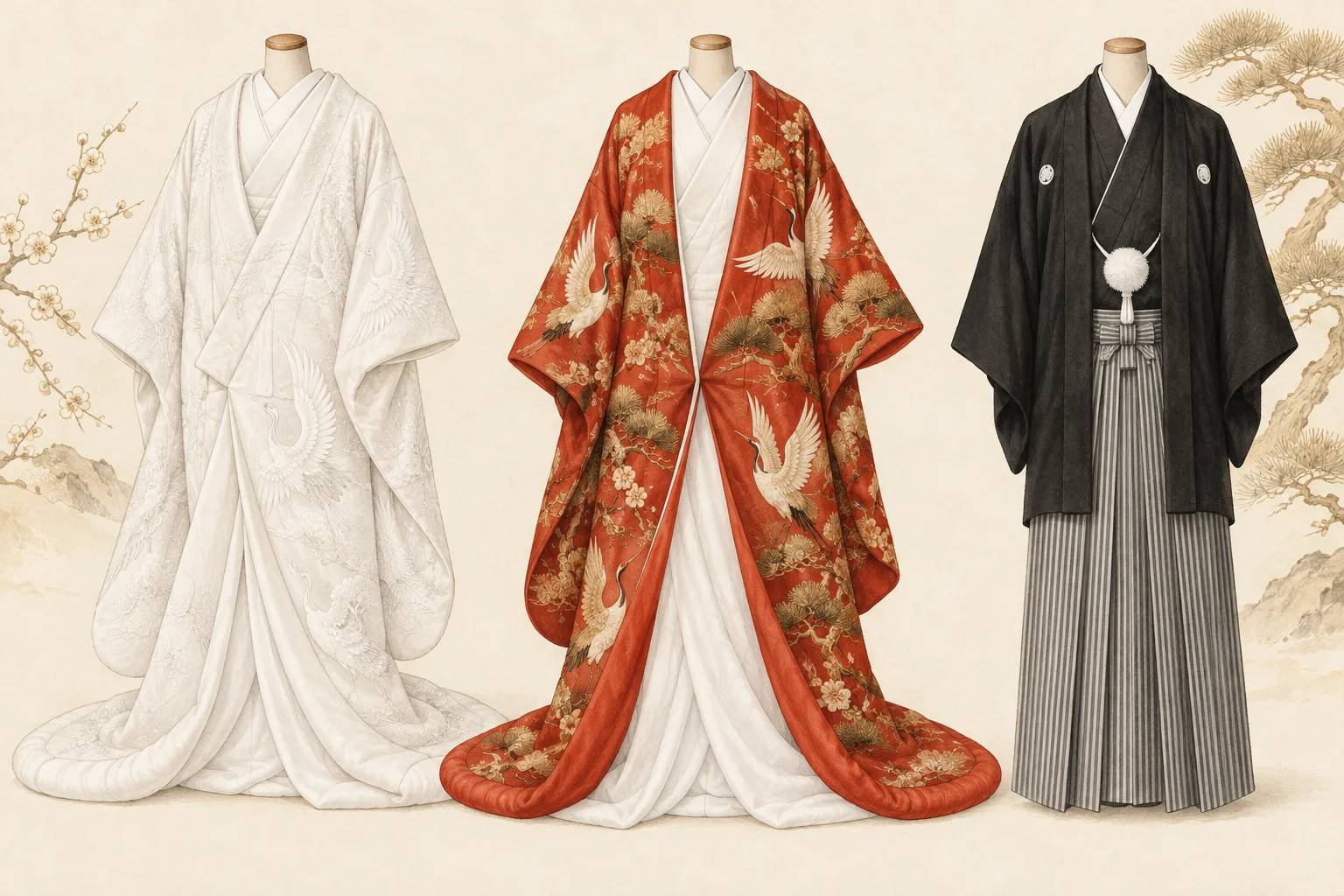
Mon means family crest, and the suffix -tsuki means "bearing." A groom looking for "the montsuki" the way he might look for "the tuxedo" is therefore looking for something that does not exist as one fixed item.
That matters because the crests are not decoration. They are the mechanism that sets formality.
Two kimono can be cut from the same black silk, and the one with more crests outranks the other. Nothing about the color, the fabric or the price changes that hierarchy. Once you know how to count crests, you can place most men's formal kimono at a glance.
Five Crests, Three Crests, One Crest — What the Count Signals
The formal arrangement is five crests, called itsutsu-mon. One sits at the center of the back, two sit symmetrically on the backs of the sleeves, and two sit symmetrically on the chest.
Reduce that set and you step down a rank. Mitsu-mon removes the two sleeve crests to leave three, and hitotsu-mon leaves only the crest on the back. Both are treated as semi-formal rather than formal.
Each position carries a meaning. The crest on the back stands for one's ancestors, the two on the chest for one's parents, and the two on the sleeves for siblings and wider family. A groom in five crests is, in the older reading of the garment, standing in front of the guests with his whole family named on his back and shoulders.
How the crest is applied also carries rank. The formal method is somenuki-mon, where the crest is left undyed as a white shape in the black ground. Embroidered crests, nui-mon, are informal by comparison.
On a rental garment this is usually settled for you, but it is worth knowing what you are looking at when a studio shows you two outwardly similar kimono at different prices. Our guide to family crests on wedding kimono covers the crest itself in more depth.
Kuro-Montsuki and Iro-Montsuki — The Two Choices a Groom Has
Once the crest count is settled, the remaining decision is color, and there are only two answers: black or not black.
Kuro-Montsuki Haori Hakama — The First Formal
The black version is the highest-ranking outfit a Japanese man can wear. It combines a black crested kimono with a haori, a hip-length jacket, and hakama, wide pleated trousers.
Its status is not a matter of taste. It was fixed by government decree in the Meiji era, when black haori and hakama bearing five family crests were designated official formal attire. The rules governing the wearing of decorations then placed that outfit as first-class formal dress.
The decree formalized what had already become common practice by the middle of the Edo period. That is why the garment is described as centuries old rather than as a nineteenth-century invention. In Western terms it sits where a tailcoat or a morning coat sits.
The practical consequence for a couple planning a shoot is that black is the uncomplicated answer. Because nothing a bride wears outranks a shiromuku, a groom in black five crests will not sit below her in formality.
Iro-Montsuki Haori Hakama — When a Groom Wants Color
An iro-montsuki is a crested kimono in any color other than black, usually a muted one — white, gray, navy, deep green. It is a comparatively recent option, having come into general use particularly after the Second World War.
Sources disagree on exactly where it ranks. Some hold that a colored montsuki with the full five crests is equal to black; others treat every colored montsuki as semi-formal regardless of crest count.
What no one disputes is that black with five crests is the most formal. If formality is what you are optimizing for, that ambiguity is itself the argument for black.
Where iro-montsuki is uncontroversial is the outfit change. At Japanese receptions grooms often move into a three-crest or single-crest colored montsuki for the second half, which is a lower-stakes moment and a natural place for personal taste.
| Kuro-montsuki | Iro-montsuki |
|---|---|---|
Choose it when | The shoot includes a ceremony, family, or formal portraits — or you simply do not want to think about rank | You already have a formal set of images and want a second, softer look |
Think twice when | You want the images to feel relaxed rather than ceremonial | Older relatives will be in the frame, or the bride is in shiromuku |
How it reads in photos | A solid dark silhouette; maximum separation from a white shiromuku | Lower contrast; sits closer in tone to a colored uchikake |
Where you will find it | The default men's garment wherever hakama is offered | Stocked less consistently; ask before assuming a color is available |
One point on that last row. Black against white is the strongest contrast available to you, and it is the reason so many Japanese wedding portraits are composed the way they are.
A colored montsuki next to a colored uchikake can look harmonious in person and muddy in a photograph. If you are drawn to color, ask the studio to show you both outfits photographed together rather than on separate hangers.
What a Full Montsuki Outfit Includes
A montsuki is not worn on its own. The formal outfit is a set of nine pieces, and each one has a fixed role and, in the strictest reading, a fixed color. Studios quote it as a package for exactly this reason — you cannot assemble it piecemeal and end up with something correct.
Piece | What it is | What to know |
|---|---|---|
Nagagi | The full-length kimono, worn over the under-layer | Black silk with five crests in the formal version |
Haori | The hip-length jacket worn over it | Also crested; the crests on the haori are the ones people see |
Hakama | The wide pleated trousers | Striped rather than plain in the formal version |
Nagajuban | The under-kimono, visible only at the collar | The white edge along the neckline comes from here |
Kaku-obi | The stiff narrow sash for men | Sits below the waist and holds the whole outfit's line |
Haori-himo | The cord that fastens the jacket at the chest | White flat braid is the most formal |
Tabi | Split-toe socks | White only with this outfit |
Setta | Flat sandals | Only setta with white thongs are correct here |
Sensu | A folding fan, carried | White-faced; part of the outfit, not a tool for cooling off |
Two of these repay a second look. The haori-himo is tied in front of the pit of the stomach with the tassels turned upward. Decorative bow knots are informal, and a dresser who knows the garment will not use one on a wedding day.
The sensu is carried closed in the hand or tucked at the waist, and it stays that way. If you find yourself fanning with it in July, you have quietly stepped out of the formality the rest of the outfit is maintaining.
Three of these pieces carry enough detail to have their own guides. If you want to go deeper, we have written separately about the hakama and how it is fitted, the kaku-obi and where it should sit, and the haori and how its length is judged.
One practical note catches couples out. Rental packages generally cover the visible garments, but underwear, tabi socks and the towels used to pad out the body line are often expected to be brought or bought separately.
Tabi are frequently sold rather than lent, since Japanese custom favors new tabi for a formal occasion, though some studios do include a pair. Ask what the package covers rather than assuming, and see our guide to what a kimono photo package actually costs for how these extras are usually itemized.
Fabric and Season — Why the Same Outfit Feels Different in July and January
The montsuki you see in photographs from a January shrine ceremony and the one worn at an August portrait session can look identical and be made of different cloth. Two fabric names account for most of the difference, and one construction detail accounts for the rest.
The black garments — both the nagagi and the haori — are traditionally habutae, a smooth, finely woven silk with a low sheen. Its formal color, when the cloth is a solid tone, is black.
The depth of that black is itself a mark of quality. Kuro-habutae is not dyed black in one pass: the cloth is given an undercolor first and then dyed over, and the dye used underneath determines its grade.
This is why two black montsuki hanging side by side can look like different colors in daylight.
The hakama is a separate cloth altogether. The formal choice is a broad-striped silk, of which sendaihira is the best known.
Sendaihira is a weave with roughly four centuries of history behind it, designated a National Important Intangible Cultural Property, prized for resisting creases, and originally made for samurai. A plain, unstriped hakama is informal by comparison.
In practice, rental stock often uses easier-care synthetic cloth instead of true sendaihira. That is a reasonable trade for a garment that will be worn once and knelt in. If the weaving itself interests you, our piece on Nishijin-ori, the Kyoto silk-weaving tradition covers how these fabrics are made.
Season changes the construction rather than the outfit. A kimono is either awase, lined, or hitoe, unlined, and the calendar governs which one you wear.
Months | Construction | What it means for a shoot |
|---|---|---|
October to May | Awase — lined | The standard montsuki. Comfortable outdoors through most of the year |
June and September | Hitoe — unlined | Same appearance, no lining. The shoulder-season option |
July and August | Ro or sha — open, gauze-like silk weaves | Woven to let air through. Visibly more open at close range |
These are conventions rather than rules, and hotter summers have loosened them — Japanese kimono retailers now generally advise choosing by the day's temperature rather than by the calendar. A rental collection may also not hold all three versions. Ask which cloth the studio will put you in.
The summer constraint is worth being honest about. A July or August outdoor session in a full montsuki means several layers of silk, a stiff sash and no ventilation at the neck. Kyoto averages a daily high of 33°C in August, and the humidity makes that figure read low.
Grooms manage it. They manage it by shooting early in the morning, keeping outdoor stretches short, and having somewhere cool to return to between frames. If you have flexibility on dates, our comparison of the best seasons for a kimono photoshoot lays out what each month actually asks of you.
Matching the Groom's Formality to the Bride's Kimono
In Japanese dress the two outfits are read together. A couple is expected to sit at the same level of formality, and the bride's kimono is usually chosen first, so in practice the groom's decision follows hers.
The anchor point is straightforward: black montsuki with five crests is the male equivalent of the shiromuku, the all-white bridal kimono that is the most formal thing a bride can wear. They belong at the same rank. Everything else arranges itself around that pair.
If the bride wears | The groom wears | Why |
|---|---|---|
Shiromuku — the all-white bridal kimono | Kuro-montsuki, five crests | Same rank; the standard pairing for a shrine ceremony |
Iro-uchikake — a colored outer robe worn over the kimono | Kuro-montsuki, or iro-montsuki | Black matches it in rank; color works if the two tones are checked together |
Hikifurisode — a trailing kimono with long swinging sleeves | Kuro-montsuki, or iro-montsuki | Slightly less formal than shiromuku, so color is easier to justify |
Western gown | Not applicable — a suit or tuxedo | Mixing a montsuki with a gown reads as mismatched in Japan |
That last row is the one couples push back on, usually because one partner wants a kimono and the other does not. It is not a rule with a penalty attached, and no one will stop you.
But in a photograph the two garments come from different visual systems, and the result rarely looks intentional. The more common solution is to shoot both looks: kimono for one set, Western dress for another.
Studios are built for this. Most of the ones that dress the groom also hold Western dress, so a single booking can cover both sides of the decision.
If the bride's side is still open, our comparison of shiromuku and iro-uchikake sets the two garments side by side, and the full guide to traditional Japanese wedding dress covers every garment either partner might wear.
What It Costs to Put the Groom in a Montsuki
Almost nobody buys a montsuki for a wedding. It is a rental garment, and the cost reaches you as part of a studio's package rather than as a line item you can price on its own.
That makes direct comparison difficult, so we approached it from the other direction. We took the starting prices published by the studios in our directory of 176 and split them into those that dress the groom and those that do not.
| Studios counted | Lowest | Median start price | Highest |
|---|---|---|---|---|
Studios offering hakama | 99 | ¥5,500 | ¥98,000 | ¥300,000 |
All listed studios | 144 | ¥5,500 | ¥88,000 | ¥300,000 |
Only studios that publish a starting price are counted, which is why the totals are 99 and 144 rather than 118 and 176. Figures collected from our directory in August 2026.
Read the ¥10,000 gap carefully, because the obvious conclusion is not the right one. It is not the price of a second outfit.
It is that studios equipped to dress two people in traditional attire tend to price from a higher floor to begin with — more garments in stock, more dressers on the day, longer sessions. The gap is a signal about what kind of business you are dealing with, not a menu item.
The range matters more than the median. A ¥5,500 starting price and a ¥300,000 starting price are not the same product at different quality levels; they are different products.
At the bottom of that range you are typically looking at a short kimono-wearing experience with a limited number of photographs. At the top you are looking at a full day with multiple outfit changes, several locations and a large set of edited images.
Both are legitimate. Neither is comparable to the other.
Two things to confirm before you treat any published number as your price. First, whether the starting figure includes the groom at all — plenty of packages are quoted for the bride, with the groom's outfit added on.
Second, what the figure covers beyond the garment. Dressing, hair and makeup, the photographer's time, location fees and the number of retouched images are all priced differently from studio to studio. Our breakdown of kimono photoshoot costs in Japan goes through each of those line items in turn.
What to Check Before You Book
This is the section we would most like couples to read. The assumption underneath most montsuki disappointments is a reasonable one that happens to be wrong: that any studio offering traditional wedding photography dresses both partners.
When we counted across the 176 studios in our directory in August 2026, 118 offer hakama and 58 do not. Roughly one studio in three will dress the bride in a shiromuku or an iro-uchikake and has nothing for the groom.
That is not an oversight on their part. Of those 58 studios, 54 stock shiromuku, 56 stock iro-uchikake and 48 stock Western dress.
Their collections are deliberate. They are simply built around the bride.
The second number narrows things further. Of the 118 studios that do offer hakama, 38 support English. The language breakdown across those 118 is 109 Japanese, 38 English, 9 Chinese and 3 Korean.
If you are arranging a shoot from abroad and need to communicate in English, the realistic field is not 176 studios and not 118 — it is closer to 38.
Language is not a convenience issue here. Kimono dressing is a hands-on process in which someone adjusts padding against your body, judges the collar depth at the back of your neck and decides how high the hakama sits on your waist. Those are small negotiations, and they go badly through gesture alone.
A third figure is useful if you want both looks in one day. 73 studios stock all four — hakama, shiromuku, iro-uchikake and Western dress — and for 62 of them those four are the entire collection, which makes it the single most common line-up in our data. A further 36 stock the three traditional garments and no Western dress at all.
From those numbers, five questions worth asking before you pay a deposit:
- Do you dress the groom? Ask it plainly and ask it first. A gallery full of couples is not proof; some of those grooms arrived in their own suits.
- What sizes do you hold? Raise this in the same message if you are tall or broadly built. Specialist kimono rental houses in Japan publish size charts reaching 190cm and in some cases 195cm, so the garments exist. What is far less certain is whether the photo studio you are booking holds them — most keep a narrower range in their own stock and do not publish it. Send your height, shoulder width and arm length with your first inquiry rather than at the fitting.
- Which crest will I be wearing? Rental garments almost always carry tsūmon — generic crests intended for anyone's use — rather than a family crest. If you have a crest of your own, some studios can apply crest stickers over the top. Ask early; it is not always possible at short notice.
- Can we do this in English? Confirm whether English support means a bilingual dresser present on the day or an English-speaking coordinator handling email only. Both are useful. They are not the same thing.
- What is not in the price? Tabi socks, undergarments, a second location, extra retouched images and transport between sites are the usual additions.
If you are organizing this from outside Japan, our guide to booking a Japanese photoshoot from abroad covers deposits, time zones and what to put in writing. The directory of English-speaking studios is filtered to the ones that can answer you in English.
Where Men's Formal Attire Is Easiest to Arrange
Choice is not distributed evenly across Japan. Some cities give you a dozen studios that dress the groom; others give you one. If a montsuki is non-negotiable for your shoot, that changes how you should think about location.
Area | Studios offering hakama |
|---|---|
Kyoto | 14 |
Asakusa, Tokyo | 12 |
Nara | 11 |
Izumo | 10 |
Hiroshima | 10 |
Matsuyama / Kamakura | 7 each |
Karuizawa / Yokohama | 6 each |
Meiji Jingu (Tokyo) / Hakone / Sendai / Nagoya | 5 each |
Nagasaki | 1 |
Counted across the 176 studios in our directory, August 2026. Studios working in more than one area are counted in each.
The practical reading is about fallback, not prestige. In Kyoto or Asakusa you can approach four or five studios, compare what they hold in your size, and still have options if your first choice is booked on your date.
In an area with a single listing, that studio's calendar and that studio's size range are simply your constraints. Peak periods compress this further, since the studios that do exist tend to fill their calendars earliest. Our notes on choosing a season cover when those pressure points fall.
Izumo deserves a note for anyone weighing atmosphere against convenience. This small city on the Sea of Japan coast has ten studios offering hakama, out of all proportion to its size.
The concentration follows Izumo Taisha, one of the oldest and most significant Shinto shrines in Japan and a long-established place to marry. Getting there from Tokyo takes several hours. Few places outside the major tourist cities give a groom this much choice.
You can browse every listed studio that dresses grooms through our hakama style page.
Frequently Asked Questions
What is a montsuki kimono?
A montsuki is any kimono bearing family crests — mon means family crest and the suffix -tsuki means "bearing." It is a category rather than a specific garment. For a wedding, the outfit usually meant by the word is the black crested kimono worn with a haori jacket and hakama trousers, the most formal thing a Japanese man can wear.
What is the difference between kuro-montsuki and iro-montsuki?
Color, and with it rank. Kuro-montsuki is black and, with five crests, is first-class formal dress. Iro-montsuki is any other color, usually muted, and is generally treated as a step below — though sources differ on whether five crests close that gap. Black is the ceremony choice; color is more often worn for an outfit change at the reception.
Can a foreign groom wear a montsuki?
Yes. There is no restriction on who may wear one, and studios that dress international couples do so routinely. What is expected is that the outfit is worn correctly and in a fitting setting — a wedding, a ceremony, a formal portrait session. Wearing it properly is the whole of the etiquette.
How many crests should a groom's kimono have?
Five, if the occasion is your own wedding. Five crests — itsutsu-mon — is the formal arrangement: one on the back, two on the sleeves, two on the chest. Three crests or one crest are semi-formal and better suited to a reception outfit change or to a guest.
Can tall or broad-shouldered grooms find a montsuki that fits?
Usually yes, but confirm it before you book. Specialist kimono rental houses publish size charts reaching 190cm and sometimes 195cm, so garments for taller men exist. Whether a given photo studio holds them is another question, and most do not publish their own size range. A hakama can be adjusted at the waist with some latitude; sleeve length and shoulder width cannot. Send your height, shoulder width and arm length when you first inquire rather than at the fitting.
Do I need my own family crest?
No. Rental garments carry tsūmon — generic crests that anyone may wear — and this is the normal case rather than a compromise. If you do have a family crest and want to use it, some studios can apply crest stickers over the existing design, but ask well in advance because it is not always available.
How long does it take to dress a groom in a montsuki?
Around 30 to 40 minutes for the full montsuki haori hakama, against roughly one to two hours for a bride in shiromuku once hair and headpiece are counted. In practice the groom's dressing is slotted in around the bride's, so the appointment length you are quoted is driven almost entirely by her side of the schedule.
Finding a Studio That Dresses the Groom Well
The montsuki is a garment with a small number of firm rules and a large amount of latitude inside them. Five crests on black silk is the formal answer, and it is the one that pairs with a shiromuku without any further thought.
Beyond that, the decisions that shape the day are practical ones. Does the studio hold men's garments at all? Do they hold your size? Can you settle the details in a language you both read?
Our directory lists 176 studios across Japan, with the styles each one offers and the languages each one works in stated on the listing. The hakama style page shows every studio that dresses the groom in traditional attire, and the English-speaking directory narrows that to the ones you can arrange in English. If the shape of the wider day is still open, our overview of what a men's kimono photoshoot involves walks through the session itself, from dressing to the last frame.
Related guides
 Style guide
Hakama Groom Japanese Wedding: Formal Styles & Fit Guide
Illustrative image · Unsplash. Not a photo of the specific people, places or services discussed.
A planner's guide to the hakama groom Japanese wedding look — montsuki, sendaihira stripes, haori, rental costs, and fitting tips for foreign grooms.
Read the guide Style guide
Men's Kimono Wedding Photoshoot: Montsuki & Hakama Guide
Illustrative image · Unsplash. Not a photo of the specific people, places or services discussed.
Men's wedding kimono in Japan: montsuki, haori, hakama components, color rules, accessories, and what foreign grooms typically wear.
Read the guide Style guide
Kaku-Obi for the Groom: Narrow Men's Bridal Obi Japan
Illustrative image · Unsplash. Not a photo of the specific people, places or services discussed.
Kaku obi mens bridal Japan guide: 9-10cm width, 4m length, kai-no-kuchi vs katabasami knots, silk vs polyester, ¥5K-¥30K rental, knot positioning for photos.
Read the guide