Tomesode Mother of the Bride: Kuro & Iro Tomesode Guide
Tomesode mother of the bride guide: kuro-tomesode vs iro-tomesode, the five kamon crests, motifs, foreign-family rentals, sizing, and what mothers wear.

Illustrative image · Unsplash. Not a photo of the specific people, places or services discussed.
Check current prices, availability and venue rules with the relevant studio or venue before booking.
At a Japanese wedding, the most quietly important garment in the room is not the bride's shiromuku — it is the tomesode worn by her mother. The tomesode is the formal married woman's kimono, and the black version, kuro-tomesode (黒留袖), is the highest-rank kimono a married woman can wear. For foreign couples planning a kimono pre-wedding shoot or ceremony in Japan, this guide explains exactly what the tomesode is, why mothers wear it, and how international families can rent and wear one with confidence — including for the mothers of the groom.
Kuro-Tomesode vs Iro-Tomesode — When Each is Appropriate
To understand tomesode meaning, start with the kanji: 留袖 literally means "fastened sleeve." When a young woman married, the long, swinging sleeves of her furisode (the unmarried woman's kimono) were traditionally shortened and the dramatic patterns moved off the upper body. The resulting garment — short-sleeved, restrained, dignified — is the tomesode. It signals that the wearer is a married woman and that the occasion is formal.
There are two principal tiers:
- Kuro-tomesode (黒留袖) — solid black above the waist, with patterns only along the lower hem (suso moyo). This is the single most formal kimono a married woman can wear. At a Japanese wedding, kuro-tomesode is the customary choice for the mothers of the bride and groom, as well as for married sisters, aunts, and grandmothers in the immediate family.
- Iro-tomesode (色留袖) — the same silhouette but in a single solid color other than black (soft pink, dove grey, pale blue, deep aubergine, beige, sage). Iro-tomesode is one rank below kuro-tomesode in formality. It is worn by married women who are close family but not the host — for example, the bride's married cousin — or by unmarried adult women in the family who prefer something more dignified than a furisode.
Wedding Planner's Notes: a common misunderstanding among international guests is that iro-tomesode is "the casual one." It is not casual. It is simply slightly less formal than black. At a wedding, anyone in iro-tomesode is signaling that they are family, that they are taking the occasion seriously, and that they are deliberately not outranking the bride's and groom's mothers.
The Five Family Crests (Kamon) — Why They Define Formality
What separates a "wedding-grade" tomesode from a merely pretty one is the number of kamon (家紋), or family crests, dyed into the fabric. A formal tomesode for a mother of the bride or groom carries five crests — one at the center of the back, one on each outer sleeve, and one on each side of the chest. This is called itsutsu mon (五つ紋), and it is what makes the garment first-rank.
Three crests (mitsu mon) drops the formality one level; one crest (hitotsu mon) drops it further, into the territory of a less formal visiting kimono. For a mother of the bride or groom at her own child's wedding, the only correct version is five crests.
For Japanese families, the crest is the household crest passed down through generations. For foreign families, this convention has relaxed considerably. Rental tomesode used today for international weddings are dyed with a generic decorative crest — often a stylized chrysanthemum, paulownia, or wisteria — and this is widely accepted by Japanese venues, photographers, and family. You do not need to invent a "family crest" or commission anything custom. A standard five-crest rental tomesode is recognized as formal regardless of whose crest is dyed onto it.
Color & Motif Conventions — Lower Hem Only
The defining design feature of tomesode is that all decoration sits on the suso, the lower hem, from roughly the knee down. Above the waist, the kimono is unbroken — black for kuro-tomesode, a single solid color for iro-tomesode. This restraint is intentional: the eye is drawn to the wearer's face, not the garment.
The motifs themselves are drawn from a vocabulary of auspicious imagery (kisshou monyou) appropriate to celebrations:
- Cranes (tsuru) — longevity, marital fidelity (cranes pair for life)
- Pine, bamboo, plum (shouchikubai) — endurance through winter, classical celebration
- Peonies, chrysanthemums — prosperity, dignity
- Phoenixes (hou-ou) — imperial elegance, harmony
- Folding fans (sensu), pine carriages (gosho-guruma) — Heian-era courtly luxury
- Waves (seigaiha), flowing water — continuity
Anything funereal, severe, or "broken" (autumn leaves implying decline, dragonflies implying transience, sharp geometric breaks) is avoided. When you rent a tomesode for a mother in a wedding context, you do not need to vet each motif yourself — every garment in a wedding rental rotation will already conform. But it is useful to know what you are looking at when you see it.
For Mothers of the Bride and Groom — The Cultural Role
In Japan, weddings are not understood solely as a union of two individuals; they are understood as a union of two families. The mothers of the bride and groom, by wearing matching kuro-tomesode, visually anchor that idea. At the ceremony, the reception, and in family group portraits, the two mothers in identical-rank black kimono read instantly as the senior women of the joining households.
A few conventions worth knowing:
- Both mothers typically wear kuro-tomesode of comparable formality. It is common for the two families to coordinate informally — not the exact same garment, but a similar level of richness in the hem design, so neither mother visibly out-dresses the other.
- Grandmothers may also wear kuro-tomesode. If a grandmother prefers something a touch softer, iro-tomesode in a muted color is acceptable.
- The mothers wear a white half-collar (han-eri), a gold or silver obi tied in a formal nijuudaiko (double drum) knot, gold or silver zori sandals, a matching fukuro handbag, and a pearl or jade kanzashi if any hair ornament at all. Hair is dressed up but restrained.
- The bride's biological mother and stepmother, or two mothers in same-sex families, can both wear kuro-tomesode together. There is no rule that limits the role to one woman.
For couples planning a kimono pre-wedding photoshoot rather than a full ceremony, the tomesode tradition still matters. If you are bringing your mothers to Japan for the shoot — see our guide on bringing parents to a Japan kimono photoshoot — having them in tomesode in the family portraits creates an heirloom image that mirrors what a Japanese family would do at the wedding itself.
For Foreign Mothers — Renting and Wearing Tomesode
Renting tomesode for a foreign mother is straightforward, but the booking has to be deliberate. A few things to know in advance:
Where to rent. Most kimono photography studios that serve international clients have an in-house tomesode collection for mothers, or a partnership with a rental house. When you book the bride's shiromuku and iro-uchikake — see shiromuku vs iro-uchikake — ask in the same conversation whether the studio offers a "mother set" (留袖セット, tomesode setto). The set typically includes the kuro-tomesode, gold/silver obi, white han-eri, undergarments (nagajuban), zori sandals, tabi socks, fukuro handbag, and basic hair styling.
What it costs (general guide). A full kuro-tomesode rental with dressing and basic hair runs roughly the same as a mid-tier furisode rental — meaningfully less than the bride's bridal kimono. For specifics, see our broader guide on kimono photo costs in 2026. We deliberately don't quote fixed numbers here because studios price tomesode sets differently and the season swings rates.
When to book. If you want both mothers in matched-formality kuro-tomesode (recommended for symmetrical family portraits), reserve at least 2-3 months out. Wedding peak seasons (cherry blossom in late March-early April, autumn foliage in November) book out earlier. Avoid the Golden Week holiday window of April 29 to May 5/6 if you can — pricing rises and tomesode inventory is competed for by domestic weddings.
Sizing across two families. Foreign mothers vary widely in height and build. Tell the studio your mothers' heights and chest/hip measurements at booking, not on the day. Tomesode are made in adjustable lengths — the excess is tucked at the waist under the ohashori fold — but very tall mothers (above about 175 cm / 5'9") and very petite mothers (below about 150 cm / 4'11") need confirmation that the studio has a garment in their range. This is why we mention sizing in our companion guide on mothers' kimono for foreign wedding guests.
What Foreign Mothers Should Know About Sizing, Fitting, and Hair
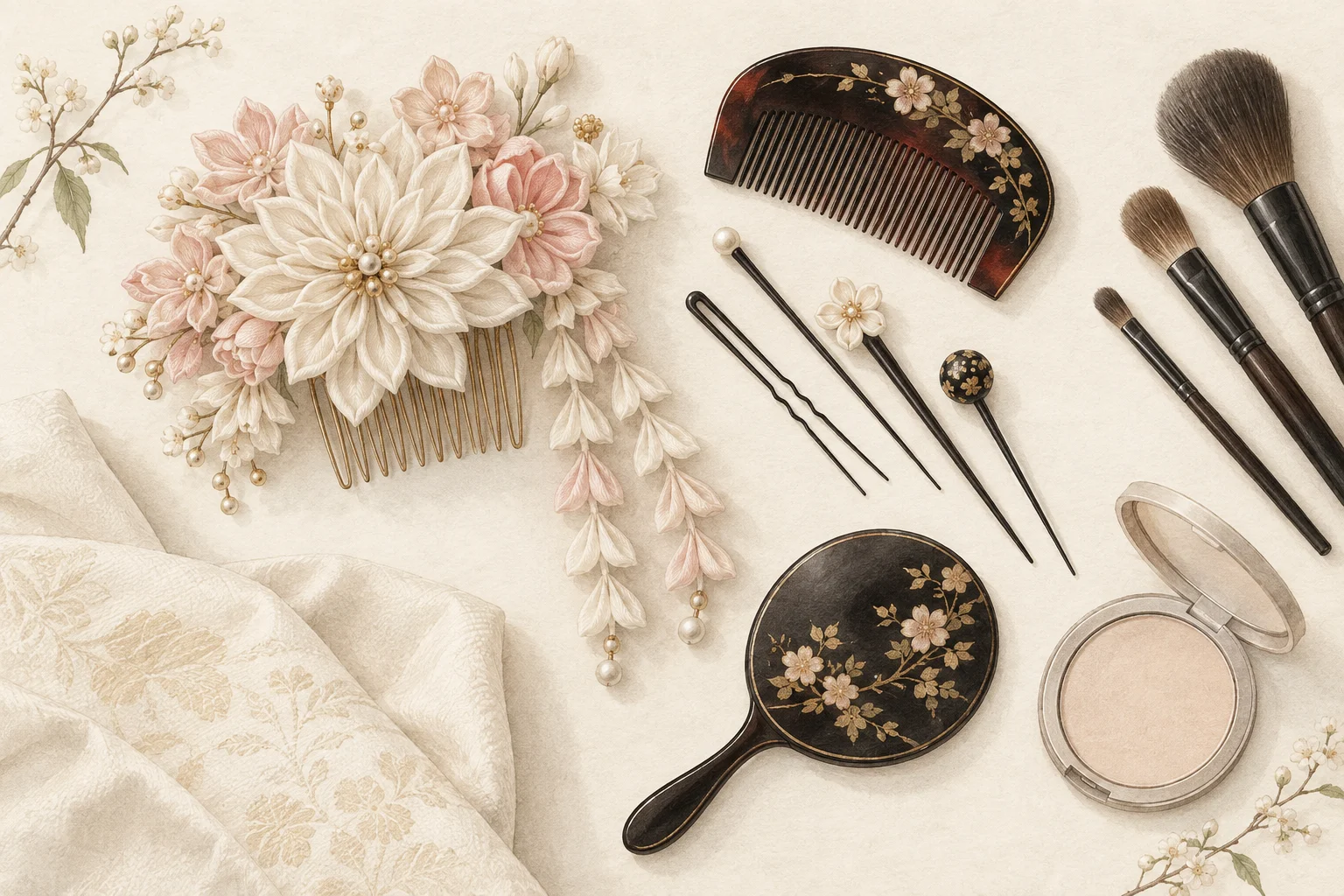
The mechanical experience of being dressed in tomesode is different from anything in Western formalwear. Plan around it:
- Dressing takes 45-60 minutes per person. The dresser (kitsuke-shi) layers the nagajuban, kimono, obi, and decorative cords (obijime, obiage) by hand. Two mothers being dressed in sequence means budgeting at least 90 minutes before the call time.
- The obi sits high and tight. The double drum obi compresses the rib cage and stomach. This is normal. Mothers who have had recent abdominal surgery, severe acid reflux, or breathing difficulty should mention it — studios can dress slightly looser.
- Movement is constrained. The hem narrows toward the floor; long strides are not possible. Stairs are taken sideways. Sitting is done at the front edge of the chair, with the obi drum unsupported. For an outdoor shoot, this affects how far the mothers can walk between locations.
- Hair. Japanese hair stylists working with tomesode default to an upswept style — usually a low chignon with restrained volume on top. Foreign mothers with very fine hair, very short hair, or extremely curly hair should mention it at booking. Solutions include adding a small tsukemo (hairpiece) for volume, or a partial styling that keeps the hair off the collar without forcing it into a Japanese-style bun. Hair coloring (grey, silver, blonde, red) is not an issue for tomesode — a dignified European or American grey reads as appropriate maturity and is photographed beautifully against black silk.
- Bathroom logistics. Once dressed, going to the bathroom is possible but slow. The kitsuke-shi will show you the technique. Hydrate before, not during.
Tomesode vs Houmongi vs Furisode — Quick Comparison

For families bringing multiple generations to Japan, here is how the main women's formal kimono compare:
Kimono | Worn by | Sleeve length | Formality at a wedding | Typical use |
|---|---|---|---|---|
Kuro-tomesode | Married women, mothers of bride/groom | Short (~49 cm) | Highest (with 5 crests) | Mother of bride/groom; married close family |
Iro-tomesode | Married women; adult unmarried women in family | Short | One step below kuro-tomesode | Cousins, aunts, grandmothers in muted color |
Houmongi (訪問着) | Any age, married or unmarried | Short | Semi-formal | Friends of the bride; non-immediate-family guests |
Furisode (振袖) | Unmarried young women | Long (75-115 cm) | Highest for unmarried women | Younger sisters, cousins; adult guests under ~30 |
For the unmarried-women branch of this question, our guide on furisode for a Japanese wedding guest goes deeper into sleeve lengths and motifs. For the broader question of what guests wear, the Japanese wedding guest attire pillar covers Western dress options as well.
Frequently Asked Questions
Can the mother of the bride wear iro-tomesode instead of kuro-tomesode?
Traditionally no — the mother of the bride wears black kuro-tomesode with five family crests. Iro-tomesode is appropriate for slightly less central family members (cousins, aunts) or for grandmothers who want a softer palette. That said, for international families and informal pre-wedding shoots, an iro-tomesode in a deep, muted color is acceptable and frequently chosen.
What if my mother and my mother-in-law have very different body types?
This is common and entirely manageable. Tell the rental house both mothers' heights and chest measurements at booking. Tomesode are sized in a range, and the dresser adjusts the length and waist tuck on the day. The two mothers do not need to wear identical kimono — only kimono of matching formality (both kuro-tomesode with five crests, with hem designs of similar density).
Do I need an authentic family kamon dyed onto the tomesode?
No. Rental tomesode for international weddings come pre-dyed with a generic decorative crest, and this is widely accepted. Custom-dyeing a true family crest is a months-long, expensive process used by Japanese families who own their tomesode outright.
Can my mother wear a kuro-tomesode if she is divorced or widowed?
Yes. Tomesode is the formal kimono for married, formerly married, and widowed women. Marital status at the time of the wedding does not change her eligibility to wear it as the bride's or groom's mother.
Is tomesode appropriate for a same-sex Japanese wedding?
Yes. Both mothers of either partner can wear kuro-tomesode, regardless of the couple's gender. The garment marks her role as senior woman of the household, not her relationship to a male groom.
Can the mothers wear tomesode for the pre-wedding photoshoot but Western dress for a separate ceremony?
Absolutely, and this is a common pattern. Many international couples do a tomesode-and-shiromuku photoshoot in Japan with the mothers in full traditional dress, then hold the actual ceremony at home in Western formalwear. The Japan shoot becomes the heirloom image; the home ceremony is the legal and social event.
What is the difference between a kuro-tomesode and a Japanese mourning kimono?
Both are black, but the differences are immediate to a Japanese eye. A mourning kimono (mofuku) is solid black throughout with no pattern and is paired with a black obi and black accessories. A kuro-tomesode has colorful auspicious patterns on the lower hem and is paired with a gold or silver obi and gold/silver zori and handbag. There is no risk of confusion in context.
Can foreign mothers keep their glasses, jewelry, or wedding rings while wearing tomesode?
Glasses, yes — thin metal frames read well; heavy plastic frames clash. Wedding rings, yes. Necklaces and earrings should be minimal — small pearl studs and a single strand of pearls if anything. A wristwatch is removed for portraits.
Plan Your Family Photoshoot in Japan
Tomesode for the mothers is one of those details that quietly elevates a Japan kimono shoot from "pretty" to "complete." When the bride is in shiromuku, the groom is in montsuki haori hakama — see our guide on men's kimono — and both mothers are in matched kuro-tomesode, the family portrait reads as a generational document rather than a vacation snapshot.
If you are starting to plan, browse photographers on the Wasou Wedding Japan directory and filter for studios that offer mother sets. For the full picture, our pillar guide on Japanese wedding photography walks through how to brief a studio about your full family group, and traditional Japanese wedding dress covers what every wearer in the family will be in. For the practical side of bringing mothers from abroad, start with bringing parents to a Japan kimono photoshoot and mothers' kimono for foreign wedding guests.
Related guides
 Style guide
Furisode Wedding Guide: The Unmarried Woman's Formal Kimono
Illustrative image · Unsplash. Not a photo of the specific people, places or services discussed.
A planner's guide to furisode wedding attire for unmarried guests in Japan — sleeve lengths, motifs, rental logistics, and advice for foreign guests.
Read the guide General guide
What to Wear to a Japanese Wedding: Guest Attire Guide
Illustrative image · Unsplash. Not a photo of the specific people, places or services discussed.
A planner's guide to what to wear to a Japanese wedding as a foreign guest — dress codes, color rules, and traditional options for ceremony and reception.
Read the guideStyle guideMother's Kimono at Japanese Weddings: Foreign Mother Guide
Illustrative image · Unsplash. Not a photo of the specific people, places or services discussed.
A planner's guide to mothers kimono japanese wedding: when foreign mothers wear kuro-tomesode, rental logistics, sizing, hair, and Western alternatives.
Read the guide