Antique & Vintage Bridal Kimono: Meiji-Era Silks Guide
A planner's guide to antique vintage kimono bridal options — Meiji and Taisho silks, where to rent in Kyoto and Tokyo, care, pricing, and heirloom basics.

Illustrative image · Unsplash. Not a photo of the specific people, places or services discussed.
Check current prices, availability and venue rules with the relevant studio or venue before booking.
Antique and vintage kimono — primarily Meiji-era (1868–1912) and Taisho-era (1912–1926) silks, with a small allocation of early Showa pieces (1926–1945) — have moved from collector territory into the bridal mainstream over the last five years. International couples increasingly ask for them by name, and the better Kyoto and Tokyo houses now keep dedicated antique racks separate from their modern uchikake inventory. The visual difference is real: heavier silk, denser embroidery, deeper natural dyes, and motifs you simply will not find in a contemporary reproduction. The trade-offs are real too. This guide walks you through what "antique vintage kimono bridal" actually means in 2026, where to rent, how to verify what you are paying for, and the handling rules a careful planner will give you before the shoot.
Meiji vs Taisho vs Showa Era Distinctions
"Vintage" and "antique" are used loosely in the bridal kimono market, so it helps to fix the vocabulary before you start looking. In the trade, antique usually means pre-1945 (Meiji and Taisho, plus early Showa); vintage usually means roughly 1945–1980. After 1980, kimono are generally referred to as "used" rather than vintage. Each era has its own visual fingerprint.
Meiji-era bridal kimono (late 19th century to 1912) tend to be the heaviest. The silk weave is dense, the embroidery is hand-couched gold thread, and motifs lean traditional — cranes, pine, chrysanthemum, peony — rendered in the formal symmetry that late-Edo conventions still dictated. Linings are often plain red silk. A Meiji uchikake in good condition can weigh 5–7 kg, noticeably more than a modern equivalent.
Taisho-era kimono (1912–1926) are the most fashion-forward of the antique categories and are often the easiest entry point. The Taisho period overlapped with European Art Nouveau and Art Deco influence; you will see geometric stripes, larger-scale florals, asymmetric compositions, and unusual color palettes — mauve, sage, oxblood, indigo against cream — that read as modern to a contemporary eye. Weight is lighter than Meiji, embroidery slightly less dense, and many pieces have survived in better condition because they are younger.
Early Showa kimono (1926–1945) sit between the two. Pre-war Showa silks can be excellent, but wartime fabric restrictions mean quality dropped sharply from the late 1930s onward. Reputable houses generally label anything post-1940 separately, and you should treat "1930s–1940s" as a flag to ask more questions about condition.
Where to Rent Vintage Bridal Kimono in Japan
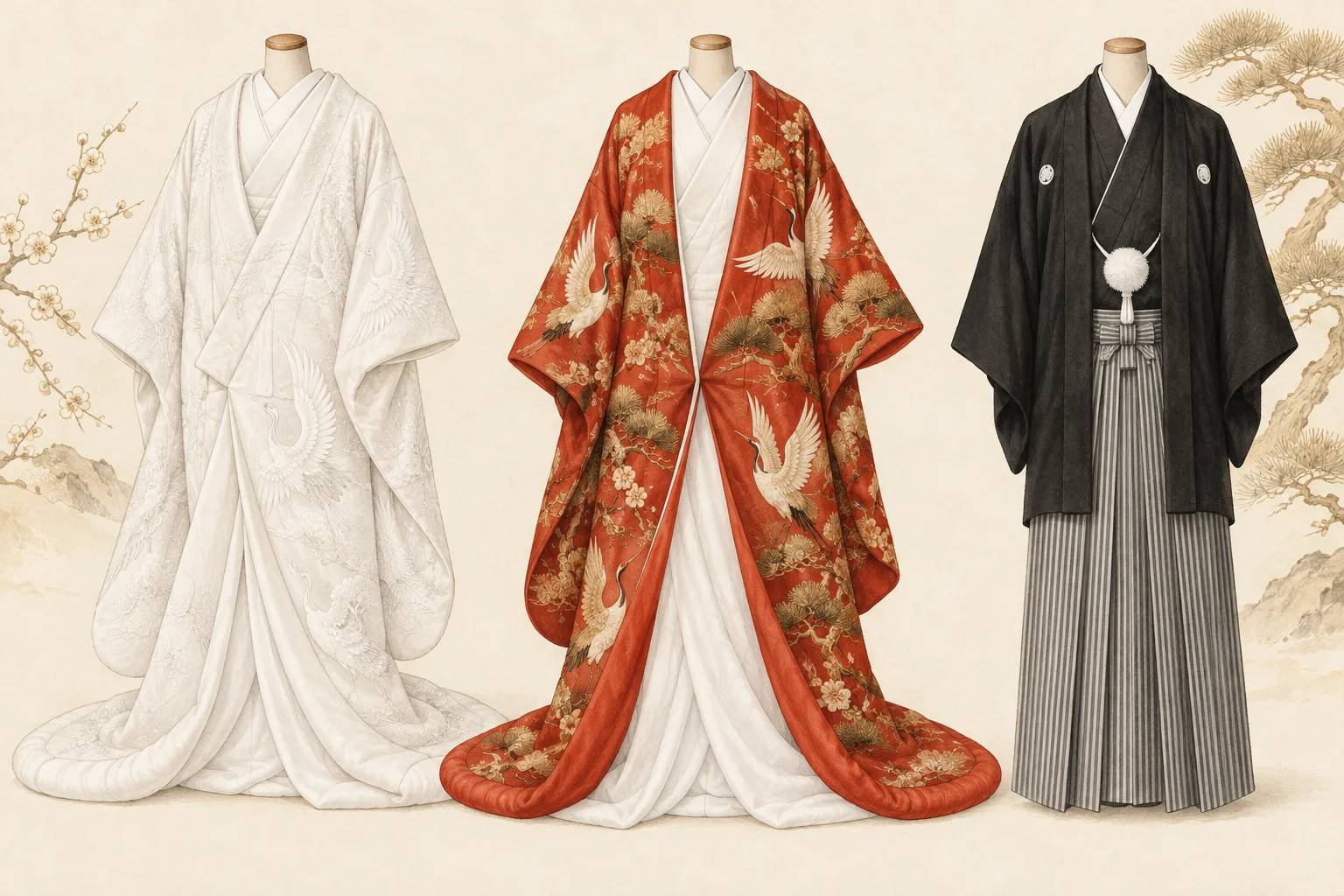
The vintage bridal kimono market is concentrated in three places: Kyoto, Tokyo (specifically Asakusa and Yanaka), and a small number of online specialists who handle international shipping. Each has a different working style.
Kyoto — Established Vintage Houses
Kyoto is the natural center for antique bridal kimono. Several long-established houses in the Higashiyama and Nishijin districts maintain inventory that has been passed down or acquired through estate sales since the 1970s. A typical Kyoto vintage house will let you make an appointment, spend 60–90 minutes trying on pieces, and reserve a kimono for a specific shoot date with a deposit. Many of these houses also offer the matching antique kanzashi (hair ornaments) and obi; see our guide to kanzashi hair ornaments for bridal kimono for how the pairing works.
Wedding Planner's Note: in Kyoto, the houses with the deepest vintage inventory are not always the ones that show up first in English search. Ask any photographer who specializes in traditional shoots for an introduction — the relationships matter, and a referred client typically gets shown better pieces than a walk-in. See our top Kyoto studios roundup for vendors that work routinely with antique houses.
Tokyo Asakusa & Yanaka — Specialty Shops
Tokyo's vintage kimono scene is split between Asakusa, which is high-volume and tourist-facing, and Yanaka, which is quieter and runs more like a specialist gallery. Asakusa has a wide range of vintage and used pieces, but the genuinely antique bridal stock tends to be smaller and you will need to ask specifically for kotto (antique) inventory rather than the standard rental rack. The shops near Asakusa that handle pre-wedding clients usually have one or two Taisho pieces and will tell you honestly if they don't have what you want.
Yanaka is the better hunting ground if you want time and attention. The neighborhood has several small shops run by collectors who deal in Meiji and Taisho silks; pricing is comparable to Kyoto, English support is variable, and most shops prefer appointments. A planner or English-speaking photographer can bridge the language gap; see our roundup of English-speaking kimono photographers for vendors who routinely arrange these visits.
Online with International Shipping
A small number of Japanese antique kimono dealers ship internationally for purchase, but international rental is rare because of insurance and cleaning logistics. If you want to handle everything from abroad, the realistic options are: (1) book through a Japan-based photographer who has a relationship with a vintage house and let them arrange fitting on arrival, or (2) buy a piece outright through an established online dealer and bring it with you. Buying is only worth it if you intend to keep the kimono — pricing for an authentic Meiji uchikake in good condition typically starts where two or three rentals would. See how to book a Japan kimono shoot from abroad for general booking logistics.
Authenticating Vintage vs Reproduction
Modern reproductions of "vintage-style" kimono are common and can be excellent in their own right, but they are not the same product and should not be priced the same. There are a few practical checks you can make yourself or ask the house to walk you through.
Weight and hand feel. Authentic Meiji and Taisho silks feel substantially heavier than a modern polyester or thin silk reproduction. The lining will usually be a separate piece of silk, sometimes faded, often slightly different in color from what would be sold today. A reproduction often has a synthetic lining and a uniform weight throughout.
Embroidery technique. Antique gold-thread embroidery is hand-couched — the gold thread sits on the surface and is held down by small stitches you can see on the back of the fabric. Modern machine embroidery is uniform and the back of the work looks mechanical. Ask to see the inside of the embroidered area.
Dye and color. Natural-dyed antique silks have small color variations and a depth that synthetic dyes don't replicate. A solid, perfectly even red on a piece sold as "Meiji" is a flag.
Provenance. A serious vintage house will tell you what they know about the piece — region, approximate decade, any restoration work. "We don't know" is an acceptable answer; "definitely Meiji" with no detail is not.
Care Requirements During Photoshoot
Antique silks are delicate. The handling rules are stricter than for a modern rental, and you should understand them at booking, not on the morning of the shoot.
Perspiration is the main enemy. Sweat from the skin can stain antique silk permanently and is very hard to clean without damaging the fabric. Most vintage houses require a cotton juban (under-kimono) plus a sweat-absorbing pad in summer shoots, and many will simply refuse to rent antique pieces in July and August. If you are shooting in summer heat, ask about this at booking; you may need to choose between an antique kimono and a comfortable shoot.
Food, drink, and makeup transfer. Most houses prohibit eating or drinking while wearing the kimono, and will provide a face cloth for makeup touch-ups so that foundation does not transfer to the collar. Lipstick is the common offender — your hair and makeup artist should know to use a transfer-resistant formula. See hair and makeup for shiromuku for general bridal makeup guidance.
Rain and weather. Antique silks should not get wet. A vintage house will usually provide a protective covering for transit and will cancel an outdoor shoot if rain is forecast. Build a backup indoor location into your plan if you are renting antique. The general framing in our studio vs outdoor guide applies, but with a stronger preference for indoor when the silk is irreplaceable.
Time on the body. Many houses cap antique kimono wear time at 4–6 hours from dressing to undressing, against 6–10 hours for modern rentals. Plan a shorter shoot or budget for a mid-day return to the studio.
Pricing — Vintage vs New Rental
Vintage and antique bridal kimono cost more to rent than standard new uchikake, but the multiplier is smaller than couples often assume.
Tier | Typical rental (kimono only, with dressing) | Notes |
|---|---|---|
Standard new iro-uchikake | JPY 50,000–120,000 | House inventory, modern reproduction |
Premium new or designer uchikake | JPY 120,000–250,000 | Modern but high-end |
Vintage (Showa, 1945–1980) | JPY 80,000–180,000 | Often excellent value |
Antique Taisho (1912–1926) | JPY 150,000–300,000 | Most fashion-forward designs |
Antique Meiji (1868–1912) | JPY 200,000–500,000+ | Heaviest silk, densest embroidery, fewer in circulation |
These ranges cover the kimono itself plus dressing (kitsuke); they do not include hair and makeup, photographer fees, or location costs. Compared with the overall budget mapped in our 2026 kimono photo cost guide, choosing antique typically adds 10–25% to the all-in shoot total rather than doubling it. Most houses will discount slightly if you book the antique kimono together with a modern second look for a half-day shoot.
A separate note on damage deposits: vintage houses commonly take a refundable deposit of JPY 50,000–200,000 against damage, and will deduct legitimate cleaning or repair costs from it. Confirm this in writing at booking.
Combining Vintage Kimono with Modern Hair/Makeup
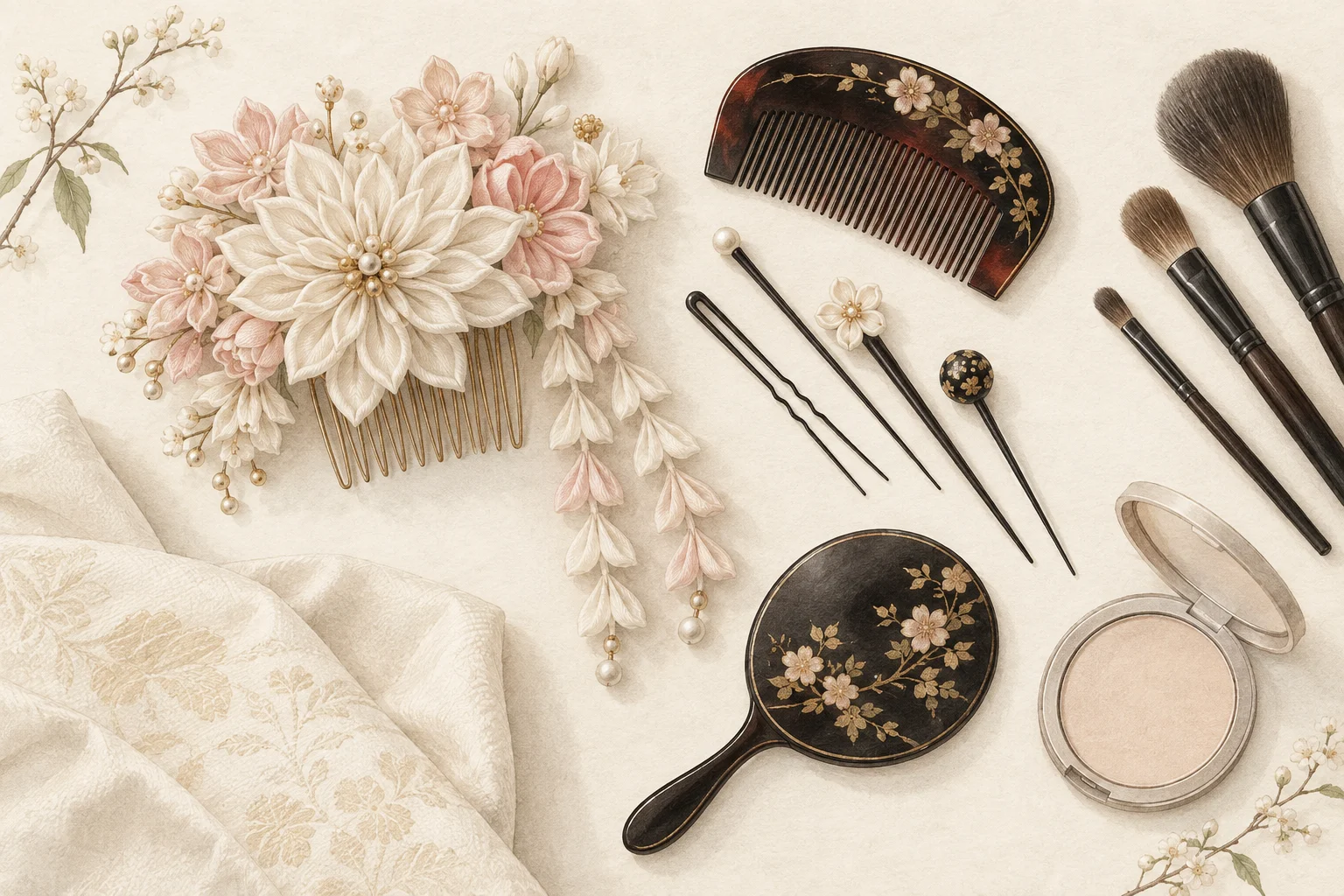
One of the strongest reasons to choose a vintage bridal kimono is that the styling around it can be entirely contemporary. The kimono carries the historical weight; the hair and makeup do not have to. A few directions work particularly well.
Soft modern updo with antique kanzashi. A loose chignon or low bun with one or two genuine antique kanzashi reads as editorial rather than reenactment. Avoid the heavily lacquered bunkin-takashimada wig unless you are committed to a full traditional ceremony look.
Natural makeup with strong lip. A clean skin finish with a deep red or muted oxblood lip pairs particularly well with Taisho-era color palettes. Heavy white oshiroi foundation is historically accurate but reads dated against modern photography; most contemporary shoots skip it.
Hair down or half-up for Taisho pieces. Because Taisho silks already carry an Art Nouveau modernity, a softer hair approach — half-up, gentle waves — can work without losing the kimono's identity. Meiji pieces are more formal and usually want a more structured updo.
Wedding Planner's Note: if you are bringing a foreign hair and makeup artist, send them reference images of the specific kimono in advance and let your Japanese kitsuke dresser confirm the silhouette works. For broader hair guidance on non-Japanese hair types, see hair styling for foreign brides in kimono.
Heirloom Kimono — Bringing Your Own
A separate category from renting: some couples have a family kimono — inherited from a grandmother, found in a relative's storage, or bought years earlier on a trip to Japan — and want to wear it for the shoot. This is increasingly common with Japanese-heritage couples and with non-Japanese couples whose families collected textiles.
The practical path is straightforward but has a few steps. First, send clear photos of the kimono (front, back, sleeves, lining, any visible damage) to the photographer or planner before booking. They will route the images to a kitsuke dresser who can advise on condition and whether the piece is wearable. Many heirloom kimono need light restoration — re-stitching a hem, replacing a damaged collar — before they can be worn for a shoot; a Kyoto or Tokyo specialist can usually handle this in 2–4 weeks.
Second, decide whether to fly the kimono with you or ship it in advance. Most couples fly with it in a carry-on garment bag. Customs treatment is generally straightforward: a personal-use textile, no commercial value declared. If the piece is genuinely valuable, declare it on the way in to avoid questions on the way out.
Third, agree on dressing fees. A kitsuke dresser handling an heirloom piece typically charges the same as a standard dressing fee (JPY 15,000–40,000) but may add a small handling premium if the silk requires extra care. Many studios will discount the rental side of their package when you bring your own kimono, but not always — confirm in writing.
One sensitive note: bridal uchikake and shiromuku are specific garments. A formal furisode or a houmongi (visiting kimono) inherited from a family member is beautiful but is not, strictly speaking, bridal dress. Many couples wear them anyway and the result is lovely; just be aware of the distinction. Our overview of shiromuku vs iro-uchikake and the broader traditional Japanese wedding dress guide cover the formal categories in detail.
If body proportions don't match the heirloom kimono, see body type kimono fitting for foreign brides for the practical limits — an antique kimono cannot be re-sized as freely as a modern rental, and very tall or curvier brides may need a tailored solution or a substitute rental piece.
Frequently Asked Questions
Is an antique kimono actually worth the extra cost?
If the visual difference matters to you — heavier silk, denser embroidery, period motifs and color palettes — yes. If you are choosing primarily on visual impact in photos and don't care about provenance, a premium modern uchikake can look comparable for less money. The honest answer depends on whether you value the object or just the image.
Can I rent an antique bridal kimono in summer?
Many houses restrict or refuse antique rentals in July and August because perspiration risk is too high. If you are committed to summer dates, expect a smaller selection and stricter handling rules; consider a vintage Showa piece (less fragile) or a modern reproduction instead.
What is the difference between vintage and antique kimono?
In trade usage, "antique" typically means pre-1945 (Meiji, Taisho, early Showa); "vintage" typically means roughly 1945–1980. Both are pre-owned and pre-loved, but antique pieces are scarcer, more delicate, and priced accordingly.
Can I take the kimono outside for the photoshoot?
Usually yes, but with conditions. Most vintage houses require dry weather, a controlled time window, and no eating or drinking while dressed. Major shrines and gardens are generally fine; check tattoo policies and other site rules through our shrine etiquette guide.
Do antique kimono come in extended sizes?
Rarely. Pre-war Japanese women were typically shorter than modern averages, and most surviving pieces fit roughly 150–165 cm in height. Tall brides may need to choose modern reproductions for fit reasons; see body type kimono fitting for the fitting limits in detail.
What happens if I damage the kimono?
Houses take a refundable damage deposit (typically JPY 50,000–200,000). Minor cleaning is usually covered by the rental fee; visible staining or tears are deducted from the deposit, and severe damage can exceed it. Confirm the policy in writing before signing.
Can I buy an antique bridal kimono outright instead of renting?
Yes. Authentic Meiji and Taisho bridal pieces in good condition are available through specialist dealers in Kyoto, Tokyo, and online. Pricing is roughly equivalent to two to four rentals, and the piece becomes a keepsake. Most reputable dealers will arrange international shipping for purchases.
Are men's antique kimono available too?
Yes, but the inventory is much smaller. Men's formal haori and hakama from the Taisho and early Showa periods turn up regularly at specialist houses. See our men's kimono guide for the formal categories and what to look for.
Find Vintage Specialist Studios
Antique and vintage bridal kimono are a specialist track, not a default offering. Browse our curated photographer directory and filter for studios with established vintage-house relationships in Kyoto, Tokyo, and Kanazawa, or contact us for a shortlist matched to your shoot dates and preferred era.
Related reading: Shiromuku vs Iro-Uchikake · Kanzashi Hair Ornaments · Body Type Kimono Fitting for Foreign Brides · 2026 Kimono Photo Cost Guide · Top Kyoto Studios 2026.
Related guides
 Style guide
Modern Color Bridal Kimono: Blush, Ivory & Pastel Guide
Illustrative image · Unsplash. Not a photo of the specific people, places or services discussed.
Modern color bridal kimono in blush, ivory, sage and dusty rose — a third option between shiromuku and iro-uchikake. Where to rent, how to style.
Read the guide Style guide
What Is a Shiromuku? Japan's White Wedding Kimono Explained
Illustrative image · Unsplash. Not a photo of the specific people, places or services discussed.
What shiromuku means, the pieces of Japan’s white bridal ensemble, and the questions to ask about clothing, styling, availability and a photo-session quote.
Read the guideStyle guideShiromuku vs Iro-Uchikake: Which Kimono Suits Your Photos?
Illustrative image · Unsplash. Not a photo of the specific people, places or services discussed.
A deep comparison of shiromuku and iro-uchikake, Japan's two iconic bridal kimono, and how to choose the right one for your photoshoot vision.
Read the guide