Mother's Kimono at Japanese Weddings: Foreign Mother Guide
A planner's guide to mothers kimono japanese wedding: when foreign mothers wear kuro-tomesode, rental logistics, sizing, hair, and Western alternatives.

Illustrative image · Unsplash. Not a photo of the specific people, places or services discussed.
Check current prices, availability and venue rules with the relevant studio or venue before booking.
If your daughter or son is marrying into a Japanese family, or if you are travelling to Japan for a wedding where kimono will feature prominently, the question of what the mothers should wear is one of the first practical decisions on the table. The Japanese convention is specific: mothers of the bride and groom wear kuro-tomesode, a black formal kimono with five family crests and a continuous design along the hem. For foreign mothers, the choice is no longer binary. More families are renting kuro-tomesode for the day, while others opt for Western formalwear and still photograph beautifully alongside a kimono-clad couple. This guide walks you through both paths from a wedding planner's perspective.
The Cultural Convention — Mothers Traditionally Wear Kuro-Tomesode
At a traditional Japanese wedding, attire is strictly stratified by relationship to the couple and by marital status. The mothers of the bride and groom occupy the most formal tier among guests, and the garment that corresponds to that tier is the kuro-tomesode (黒留袖). Kuro means black; tomesode literally means "shortened sleeve," distinguishing it from the long-sleeved furisode worn by unmarried young women. The kuro-tomesode is reserved for married women and is the most formal kimono in a Japanese woman's wardrobe.
Three features identify a true kuro-tomesode. The body is solid black above the waistline. The hem and lower skirt carry an eba-moyō design — a continuous painted pattern that flows around the garment, often featuring auspicious motifs such as cranes, pine, plum, or flowing water. And the garment bears five kamon (family crests): one on the centre back, one on each chest panel, and one on each upper sleeve. Five crests (itsutsu-mon) signal the highest level of formality.
The mother of the bride and the mother of the groom historically wore matching kuro-tomesode to visually present a unified front during the ceremony and the formal photo session. This convention remains the default at hotel weddings and shrine weddings across Japan today. For a deeper look at the garment itself and how it differs from iro-tomesode, see our companion guide on tomesode for mothers.
Should Foreign Mothers Wear Kimono?
The short answer from working planners: yes, increasingly so, and yes, it is welcomed. There is no rule that excludes a foreign mother from wearing kuro-tomesode at her child's Japanese wedding. The Japanese side of the family — particularly older relatives — almost universally interprets the gesture as respectful and considered. Photographers love it because the family portraits gain visual coherence.
What has shifted in the past decade is the kamon convention. Traditionally a kuro-tomesode carried the wearer's own family crest, which for foreign families simply does not exist in the Japanese registry sense. Rental houses have responded by offering kuro-tomesode with neutral decorative crests — typically a generic auspicious motif such as agehano-cho (butterfly) or maru-ni-kikko (encircled tortoise shell) — which are universally read as "formal kimono" rather than as a specific family. Foreign mothers wearing these rentals are not committing a faux pas; the Japanese guest table will see a kuro-tomesode, recognise the appropriate level of formality, and not scrutinise which household the crest belongs to.
Wedding Planner's Notes: if both mothers are choosing attire together, decide early whether they will match (both in kuro-tomesode) or diverge (one in kimono, one in Western dress). Mismatched expectations are the single most common source of friction we see in the months before the wedding. A short three-way video call between the two families resolves it within minutes.
Renting Kuro-Tomesode in Japan
For a single-day rental, virtually no foreign mother purchases a kuro-tomesode outright. A new one costs the equivalent of several thousand US dollars and the garment has limited use outside Japanese formal weddings. Rental is the standard route.
You have three main rental channels:
- The venue's in-house kimono service. Hotels and full-service wedding venues almost always operate a kimono rental and dressing salon on site. The advantage is convenience: rental, dressing, hair, and makeup happen in one location on the morning of the wedding. The disadvantage is price and selection — venue salons tend to be the most expensive option and stock a curated rather than broad inventory.
- Independent kimono rental houses. Cities such as Tokyo, Kyoto, Osaka, and Kanazawa have dedicated rental shops with extensive kuro-tomesode inventory, including pieces in modern proportions for taller wearers. Pricing is generally 30 to 50 percent below venue rentals. Most arrange same-day dressing at the venue or at their own studio.
- Online rental with shipping. Several major rental companies allow you to reserve a kuro-tomesode online, ship it to your hotel, and return it after the event. This works well only if you have someone competent to do the dressing — kuro-tomesode requires a professional dresser (kitsuke-shi) to tie the obi correctly.
Typical all-in cost for a kuro-tomesode rental including the obi, accessories, dressing, and traditional hairstyle ranges roughly from JPY 40,000 to JPY 120,000 (USD 270–800) depending on channel and city. Booking two to four months in advance is sensible; for goldenweek-adjacent dates or peak cherry blossom and autumn periods, six months ahead is safer.
Sizing for Non-Standard Body Types
Kuro-tomesode is structurally forgiving — the kimono is wrapped and adjusted at the time of dressing rather than tailored — but there are real limits. Most rental inventory is cut for the historical Japanese silhouette: roughly 150–165cm in height and a moderate frame. Taller mothers, very petite mothers, and mothers with significantly larger bust, hip, or shoulder measurements need to be specific at the rental enquiry stage.
Three measurements drive whether a given kuro-tomesode will work for you:
Measurement | Why it matters |
|---|---|
Height (without shoes) | The kimono length must reach the floor when the ohashori waist fold is taken. Standard inventory tops out around 165–168cm; "tall size" inventory extends to about 175cm. |
Bust circumference | The front overlap must close cleanly. Bust above 100cm typically requires "large size" inventory. |
Wingspan (yuki) — neck base to wrist | The sleeves must reach the wrist bone. Foreign mothers with longer arms often need oversized inventory even if bust and height are average. |
Send these three measurements (in centimetres) to the rental house at the time of enquiry. A responsible salon will tell you immediately whether they have stock to fit you. If a venue salon says "we will manage on the day" without confirming measurements, treat it as a yellow flag and bring a backup Western formal outfit.
Hair, Accessories, Footwear
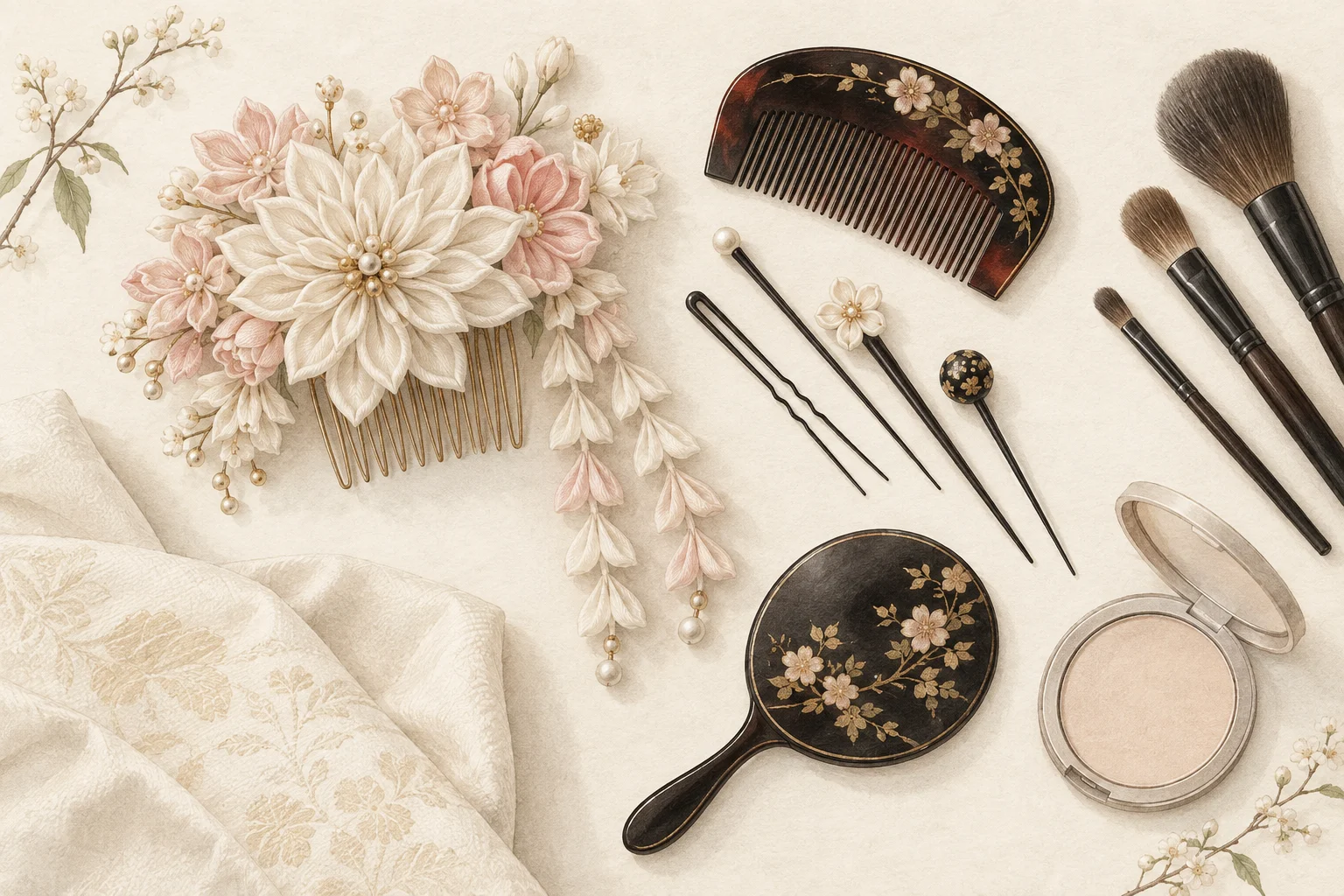
The kuro-tomesode silhouette is completed by a small, specific set of accessories. Most rentals include them in the package, but it is worth knowing what should appear:
- Obi: a fukuro-obi in gold, silver, or richly woven brocade. For mothers, the obi is tied in the formal nijudaiko (double drum) knot.
- Obijime and obiage: the decorative cord and sash that secure the obi. For mothers, these are traditionally white or pale gold to maintain formality.
- Hakoseko and sensu: a small decorative purse tucked into the front of the obi and a folded fan placed at the obi's edge. Both are decorative-only.
- Zori and tabi: formal zori sandals (typically gold or silver) and white tabi socks. For foreign mothers with wide feet, request the largest available size when reserving — Japanese zori run small.
For hair, the traditional mother's style is a refined updo with a single ornamental piece — never the elaborate kanzashi arrangements worn by the bride. Modern salons will adapt to natural hair texture; if you have very fine, very curly, or very short hair, mention it at booking so the stylist can plan for added volume pads or a partial hairpiece. Our shiromuku hair and makeup guide covers the general logistics and applies in principle to mothers as well.
Jewellery is minimal: pearl earrings and a simple pearl necklace are the only accessories typically worn with kuro-tomesode. Wedding rings stay on; everything else comes off.
Western Formal as Alternative
Wearing kuro-tomesode is not obligatory, and a Western formal outfit is perfectly acceptable for a foreign mother. The Japanese guest list will read it as a cultural choice rather than a misstep. The Western options that work well at a Japanese wedding are narrower than at a Western reception, however.
What works: a calf-length or floor-length dress in muted tones — navy, deep wine, charcoal, or soft champagne. A formal long-sleeved dress with modest neckline reads as the closest Western equivalent to kuro-tomesode's gravitas. A two-piece formal suit (jacket and long skirt) in similar tones is also appropriate.
What to avoid:
- Pure white or off-white. White is reserved for the bride at any wedding, and at a Japanese wedding the shiromuku makes this even more pronounced.
- Pure black short dresses. A black cocktail dress reads as funeral attire in Japan. Black is acceptable only if the dress is long, has formal detailing, and is paired with non-black accessories.
- Sleeveless or strapless without a jacket. Bare shoulders at a formal Japanese ceremony are considered too casual; bring a structured jacket or bolero.
- Heavy floral prints. Florals shift the register toward "garden party" rather than "formal wedding."
For a pre-wedding photoshoot rather than the ceremony itself, the rules relax considerably. See our notes on bringing parents to a kimono photoshoot for what works when the parents themselves are not in kimono.
The Mother-of-Groom vs Mother-of-Bride Distinction
In strict traditional etiquette, the mother of the bride and the mother of the groom wear kuro-tomesode of identical formality, with the same five-crest configuration and the same kind of hem design. There is no Japanese equivalent of the Western "mother of the groom should not upstage the mother of the bride" rule — both mothers are framed as equally important hosts of the day.
In practice, the only subtle distinction is in the choice of hem pattern. Some families coordinate so that the bride's mother wears a slightly more elaborate pattern, while the groom's mother wears a quieter one. This is a personal preference rather than a rule, and most families ignore it entirely. If both mothers are renting from the same shop, the shop will happily help you pick two complementary pieces.
One practical recommendation: if one mother is wearing kimono and the other is wearing Western formal, dress the foreign mother in kimono only if she is comfortable in it. A mother who is anxious about sitting, walking, or eating in kuro-tomesode will not photograph well, no matter how beautiful the garment. Comfort beats convention.
Photographing the Family in Mixed Attire
If the couple is in kimono and one or both mothers are in Western formal — or vice versa — the family photographs need a small amount of planning to look intentional rather than mismatched. Experienced wedding photographers handle this routinely, but it helps to brief them in advance.
Three planner-level tips:
- Coordinate colour tones across the group. If the couple is in shiromuku and iro-uchikake, ask the Western-dressed mother to choose a tone that complements rather than fights the kimono palette. Soft champagne, slate blue, or muted plum sit well next to most bridal kimono. See our shiromuku vs iro-uchikake guide for kimono colour planning.
- Plan the formal group shot indoors or in front of a clean backdrop. Mixed attire reads best against a neutral background where the eye is drawn to faces and posture rather than to clashing patterns behind the group.
- Stagger heights and group by attire family. Place kimono-wearers together and Western-wearers together within the composition; do not alternate. This reads more deliberate in the final frame.
For a full pre-wedding photoshoot with parents present, our companion piece on bringing parents to a kimono photoshoot in Japan covers logistics around dressing time, shoot pace, and rest breaks for older relatives. The same logistics apply on the wedding day itself.
Frequently Asked Questions
Is it considered cultural appropriation for a foreign mother to wear kuro-tomesode?
No. Kuro-tomesode worn by a foreign mother at a Japanese family wedding is read by the Japanese side as a gesture of respect, not appropriation. The garment exists specifically to mark the mothers' role on the day, and the role is what determines who wears it — not nationality.
Can I bring my own kuro-tomesode from a previous Japanese wedding?
If you have a kuro-tomesode of your own that fits and has appropriate crests, you can absolutely re-wear it. You still need a dresser to put it on — kuro-tomesode is not a self-dressing garment.
How long does dressing take on the wedding day?
Plan for 60 to 90 minutes for dressing, hair, and makeup. Bring a button-front or zip-front top to wear over your underwear during the morning preparation so you can change out of it without disturbing the hair and makeup.
Can I sit at a low Japanese-style table or chair in kuro-tomesode?
Yes, but with care. The obi knot at the back makes leaning against a chair back uncomfortable; sit upright and forward. For long ceremony segments where you must kneel seiza-style, ask the venue in advance whether a small folding stool is permitted.
What if my measurements exceed all rental house "large size" inventory?
A small number of specialist shops in Tokyo and Osaka stock semi-custom kuro-tomesode for taller or larger international clients. Allow at least three months from enquiry to wedding date for this route. As a backup, plan a Western formal outfit so you are not under pressure on the day.
Do I need to wear a kuro-tomesode if it is a small civil ceremony rather than a hotel wedding?
No. For a small civil ceremony or a casual restaurant-based reception, a refined Western formal outfit or a less formal houmongi kimono is appropriate. Kuro-tomesode is specifically the dress code for ceremonial weddings.
Can the bride's mother and groom's mother wear different colours?
If both are wearing kimono, both should be in kuro-tomesode (black). The colour is the marker of formality and of the mother's role. If one mother chooses Western formal, she can wear another colour within the muted formal palette described above.
Should I tell the rental house I am a foreign mother?
Yes, at the first enquiry. It allows the salon to allocate larger-size stock, prepare neutral-crest options, and arrange an English-speaking dresser if available. It is helpful information, not a problem to be hidden.
Plan Your Family Photoshoot
Whether you are planning the ceremony itself or a pre-wedding portrait session that includes the parents, the photographers in our directory are experienced in working with mixed-attire family groups and with foreign mothers in kuro-tomesode. Browse the Wasou Wedding Japan photographer directory to find a studio that handles the full family, or read our guide to bringing parents to a kimono photoshoot and our companion pieces on tomesode for mothers and furisode for young women guests.
Related guides
 Style guide
Tomesode Mother of the Bride: Kuro & Iro Tomesode Guide
Illustrative image · Unsplash. Not a photo of the specific people, places or services discussed.
Tomesode mother of the bride guide: kuro-tomesode vs iro-tomesode, the five kamon crests, motifs, foreign-family rentals, sizing, and what mothers wear.
Read the guideStyle guideFurisode Wedding Guide: The Unmarried Woman's Formal Kimono
Illustrative image · Unsplash. Not a photo of the specific people, places or services discussed.
A planner's guide to furisode wedding attire for unmarried guests in Japan — sleeve lengths, motifs, rental logistics, and advice for foreign guests.
Read the guide General guide
What to Wear to a Japanese Wedding: Guest Attire Guide
Illustrative image · Unsplash. Not a photo of the specific people, places or services discussed.
A planner's guide to what to wear to a Japanese wedding as a foreign guest — dress codes, color rules, and traditional options for ceremony and reception.
Read the guide