Hakama Groom Japanese Wedding: Formal Styles & Fit Guide
A planner's guide to the hakama groom Japanese wedding look — montsuki, sendaihira stripes, haori, rental costs, and fitting tips for foreign grooms.

Illustrative image · Unsplash. Not a photo of the specific people, places or services discussed.
Check current prices, availability and venue rules with the relevant studio or venue before booking.
The hakama defines the groom's silhouette at a Japanese wedding more than any other single garment. Paired with a montsuki top and haori jacket, the wide pleated trouser-skirt gives him stature next to a bride in shiromuku or iro-uchikake — and dictates how he stands, walks, and sits in every paired portrait. Most foreign grooms underestimate it: the hakama is not a Japanese skirt. It is a structured formal garment with a fitting protocol, color hierarchy, and movement vocabulary you should understand before booking.
What the Hakama Is and Why It Matters at a Wedding
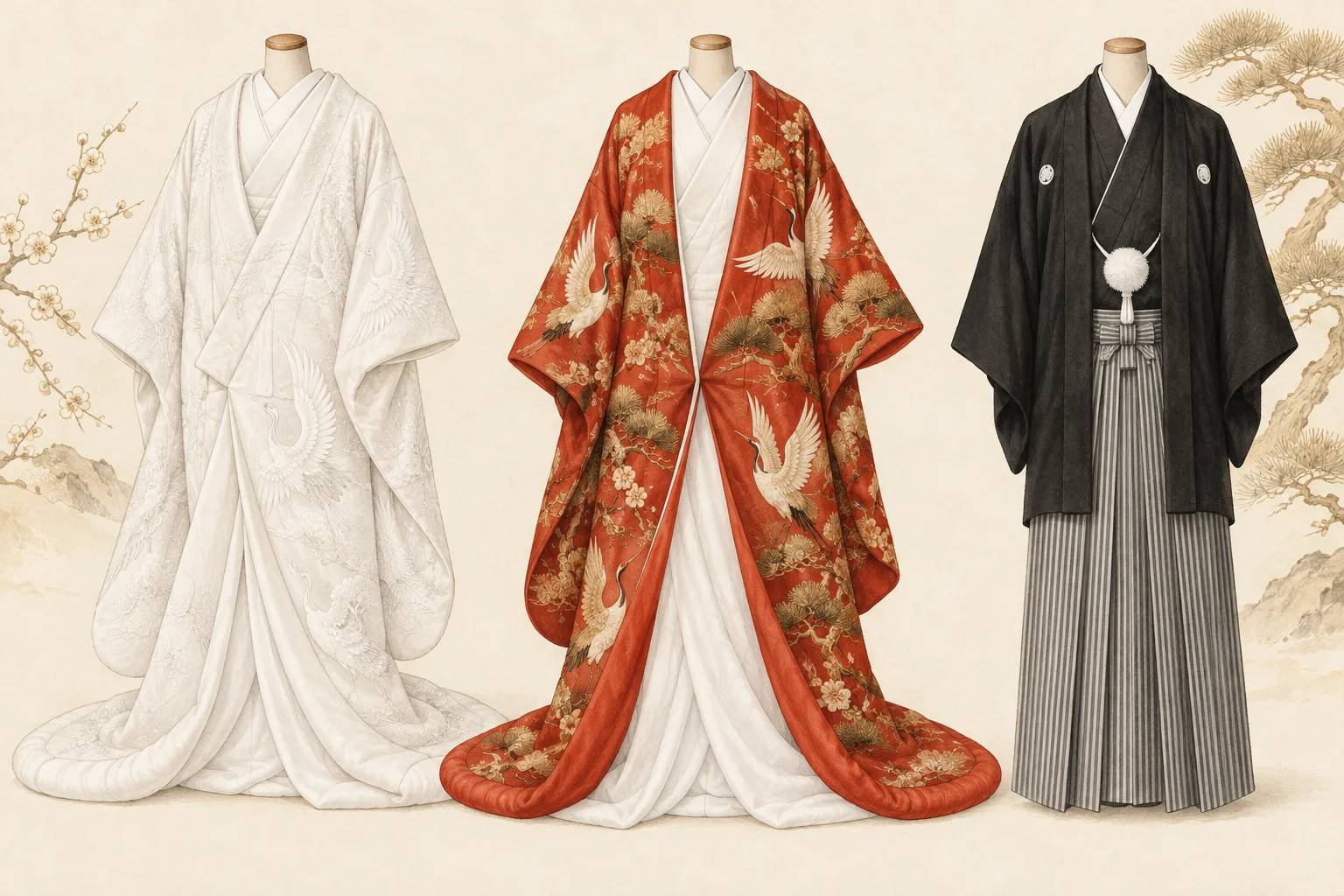
A hakama is a pleated, wide-legged trouser-skirt worn over a kimono. There are two structural types: umanori (divided, with separate legs — used by samurai and modern martial artists) and andon-bakama (undivided, more like a skirt). For wedding formalwear, grooms wear umanori almost universally because it gives the cleaner pleated silhouette in photographs and allows easier walking on shrine gravel and stone steps.
The hakama has seven pleats — five at the front, two at the back — each carrying symbolic meaning rooted in samurai virtue codes. You do not need to memorize the symbolism, but the pleat structure is why a hakama photographs so well: the vertical lines elongate the leg, broaden the shoulder line by contrast, and read as architectural rather than soft. This is also why a poorly tied or wrongly-sized hakama is so visible — the pleats will sag, twist, or pool at the ankles.
Wedding Planner's Notes: At about half the foreign-groom shoots we coordinate, the groom shows up assuming the hakama is essentially loose pants and that fit will be forgiving. It isn't. The koshi-ita (back board) sits at the small of the back, the himo (waist cords) tie at a specific height relative to the obi underneath, and the hem must clear the ankle by a precise margin — too long and you trip on shrine steps; too short and the silhouette breaks. Budget 30-45 minutes for proper kitsuke (dressing).
The Formal Wedding Form
For a Shinto ceremony, the formal full-dress combination is non-negotiable in traditional venues. Three components define it.
Black or Silver Montsuki (Mon-Bearing Top)
The montsuki is the kimono worn under the hakama. For wedding formalwear it is almost always kuromontsuki — black silk with five family crests (itsutsu-mon) placed on the chest, shoulders, and back. Five crests indicate the highest formality level in the kimono hierarchy. The crests are usually round, white, and small (about 4 cm diameter), printed or dyed onto the fabric. If a foreign groom has no family crest, studios use a generic auspicious mon (often a stylized chrysanthemum or paulownia leaf) — this is standard practice for rentals and carries no cultural overstep.
Silver-toned montsuki (silver-gray or pale ash) is a modern variant used at reception parties or for a second-look change after the ceremony. It is not appropriate for the ceremony itself in a traditional shrine, but works well for paired portraits where the bride is in a color uchikake.
Striped Sendaihira Hakama
The wedding hakama is woven from sendaihira — a stiff, lustrous silk originally produced in Sendai (Tohoku region) and now made in only a handful of workshops. Its stiffness is functional: it holds the pleats sharp throughout the ceremony and during long photo sessions. The pattern is a vertical pinstripe in black and white (or black and pale gray) — the alternating stripes are called shima. Width of the stripes varies subtly between makers; closer stripes read as more formal, wider stripes as slightly more relaxed.
Authentic sendaihira hakama for rental tend to be at the higher end of the price range (¥50,000-¥80,000 for a full montsuki-hakama set). Synthetic or polyester-blend hakama in similar striped patterns are available at the lower tier (¥30,000-¥45,000). For a 90-minute shrine ceremony with photographs, polyester is acceptable; for an extended editorial shoot with golden-hour exteriors, silk holds shape better.
Haori, Tabi, and Zori Accessories
The set is incomplete without three accessories. The haori is a black silk jacket worn over the montsuki, also bearing five crests in the same positions — see our companion piece on haori styling for how the bridal and groom haori coordinate. The haori-himo (a white silk braided cord) ties across the chest with a decorative knot.
White tabi socks — split-toed at the big toe to accommodate sandal thongs — are worn with white zori sandals. The zori for grooms have a higher heel block (about 4-5 cm) than casual zori. A sensu (folded white fan) tucked into the obi at the front completes the look; the groom holds it during certain portrait poses.
Color Variations
Color choice signals formality level. Most grooms only consider one combination, but in 2026 studios offer three viable tiers.
Black/White Stripe (Most Formal)
The default and the only choice for a traditional Shinto ceremony. Black kuromontsuki with five crests + black-and-white striped sendaihira hakama + black haori. This is what shrines expect, what officiants are accustomed to, and what photographs cleanly against both bright shrine architecture (Meiji Jingu, Heian Jingu) and dark interiors (Yasaka Jinja honden). If you book a ceremony slot, default to this combination unless your studio specifically suggests otherwise.
Dark Navy or Dark Green (Modern)
For reception parties, second-look portraits, or non-ceremony editorial shoots, dark navy or dark forest green montsuki paired with striped hakama is a modern alternative. The crest count drops to three (mitsu-mon) or one (hitotsu-mon) for these less formal versions, which signals semi-formal rather than full ceremonial. Navy reads particularly well in cherry blossom (April) settings; dark green pairs with autumn foliage (mid-November) — see our notes on spring versus autumn shoots.
Gray Tones (Less Formal, Reception)
Light gray, charcoal, or silver montsuki signal modern reception attire — appropriate for after-party drinks, a hotel reception, or a styled editorial where the bride is in colorful iro-uchikake or modern iro-muji. Gray is also the most flattering for grooms with very pale skin or red hair, where stark black can wash out facial features in flash photography. Discuss tone-matching with your studio during the trial fitting.
Casual & Modern Hakama Variants
Outside ceremonial formalwear, there is a casual hakama category that some grooms request for tea-house-style photos, garden walks, or pre-wedding documentary sessions. These use cotton or hemp blend hakama in solid colors (indigo, sage, off-white) without the formal stripe, paired with a simple kimono (unmonted, in a single color or subtle pattern) and no haori. The look is closer to what a Japanese teacher of tea ceremony or martial arts might wear daily.
This is a legitimate photo style but not appropriate for shrine ceremony entry. If you want both a formal portrait and a relaxed casual look in the same day, plan a two-outfit shoot: the kuromontsuki-hakama for shrine ceremony images, then change into the casual hakama for tea-house or garden portraits. Most studios charge a single-outfit-change supplement of ¥10,000-¥20,000.
Mens Kimono vs Hakama — Which to Wear
Some grooms ask whether they need the full hakama at all, or whether a simpler men's kimono (without hakama) is acceptable. The answer depends on what kind of event you are creating.
For a formal Shinto ceremony — sake exchange in front of an officiating priest, family witnesses present — the hakama is the expected formal dress. A montsuki kimono alone, without hakama, reads as undressed in that setting. For a non-ceremonial portrait session, a styled pre-wedding shoot, or an editorial concept where the kimono drape is the photographic focus, a hakama-less men's kimono is a legitimate choice. Our companion piece, men's kimono for Japanese wedding photos, walks through the non-hakama options in more depth.
Wedding Planner's Notes: A surprising number of foreign grooms initially resist the hakama because they think it will look "skirt-like" in photographs. Once they see test shots, the resistance usually disappears — the hakama gives a much more architectural, intentional silhouette than a kimono alone. The exception is for very tall grooms (190cm+) where the proportion is harder to balance — see fitting notes below.
Rental Costs (¥30,000-¥80,000 Typical)
Rental pricing varies by material, completeness of the set, and studio tier. The table below reflects 2026 rates we see across Tokyo and Kyoto studios.
Tier | Material | Set Includes | Cost (JPY) |
|---|---|---|---|
Entry | Polyester / synthetic blend | Montsuki, hakama, haori, tabi, zori, sensu, basic kitsuke (dressing) | ¥30,000-¥45,000 |
Standard | Silk montsuki + polyester hakama | Same as above + crest customization + light styling | ¥45,000-¥60,000 |
Premium | Full silk including sendaihira hakama | Same as above + professional kitsuke-shi (specialist dresser) + on-location dressing | ¥60,000-¥80,000 |
What is usually not included: transportation of garments to a shrine location (¥5,000-¥15,000 add-on), late-return fees (any return after 24 hours typically doubles), and damage liability for the hakama cords or zori straps if they break during the ceremony. Most studios require a credit card hold of ¥30,000-¥50,000 against damage, refunded after garment inspection. Bundled bride + groom packages save ¥20,000-¥40,000 versus booking separately.
Fitting for Foreign Grooms (Height & Shoulder Adjustments)
Hakama and montsuki sets are sized in three to five height-and-build bands in most rental studios. The ranges are calibrated to Japanese male averages, so foreign grooms with unusual proportions need to confirm fit options in advance.
Tall grooms (185cm+): The largest standard rental hakama hems out at about 185cm wearer height. Above that, you need either a custom-tailored hakama (most studios offer this with 4-6 week lead time, ¥80,000-¥150,000 surcharge) or a Tokyo studio specifically maintaining tall-groom inventory. Ask explicitly: "Do you have hakama in size LL or 3L?" Heights of 190cm+ are tight even at specialist studios.
Broad-shouldered or athletic builds: The montsuki kimono is wrapped, not buttoned, so chest and shoulder size is more forgiving than Western tailored garments. But very broad shoulders (above ~48cm) cause the haori shoulder line to bunch, breaking the clean silhouette. Studios will swap to a larger haori; ensure your studio confirms the haori fits separately, not just the montsuki.
Short grooms (under 165cm): The opposite problem — standard hakama may pool at the ankles. Studios will hem with internal folds (no permanent alteration), which works for a single-day shoot but reduces movement comfort. Walk-test before the ceremony begins.
Wedding Planner's Notes: The single best preparation step is a virtual fitting consultation. Send the studio your height, chest, waist, hip, and shoulder measurements, plus three head-to-toe photos (front, side, back, in fitted clothing). Studios with foreign-couple experience will respond with size recommendations and flag any fit concerns before you arrive in Japan. Most studios will not commit to a specific size band until they see you in person — but they will tell you whether they can fit you at all.
How to Walk and Sit in a Hakama
The hakama changes how you move. Two specific points matter for ceremony and photography.
Walking: Steps should be smaller than your Western default — about 60-70% of your natural stride. The hakama hem can catch on shrine steps if you take long strides. Lift slightly from the hip rather than swinging the leg. On gravel or uneven ground (Meiji Jingu approach, Fushimi Inari steps), walk with the bride at half-pace — this also gives photographers the cleaner paired shot. Avoid stairs if possible during the formal sequence; if unavoidable, the bride descends first and the groom follows.
Sitting: Two postures are used. Seiza (formal kneeling — folded knees, sitting on heels) is required for sake exchange (san-san-kudo) and most ceremony moments. Practice seiza for 5-10 minutes before the wedding day if you have not done it; foreign grooms often experience leg numbness within 3 minutes if untrained. Agura (cross-legged) is used for casual portrait poses but the hakama pleats need to be arranged carefully before sitting — let the kitsuke-shi or studio assistant arrange them, do not pull the fabric yourself.
For the san-san-kudo sequence in particular, you sit in seiza facing the bride. Hands rest on thighs, back straight, shoulders down. The miko (shrine attendant) will guide cup positioning; you do not need to time anything yourself. See our deep-dive on the san-san-kudo sake ritual for the full sequence.
Frequently Asked Questions
Can I wear my own dress shoes under the hakama instead of zori?
No — the hakama is cut to break visually at the ankle on the white zori platform. Dress shoes break the silhouette and look immediately wrong in photos. If zori cause foot pain, request silicone gel insoles (most studios stock them) or schedule rest breaks every 30 minutes.
Do I need a haircut or specific grooming for the hakama look?
Hair should be clean and tidy; traditional preference is short and neat, but contemporary grooms with longer hair are fine — most studios will style on the day. Facial hair is acceptable. Avoid strong cologne (it lingers in silk fabric and may incur cleaning fees). Trim nails the day before.
What happens if it rains and I'm in a hakama at an outdoor shrine?
Silk montsuki and sendaihira hakama are water-vulnerable. Studios provide large clear umbrellas and the shrine ceremony itself is always under cover; the only risk is the approach walk. In heavy rain, studios reschedule outdoor portrait segments and shoot covered architectural sequences instead. Discuss rainy season backup plans at booking, not on the day.
Can I keep my wedding ring on with the hakama, or should I remove it?
Keep it on. Rings are visible in close paired portraits (sake exchange shots, ring-detail close-ups) and are standard for foreign couples regardless of the formalwear. Watches should be removed — they read as anachronistic against the formal silk.
How long does kitsuke (dressing) actually take?
For the full montsuki-hakama-haori set with proper accessories: 30-45 minutes for an experienced kitsuke-shi, sometimes 60 minutes if measurements need adjustment. The bride's kitsuke (shiromuku or iro-uchikake) takes 90-120 minutes. Studios typically schedule the bride first; the groom is dressed during the bride's hair-and-makeup interval.
Is it acceptable for the groom to wear hakama but the bride to wear a Western gown?
Yes, increasingly common in modern receptions and editorial shoots. The visual contrast can work beautifully but requires intentional styling — discuss color coordination (your haori-himo and her gown accent colors) with the studio in advance.
Can I take the hakama home as a souvenir if I love it?
Rentals are returned; for-purchase options exist but are expensive (¥150,000-¥500,000 for a full new set). A more realistic souvenir: many studios will sell you the haori-himo (silk braided cord) or the sensu (folded fan) at the end of the shoot for ¥3,000-¥8,000 — both items pack flat and travel home easily.
What if my partner is also male — can both grooms wear hakama?
Yes. Many studios now style both partners in coordinated montsuki-hakama sets with different crest patterns or hakama stripe widths for visual differentiation in paired portraits. See our note on same-sex kimono wedding photography for studio recommendations.
Find a Hakama-Fitting Studio with Foreign-Groom Experience
The fit and material of a groom's hakama set are not interchangeable across studios — sizing inventory, kitsuke-shi expertise, and willingness to accommodate non-Japanese proportions vary widely. Browse our directory of vetted kimono wedding studios filtered by tall-groom inventory and English-speaking kitsuke-shi to shortlist studios who can actually dress you well, not just rent you the garment.
Next in this batch, we recommend reading our companion piece on obi musubi knots for the bride to understand how her silhouette pairs with yours, then haori bridal coat styling for the coordinated outer-layer story across both partners.
Related guides
 Style guide
Men's Kimono Wedding Photoshoot: Montsuki & Hakama Guide
Illustrative image · Unsplash. Not a photo of the specific people, places or services discussed.
Men's wedding kimono in Japan: montsuki, haori, hakama components, color rules, accessories, and what foreign grooms typically wear.
Read the guide Style guide
Kaku-Obi for the Groom: Narrow Men's Bridal Obi Japan
Illustrative image · Unsplash. Not a photo of the specific people, places or services discussed.
Kaku obi mens bridal Japan guide: 9-10cm width, 4m length, kai-no-kuchi vs katabasami knots, silk vs polyester, ¥5K-¥30K rental, knot positioning for photos.
Read the guide Style guide
Family Crests (Kamon) on Wedding Kimono
Illustrative image · Unsplash. Not a photo of the specific people, places or services discussed.
Kamon (家紋) are family signatures stitched into formal kimono — five, three, or one crest in fixed positions. Here is how the system works, what rental studios actually provide, and what couples with Japanese heritage should research before the ceremony.
Read the guide