Traditional Japanese Wedding Dress & Attire: Bridal Kimono Guide
A complete guide to traditional Japanese wedding attire: the shiromuku, iro-uchikake, and hikifurisode, plus headpieces, accessories, the groom's montsuki, rental costs, and how to choose.

Illustrative image · Unsplash. Not a photo of the specific people, places or services discussed.
Check current prices, availability and venue rules with the relevant studio or venue before booking.
When international couples search for a traditional Japanese wedding dress, what they are actually looking for is the bridal kimono — a layered, sculptural garment that has no Western equivalent. The English word "dress" is imprecise here, because Japanese bridal attire is not a single gown but a coordinated system of inner robes, an outer overcoat, a headpiece, and a small cluster of symbolic accessories. This guide walks you through every piece of the traditional Japanese wedding clothing wardrobe, when each garment is appropriate, how the categories differ visually and historically, and how to choose between them for a Shinto ceremony, a pre-wedding photoshoot, or a hybrid celebration. It is written for couples planning kimono weddings in Japan and for readers who simply want to understand what they are seeing in a photograph.
Traditional Japanese Wedding Attire at a Glance
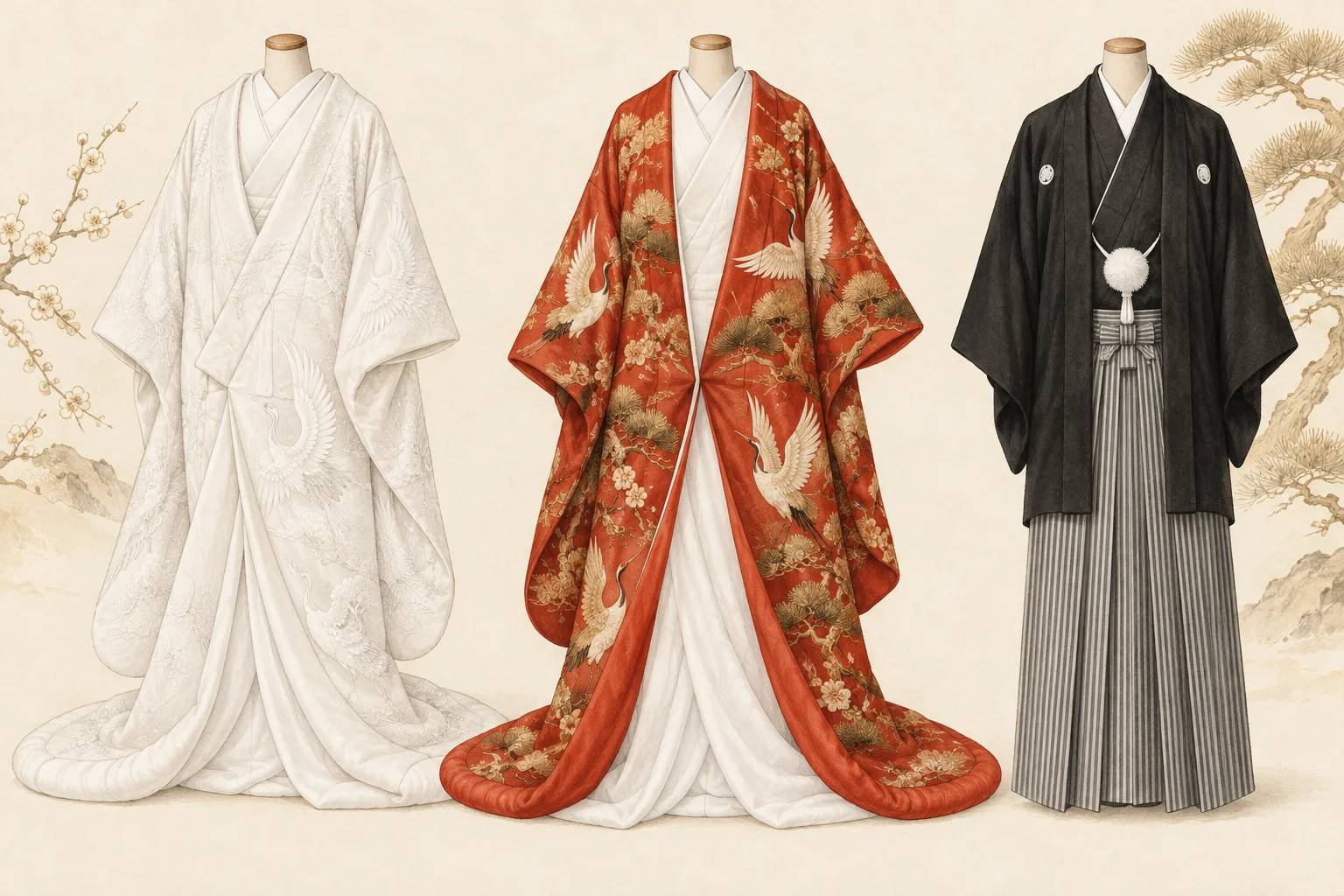
Before drilling into individual garments, it helps to see the categories side by side. The contemporary Japanese wedding dress vocabulary distills down to three principal "looks" for the bride — shiromuku, iro-uchikake, and hikifurisode — plus a foundational under-layer called the kakeshita that all of them share. Each look implies a slightly different ceremony context, photographic mood, and price tier when renting.
Garment | Reading | Visual | Typical Use | Rental Tier |
|---|---|---|---|---|
Shiromuku | 白無垢 | All white, top to bottom | Shinto ceremony, formal portrait | Mid–High |
Iro-uchikake | 色打掛 | Colored overcoat with embroidery | Reception, iro-naoshi, outdoor shoot | Mid–High |
Hikifurisode | 引き振袖 | Long-sleeved kimono, no overcoat | Modern weddings, second look | Mid |
Kakeshita | 掛下 | Inner layer under uchikake | Worn under shiromuku/iro-uchikake | Included |
Montsuki haori hakama | 紋付羽織袴 | Black silk with five family crests | Groom's formal attire | Mid |
One nuance worth absorbing early: the shiromuku and iro-uchikake are not separate "dresses" in the Western sense — they share the same construction. Both consist of a kakeshita (inner kimono) worn under an uchikake (the heavy, trailing overcoat). The category name describes the overcoat. A shiromuku is white-on-white; an iro-uchikake replaces the white overcoat with a colored, embroidered one. Understanding this shared architecture makes the rest of the wardrobe vocabulary much easier to follow.
Wedding Planner's Note: If you are planning a single photoshoot rather than a full ceremony, most studios in Kyoto and Tokyo will let you select one or two looks from this list. A common combination is shiromuku for the formal shrine sequence and an iro-uchikake for the colorful outdoor portraits. We cover that decision in detail below.
Shiromuku (白無垢) — The Pure White Bridal Kimono
The shiromuku is the most ceremonially significant of all traditional Japanese wedding attire. It is the white-on-white ensemble most Westerners associate with a Shinto shrine wedding, and it is the only bridal kimono historically considered appropriate for the ceremony itself. The name literally means "pure white, without stain" (白=white, 無垢=unblemished), and the entire silhouette — overcoat, inner kimono, obi, accessories, even the footwear and hair ornaments — is rendered in shades of ivory, cream, and silvered white.
Origins and Symbolism
The shiromuku traces to samurai-class weddings of the Muromachi period (14th–16th century). White carried two layered meanings in that context. First, it symbolized purity and the bride's readiness to "be dyed in the colors of her new family" — a metaphor that, while traditional, is rarely emphasized in contemporary wedding planning. Second, white was the color of sacred ritual in Shinto, the same white used for shrine offerings and priestly garments. By the Edo period, the shiromuku had become the standard bridal ceremony garment among the warrior and merchant classes, and the convention persists today.
Fabric, Construction, and What to Expect on Your Body
A traditional Japanese wedding gown of this type is built from multiple silk layers. The outermost piece is the shiro-uchikake, a long-trailing overcoat woven from white silk and decorated with subtle white-on-white embroidery or jacquard motifs — typically cranes (tsuru), pines (matsu), bamboo (take), plum (ume), or phoenix (ho-o). Underneath, the kakeshita is a full-length white kimono tied with a white maru-obi. The total weight, including under-layers, is often 8–15 kilograms. Plan on slower movement, shorter walking distances, and one or two breaks during a shoot.
When to Choose Shiromuku
Choose the shiromuku if any of the following apply: you are having a Shinto ceremony at a shrine, you want the most ceremonially "correct" look for formal portraits with parents, you want photography inside a temple or traditional teahouse where a colored overcoat would compete with the architecture, or you simply prefer a monochrome aesthetic. For a deeper comparison with the colored alternative, see shiromuku vs iro-uchikake.
Iro-Uchikake (色打掛) — The Colorful Overcoat
If the shiromuku is the ceremonial garment, the iro-uchikake is the celebratory one. The character 色 means "color," and the iro-uchikake is the colored, heavily embroidered overcoat traditionally worn during the reception (hiroen) or for the iro-naoshi — the bride's outfit change midway through the celebration. In a contemporary photoshoot context, the iro-uchikake has become the most visually dramatic of all Japanese wedding dresses, and the look many couples request specifically for outdoor portraits in autumn foliage or against shrine vermilion gates.
Colors and What They Mean
Red (赤, aka) is by far the most popular iro-uchikake color. In Japanese tradition, red is the color of life, vitality, and protection against misfortune — the same color used for shrine torii and ritual implements. A red iro-uchikake with gold embroidery is the most photographically "obvious" Japanese wedding image and the safest choice if you cannot decide. Beyond red, common options include:
- Gold / kinran (金襴) — opulent, ceremonial, photographs well in low light
- Black (黒) — restrained and dramatic; favored for evening or studio shoots
- Pink / peach (桃色) — softer, often chosen for spring sakura shoots
- Blue or navy (紺) — rarer, modern, sometimes preferred for second looks
- Purple (紫) — historically the color of nobility; understated formality
Motifs and Their Meanings
Iro-uchikake embroidery is not decorative noise; each motif carries a specific auspicious meaning, and your selection is part of the styling conversation with the rental shop. Common patterns include:
- Cranes (鶴, tsuru) — longevity and a lifelong marriage
- Phoenix (鳳凰, ho-o) — peace and prosperity
- Pine, bamboo, plum (松竹梅, sho-chiku-bai) — endurance, flexibility, perseverance
- Peony (牡丹, botan) — wealth and elegance
- Cherry blossom (桜, sakura) — beauty and renewal
- Chrysanthemum (菊, kiku) — long life and imperial dignity
- Mandarin ducks (鴛鴦, oshidori) — marital harmony
When to Choose Iro-Uchikake
Choose the iro-uchikake for: outdoor portraits where you want strong color against greenery or shrine architecture; the reception phase of a Shinto wedding; a second look in a two-outfit photoshoot; or simply when you find the all-white shiromuku visually flat in photographs. For the side-by-side decision, see our bridal kimono comparison.
Hikifurisode (引き振袖) — The Long-Sleeved Modern Bridal Option
The hikifurisode is the third major category of bridal kimono and the one most likely to be unfamiliar even to readers who already recognize the shiromuku and iro-uchikake. The name combines 引き (hiki, "to trail") and 振袖 (furisode, "swinging sleeves"). It is a long-sleeved kimono — the sleeve length is the same as the formal furisode worn by unmarried young women — but with an extended, trailing hem that the bride lets sweep behind her instead of being tucked up.
Critically, the hikifurisode is worn without the heavy uchikake overcoat. This makes it lighter, more mobile, and visually less voluminous than either the shiromuku or iro-uchikake. The obi is tied prominently at the back in a decorative knot (often a fukura-suzume or tateya-musubi), which becomes a focal point of the look from behind.
Style and Practical Differences
Because there is no overcoat, the hikifurisode shows off the patterning of the kimono itself across the full body. Designs are often bolder and more graphic than the embroidered overcoats — large peonies, abstract waves, gold-leaf motifs. The garment is lighter (roughly half the weight of a shiromuku ensemble) and easier to walk in, which makes it a popular choice for:
- Modern hotel or restaurant weddings without a shrine component
- The reception or after-party where mobility matters
- Pre-wedding photoshoots in walking-style locations like Asakusa, Gion, or Kamakura
- Brides who find the uchikake silhouette too heavy or too "costume-like"
Historically, the kuro-hikifurisode (black hikifurisode) was the standard bridal garment for samurai-class brides before the all-white shiromuku became dominant, and a black hikifurisode remains a distinctive, slightly counter-traditional choice with strong photographic results. A red or colored hikifurisode reads as both bridal and modern, and is increasingly common in contemporary kimono weddings.
Kakeshita (掛下) — The Under-Layer
The kakeshita is the inner kimono worn under the uchikake overcoat in both shiromuku and iro-uchikake ensembles. It is a full-length silk kimono in its own right, usually white or off-white, paired with a white maru-obi tied in a specific bridal knot at the back. You rarely see the kakeshita in full because the overcoat covers most of it, but it shows at the collar, the sleeve openings, and along the front hem where the uchikake falls open.
When discussing your wardrobe with a rental shop, the kakeshita is almost always included as part of the package — you do not need to select it separately. The exception is if you specifically want a colored or patterned kakeshita to peek out from under a white shiro-uchikake; some studios offer this as an upgrade. Couples doing a formal portrait at a tatami room sometimes have the bride remove the uchikake to reveal the kakeshita underneath as a "third look" without the cost of renting a separate full kimono.
The kakeshita is also the layer that determines comfort. Cotton-blend kakeshita are easier to wear in summer; silk kakeshita are warmer and drape better but make hot-weather shoots difficult. If your shoot is in July or August, ask the studio about lightweight kakeshita options.
Headpieces — Wataboshi & Tsunokakushi
The bridal kimono is incomplete without a headpiece, and the choice you make here changes the silhouette and the symbolism of the entire look. There are two traditional options, both worn exclusively with the shiromuku.
Wataboshi (綿帽子)
The wataboshi is the large, white, hood-like headpiece that completely covers the bride's traditionally styled hair. It looks like a soft, structured cocoon framing the face and is worn only with the shiromuku, only during outdoor or processional moments (such as the sanshin-no-gi shrine procession). Historically, the wataboshi served the same symbolic function as the Western veil — concealing the bride's face from anyone other than the groom until the ceremony's conclusion.
The wataboshi reads as the most "classic" bridal silhouette in Japanese photography. It is heavy enough that you will feel it on your head and may need a hairstylist's help to keep it positioned correctly during a long shoot. It is also visually large, which means tight indoor framings can be challenging — most photographers will use wataboshi shots for wider, environmental compositions.
Tsunokakushi (角隠し)
The tsunokakushi is the alternative: a flat, rectangular white silk band worn around the head, covering the elaborate bridal hairstyle (typically a bunkin-takashimada chignon) but allowing the kanzashi hair ornaments to remain visible. The literal translation is "horn hider," from an older folk interpretation that the headpiece concealed the bride's metaphorical "horns" of jealousy or ego — a symbol of her commitment to enter the marriage with humility. Modern brides and planners rarely emphasize this reading.
The tsunokakushi can be worn with either the shiromuku or the iro-uchikake (the wataboshi can only be worn with the shiromuku). This makes it the more flexible choice for couples who want to switch overcoats mid-shoot without restyling the head. For a deeper look at the hair and makeup that supports both options, see our guide to hair and makeup for the shiromuku.
Bridal Accessories — Kanzashi, Sensu, Hakoseko, Kaiken, Shiro-Tabi, Zori
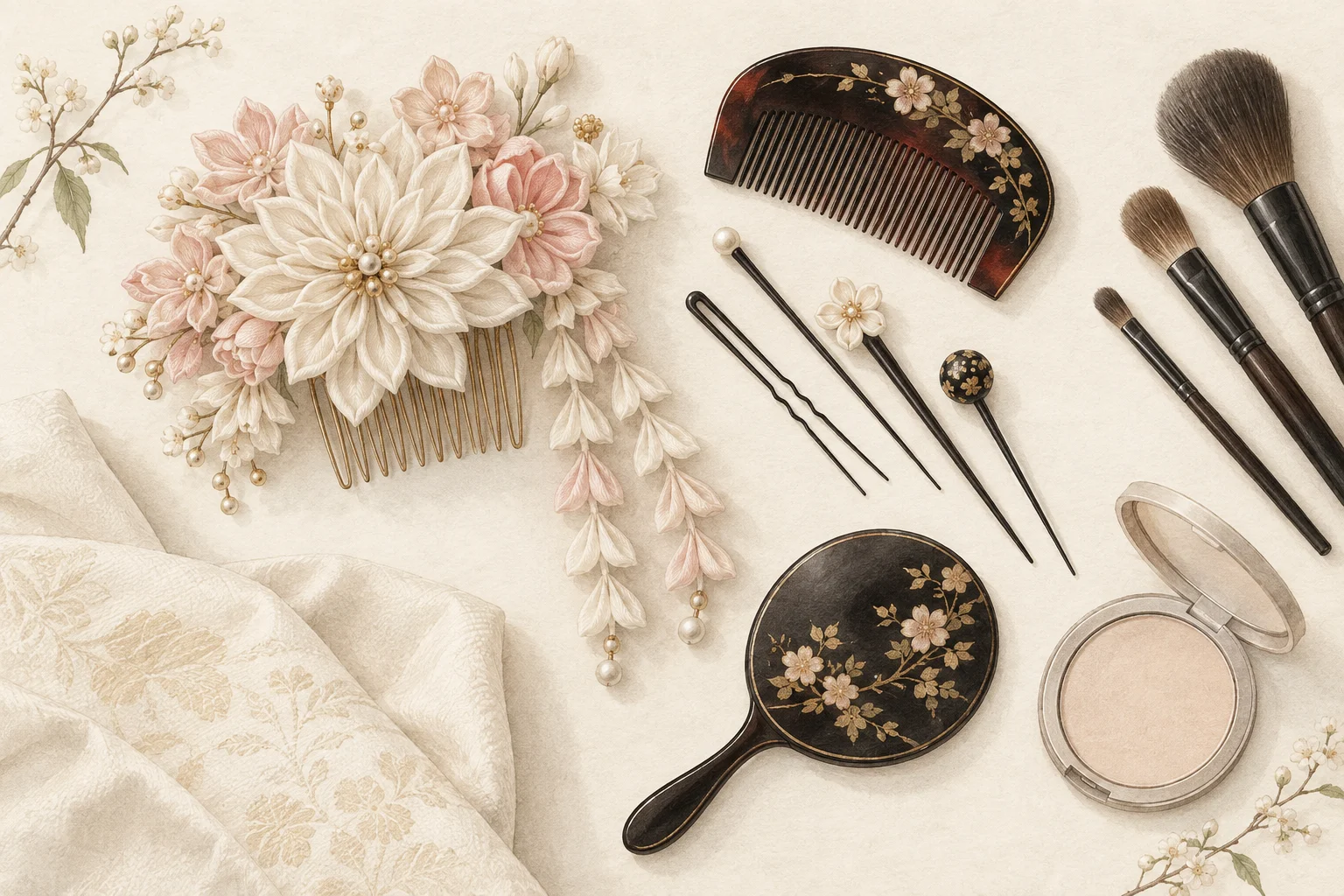
Traditional Japanese bridal dress is completed by a small set of accessories, each with a specific position on the body and a symbolic role. None of them are optional in a formal bridal styling, and most are included in the rental package without separate cost. Knowing what each item is will help you understand the styling conversation and the photographs that come back.
Kanzashi (簪)
Kanzashi are the decorative hair ornaments inserted into the bridal chignon. Bridal kanzashi are larger and more elaborate than everyday versions — typically tortoiseshell-finish combs, long silver bira-bira pins with dangling petals, and floral pins in seasonal motifs. With a tsunokakushi the kanzashi remain visible at the sides; with a wataboshi they are mostly hidden. Read our dedicated piece on kanzashi hair ornaments for the bridal kimono for the full vocabulary.
Sensu (扇子)
The sensu is a small folding fan held in the right hand or tucked into the obi. It is decorative rather than functional — a bridal sensu is gilded and patterned to coordinate with the overcoat. In portraits, it is usually held closed at chest height, providing a focal point for the hands.
Hakoseko (筥迫)
The hakoseko is a small embroidered pouch tucked into the front of the obi, just below the collar. Historically it held a samurai-class bride's personal effects — a mirror, paper, small items. Today it is purely decorative, and the embroidered front is chosen to match the overcoat.
Kaiken (懐剣)
The kaiken is a small ornamental dagger in a silk-wrapped sheath, tucked into the obi alongside the hakoseko. Its historical origin is a samurai-class bride's personal protective weapon. Today it is decorative and ceremonial. Modern brides rarely think about the dagger element; it simply reads as a small fabric-wrapped accessory in the obi area.
Shiro-tabi (白足袋) and Zori (草履)
The bride wears white split-toe socks (shiro-tabi) and white or gold-finished zori sandals. The shiro-tabi must be white for any bridal look. The zori platforms are higher than everyday versions, which raises the bride's height and helps the trailing hem fall correctly. Plan on slower walking and short steps — this is one of the reasons shrine procession photographs have a deliberate, ceremonial pace.
Groom's Attire — Montsuki Haori Hakama
While this guide focuses on the bridal kimono, a brief note on the groom's traditional Japanese wedding attire is essential context. The groom wears the montsuki haori hakama (紋付羽織袴): a black silk kimono (montsuki) marked with five family crests in white, layered with a black haori jacket (also crested) and finished with a striped hakama — wide, pleated trousers — in black-and-grey or black-and-white stripes. White tabi and black-and-white zori complete the look. Accessories include a white folded fan tucked into the obi and a haori-himo cord across the chest.
The montsuki haori hakama is the male equivalent of the shiromuku in formality — it is the only kimono ensemble considered fully appropriate for a Shinto wedding ceremony. For more on options, fit considerations for taller Western grooms, and how to coordinate the groom's look with the bride's, see our piece on men's kimono for Japanese wedding photos.
Regional Variations — Bingata & Ryusou in Okinawa
Outside the main islands of Japan, Okinawa preserves a completely distinct bridal wardrobe rooted in the Ryukyu Kingdom rather than mainland samurai tradition. The Okinawan bridal dress is called ryusou (琉装, "Ryukyu dress") and uses bingata (紅型) — a stencil-resist dyed textile with bold, sun-bleached colors and tropical motifs (hibiscus, deigo flowers, fish, stylized waves). The silhouette is looser than a mainland kimono, the sleeves shorter and wider, and the headpiece is a hanagasa (花笠) — a flat woven hat decorated with floral elements rather than a wataboshi or tsunokakushi.
Bingata ryusou is not a "kimono variation" — it is its own tradition. If you are shooting on Okinawa's main island or the outer Yaeyama islands and want a locally rooted look rather than a mainland shiromuku, ask studios specifically about bingata or ryusou options. For full context, see our piece on bingata, ryusou, and Okinawan traditional dress, and our broader guide to an Okinawa kimono photoshoot.
Japanese Wedding Dress vs Western Wedding Gown
Most couples booking a shoot in Japan are not choosing between a Japanese wedding dress and a Western wedding gown — they are deciding whether to wear both. Studio packages routinely bundle a kimono block and a white-gown block into the same day, so the real question is time and budget rather than taste.
The practical differences matter more than the aesthetic ones:
- Dressing time. A bridal kimono takes a specialist dresser 30 to 45 minutes to put on, and the hair and makeup that precede it run 90 to 120 minutes. A gown is quicker to step into, but switching formats mid-shoot means restyling hair and makeup as well, which adds another 30 to 45 minutes.
- Shoot time lost to the change. Adding a Western change after the iro-uchikake block typically costs 60 to 90 minutes of the day. On a four-hour package that is a large share of the window.
- Movement. An uchikake restricts your stride and is not practical on uneven ground or for long walks between locations. A gown opens up more of the site.
- Cost. A second outfit is almost always a paid add-on, not an included option. Confirm the fee before you book.
If your package only has room for one look, the honest trade-off is this: a bridal kimono with a licensed dresser, a shrine or garden setting, and a photographer who knows how the fabric moves is difficult to arrange outside Japan. A white gown is available at home. Couples who want both usually shoot the kimono first, while hair, energy, and light are all at their best.
For a fuller comparison of the two formats, see Western dress vs kimono for a Japan pre-wedding photoshoot, and browse studios offering Western-dress plans alongside kimono.
Renting vs Buying — Cost and Logistics
Almost no international couple — and very few Japanese couples — buy a bridal kimono outright. The rental ecosystem is mature, comprehensive, and almost always the right choice. A new shiromuku or iro-uchikake purchased outright can run from several million yen into the tens of millions for fully hand-embroidered, designer pieces. By contrast, a rental for a single day or photoshoot is a fraction of that.
Typical Rental Price Bands
Tier | Garment | Indicative Range (JPY) | What You Get |
|---|---|---|---|
Entry | Studio-grade kimono, machine embroidery | ¥30,000–¥80,000 | Basic styling, photo studio package |
Mid | Better silk, mixed embroidery | ¥80,000–¥200,000 | Wider motif selection, location-friendly |
Premium | High-end silk, hand embroidery, designer pieces | ¥200,000–¥500,000+ | Ceremony-grade, rare motifs, lighter weight |
Prices vary substantially by region (Kyoto is typically higher than Tokyo for premium pieces) and by package structure (whether dressing, hair, makeup, location use, and the photoshoot itself are bundled). For the broader cost picture including photography and venue, see our guide to kimono photoshoot cost in 2026.
Logistical Notes
- Dressing (kitsuke) takes 45–90 minutes and is almost always included in the rental.
- You cannot dress yourself — a licensed dresser handles the layering, knotting, and final adjustments.
- Bridal hair (nihongami chignon or a wig variation) takes another 30–60 minutes; modern brides increasingly use a wig (katsura) rather than styling their own hair.
- The full process from arrival to "ready" runs 2–3 hours. Plan your day accordingly.
- You typically cannot eat or drink freely while wearing the kimono. Use a straw, and schedule food before or after.
How to Choose Your Bridal Kimono — A Decision Framework
The choice between shiromuku, iro-uchikake, and hikifurisode is the single biggest styling decision in planning a kimono photoshoot or wedding. Below is the decision framework we walk clients through.
Step 1: Define the Context
Start with what you are actually shooting. A Shinto ceremony at a major shrine strongly implies a shiromuku for the ceremony portion. A pure photoshoot with no ceremony component has no obligation to use one specific category — you choose based on aesthetic and location. A two-look photoshoot (the most common arrangement) typically pairs a shiromuku with an iro-uchikake or a hikifurisode.
Step 2: Consider the Location
Location strongly affects which look photographs best:
- Inside a temple or shrine — shiromuku, because the architecture is the color
- Outdoor garden, autumn foliage, sakura — iro-uchikake, because color competes with nature
- Urban street (Asakusa, Gion) — hikifurisode, because mobility matters; see our Asakusa kimono shoot guide
- Modern hotel or studio — any of the three; iro-uchikake or hikifurisode tend to photograph better against neutral backgrounds
Step 3: Consider the Season
Heavy uchikake-based looks are difficult in July–August heat and easier in October–April. If you are shooting in summer, ask explicitly about lightweight kakeshita options or consider a hikifurisode. For seasonal considerations more broadly, see our guide to the best season for a kimono photoshoot.
Step 4: Consider Your Body and Mobility
The shiromuku and iro-uchikake are heavy and restrict movement. If you have any concern about wearing 10+ kilograms of silk for several hours of walking, prioritize the hikifurisode for at least one of your looks, or schedule shorter outdoor segments with an indoor break in between.
Step 5: Make the Choice — A Simple Rule
If you can only afford one look and want the most "traditional Japanese wedding dress" image: shiromuku with wataboshi. If you can afford two and want maximum visual variety: shiromuku + iro-uchikake. If you want a modern, mobile, fashion-forward look: hikifurisode. If you want regional distinctiveness in Okinawa: ryusou with bingata.
For location-specific advice across Japan, our regional guides cover Kamakura, Kanazawa, and Hokkaido. For the broader cultural background to the ceremony itself, see our complete guide to Japanese weddings and our overview of Japanese wedding traditions and customs.
Frequently Asked Questions
What is the traditional Japanese wedding dress called?
There is no single name. The category is called "wasou" (和装, Japanese-style dress) or simply "bridal kimono" (花嫁衣装, hanayome ishou). Within that category, the three main looks are shiromuku (white-on-white), iro-uchikake (colored overcoat), and hikifurisode (long-sleeved kimono without overcoat). All three are correctly described in English as a "traditional Japanese wedding dress," but each has its own ceremonial position and visual identity.
Is the shiromuku really pure white, or is it off-white?
It is intentionally a soft, layered white — closer to ivory or cream than to bridal Western white. The silk is often woven with subtle white-on-white jacquard motifs (cranes, pines, phoenixes), and the embroidery uses silver or white threads. In direct sunlight the shiromuku reads as a warm white; in shade it reads as cream. This is by design, and it photographs better than pure paper-white silk would.
Can I wear an iro-uchikake at a shrine ceremony?
Most shrines will allow it, but the traditional convention is shiromuku for the ceremony itself and iro-uchikake for the reception or post-ceremony portraits. Some shrines have stricter dress policies than others — Meiji Jingu, for example, follows traditional convention closely. If your priority is the ceremony's traditional integrity, default to shiromuku; if your priority is photographic color variety, plan an iro-uchikake change after the ceremony.
What does the bride wear under the uchikake?
The kakeshita — a full-length white kimono tied with a white maru-obi. Underneath that is a hadajuban (skin layer) and a nagajuban (inner kimono), the same base layers worn under any formal kimono. The full layering means even a "single garment" shiromuku is actually four or five layers of silk.
How heavy is a bridal kimono?
A shiromuku or iro-uchikake ensemble runs roughly 8–15 kilograms (18–33 pounds), including the overcoat, inner kimono, obi, and accessories. A hikifurisode without the overcoat runs roughly 4–7 kilograms. Plan on slower movement, shorter walking distances, and breaks every 60–90 minutes during a shoot.
Can I rent a Japanese wedding kimono if I'm not Japanese?
Yes, without exception. Every rental studio in Kyoto, Tokyo, Kanazawa, Kamakura, and other photoshoot hubs serves international clients, and a substantial portion of premium bridal kimono rentals are now booked by overseas couples. Sizing is handled through the dressing process — the kimono is not cut to fit, it is wrapped and tied to fit. Heights up to roughly 180 cm are usually accommodated without difficulty.
Can a man wear a colored kimono at a wedding?
The strictly traditional answer is no — the groom wears the formal black montsuki haori hakama. However, modern Japanese weddings have relaxed this convention substantially, and a colored montsuki (often deep grey, navy, or earth tones) is now common in fashion-forward weddings. For a pre-wedding photoshoot, the groom's options are wider still. See men's kimono for Japanese wedding photos for the full picture.
What is the difference between shiromuku and iro-uchikake?
The two share the same construction — both consist of a kakeshita inner kimono worn under an uchikake overcoat. The difference is the overcoat: a shiromuku has a white-on-white uchikake; an iro-uchikake has a colored, embroidered one. Ceremonially, the shiromuku is the traditional ceremony garment and the iro-uchikake is the reception or iro-naoshi garment. Photographically, the shiromuku reads as restrained and ceremonial; the iro-uchikake reads as celebratory and dramatic. Our dedicated comparison piece goes deeper.
Find a Studio for Your Bridal Kimono Photoshoot
Choosing your traditional Japanese wedding dress is the first half of the decision. The second half is choosing the studio and photographer who will style, dress, and photograph you. The Wasou Wedding Japan directory features curated kimono studios across Kyoto, Tokyo, Kanazawa, Kamakura, Okinawa, and other locations — each vetted for international client experience, garment quality, and photographic output. Browse the directory of kimono wedding photographers to find a studio that matches your aesthetic, location, and budget.
If you are still in the research phase, read our complete guide to Japanese weddings for the broader cultural context, our overview of Japanese wedding traditions and customs, and our practical pieces on booking from abroad and the best season for a kimono photoshoot.
Related guides
 Style guide
Traditional Japanese Wedding Costumes: Who Wears What
Illustrative image · Unsplash. Not a photo of the specific people, places or services discussed.
Traditional Japanese wedding costumes for the bride, groom, family and guests: how formality ranks, what to avoid, and which garments you can actually rent.
Read the guide Style guide
Kimono Fitting for Foreign Brides: Tall, Curvy & Petite
Illustrative image · Unsplash. Not a photo of the specific people, places or services discussed.
Kimono fitting for foreign bride body types: how tall, curvy, plus-size, and petite brides find studios with extended sizing and skilled kitsuke teams.
Read the guide Style guide
Antique & Vintage Bridal Kimono: Meiji-Era Silks Guide
Illustrative image · Unsplash. Not a photo of the specific people, places or services discussed.
A planner's guide to antique vintage kimono bridal options — Meiji and Taisho silks, where to rent in Kyoto and Tokyo, care, pricing, and heirloom basics.
Read the guide