Spring vs Autumn Kimono Photoshoot: Sakura or Momiji
Sakura versus momiji compared honestly: cost, crowds, light, booking lead time, and which couples pick which. Planner guidance for choosing your kimono shoot season.

Illustrative image · Unsplash. Not a photo of the specific people, places or services discussed.
Check current prices, availability and venue rules with the relevant studio or venue before booking.
Couples asking us "spring or autumn?" usually expect a confident answer. The honest one is: it depends on what you can tolerate. Cherry blossom and autumn foliage are the two seasons that put kimono photography on most international couples' radar, and they trade off differently across cost, crowds, light, and booking lead time. Sakura wins on iconography and gets crushed on crowding. Momiji wins on light quality and stretches across a longer window. Below is how we walk clients through the choice — without pretending either season is universally better.
At-a-Glance Comparison Table
Before we go category by category, here is the planner-level summary we share with couples in initial consults. Use it as a quick filter, then read the sections that matter to your situation.
Factor | Spring (Sakura) | Autumn (Momiji) |
|---|---|---|
Peak window | ~10 days late March-early April (region dependent) | ~3-4 weeks mid-October to late November |
Booking lead time | 9-12 months | 6-9 months |
Per-shoot price | Comparable | Comparable, with weekday discounts more available |
Tourist crowding | Heaviest of the year | Heavy but manageable |
Light quality | Soft, often hazy or overcast | Lower-angle, golden, dramatic |
Weather risk | Wind, rain, early-bloom or late-bloom mismatch | Typhoon tail in early October, generally drier by November |
Recognizable locations | Philosopher's Path, Maruyama Park, Chidorigafuchi | Tofuku-ji, Eikan-do, Rikugien, Korankei |
Best for | Couples whose Japan trip is locked to early April | Couples with date flexibility and a preference for warmer color palettes |
Wedding Planner's Notes: the table above hides a real planning trap. Sakura's 10-day window means if your trip is locked four weeks long, you can usually catch it — but if your trip is locked to a specific 5 days, the probability that those 5 days overlap full bloom is substantially lower in any given Kyoto or Tokyo year. Couples who absolutely need pink blossoms in the frame should either fly with flexibility or shoot in late autumn instead.
Spring (Sakura) Strengths and Weaknesses
Sakura season is the most-requested kimono shoot window for international couples by a wide margin. The visual association — shiromuku or color uchikake against pink blossoms — is what brought most of our inbound first-time inquiries during March-April 2026. Our companion article on cherry blossom wedding photoshoots covers the location-by-location bloom timing in more detail.
Strengths: the postcard Japan imagery your friends and family will recognize without explanation; pastel palette that complements pink and ivory uchikake; longer daylight than autumn by the time peak bloom hits.
Weaknesses: bloom timing is a moving target — official forecasts only stabilize 7-10 days out, which collides badly with international flight bookings made months in advance. Crowds at famous spots like Philosopher's Path or Meguro River reach the point where clean two-shot framing is genuinely difficult. And March in particular can deliver cold-snap days that fight against bridal kimono comfort — temperatures in single-digit Celsius with wind are not what most foreign brides expect from "spring in Kyoto."
Autumn (Momiji) Strengths and Weaknesses
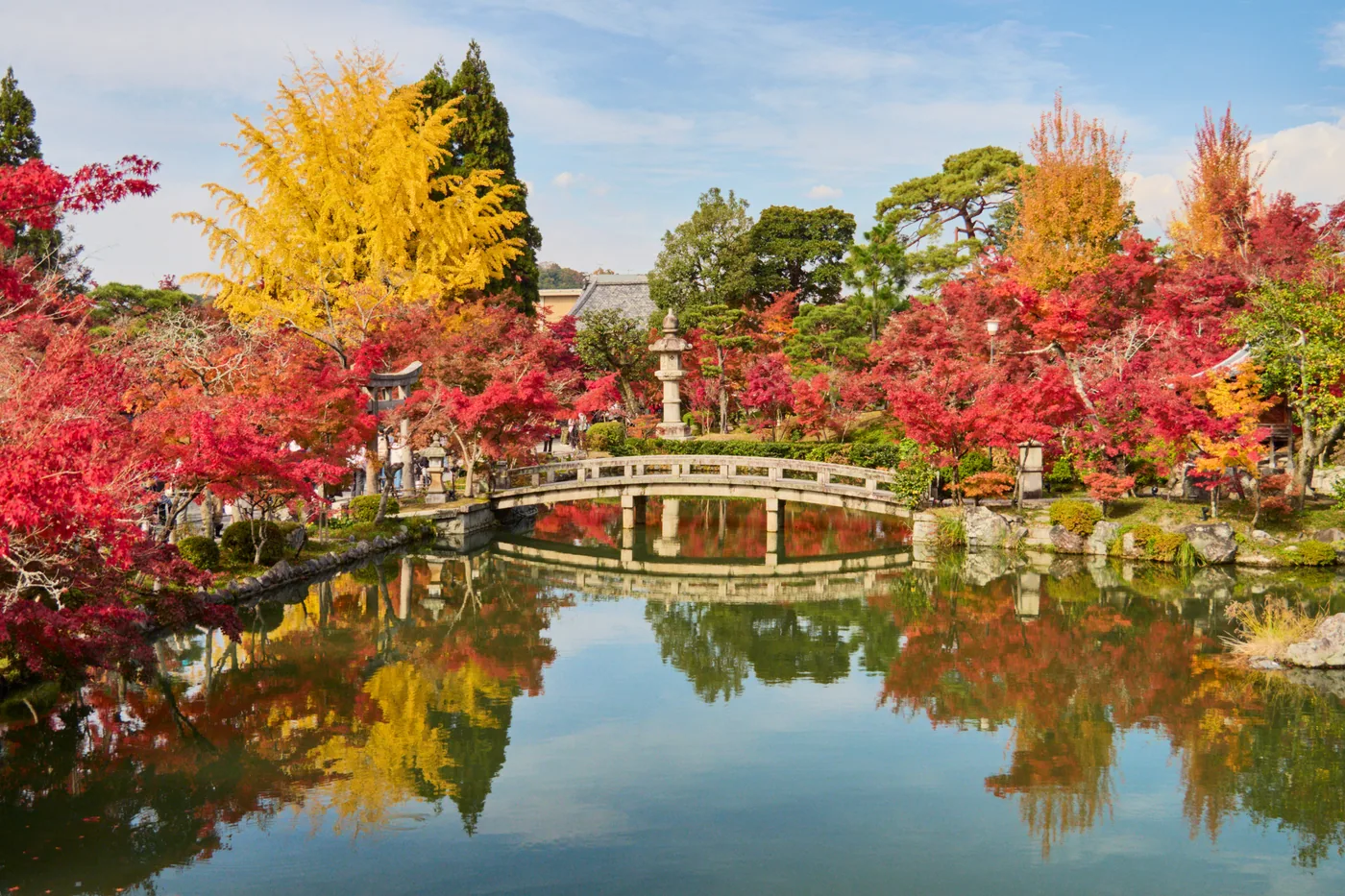

Autumn foliage is the season our photographers usually recommend when couples ask "which season do you personally prefer to shoot?" The reasons are technical, and we walk through them in depth in our autumn foliage kimono photoshoot guide.
Strengths: a three-to-four-week peak window (early November in mountain Kyoto, late November in central Kyoto, can extend into early December in some Tokyo gardens) is dramatically more forgiving than sakura's ten days. The lower sun angle in November produces directional warm light that flatters faces and kimono fabric texture better than the diffuse light of April. Crowds exist but rarely reach the gridlock state of peak sakura.
Weaknesses: red maple is harder to compose against red, orange, or scarlet uchikake — you risk a one-note frame. Many couples end up choosing more neutral or ivory kimono for autumn shoots to keep the foliage as the color statement. The season also coincides with the end of typhoon tail risk in early October, and late November in Kyoto can deliver chilly mornings that require obi-warming pads under the kimono.
Cost Comparison

On per-shoot package price, spring and autumn are very close — typically within ¥10,000-¥20,000 of each other for the same photographer and same kimono tier. What differs are the surrounding costs that most couples forget to budget for.
Spring's hidden costs: airfare during late March and early April spikes 20-40 percent above shoulder-season rates because of overlap with Golden Week buildup and Japanese university graduation travel. Hotel rates in Kyoto can double for properties near Higashiyama. Studios may add a "peak sakura surcharge" of ¥10,000-¥30,000 for shoots in the actual full-bloom week, especially weekend slots.
Autumn's hidden costs: lower than spring overall. Mid-week shoots in mid-November often get standard pricing with no peak surcharge. Airfare softens after the early October typhoon window. Hotel rates rise in Kyoto for the second half of November but rarely double the way they do for sakura. For couples on a defined budget, we typically recommend autumn — see our 2026 kimono photo cost breakdown for full pricing tiers across both seasons.
Crowding — Spring Sometimes Crippling
This is the section we wish more couples read before booking. At peak sakura in Kyoto's busiest photo spots — Maruyama Park, Heian Shrine front gate, Philosopher's Path — foot traffic between roughly 9 AM and 5 PM during full bloom week can make a clean wide shot impossible without an early start. Local photographers regularly begin sakura shoots at 5:30-6:00 AM specifically to capture 30-45 minutes of light traffic before tourist buses arrive.
Autumn crowds exist, especially at famous foliage spots like Tofuku-ji or Eikan-do, but the pattern is different. Crowds concentrate around midday and disperse by 3:30 PM as guided tours leave. A 2:30-4:00 PM autumn slot at most Kyoto temples is more workable than the equivalent slot during sakura. For Tokyo, the gap narrows — Chidorigafuchi at peak sakura is famously crowded, but Rikugien at peak autumn is also packed.
Wedding Planner's Notes: when couples insist on Kyoto sakura, we now build their day around a 5:30 AM start at Maruyama Park or Heian Shrine, finish the headline location by 7:00 AM, then move to a less-trafficked secondary location like a small Higashiyama temple by 8:30 AM. The result is usable wide shots and a complete sleep schedule disruption that most jet-lagged couples actually appreciate.
Light Quality — Autumn Wins for Many Photographers
Photographers who shoot both seasons regularly almost always cite light quality as their reason for preferring autumn. The mechanics are straightforward: in late November and early December the sun stays lower in the sky for more hours, giving directional warm light from a wider window than April delivers. April's sun is already climbing high by 10 AM in Kyoto, which means harsher overhead light unless the day is overcast.
That said, "overcast spring" is itself a desirable look — the soft, diffuse light common in early April hides skin imperfections, evens out the kimono fabric, and reduces the harsh shadow problem entirely. Some photographers prefer overcast spring for portraiture and clear-sky autumn for environmental shots. If your shoot includes a strong portrait component, ask the photographer how they manage harsh sun — their answer reveals their comfort level.
Autumn's reds and oranges also tend to bounce warm reflected light back onto the subject's face, which most couples find flattering. Sakura's pale pink reflects almost no color onto the subject — which is neutral, not negative, but means your skin tone reads however the ambient light renders it.
Booking Window — How Far Ahead
Sakura: top-tier Kyoto photographers fill their full-bloom weekend slots 9-12 months out. By the time forecasts confirm bloom timing in late February, the prime slots have been booked since the previous June or July. Practical advice: book your photographer first based on a date range (e.g., March 28-April 5), then layer your trip around the booking. We coach couples to add 2-3 buffer days on each side of their target bloom date because shifting the shoot by even one day requires the photographer to have that flexibility too.
Autumn: 6-9 months out is sufficient for most top-tier photographers. Booking by mid-March for a November shoot is usually enough. The reason is that autumn's peak window is wider, so demand spreads across more days rather than concentrating into a single weekend. Couples sometimes succeed with 3-4 months lead time for autumn weekday slots, though the best photographers will be tight by then.
For both seasons, if you are flying internationally, lock the photographer before booking flights. We have seen couples book non-refundable JAL fares around target sakura dates only to discover their preferred photographer is unavailable — at which point either the trip dates have to flex (impossible with the flights) or the photographer changes (preferred result is gone).
For Foreign Couples — Travel and Visa
Both seasons are accessible to foreign couples on standard tourist entry — Japan does not require a special visa for a pre-wedding or commemorative photoshoot. Most Western passport holders (US, EU, UK, Australia, Canada) get 90 days visa-free, which covers any sakura or momiji trip comfortably. Our photoshoot visa requirements guide covers the few situations where you need to declare commercial intent (rare, generally not applicable to a personal commemorative shoot).
Practical travel notes for each season: spring trips need warmer clothing than couples expect — Kyoto in late March can be 8-12°C in the morning. Pack a packable down layer to put on between shoot setups. Autumn trips need layered clothing — November mornings 5-10°C, afternoons 15-18°C, with significant rain risk in the first half of November. Either way, the kimono itself is warmer than couples expect because of the multiple under-layers, but the brief moments of changing in the dressing room can be cold.
If your trip combines the shoot with sightseeing, consider that sakura week sees most major temples and gardens charge premium admission and have entry queues. Autumn admission stays standard. Our 7-day Japan itinerary shows how to sequence a kimono shoot with surrounding travel for both seasons.
Couple Profiles — Who Picks Which
After hundreds of consults, certain patterns emerge clearly enough to share without violating client privacy. Use these as starting points — your situation may obviously override the pattern.
Picks spring: couples whose primary visual reference for "Japan wedding" comes from movies, Instagram, or postcards — that imagery is overwhelmingly sakura. Couples with a fixed trip in late March-early April for other reasons (work travel, university break, family availability) who want to maximize that trip's content. Couples bringing parents who want the postcard Japan moment with cherry blossoms. First-time Japan visitors who want the postcard reference points.
Picks autumn: couples on second or third Japan trips who already have sakura content from previous visits. Couples shooting in red, scarlet, or burgundy uchikake who want warm-tone foliage instead of pink contrast. Photographers themselves when shooting their own portfolio. Couples with flexible work schedules who can travel mid-week. Couples who prioritize cost discipline — autumn is consistently the less expensive total trip.
Picks something else entirely: couples whose travel window falls in May-June (consider wisteria season), late June-July (yukata coverage), or December-February (consider snow wedding shoots in Hokkaido or northern Honshu). The sakura-versus-momiji framing assumes you have a Japan trip window in April or November; many couples don't.
For couples comparing locations within either season, our Tokyo vs Kamakura comparison covers how location choice interacts with seasonal choice — Kamakura's late-blooming cherries and its quieter autumn foliage at Hokoku-ji are good options if you want the seasonal look without Kyoto's crowds.
Frequently Asked Questions
Can I shoot kimono in both seasons on the same trip?
Only if your trip is unusually long. Sakura peaks around April 1-7 in Kyoto and Tokyo; momiji peaks around November 15-30 in the same cities. The two are roughly seven months apart. We have done it for couples who built a 9-month Japan residency (work visa or extended travel) and wanted a sakura plus momiji series, but for trip-based travel it's not feasible.
Is shoulder season (May or October) a workable compromise?
Yes for some couples. Mid-May offers wisteria and azalea — different look, smaller crowds, similar pricing. Mid-October offers early autumn color in higher elevation locations like Korankei or Tohoku, with the trade-off of typhoon tail risk. Late October is generally past typhoon risk and starting to show color in Tokyo gardens. Neither matches the sakura or momiji headliners but both produce strong shoots.
What if our trip dates do not match either season?
Then build your shoot concept around what is actually in season. We do not recommend traveling for sakura in August or momiji in January — the visual reference will be wrong and budgets are better spent on a season-appropriate concept (yukata summer shoot, winter snow shoot, plum blossom February shoot). Forcing the wrong season produces flat results.
Are weekday autumn shoots really cheaper?
Mid-week (Tuesday, Wednesday, Thursday) autumn shoots in November often skip the weekend surcharge that some studios apply. The savings range ¥10,000-¥30,000 depending on photographer. Sakura weekday shoots see less of this discount because the peak window is so short that every day is treated as premium.
What is the rain plan for either season?
Spring: April rain happens, especially second-half April after cherry blossom peak. Most photographers carry vermillion umbrellas as styling props and shoot under temple gate cover or covered walkways. Reschedule risk exists for heavy rain. Autumn: November rain is less frequent but does happen. Same umbrella approach. Both seasons should have a rain-shift policy in the contract — confirm it before booking. Our article on cancellation and rescheduling covers the standard terms.
Which season is better for grandparents or older guests joining?
Autumn, generally. November mornings are cold but not as cold as late March. Crowds are lighter, which matters for guests with mobility limitations. Heat risk is lower than May. If grandparents are joining, the case for autumn over spring strengthens significantly.
Will my photographer travel between Kyoto and Tokyo for either season?
Some will, with travel fees added (typically ¥15,000-¥40,000 plus shinkansen for one direction). However, photographers who are based in their city know the light, the peak timing, and the location quirks better than someone traveling in. Unless you have a specific reason to keep the same photographer for both cities, hiring local in each city usually produces better results.
Can I lock the season choice before deciding the location?
Yes, and we encourage this for couples with constrained travel windows. If you can only travel in November, the season choice is made — then we work backward to which city's foliage peaks in your specific available days. Kyoto and Tokyo peak slightly differently in November (Tokyo a bit earlier in the second half of the month, Kyoto running into early December for some spots), which gives flexibility within the season decision.
Plan Your Seasonal Shoot
Choosing sakura or momiji is the second decision in a kimono shoot, not the first. The first is photographer availability — without that, your season choice has no executor. Browse the Wasou Wedding Japan featured photographer directory filtered by Kyoto, Tokyo, or your preferred city to see who has openings in your target window, then layer the season decision on top.
If you are still working through season versus location, read our Tokyo vs Kamakura kimono comparison next for how city choice interacts with the seasonal look you are after. For couples whose trip is locked to specific dates already, our best season for kimono photoshoots overview covers all twelve months at a glance.
Locations in this guide
Related guides
SeasonCherry Blossom Wedding Photoshoot in Japan: Booking Timeline & Tips
Illustrative image · Unsplash. Not a photo of the specific people, places or services discussed.
How to book a cherry blossom kimono photoshoot in Japan. Best timing, top locations, permits, and how far in advance to reserve your photographer.
Read the guide Season
Plum Blossom Kimono Photoshoot: February–March Timing in Japan
Illustrative image · Unsplash. Not a photo of the specific people, places or services discussed.
Plan a plum blossom kimono shoot in Japan: peak windows in Kyoto, Tokyo, Mito and Dazaifu, plus why it costs 15-25% less than cherry season.
Read the guide Season
Wisteria Kimono Photoshoot in Japan: Late Spring's Hidden Season
Illustrative image · Unsplash. Not a photo of the specific people, places or services discussed.
Plan a wisteria kimono shoot in Japan: peak windows at Ashikaga, Kasuga, Kameido and Kawachi Fuji-en, plus how to avoid Golden Week crowds.
Read the guide