Japan Photoshoot Cancellation Policies: Planner's Guide
A planner-style guide to Japanese kimono photoshoot cancellation tiers, weather reschedule clauses, illness and travel-disruption negotiation, force majeure, and insurance — with the specific contract questions to ask before you pay a deposit.

Illustrative image · Unsplash. Not a photo of the specific people, places or services discussed.
Check current prices, availability and venue rules with the relevant studio or venue before booking.
The contract you sign at booking commits you to a fee schedule that tightens every week — and most couples don't discover their position on that curve until they need to move the date. Across reputable Japanese kimono studios, the tier shape is consistent enough that one framework covers most situations. The exceptions matter, particularly for shrine permits and peak-season dates. This guide walks through what is fixed, what is negotiable, and where the goodwill space genuinely sits.
If You Only Read One Section
What matters most | Why |
|---|---|
The weather reschedule clause | One free reschedule is industry norm. Confirm the cut-off time (usually 7am) and whether a second weather move carries a fee. |
The day-30 cutoff | This is where fees jump from ~30% to ~50%. If your flights or visa are unconfirmed at day 30, you are exposed. |
Permit fees on top | Shrine and garden permits are non-refundable from the moment the studio pays them forward. They sit outside the tier percentages. |
The English-language contract | If the studio won't send the cancellation tier in writing before deposit, walk away. |
Industry-Standard Cancellation Tiers
The cancellation policy at most reputable kimono studios in Japan follows a tiered structure based on how far in advance you cancel. The closer to the shoot date, the higher the fee — the studio cannot resell a peak-season slot at three days' notice. Exact percentages vary by studio, but the shape of the curve is the same across the industry.
Days before shoot date | Typical cancellation fee | What is refunded |
|---|---|---|
61+ days | 0% to 10% (admin fee) | Most or all of deposit |
31–60 days | 20% to 30% | Balance of deposit minus fee |
15–30 days | 50% | Half of total package |
8–14 days | 70% to 80% | Small portion only |
0–7 days | 100% | No refund |
No-show on day | 100% plus venue fees | No refund; permit costs forfeited |
Two studio-side variables change this chart. First, peak-season dates (cherry blossom late March to early April, autumn foliage mid-November to early December, Golden Week) shift the tiers earlier — some studios use 90 days as the first cutoff. Second, packages that include external permits (Meiji Jingu, Kenrokuen, private gardens) carry non-refundable permit fees on top of the studio percentage, because the studio paid those fees forward to the venue.
Wedding Planner's Note: When I see couples land in the 50% tier it is almost always because they booked in November for an April shoot, then waited until late February to confirm flights — by which point they were already past the 60-day cutoff. If you are booking more than four months out, mark the 61-day and 31-day dates in your calendar at the same time you sign the contract. That single act of diary-keeping has saved more deposits than any insurance product.
When you receive the contract, look specifically for the row that covers your distance from the shoot date at the moment you would realistically need to cancel. Couples flying in from overseas often discover, on reading the fine print, that they are already past the most generous tier before they have even purchased flights. See our guide to booking from abroad for booking timeline strategy.
Weather Cancellation — Free Once, Fee Twice
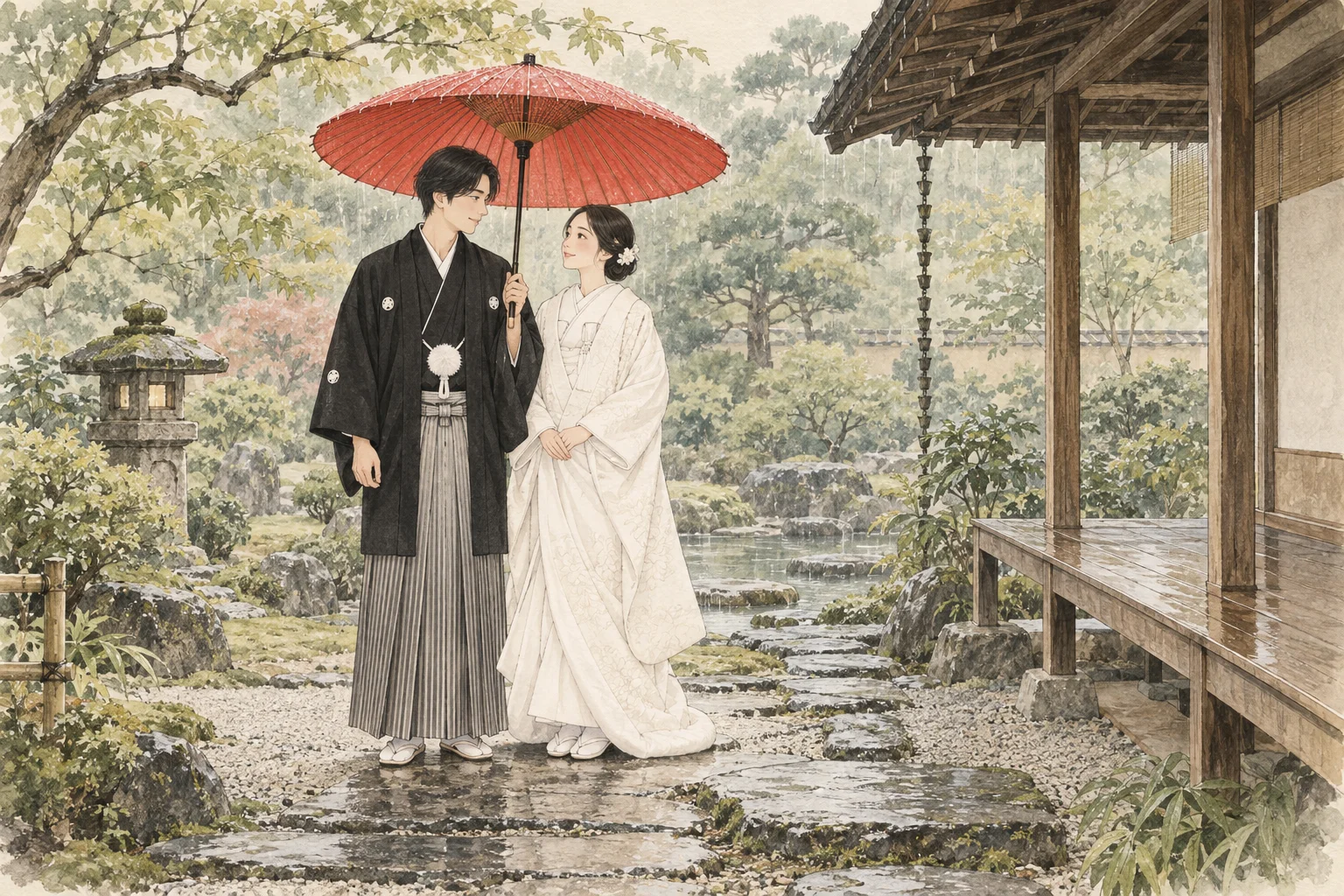
For an outdoor shoot, the weather reschedule clause is the policy line to read first. The Japanese industry standard is one free weather reschedule, declared by the studio or by mutual agreement on the morning of the shoot. "Free" here means no rebooking fee and no cancellation penalty — but you still have to fly back to Japan or stay long enough for the rescheduled date.
What counts as weather sufficient to trigger a reschedule is where studio variance is real. Most studios reschedule for heavy rain, typhoon warnings, or snow accumulation that makes locations unsafe. Light drizzle is not grounds — many photographers actively prefer overcast or misty weather for kimono shoots, and you will be expected to proceed unless you have specifically negotiated a "no rain at all" clause.
A few practical notes on weather rescheduling:
- The call is made by 7am local time, giving the hair-and-makeup team enough notice to stand down. Confirm the cut-off time at booking.
- The rescheduled date must work for both parties — if your only flexibility is the next day and the photographer is booked, you may forfeit the free reschedule.
- A second weather cancellation carries a fee, even within the same trip. The first reschedule is goodwill; the second eats into the studio's calendar.
- Studio-only or covered-location alternatives are sometimes offered instead of rescheduling — useful if your trip has no flexibility.
For shoots tied to specific natural conditions — cherry blossoms, autumn foliage, snow — also ask about conditions rescheduling, not just weather. If the blossoms open two weeks early, can you move the date? See best season for kimono photoshoots for how peak-window timing intersects with rescheduling risk.
Illness or Emergency — What's Negotiable
If you or your partner falls ill close to the shoot date, the policy that applies is the standard cancellation tier — there is no automatic medical exemption in most Japanese studio contracts. In practice, reputable studios will often offer goodwill rescheduling for documented illness, particularly if you have time remaining in Japan to reshoot. This is not a contractual right; it is a relationship-based concession.
To improve the chance of a goodwill reschedule:
- Notify the studio immediately, not the morning of. Twelve hours of warning is very different from two.
- Offer documentation — a clinic receipt, a doctor's note in any language, a positive test photo. You do not need to share medical details, only proof that the issue is real.
- Propose specific reschedule windows, not vague "later this week". Studios are running schedules; concrete options are easier to say yes to.
- Be willing to accept reduced services — a shorter shoot, a single location instead of two, the assistant photographer instead of the principal — if these unblock a same-trip reschedule.
Wedding Planner's Note: A goodwill ask that worked recently for a client started with the bride messaging the studio at 11pm the night before, with a clinic receipt attached, and a one-line proposal: "We can be ready 9am Thursday or any time Friday — please advise which works for your team." The studio rescheduled at no charge for Friday morning. Vague "we might need to move" notes the morning of the shoot rarely earn the same answer.
Family emergency back home (bereavement, hospitalization of a parent) is handled similarly — there is no contractual exemption, but most studios will work with you, often offering credit toward a future shoot rather than a cash refund. The credit may be transferable to friends or family in some cases; ask.
Travel Disruption — Flight Cancelled, Quarantine

Travel disruption is the gray zone where the policy on paper and the policy in practice diverge most. A cancelled flight, a denied boarding due to documentation, or a sudden quarantine requirement are not the studio's fault, but they are not yours either. Most Japanese studio contracts treat these as standard cancellations — meaning a missed shoot due to a cancelled flight one day before falls into the 100% fee tier.
The realistic options:
- Claim under travel insurance. Most comprehensive travel insurance policies cover prepaid non-refundable services lost due to flight cancellation or covered medical reasons. The studio will issue a paid-invoice statement to support your claim.
- Negotiate reschedule within the same trip. If your flight is delayed but not cancelled, the studio may be able to shift the shoot one or two days within your stay — this is far more achievable than asking for a refund.
- Convert to a future credit. Some studios will hold your deposit as credit toward a future booking, valid 12 to 24 months. Useful only if you genuinely plan to return.
- Accept the partial loss. If none of the above work and you have no insurance, the cancellation fee applies as written.
For couples coming on tighter visas, also confirm what happens if your visa is denied or delayed — see our visa requirements guide. Some studios offer a documented "visa denial" refund clause if you ask at booking; few volunteer it.
Deposits vs Full Payments — Standard Structure
Payment structure shapes how cancellation fees actually feel. Most studios use one of three models:
Model | Deposit at booking | Balance due | Refund mechanics |
|---|---|---|---|
Deposit + balance | 20% to 30% | 30 days before shoot, or on shoot day | Deposit non-refundable after grace period; balance refundable per tier |
50/50 split | 50% | 14 days before shoot | Both halves subject to tier policy |
Full upfront | 100% | — | Refunded per tier; most generous for early cancellation |
From a cancellation-risk perspective, the deposit-plus-balance model is the most forgiving for early cancellation (you only have the deposit at risk until the balance is due) but the least forgiving for late cancellation (you owe the balance even after cancellation). The 50/50 model splits the risk evenly. Full upfront is the simplest but commits the most cash earliest.
One important detail: many studios accept payment in JPY by bank transfer, in USD/EUR/AUD/SGD by credit card, or in JPY cash on the day for the balance. The currency of payment determines the currency of refund — meaning exchange-rate movement between booking and cancellation is your risk, not the studio's. If the yen has weakened, a 50% refund in JPY may be 5% less than half what you paid in USD.
Force Majeure & Pandemic Clauses
Post-2020, almost every Japanese kimono studio rewrote its contract to include force majeure language covering pandemic-related disruptions. The current standard includes:
- Government border closures or entry restrictions — full refund minus an admin fee, or full credit toward future use.
- Mandatory quarantine that would prevent attendance — same treatment as border closure.
- Studio closure under public health order — full refund or credit.
- Venue closure (shrine, garden, castle grounds) — studio offers alternative venue or refund of any permit fees paid forward.
- Natural disaster (typhoon, earthquake) preventing operation — full refund or rescheduling without fee.
What force majeure clauses do not cover: personal travel anxiety, an outbreak that has not triggered official restrictions, or self-imposed quarantine. If you have personal health concerns, those are managed under the standard illness policy or via travel insurance — not force majeure.
If you are booking 8 to 14 months ahead, ask the studio to send the latest version of the force majeure clause when you sign. Studios update their template language quarterly; the version in last year's blog post is not necessarily what you are signing.
Photographer Cancellation — Backup Arrangements
Cancellation works in both directions. What happens if the photographer is sick, the studio's equipment fails, or the venue is unexpectedly closed on the morning of your shoot?
Reputable studios carry one of three protections:
- Backup photographer. The studio guarantees that if the principal photographer cannot work, a named or unnamed substitute of equivalent experience will cover. Confirm whether the substitute is the studio's lead assistant or an external contractor — these are different quality levels.
- Full refund plus rebooking priority. If no substitute is available, the studio refunds in full and offers a no-fee priority slot on your next visit. Useful only if you can return.
- Partial refund and reduced service. A reduced-scope shoot with another team member (no kimono change, single location, etc.) at a discounted rate. Less common; ask at booking whether this is on the table.
For more on what to look for in a studio's professional setup, see photographer contracts and insurance in Japan.
One specific question worth asking: "If the photographer cancels less than 24 hours before, what is the substitute's portfolio and style, and can I see it before agreeing?" Some studios match by style; others match by availability. The answer to this question is a strong signal of how the studio operates.
Cancellation Insurance — When It's Worth It
Photoshoot-specific cancellation insurance is not a standard product in Japan the way wedding insurance is in the US or UK. The realistic insurance options are:
- Comprehensive travel insurance with prepaid services cover — the standard policy from most international insurers covers non-refundable prepaid services lost due to covered reasons (illness, flight disruption, family emergency). This is the most common protection.
- Credit card travel protection — many premium cards (Amex Platinum, Chase Sapphire Reserve, etc.) include trip cancellation cover when the photoshoot is paid on the card. Coverage limits and definitions vary; read your benefits guide.
- Cancel-for-any-reason (CFAR) supplements — 40% to 75% reimbursement regardless of reason, sold as an add-on to standard travel insurance. Available in the US and selected markets; not common in Asia-Pacific.
- Studio-offered protection plans — a few larger studios now offer an in-house cancellation protection plan (typically 5% to 10% of package value) that converts a hard cancellation into credit or a reduced fee. Read the terms; the protection is often narrower than it looks.
The cost-benefit math is straightforward: if your package is over USD 3,000 and you are traveling more than six time zones, comprehensive travel insurance with prepaid services cover pays for itself the first time it is needed. For smaller packages or short-haul trips, the math is closer.
Booking Through Agencies vs Direct
Where you book changes who controls the cancellation policy. Booking direct with the studio means the studio's policy applies as written and is negotiable at the margins (you can ask for terms, and a reasonable studio will sometimes adjust). Booking through an agency, concierge, or third-party platform stacks two policies on top of each other: the studio's policy and the agency's.
The practical implications:
Booking channel | Cancellation policy that applies | Refund mechanics |
|---|---|---|
Direct with studio | Studio's policy only | Refund from studio in original currency |
Local Japanese agency | Studio + agency fee (typically non-refundable) | Studio refund minus agency commission |
International platform | Platform terms override studio | Refund per platform schedule; may be slower |
Travel agent package | Travel agent's bundled-tour terms | Tour terms apply; photoshoot may not refund separately |
If a bundled honeymoon-and-photoshoot package is sold by a travel agent, the photoshoot portion is often locked into the broader tour terms — meaning you may not be able to cancel the photoshoot without cancelling the entire trip. Read this carefully. See our honeymoon kimono photoshoot guide for the trade-offs of bundled versus standalone booking.
For couples valuing flexibility above all else, direct booking with a studio that has a clearly written cancellation tier and an English-language contract is the cleanest setup. The strongest-reviewed studios in our directory all publish their cancellation policies on request; if a studio refuses to share theirs before you pay a deposit, treat that as a signal.
Frequently Asked Questions
My flight lands the morning of the shoot — should I rebook the shoot or push my flight?
Push the flight. A same-day-arrival shoot has no recovery room: any flight delay, lost luggage incident, or immigration queue eats directly into the call time. Studios will not hold the hair-and-makeup team for a delayed arrival, and a no-show falls into the 100% fee tier. The cheaper move is to add one buffer night before the shoot — the cost of a Tokyo hotel night is dramatically less than a forfeited package fee.
Can I transfer my deposit to a friend's photoshoot if I cancel?
Some studios allow deposit transfer to a named third party (a friend, sibling, or family member) within 12 months, treating the transfer as a goodwill gesture rather than a contractual right. Ask explicitly at booking — the answer is rarely in the standard contract. Transfers are easier when the studio knows the recipient is a real prospective client, so providing the friend's name and rough date range when you ask helps.
Can I get a photo session refund in Japan if I get sick?
There is no automatic medical exemption in most Japanese studio contracts — the standard cancellation tier applies. In practice, reputable studios offer goodwill rescheduling or credit toward a future shoot if you provide documentation and notify them as early as possible. A cash refund for illness is unusual; same-trip reschedule or future credit is the more realistic ask.
What happens if I have to move my date because the cherry blossoms peaked early?
This is a conditions-rescheduling question, not a weather one. Standard contracts do not cover early-blooming or late-blooming peak windows — if the studio's calendar can accommodate a one-week move, most will do it as a courtesy, but during sakura peak every weekend slot is already booked. The realistic path is to add a buffer week to your trip and treat the official peak date as a target, not a guarantee.
If the studio offers credit instead of a refund, how long is it valid and can I share it?
Studio-issued credit is typically valid 12 to 24 months from the original shoot date, not from when it was issued. Some studios allow transfer to a named friend or family member; others restrict it to the original couple. Always get the validity period and transferability rule confirmed in writing — credit terms are rarely in the public-facing policy.
Does travel insurance cover photoshoot cancellation in Japan?
Comprehensive travel insurance with prepaid non-refundable services cover reimburses photoshoot costs lost due to covered reasons such as illness, flight cancellation, or family emergency. Read your policy's definition of covered reasons carefully — anxiety, weather, and self-imposed quarantine are usually not covered. Cancel-for-any-reason (CFAR) supplements offer broader protection at higher cost.
What if the photographer cancels on me?
Reputable studios offer one of three protections: a backup photographer of equivalent experience, a full refund plus priority rebooking on your next visit, or a partial refund with reduced-scope alternative. Ask at booking what specific arrangement is in place; the answer is a strong signal of how the studio operates professionally.
Email Your Studio This One Question Today
Before anything else, send your studio (or shortlist) one line: "Please send me the cancellation tier schedule and the latest force majeure clause in English." A studio that replies with a clear PDF within two business days is one you can trust; one that hedges, delays, or quotes a verbal answer is one to reconsider. Browse our curated directory of kimono photographers in Japan for studios that publish transparent cancellation tiers and weather-reschedule policies up front.
Related reading from our editorial library: wedding photo album delivery timelines in Japan, photographer contracts and insurance, how to book a Japan kimono photoshoot from abroad, visa requirements for prewedding photoshoots, and choosing the best season for your kimono photoshoot.
Related guides
 General guide
Photographer No-Show Backup in Japan: Protection Plans
Illustrative image · Unsplash. Not a photo of the specific people, places or services discussed.
How reputable Japanese studios handle photographer illness, accidents, and rare last-minute replacements — and the questions to ask before paying any deposit.
Read the guideGeneral guideJapan Wedding Booking: Watabe vs Agency vs Direct Studio
Illustrative image · Unsplash. Not a photo of the specific people, places or services discussed.
Japan wedding booking compared: full-service chains like Watabe, mid-tier bilingual agencies, and direct studio booking — cost, control, and risk trade-offs.
Read the guide General guide
Multilingual Wedding Photography Japan: Beyond English
Illustrative image · Unsplash. Not a photo of the specific people, places or services discussed.
A planner's audit of which languages — Korean, Mandarin, Spanish, French, JSL — Japanese kimono studios actually support, plus interpreter costs and when to hire one.
Read the guide