Wisteria Kimono Photoshoot in Japan: Late Spring's Hidden Season
Plan a wisteria kimono shoot in Japan: peak windows at Ashikaga, Kasuga, Kameido and Kawachi Fuji-en, plus how to avoid Golden Week crowds.

Illustrative image · Unsplash. Not a photo of the specific people, places or services discussed.
Check current prices, availability and venue rules with the relevant studio or venue before booking.
The Japanese wisteria (fuji) season is the country's most under-utilised post-sakura window — exactly two weeks long, falling between late April and early May, and falling almost entirely within the Golden Week public holiday that the most successful foreign couples explicitly avoid. The strategic insight: book your shoot for the week immediately before Golden Week (April 22-28) or immediately after (May 6-12) and you get the country's most distinctive purple-canopy backdrops — Ashikaga Flower Park's 160-year-old great wisteria, Kawachi Fuji-en's ticket-only tunnels, Kasuga Taisha's 250 trees of 20 varieties — at half the crowd density that domestic Golden Week travellers create. The visual signature is unique: a hanging four-metre purple curtain framing a white shiromuku, with no equivalent backdrop available anywhere else in Japan. The trade-off is that the season is short and the best Tochigi and Fukuoka specialists fill their May weekends eight months ahead. This guide walks foreign couples through Ashikaga, Kasuga, Kameido Tenjin and Kawachi Fuji-en, the strict park-ticket rules, and how to time your booking around Golden Week rather than into it.
When Is the Best Time to Book a Wisteria Photoshoot
Japan's wisteria season is short — roughly two weeks at any single location — and the peak depends heavily on early-spring temperatures. In a typical year, southern Japan and Kyushu peak first in late April, central Honshu peaks in early May, and the northern Kanto and Tohoku trellises peak in mid May. Most parks and shrines publish daily bloom-condition updates on their websites and social media accounts from late April through May. For couples booking from overseas, the safe target window is the last week of April through the second week of May, with at least three flexible days built into your itinerary so the shoot can move to the day the trellises are at their photographic peak.
Regional Wisteria Calendar at a Glance
Kawachi Fuji-en in Fukuoka opens first, with peak typically in late April. Kasuga Taisha's Manyo Botanical Garden in Nara peaks in late April to early May. Tokyo's Kameido Tenjin Shrine peaks in early May. Ashikaga Flower Park in Tochigi — home to the country's most famous hundred-and-sixty year-old great wisteria — peaks in early to mid May. Couples flying long-haul should choose their destination based on which region's peak aligns with their travel dates and the type of imagery they want.
Region | Typical Peak Bloom | Best For |
|---|---|---|
Kitakyushu (Kawachi Fuji-en) | April 22 – May 5 | Famous wisteria tunnels, ticket-only entry |
Nara (Kasuga Taisha botanical garden) | April 25 – May 8 | UNESCO shrine plus 250 wisteria of 20 varieties |
Tokyo (Kameido Tenjin) | April 28 – May 10 | City-based shoot with shrine bridges and koi pond |
Ashikaga (Flower Park) | May 1 – May 15 | 160-year-old great wisteria, evening illumination |
Top Locations for a Wisteria Kimono Photoshoot
The location you choose shapes the photographer you can hire, the permit rules, and the visual mood of your images. Four destinations consistently rank as the most requested for foreign couples planning a fuji kimono shoot in Japan.
Ashikaga Flower Park, Tochigi
Ashikaga Flower Park is home to a hundred-and-sixty year-old great wisteria with a thousand-square-metre canopy — the largest such tree in Japan and the visual anchor of the country's wisteria identity. The park stages an evening illumination through the first two weeks of May. Photography is permitted with park entry tickets, but tripods, lighting equipment, and commercial-scale shoots require advance coordination with the park office. Reputable Tochigi-based photographers handle this through standing relationships. Ashikaga is ninety minutes by JR from Ueno on the Ryomo Line.
Kasuga Taisha Manyo Botanical Garden, Nara
Kasuga Taisha's botanical garden holds two hundred and fifty wisteria of twenty varieties, arranged along walking paths through the shrine forest. Unlike commercial flower parks, the setting feels genuinely sacred — moss-covered stone lanterns, ancient cedars, and the distant chime of shrine bells form the soundtrack. Photography on the public garden paths is unrestricted for couple shoots; commercial photography in the inner garden requires a small coordination fee. Browse our Kasuga Taisha location guide for context.
Kameido Tenjin Shrine, Tokyo
Kameido Tenjin's wisteria-and-bridge composition is the classical Edo period image: red taikobashi arched bridge crossing a koi pond, with hanging wisteria trellises framing the foreground. The shrine has roughly fifty trees of fifteen varieties and is one of central Tokyo's most quintessentially Japanese spring backdrops. The shrine permits couple shoots with small crews for a modest coordination fee on non-festival weekends. The location is fully accessible by subway from anywhere in central Tokyo.
Kawachi Fuji-en, Kitakyushu
Kawachi Fuji-en is privately owned and accessible only by advance ticket — typically released in early March and sold out within hours. The wisteria tunnels here are the country's most famous and produce some of the most-shared images of any Japanese flower season. Because of the ticket restriction, commercial photography is tightly limited and most foreign couples engage a Fukuoka-based photographer who can secure tickets months in advance. The park is two hours by train and bus from Hakata Station.
How Far in Advance to Book Your Wisteria Shoot
Wisteria booking timelines are tighter than the bloom suggests because the photographer pool is smaller — wisteria is a niche specialty and only a fraction of kimono studios have proven portfolios at the key locations. The best Tochigi and Fukuoka specialists sell out their May weekends eight months in advance.
Eight to Six Months Out
Begin researching photographers. This is the window in which Ashikaga, Kasuga and Kawachi Fuji-en specialists fill their best wisteria days. Send inquiries to three to five providers, request itemised quotes, and place a deposit on your first choice. For Kawachi Fuji-en specifically, confirm explicitly that the studio will secure your park tickets when the March release opens.
Six to Four Months Out
Confirm kimono selection. Wisteria's purple-and-white palette pairs strikingly with shiromuku for a white-on-purple cathedral image, or with a pale purple iro-uchikake for a tonal harmony approach. Many studios stock specific spring-themed silk pieces that release each January. If you want a specific design featured on the studio's website, lock it in now.
Four to Two Months Out
Finalise the shooting itinerary. Wisteria parks are larger and more linear than plum gardens, so the choreography is more sweeping — typically sixty to ninety minutes at the trellises. Book hotels within walking or short-taxi distance of your shoot. For Ashikaga, the JR train connection from Tokyo means most couples shoot as a day trip rather than overnighting.
Two Months to One Week Out
Watch the bloom forecast. Around seven to ten days before the predicted peak at your chosen site, your photographer will confirm the optimal shoot day within your flexibility window. Build in at least three flexible days so the shoot can be rescheduled if the bloom is significantly earlier or later than forecast.
Permits, Fees, and What You Cannot Photograph
Wisteria permit rules vary widely by location and tend to be stricter than plum but more permissive than the cherry blossom peak. Privately owned parks have specific commercial photography fees; shrines have their normal coordination structures; public spaces are generally free.
Typical Permit Costs and Restrictions
Ashikaga Flower Park requires park entry tickets (approximately ¥2,000 each in peak season) plus a commercial photography coordination fee of approximately ¥30,000 for couple shoots with tripods or lighting. Kasuga Taisha permits unrestricted couple photography on the public garden paths; commercial photography in the inner botanical garden requires approximately ¥10,000 to ¥20,000. Kameido Tenjin permits couple shoots for approximately ¥15,000 on non-festival weekends. Kawachi Fuji-en's tight admission structure makes commercial shoots there only practical through established Fukuoka studios with park relationships. For broader background on shrine etiquette during the shoot itself, see our shrine manners guide.
What Is Generally Prohibited
Drones are banned at all major wisteria sites. Lighting equipment beyond a single reflector requires permission. Touching, picking, or moving the wisteria flowers themselves is prohibited at every park and shrine, and violations can result in being asked to leave. Reputable photographers handle these restrictions silently.
How to Choose the Right Wisteria Photographer
The photographer you hire will determine whether your wisteria shoot becomes a genuinely once-in-a-lifetime portrait session or a confused improvisation in unfamiliar conditions. Foreign couples should evaluate candidates against four criteria.
Wisteria-Specific Portfolio
Wisteria is a niche specialty and the photographer's portfolio should prove it. Look for at least ten distinct wisteria shoots in recent springs, ideally at the specific park you want to visit. A photographer who has shot Ashikaga across multiple seasons knows precisely which two-hour window the great wisteria is at its photographic best, which trellis avoids midday tourist congestion, and how the evening illumination changes the colour rendering. Generic spring stock is not enough.
Language and Communication
You will be making aesthetic decisions in real time, often under time pressure as the light shifts across the trellis. A photographer who speaks fluent English or works with a coordinator who does is essential unless you speak conversational Japanese. Confirm communication channel in advance, whether that is email, LINE, WhatsApp, or WeChat.
Transparent Pricing
Reputable studios provide itemised written quotes covering kimono, hair and makeup, dressing assistance, location and permit fees, park ticket procurement, hours of coverage, and number of edited photos delivered. Wisteria season pricing typically runs comparable to the late-sakura rate — roughly ¥160,000 to ¥240,000 mid-tier in Tokyo and Tochigi. Beware of headline prices significantly below ¥80,000, which usually exclude essentials that get added later. For broader pricing context, see our kimono photoshoot cost guide.
Wisteria Reschedule Policy
The short wisteria window means reschedules are harder to absorb than plum or autumn. The best photographers offer one free reschedule within the same season and a partial refund if the season is so far off your dates that no rescheduling produces acceptable conditions. Confirm in writing before paying the deposit.
Weather Risk and Contingency Planning
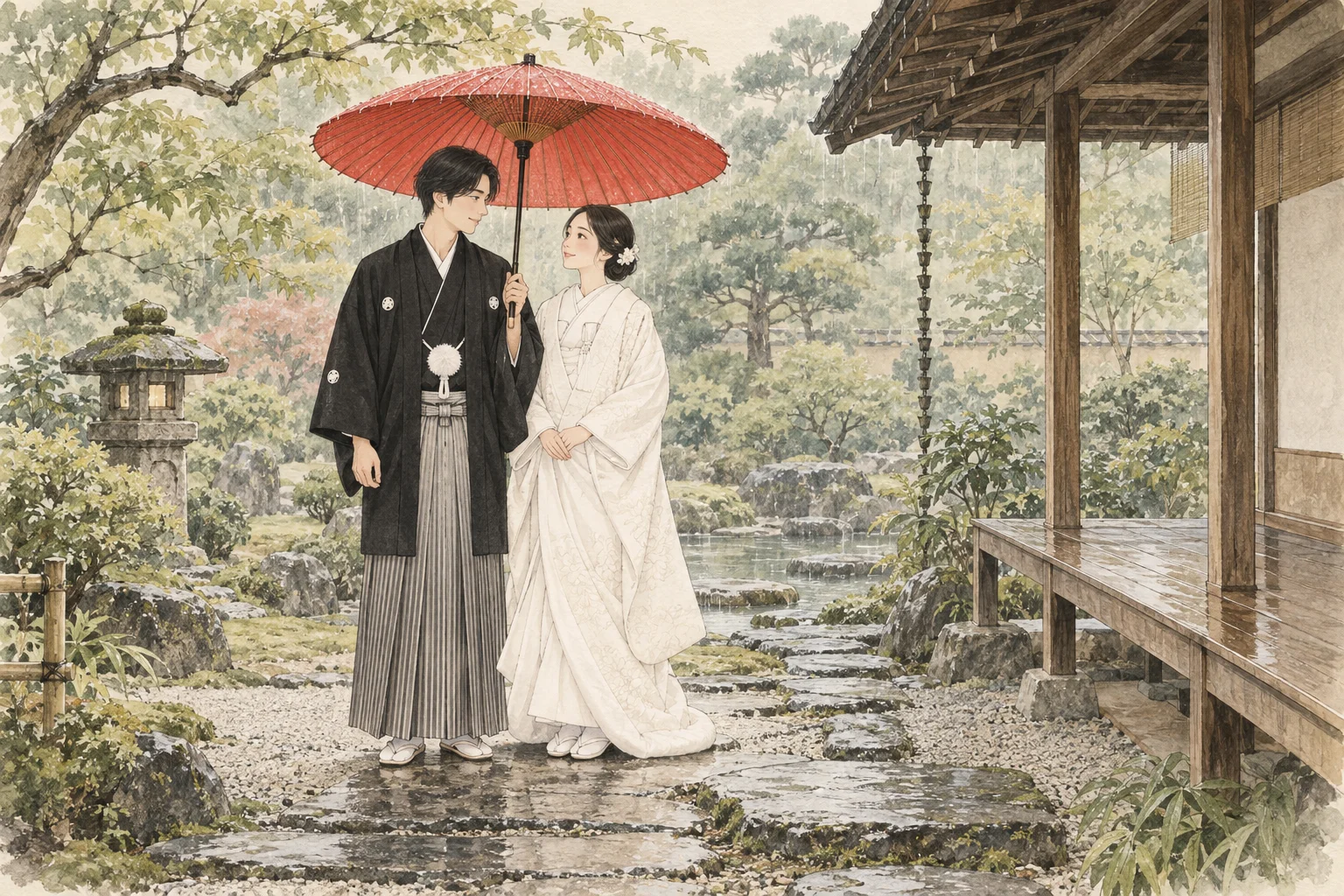
Late spring weather in Japan is statistically the most stable photography weather of the year — but the wisteria season carries unique risks. An unusually warm April can push the bloom forward by ten days and end the peak before couples arrive. The Golden Week public holiday (April 29 – May 5) brings the largest domestic crowds of the year to popular wisteria parks, particularly Ashikaga, and shoots scheduled inside that week face significant congestion. The best photographers prepare for these scenarios by offering reschedules within the season, by maintaining a Plan B location that peaks a week later (for example Ashikaga as a back-up for Kasuga), and by recommending shoot days outside the Golden Week window when possible.
What to Wear: Kimono Choices for a Wisteria Shoot
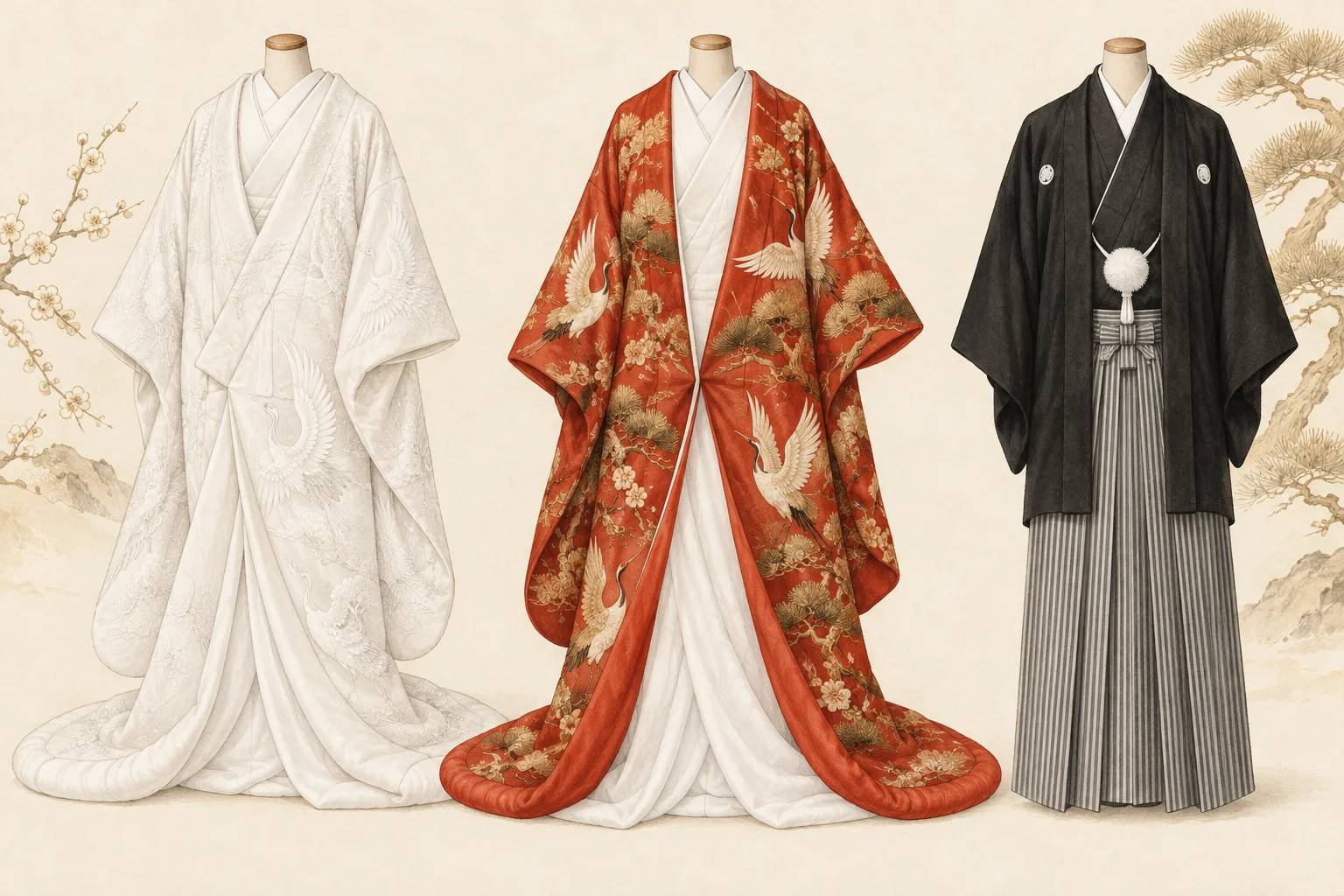
The wisteria's deep purple bloom pairs strikingly with shiromuku for a high-contrast white-on-purple cathedral effect — many couples consider this the single most painterly bridal portrait Japan can produce. A pale purple or lavender iro-uchikake takes the opposite approach, harmonising tonally with the bloom for a softer, more intimate mood. Avoid red or orange palettes which compete unflatteringly with the wisteria's cool tones. For a detailed comparison of the two formal styles, see our shiromuku vs iro-uchikake guide. Grooms wear the formal montsuki hakama in black or charcoal grey, with white tabi socks and zori sandals. The full ensemble is provided by the studio.
Frequently Asked Questions
Below are the questions we hear most often from couples planning a wisteria kimono shoot in Japan. For more answers, see our complete article library or contact a matched photographer directly.
When should I book a wisteria photoshoot in Japan?
Book eight months in advance for Ashikaga and Kawachi Fuji-en specialists. Four months is the latest realistic window for a quality shoot at the major sites. Tokyo-based shoots at Kameido Tenjin sometimes have availability within two months.
How accurate are Japan's wisteria forecasts?
Each major park publishes daily bloom-condition updates on its website and social media accounts from mid-April through May. These are accurate to within one to three days and far more reliable than the national flower forecasts that cover cherry and plum.
Do I need a permit for a wisteria shoot?
Ashikaga Flower Park requires entry tickets plus an approximately ¥30,000 commercial photography fee. Kasuga and Kameido Tenjin charge approximately ¥10,000 to ¥20,000. Kawachi Fuji-en is ticket-only and only practical through established local studios. Your photographer handles ticket procurement and permit applications on your behalf.
Should I avoid Golden Week for a wisteria shoot?
Yes if you have flexibility. April 29 to May 5 brings the year's largest domestic crowds to popular wisteria parks, especially Ashikaga. Shoots immediately before April 29 or after May 5 are noticeably easier and produce cleaner images.
Is the Ashikaga evening illumination good for photoshoots?
It produces extraordinary images but requires advance coordination because the park is at peak crowd capacity during illumination hours. Most commercial photoshoots use the hour before illumination starts (sunset) or schedule for early morning when the park is empty.
Can we combine wisteria with sakura in one trip?
Rarely. Cherry blossoms end in early to mid April in most of Honshu, and wisteria starts in late April. The five to ten day gap is the country's quietest spring window. Couples wanting both should consider Tohoku late cherries combined with a Honshu wisteria stop, or accept that one of the two will be a Plan A and the other a missed opportunity.
Compare Other Seasons
- Cherry Blossom Kimono Photoshoot in Japan
- Autumn Foliage Kimono Photoshoot in Japan
- Snow Wedding Photoshoot in Japan
- Plum Blossom Kimono Photoshoot in Japan
Ready to Book Your Wisteria Shoot
A wisteria kimono photoshoot in Japan rewards couples who can travel in the post-sakura window and want imagery that almost no foreign couple captures. Lock in your photographer eight months ahead, build at least three flexible days into your travel itinerary, and choose a region whose peak aligns with your travel dates while avoiding Golden Week if possible. Then trust your photographer to handle the park tickets, the permits, and the choreography on the day. We have curated a directory of 176 vetted kimono photographers across Japan, all reviewed for spring experience, English communication, and transparent pricing. Find a photographer matched to your wisteria plans and start the conversation today. For the broader booking framework that applies across every season, see our ultimate guide to Japan pre-wedding photoshoots.
Locations in this guide

Related guides
 Budget
Kimono Rental in Japan: What It Costs and Which Kind You Need
Illustrative image · Unsplash. Not a photo of the specific people, places or services discussed.
Kimono rental in Japan means two very different things: a ¥3,000 afternoon in Kyoto, or a bridal shoot from ¥88,000. What each costs, includes and takes.
Read the guideStyle guideTraditional Japanese Wedding Costumes: Who Wears What
Illustrative image · Unsplash. Not a photo of the specific people, places or services discussed.
Traditional Japanese wedding costumes for the bride, groom, family and guests: how formality ranks, what to avoid, and which garments you can actually rent.
Read the guide Location deep dive
Kawaguchiko Kimono Photoshoot: Mt Fuji's Iconic Vista
Illustrative image · Unsplash. Not a photo of the specific people, places or services discussed.
Plan a kimono photoshoot at Lake Kawaguchi with honest clear-Fuji probability guidance, Chureito Pagoda and Oishi Park location logistics, seasonal trade-offs, and access from Tokyo via the Fujikyu Express.
Read the guide