Tokyo vs Kamakura Kimono Photoshoot: How to Choose
Tokyo vs Kamakura for your kimono wedding photoshoot — comparison of aesthetics, costs (JPY 80,000-290,000), travel logistics, crowding by season, and when to combine both cities in a single Japan trip.

Illustrative image · Unsplash. Not a photo of the specific people, places or services discussed.
Check current prices, availability and venue rules with the relevant studio or venue before booking.
Couples sometimes treat Tokyo and Kamakura as interchangeable because Kamakura sits 50 minutes south of Tokyo Station on a single train. The two cities are opposites. Tokyo gives you metropolitan density — Asakusa lanterns, Meiji Jingu's forested approach, Shibuya neon as a stylistic counterpoint. Kamakura is a samurai-era coastal town where the dominant aesthetic is wooden shrine gates, bamboo groves, and Edo-period restraint. The right choice depends on whether you want energy or quiet — and many couples want both.
At-a-Glance Comparison Table
Here is how the two cities compare across the factors couples weigh most heavily during planning.
Factor | Tokyo | Kamakura |
|---|---|---|
Aesthetic | Metropolitan, mixed-era, neon-vs-shrine contrast | Samurai-era, coastal, restrained, monochromatic |
Signature locations | Asakusa Senso-ji, Meiji Jingu, Hamarikyu, Yanaka | Tsurugaoka Hachimangu, Hokoku-ji bamboo, Great Buddha, Hase-dera |
Typical half-day shoot | JPY 80,000-150,000 | JPY 90,000-160,000 |
Travel from Tokyo Station | 0-30 min by train | 50-65 min by JR Yokosuka or Shonan-Shinjuku Line |
Crowd intensity | Very high at signature sites year-round | Moderate weekdays, very high weekends and hydrangea season |
English studio availability | Broad — among the largest selections in Japan | Limited; most teams travel in from Tokyo or Yokohama |
Permit complexity | Strict at Meiji Jingu and Imperial gardens, looser elsewhere | Generally looser at smaller shrines; Hokoku-ji has admission, not permit |
Best for | One-day-only couples, urban-aesthetic preference, late evening shoots | Quieter mood, full kimono walks, brides preferring older architecture |
Wedding Planner's Notes: Kamakura runs slightly more expensive on average, not because the town is fancier, but because the photographer is travelling in from Tokyo and that hour each way is folded into the package.
Tokyo Strengths
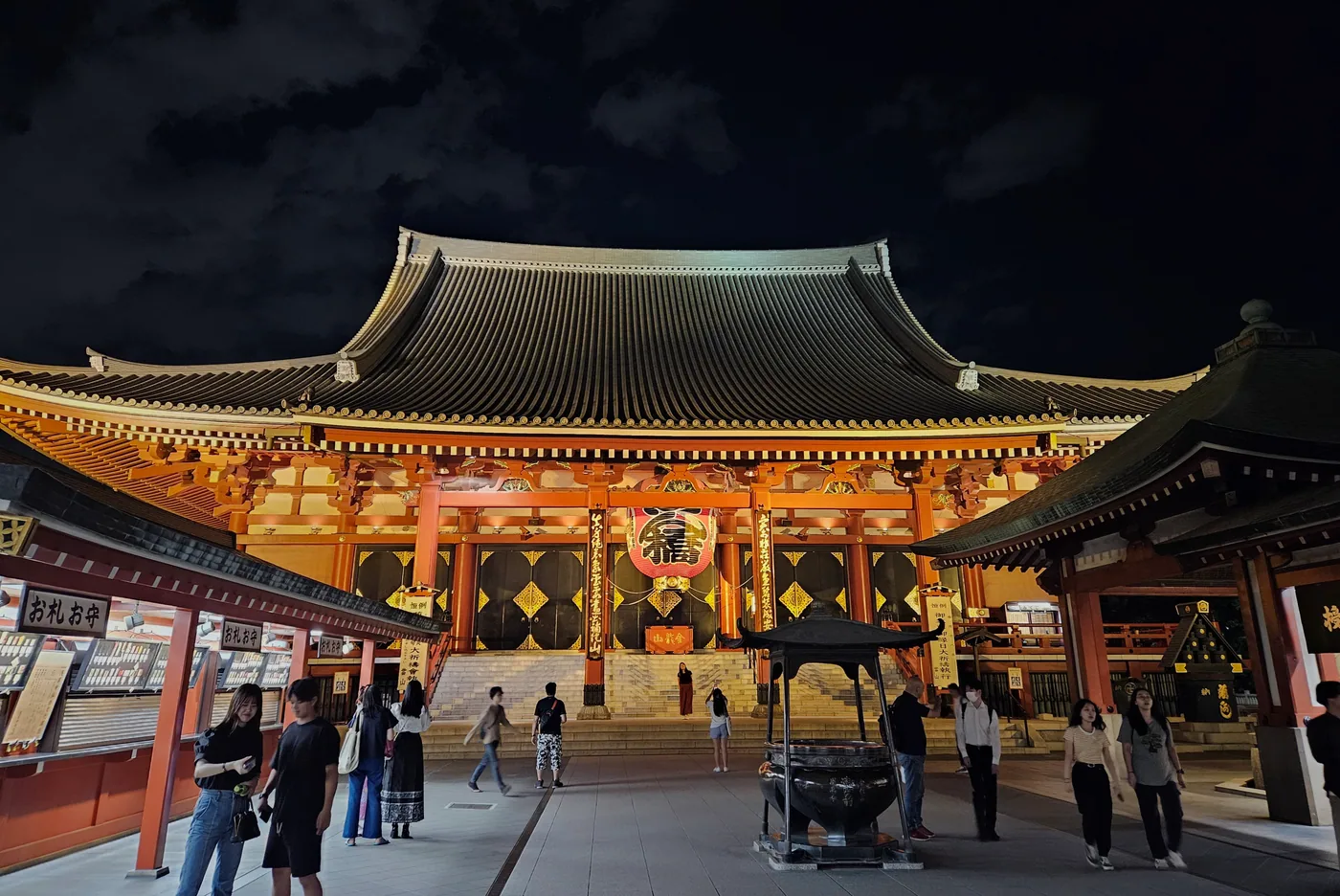
Tokyo's case rests on three pillars. Scale — there are more English-speaking kimono studios, more bilingual photographers, and more dressing-and-hair-and-makeup options in central Tokyo than in any other Japanese city combined. Variety — within a single shoot day you can pair Asakusa's traditional lantern-lit alleys with a Marunouchi rooftop or Hamarikyu's tea house. Logistics — most international couples land at Haneda or Narita, and Tokyo lets you shoot on day two of the trip without a separate transit day.
The two signature shrines tell the story. Senso-ji in Asakusa is one of the busiest wedding photography sites in Japan, alongside Kyoto's Kiyomizu — the orange Hozomon Gate, the red five-storey pagoda, and Nakamise shopping street give you three completely different backdrops within 100 metres. Our Asakusa kimono shoot guide details the standard 2.5-hour route. Meiji Jingu, by contrast, is forested and ceremonial — gravelled approach, towering torii, restrained mood. The catch is that Meiji Jingu's permit policy requires a real Shinto ceremony for shrine-interior shoots; for posed photography in the outer approach, the rule is "discreet personal photos only."
Tokyo also wins on evening capacity. Asakusa lights up after dark with Skytree visible in the background; Roppongi's Tokyo Tower offers night silhouettes; Shibuya Crossing in kimono produces an Instagram-saturated shot that Kamakura simply cannot replicate. If you want the lit-up-modern-Japan aesthetic, Tokyo is the only choice.
Kamakura Strengths
Kamakura was Japan's political capital from 1185 to 1333 — the seat of the first samurai government — and the town still feels like that era. The grid of small shrines, the Pacific coastline visible from many vantage points, and the relative absence of tall buildings give you a backdrop closer to what wedding portraits looked like 100 years ago. For couples who specifically want "old Japan" rather than "modern Japan with shrines tucked into it," Kamakura is the answer.
Three locations carry most Kamakura shoots. Tsurugaoka Hachimangu is the main shrine — a long red-painted approach, twin koi ponds, a steep stone staircase to the main hall. Hokoku-ji is the bamboo temple, with roughly 2,000 stalks creating green vertical lines that work especially well with a white shiromuku or vermilion umbrella. The Great Buddha (Daibutsu) at Kotoku-in is a 13.35-metre bronze Buddha sitting outdoors since 1252 — not a typical wedding backdrop, but powerful for couples who want a non-shrine focal point. Hase-dera adds a hydrangea garden in June and ocean views year-round. Our Kamakura kimono photoshoot guide walks through the standard half-day circuit.
Train access is simpler than it looks for first-time visitors. From Tokyo Station, the JR Yokosuka Line runs direct to Kamakura Station with no transfers; signage at Tokyo Station is bilingual, the IC card you already use for Tokyo subways works straight through, and Kamakura Station's small size makes orientation easy. Couples who are nervous about JR navigation generally find the Kamakura day far simpler than they expected.
Wedding Planner's Notes: Hokoku-ji charges JPY 400-600 admission per person and politely declines tripod-based commercial shoots without prior contact, but handheld shoots blend in as ordinary visitors. Most photographers shoot it as a "natural pass-through" rather than declaring it. Confirm before the day.
Kamakura also offers the genuinely quiet shrines that Tokyo lacks. Sasuke Inari, located west of Kamakura Station near Zeniarai Benten, has a small wooded approach with red torii stacked in series. Egara Tenjin and Zeniarai Benten itself see far fewer foreign visitors. For brides who specifically asked "where can we shoot without a crowd?" the answer is usually one of these lesser-known Kamakura sites rather than anywhere in Tokyo.
Costs Compared
Average package prices for a half-day couple kimono shoot fall roughly in this range:
- Tokyo half-day (4 hours, 1-2 locations, 60-80 edited images): JPY 80,000-150,000
- Kamakura half-day (4 hours, 2-3 shrine stops, 60-80 edited images): JPY 90,000-160,000
- Tokyo full-day (8 hours, 3-4 locations, 120+ images): JPY 150,000-280,000
- Kamakura full-day (8 hours, 4-5 locations): JPY 160,000-290,000
- Tokyo + Kamakura combined two-day: JPY 220,000-380,000 depending on photographer continuity
Beyond the travel-time factor noted above, two other drivers push Kamakura packages higher: more shrine admissions to coordinate, and less price competition because fewer studios are based in town. What Kamakura usually does not add: dressing or hair-and-makeup, which still happens in a Tokyo or Yokohama studio in the morning. See Kimono photoshoot cost 2026 for full pricing breakdown.
Travel Time and Logistics
From central Tokyo, the JR Yokosuka Line runs direct from Tokyo Station to Kamakura Station in 56 minutes; the Shonan-Shinjuku Line from Shinjuku takes 60-65 minutes. Both arrive at the same Kamakura Station, a 10-minute walk from Tsurugaoka Hachimangu. Trains run every 10-15 minutes from 5 AM to midnight. Reserved seats are not needed for this route.
The practical logistics challenge is the kimono itself. You cannot easily walk through Tokyo Station in a full shiromuku and uchikake — the fabric, train length, and dressing maintenance make public transit impractical for the full bridal kimono. Three solutions:
- Dress in Kamakura. A handful of studios in Kamakura town will dress you on arrival. You travel in regular clothes, change at the studio, walk 10 minutes to Tsurugaoka Hachimangu, and shoot. This is the cleanest option but limits studio choice.
- Hire a private vehicle. Most photographer teams arrange a kimono-friendly van or taxi for travel between dressing studio (Tokyo or Yokohama) and Kamakura shoot locations. Add JPY 20,000-40,000 to the package.
- Shoot in komon or hakama instead of shiromuku. A simpler kimono is train-friendly and still produces excellent Kamakura imagery. Many couples switch to this approach after consulting their photographer.
Wedding Planner's Notes: Budget travel time as a full 2 hours each way, not 1 hour. Dressing happens early (6:30-7:30 AM start), the team consolidates equipment, transit to Kamakura takes longer in a kimono-friendly vehicle than a Suica-tapped Yokosuka Line ride. A "4-hour shoot" with Tokyo dressing is really a 9-hour day for the bride.
Crowding by Season
Both cities crowd predictably. Tokyo's peak crowd at Senso-ji is constant year-round and intensifies during cherry blossom (late March-early April), Golden Week (April 29-May 5), and New Year's. Meiji Jingu's gravel approach handles foot traffic well but the Inner Garden iris season (mid-June) doubles visitor counts.
Kamakura's seasonal pattern is sharper. Tsurugaoka Hachimangu is moderate on weekdays but very busy on weekends. Hokoku-ji's bamboo grove is quieter on weekday mornings and overrun by 1 PM on weekends. The dominant crowding event is hydrangea season at Hase-dera in mid-June, when entry can be limited to ticketed time slots. The Great Buddha sees foreign-tourist crowds year-round but they cluster in front of the statue, so side and rear angles stay clear.
For comparison of when to shoot in each city, see Spring vs autumn kimono photoshoot — the short answer is that autumn (mid-November) at Kamakura's Tsurugaoka Hachimangu offers a strong ratio of dramatic foliage to manageable crowds.
When to Combine Both (Same Trip)
A meaningful share of two-week-trip couples shoot in both cities. The standard combined approach:
Day | Plan | Why |
|---|---|---|
Day 2 (Tokyo) | Asakusa half-day shoot, white shiromuku | Recovers from jet lag, gets the lantern-and-pagoda Asakusa set immediately |
Day 4 or 5 (Kamakura) | Full-day shoot, iro-uchikake or color kimono | Contrast color and setting from Tokyo day; weekday timing to avoid weekend crowds |
Days 6-7 | Kyoto travel and shoot (optional third leg) | For couples wanting the full Tokyo-Kamakura-Kyoto contrast |
The reason to do both shoots within 5-7 days of each other: outfit and hair styling rhythm. Hair extensions, scalp irritation, and makeup-skin recovery all argue for spacing the shoots at least 48 hours apart but no more than a week, so the bride is not repeatedly committing to the multi-hour kanzashi-and-katsura styling process. Two shoots in the same week, one stylist team, two different aesthetics — this is the sweet spot.
The cheaper combined option: same photographer, both cities. A handful of Tokyo-based photographers will quote a discounted two-day package because they avoid the second-team onboarding cost. Ask directly; it is often not advertised.
Couple Profiles — Who Picks Which
From recurring consultation patterns, the rough segments look like this:
Tokyo-only couples: first-time Japan visitors with under 7 days in country; couples planning a single shoot day; couples wanting modern-vs-traditional contrast in one frame; brides who specifically want the lit-up Skytree or neon background; LGBTQ+ couples (more bilingual studios in Tokyo openly experienced with same-sex bookings — see same-sex kimono wedding photography guide); couples bringing parents who cannot walk Kamakura's stair-heavy shrine approaches.
Kamakura-only couples: couples on a second or third trip to Japan who have already shot Tokyo; brides preferring quieter aesthetic and willing to commit a full day; couples with strong samurai-era or pre-modern Japan interest; couples whose aesthetic reference photos are dominated by wooden architecture and bamboo (rather than red lacquer); local Yokohama or Kanagawa-based residents.
Both-cities couples: two-week Japan trip budget; brides splitting outfits (white kimono in one city, color in the other); couples who want a "magazine spread" feel of varied locations; honeymoon-and-engagement-combined trips. For honeymoon planning context see Honeymoon Japan kimono photoshoot.
Neither city: couples whose aesthetic priority is "old capital with traditional density everywhere" almost always prefer Kyoto over either Tokyo or Kamakura. See Tokyo vs Kyoto for that comparison.
Frequently Asked Questions
Can I do both Tokyo and Kamakura in a single day?
Possible but exhausting. The realistic minimum is dressing at 6 AM in Tokyo, shoot Asakusa 7:30-9:30 AM, train to Kamakura by 11 AM (in regular clothes carrying kimono), redress at a Kamakura studio, shoot 12:30-3:30 PM, train back. Total bride-on-her-feet time exceeds 10 hours. We discourage this and recommend two separate days even within a tight trip.
Is Kamakura cherry blossom season as good as Tokyo's?
Different rather than worse. Tokyo's headline cherry blossom spots — Chidorigafuchi, Shinjuku Gyoen, Meguro River — peak around April 1-7 and are extremely crowded. Kamakura's Dankazura approach to Tsurugaoka Hachimangu has cherry trees lining 600 metres of the central path; peak is slightly later (April 3-10) and the crowds are noticeably lighter than at Tokyo's headline spots. Kamakura is a stronger choice during cherry blossom for couples who care about clean compositions.
Can foreign tourists visit Tsurugaoka Hachimangu in full kimono without permits?
Yes for handheld photography of guests in kimono. The shrine grounds are public and free. Commercial photography with a clearly professional setup (multiple lights, assistants holding reflectors) may attract staff attention; most photo teams use natural light and discreet handheld setups specifically to avoid this. Confirm with your photographer in advance.
Are kimono rental fees different between the two cities?
Tokyo has more rental shop competition, so basic kimono rental rates run 10-20% cheaper than Kamakura equivalents. However, most couples we work with do not rent locally in Kamakura — they dress in Tokyo or Yokohama and travel to Kamakura with the kimono on. So the rental cost difference rarely matters in practice.
Which city is better for couples bringing parents?
Tokyo, in most cases. Kamakura involves more walking, stairs (especially at Tsurugaoka Hachimangu's main hall and Hokoku-ji), and less elevator access. Asakusa, Meiji Jingu's outer approach, and Hamarikyu gardens all offer relatively flat routes. See Bringing parents to Japan kimono photoshoot for accessibility-focused planning.
Does Kamakura have indoor backup if it rains?
Limited. Tsurugaoka Hachimangu's main hall is covered but not designed for photo sessions. Hase-dera has covered walkways. The Great Buddha is fully outdoor. Tokyo's advantage on weather flexibility is substantial — Asakusa Kaminarimon's covered shopping arcade, Meiji Memorial Picture Gallery, hotel-based studio packages — all of which can absorb a sudden rainstorm. If your trip falls during rainy season (mid-June to mid-July), default to Tokyo unless you can flex shoot dates.
What is the best month to shoot Kamakura specifically?
Mid-November for autumn foliage at Tsurugaoka Hachimangu and the Hokoku-ji bamboo grove framed by maples. Second best is late March-early April for cherry blossoms along Dankazura. Avoid mid-June through mid-July (rainy season) unless you specifically want the hydrangea-at-Hase-dera shot. February has bare trees but clear winter light and very few crowds — a quiet winter choice for couples who want a private feel.
Will my photographer know Kamakura if they are Tokyo-based?
The competent ones do. Look for portfolio variety — does their published work include at least three to five different Kamakura shrines, not just Tsurugaoka Hachimangu? Do they show different seasons? If their entire Kamakura portfolio is two locations in summer, they likely shoot Kamakura twice a year. Ask directly: "How many Kamakura shoots have you done this year?" See best English-speaking kimono photographers for our vetted directory.
Plan Your Tokyo and Kamakura Trip
The right answer for most couples is not Tokyo or Kamakura — it is both, with the right photographer and a two-shoot rhythm across the trip. Browse our curated photographer directory filtered for Tokyo and Kanagawa coverage, or compare seasonal timing with our spring vs autumn shoot guide. For couples adding a third city to the trip, our Tokyo vs Kyoto comparison covers the next decision point.
Locations in this guide


Related guides
 Location deep dive
Kamakura Kimono Photoshoot: Tsurugaoka, Hokokuji & The Great Buddha
Illustrative image · Unsplash. Not a photo of the specific people, places or services discussed.
Plan a Kamakura kimono shoot from Tokyo: Tsurugaoka Hachimangu, Hokokuji bamboo grove, the Great Buddha, and English-speaking photographers.
Read the guide Location deep dive
Kawaguchiko Kimono Photoshoot: Mt Fuji's Iconic Vista
Illustrative image · Unsplash. Not a photo of the specific people, places or services discussed.
Plan a kimono photoshoot at Lake Kawaguchi with honest clear-Fuji probability guidance, Chureito Pagoda and Oishi Park location logistics, seasonal trade-offs, and access from Tokyo via the Fujikyu Express.
Read the guideLocation deep diveKagoshima Sakurajima Kimono Photoshoot: Volcano & Garden
Illustrative image · Unsplash. Not a photo of the specific people, places or services discussed.
Kagoshima Sakurajima kimono photoshoot guide: active volcano backdrop, Sengan-en Shimazu garden, ash-day strategy, seasons, photographer access from Tokyo.
Read the guide