Buddhist Wedding Ceremony in Japan: Foreigner's Guide
Butsuzen-shiki explained for foreign couples: ritual order, juzu bead exchange, temple settings, sect-aware booking, and realistic planning lead time.

Illustrative image · Unsplash. Not a photo of the specific people, places or services discussed.
Check current prices, availability and venue rules with the relevant studio or venue before booking.
Fewer than one in a hundred Japanese weddings is performed before the Buddha — yet butsuzen-shiki (仏前式) is the rite we recommend to a specific kind of couple: those drawn to interior temple light over outdoor shrine courtyards, to a 20-minute meditative ceremony over a 40-minute Shinto procession, or to the lineage-conscious framing of karmic connection over presentation to a local kami. This guide explains how a Buddhist wedding in Japan actually works, how it differs from the dominant Shinto format, and what foreign couples need to plan one — either as a symbolic photoshoot ceremony or, less commonly, as a sectarian rite.
How a Buddhist Wedding Differs from a Shinto Wedding
The first thing to understand is that both ceremonies are religious rites — neither has any legal force in Japan. Legal marriage in Japan is registered separately at the municipal office (see our guide for foreigners marrying in Japan). What changes between the two formats is the cosmology, the officiant, the symbolic objects, and the setting.
A Shinto wedding (shinzen-shiki, 神前式) is performed by a Shinto priest at a shrine, in front of a kami (deity) enshrined there. The central rituals are purification with a haraegushi wand, recitation of norito prayers, and the san-san-kudo nuptial sake exchange. The cosmology is that the couple is presented to the kami of that specific shrine, and the kami witnesses the union. For more on the Shinto format, see our Shinto wedding ceremony guide and the san-san-kudo ritual explanation.
A Buddhist wedding (butsuzen-shiki, 仏前式 — literally "ceremony before the Buddha") is performed by a Buddhist priest at a temple, in front of the principal image of that temple's honored Buddha or Bodhisattva. The central symbolic act is not a sake exchange but the conferral of juzu — Buddhist prayer beads — onto the bride and groom. The cosmology is also fundamentally different: in Buddhist thought, the couple's union is understood as the fruit of en (縁), the karmic connection that has brought them together across past lives. The marriage is reported to the ancestors and to the Buddha, not to a kami.
Wedding Planner's Notes: A Buddhist rite feels more interior, more reflective, and more genealogical than a Shinto one. Where Shinto emphasizes the immediate moment of union before the gods, Buddhist practice emphasizes lineage — the couple as the latest expression of a long chain of family and past-life connections. The practical test we give clients: if your family altar at home is Buddhist, or if you want a 20-minute interior rite in candlelight rather than a 40-minute outdoor procession, butsuzen-shiki fits. If you want the photogenic torii-and-courtyard frame, book Shinto and don't second-guess it.
The Setting — Temple Hall, Family Altar (Butsudan)
Buddhist weddings take place in one of two settings, with very different implications for foreign couples.
The first setting is a temple hall — specifically the main hall (hondo, 本堂) of a Buddhist temple. This is the formal, public version of butsuzen-shiki. The hall has tatami flooring, a central altar with the temple's principal Buddha image, hanging incense burners, and offerings of flowers, water, and rice. The couple sits in seiza position (formal kneeling) on cushions in front of the altar, family seated behind them, and the resident priest officiates. Temples that host weddings will have a small adjoining changing room for kimono dressing, but most do not have full bridal facilities the way large shrines do.
The second setting is a family Buddhist altar at home — known as a butsudan (仏壇). This is the older, more intimate version. Before the Meiji era, many weddings in Japan were performed at home in front of the family butsudan, with a family priest or elder presiding. Today this is rare, but it remains an option for couples whose family temple is distant or whose head priest is willing to travel. For foreign couples this version is generally not practical, but it is worth knowing because some photographers replicate the aesthetic of a home butsudan ceremony for editorial shoots.
For a realistic temple-hosted ceremony that foreign couples can actually book, the main hall of a sect temple is the standard answer — and as we explain below, the choice of sect matters more than couples often expect.
The Ritual Order: Step by Step
A traditional butsuzen-shiki follows a defined sequence. Different Buddhist sects (Jodo, Jodo Shinshu, Shingon, Tendai, Zen, Nichiren) vary in chants and details, but the underlying structure is consistent.
Step | Japanese | What Happens |
|---|---|---|
1. Procession | 入堂 (nyudo) | The priest, then the couple, then family members process into the hall and take their seats. The hall is silent except for footfalls on tatami. |
2. Incense offering | 焼香 (shoko) | The priest, and then the couple, offer powdered incense before the Buddha. This act announces the marriage to the Buddha and to the ancestors. |
3. Juzu conferral | 念珠授与 (juzu sazuke) | The priest hands a Buddhist prayer bead bracelet (juzu) to the groom (white tassel) and to the bride (red tassel). This is the symbolic heart of the ceremony — see the next section. |
4. Officiant's words | 司婚の辞 (shikon no ji) | The priest formally declares the couple married before the Buddha and recites a brief teaching, typically on the meaning of en (karmic connection) and the duties of married life. |
5. Family sake cup | 親族盃 (shinzoku hai) | A simplified version of the san-san-kudo style sake exchange is performed, but here the focus is on the union of the two families. Often the couple and parents share a single cup in sequence. |
6. Recessional | 退堂 (taido) | The priest leads the recessional out of the hall. The ceremony itself is typically 20 to 30 minutes. |
This is shorter than many couples expect. Buddhist weddings are deliberately restrained — there is no music, no congregation participation, no readings from family members. The mood is closer to a meditation session than a public celebration.
The Juzu Exchange — Unique to Buddhist Weddings
If any single element distinguishes a Buddhist wedding visually and symbolically, it is the juzu conferral. Juzu (数珠) are Buddhist prayer beads — traditionally 108 beads, the number of human kleshas (worldly attachments) in Buddhist teaching, though wedding juzu are usually shorter bracelet-style strands designed to be worn on the wrist.
During the ceremony, the priest places one juzu bracelet on the groom's left wrist and one on the bride's left wrist. The groom's juzu traditionally has a white tassel; the bride's has a red tassel — the same red-and-white pairing used throughout Japanese celebration. The bride and groom then hold their juzu-clasped hands together in gassho (合掌), the palms-pressed prayer position, while the priest chants a short sutra.
The symbolism is layered. The 108 beads represent the worldly attachments the couple commits to working through together. The act of receiving the juzu from a priest, rather than exchanging objects with each other (as in a Western ring exchange), emphasizes that the marriage is sanctified from outside — by the Buddha's teaching, transmitted through the priest. And because juzu are used in daily Buddhist practice, the couple is meant to keep these specific beads for life and use them in their own prayer and at funerals of family members.
For photographers, the juzu exchange is the most distinctive butsuzen-shiki shot to capture. The gassho position with the red and white tassels visible against the bride's shiromuku is iconic.
Dress for Buddhist Weddings
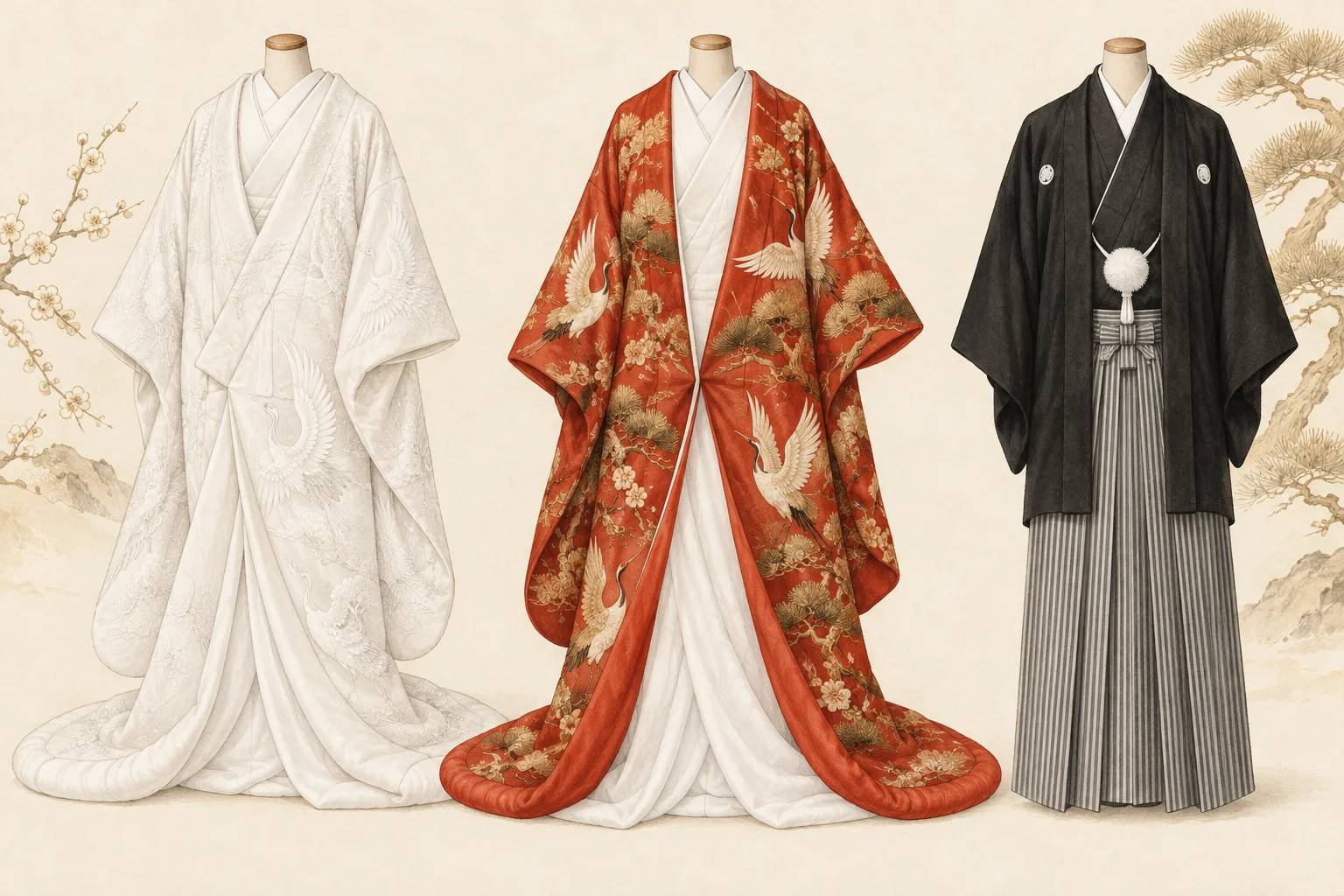
Bridal and groom attire is essentially identical to Shinto: shiromuku or iro-uchikake for the bride (with watabōshi or tsunokakushi headpiece), montsuki haori hakama for the groom. See our traditional Japanese wedding dress guide, the shiromuku vs iro-uchikake comparison, and the men's kimono guide for the garments themselves. The Buddhist-specific variation worth knowing: in some sects the couple carries a small juzu visibly during the procession rather than receiving it during the ceremony, which changes how the photographer frames the entrance. Visually, the shiromuku also reads quite differently against dark temple wood and candle-light than it does in a sunlit shrine courtyard — the white reads warmer and more luminous, and bead detail on the bride's juzu becomes a focal point rather than a quiet accent.
Which Temples Host Foreign Weddings — General Framework
This is the question we are asked most often, and the honest answer requires some unpacking. There is no central registry of "temples that accept foreign weddings" comparable to the lists maintained for shrines. The reality is that butsuzen-shiki bookings for non-Japanese couples are handled case by case, almost always through a wedding planner, photographer, or kimono studio that has an existing relationship with a specific temple.
The general framework looks like this:
- Sect alignment. Most temples will only host weddings for families affiliated with that sect, because the ceremony is a sectarian rite. The major sects you may encounter as host options are Jodo (浄土宗), Jodo Shinshu (浄土真宗), Shingon (真言宗), Tendai (天台宗), Zen (禅宗 — Rinzai and Soto), and Nichiren (日蓮宗). For foreign couples without sect affiliation, the planner will typically approach a temple that accepts non-sectarian guest ceremonies — these exist but are uncommon.
- Photoshoot ceremonies vs legal/official ceremonies. Far more common for foreign couples is a symbolic Buddhist-style ceremony performed during a photoshoot, with a temple permitting use of the hall for a fixed donation. The priest may or may not perform the actual rites. This is the format most international planner packages actually deliver when they advertise a Buddhist temple wedding.
- Tourist temples vs working temples. Famous tourist-photographed temples (Kinkaku-ji, Kiyomizu-dera, Senso-ji, etc.) effectively do not host weddings or wedding-style shoots — the visitor traffic is too high and the religious calendar is too full. Smaller neighborhood temples and certain head temples with dedicated event facilities are the realistic options.
- Photography permissions. Even when a temple permits a ceremony, photography rules inside the hall are typically restrictive. Flash is almost always prohibited; tripods often prohibited; and some sects do not allow images of the principal Buddha to be included in the frame.
Wedding Planner's Notes: Here is what actually happens when a foreign couple asks us for a Buddhist ceremony. We make three or four phone calls, not thirty — there are perhaps two or three temples in Kyoto we will realistically ring for a non-sectarian symbolic ceremony, one or two in Kamakura, and a handful in the Koyasan ecosystem. The donation (ofuse) for a symbolic ceremony with priest presence typically lands in the mid five-figure to low six-figure yen range; without priest presence, it can be a quarter of that. Lead time is the part that surprises couples: a Shinto rite at a tourist-friendly shrine can sometimes be confirmed 6 to 8 weeks out, but a temple booking needs 4 to 6 months — partly because the temple's religious calendar fills early, partly because the head priest is the decision maker and not always available by email. Start the conversation before you book your flights.
For couples who want the temple aesthetic without the complexity of a sectarian ceremony, a temple-garden photoshoot (where the ceremony elements are minimal or symbolic) is often the better path. Kyoto, Kamakura, and Nara have the deepest selection of temples that allow exterior or garden photography — see our Kamakura kimono photoshoot guide and the top Kyoto studios for 2026 for studios that specialize in temple settings.
Photographing a Buddhist Wedding
The photographic challenges of a butsuzen-shiki are different from those of a Shinto rite, and worth flagging clearly before you book.
The setting is darker. Temple main halls are lit primarily by candles, hanging lanterns, and whatever daylight enters through paper screens (shoji). The interior wood is dark, and gold leaf reflects but does not illuminate. Compared to a sunlit shrine courtyard, you are working with perhaps two to four stops less ambient light. Photographers experienced in temple work bring fast lenses (f/1.4 or f/1.8 primes) and accept higher ISO than they would outdoors.
Flash is almost universally prohibited inside the hall. This is non-negotiable in most temples and is a religious rather than a logistical rule — flash is considered intrusive to the meditative atmosphere and disrespectful to the Buddha image.
Movement is restricted. Photographers generally cannot walk around during the ceremony itself and must shoot from a single fixed position behind or beside the seated family. Many temples designate a specific spot.
The key shots to plan in advance:
- The procession entering the hall (nyudo) — possible from outside the hall before the ceremony begins.
- The incense offering — the priest's hands and the rising incense smoke.
- The juzu conferral and the gassho moment — the single most distinctive image.
- Family sake exchange — restrained and quiet, but compositionally similar to Shinto san-san-kudo.
- The recessional out of the hall, ideally framed through the wooden doorway with the bride's shiromuku train visible.
Many photographers who work primarily with Shinto weddings will not have shot inside a temple hall, so when booking, ask specifically for portfolio examples of butsuzen-shiki or temple interior work. Our English-speaking photographer directory includes a small number of photographers with explicit temple experience.
Frequently Asked Questions
Is a Buddhist wedding ceremony in Japan legally recognized?
No — neither Buddhist nor Shinto weddings have legal force in Japan. Legal marriage is registered at the municipal office (yakusho) independently of any ceremony. The butsuzen-shiki is a religious and family rite. Foreign couples should plan to handle legal registration separately, either in their home country or in Japan with the required documentation.
Can we have a Buddhist wedding if we are not Buddhist?
It depends on the temple. Most sect temples will only marry couples with a family connection to that sect, because the rite is sectarian. However, some temples accept non-affiliated couples for symbolic ceremonies, and most temples will permit a photoshoot-style symbolic ceremony for a donation. Work with a planner who has an existing temple relationship — cold-approaching temples rarely succeeds.
How long does a butsuzen-shiki take?
The ceremony itself is typically 20 to 30 minutes, shorter than a Shinto rite. Including kimono dressing (1.5 to 2 hours beforehand), the procession, family photos, and any garden portraits, a full Buddhist wedding day is usually 4 to 6 hours.
What does a Buddhist wedding cost?
Costs vary widely and depend more on the temple and the planner package than on the rite itself. The temple donation (ofuse) for officiating is typically modest, but the kimono rental, hair and makeup, photographer, and any reception meal add up similarly to a Shinto wedding. For a general cost framework see our kimono photoshoot cost guide for 2026.
Can we combine a Buddhist ceremony with a Western reception?
Yes. Many Japanese couples who choose butsuzen-shiki follow it with a Western-style reception at a hotel or restaurant, with the bride changing into a wedding dress. This is logistically straightforward and is essentially the standard Japanese wedding day format, with the religious rite swapped for the Buddhist version.
Do we exchange wedding rings during a Buddhist ceremony?
Traditionally no — the juzu conferral takes the place of any object exchange between the couple. Some modern butsuzen-shiki include a Western-style ring exchange after the juzu conferral, but this is a contemporary addition rather than a traditional element. See our Japanese wedding rings guide for context.
Is a Buddhist wedding photoshoot possible without a real ceremony?
Yes, and this is by far the most common format for foreign couples. A symbolic styled shoot at a temple — with kimono, juzu, and the visual elements of a Buddhist wedding but without the formal sectarian rite — captures the aesthetic without the booking complexity. Most kimono studios in Kyoto, Kamakura, and Nara can arrange this with their partner temples.
Which areas of Japan are best for a Buddhist temple photoshoot?
Kyoto is the obvious first answer — the density of historic sect temples, the established photoshoot infrastructure, and the available Shingon-Tendai-Zen mix mean a planner can match almost any aesthetic brief without leaving the city. Kamakura is the strongest second option for couples drawn to Zen austerity and Pure Land warmth in the same itinerary; the major Zen temples (Engaku-ji, Kencho-ji) and the Pure Land Hase-dera/Komyo-ji axis sit within a single train line. Nara has the oldest temples and the most restrictive permissions — beautiful for exterior work, harder for interior shoots, and worth visiting only if you have a planner with an established Nara contact. Koyasan is the spiritual heart of Shingon and the most dramatic visually (mountain mist, cedar forest, mausoleum approach), but logistics are demanding — overnight stay at a shukubo temple lodging is essentially required, and weather is unforgiving in winter and early spring.
Plan Your Buddhist Wedding Photoshoot
If a temple-interior rite is what draws you, the work starts 4 to 6 months out, goes through a relationship rather than a website, and asks you to choose a sect aesthetic before you choose a date. That is genuinely different from booking a Shinto wedding, and it rewards working with a photographer who has already done the booking dance once.
Browse the Wasou Wedding Japan photographer directory to find photographers with documented temple-interior experience. For broader context, see our complete guide to Japanese weddings, the traditions and customs overview, and the Shinto wedding ceremony guide to compare formats. Couples considering a more relaxed alternative may also want to read our Hawaiian-style wedding in Japan guide.
Related guides
 General guide
Pre-Wedding vs Ceremony Kimono in Japan: Key Differences
Illustrative image · Unsplash. Not a photo of the specific people, places or services discussed.
Pre-wedding (maedori) vs wedding-day kimono shoot in Japan: cost, legal requirements, why foreign couples almost always book pre-wedding.
Read the guide General guide
Japanese Wedding: Complete Guide to Ceremony & Traditions
Illustrative image · Unsplash. Not a photo of the specific people, places or services discussed.
A planner-led guide to the modern Japanese wedding: the Shinto ceremony, kimono and Western dress, the hiroen reception, engagement traditions, and how international couples can plan a kimono photo day in Japan.
Read the guide General guide
Japanese Wedding Traditions, Customs & Rituals: Full Guide
Illustrative image · Unsplash. Not a photo of the specific people, places or services discussed.
Complete guide to Japanese wedding traditions: Shinto ceremony rituals, san-san-kudo, goshugi gift money, hiroen reception customs, and modern adaptations.
Read the guide