Japanese Wedding Rings & Bands: Tradition vs Modern
A planner's guide to Japanese wedding bands: the history of yubiwa-no-gi, brands like Mikimoto, Niwaka, and Tasaki, and how couples wear rings today.

Illustrative image · Unsplash. Not a photo of the specific people, places or services discussed.
Check current prices, availability and venue rules with the relevant studio or venue before booking.
On the bridal floor of any Ginza department store, two displays sit metres apart: Mikimoto's restrained platinum bands on one side, Niwaka's hammered Kyoto-designed rings on the other. Both look unmistakably Japanese. Neither would have appeared at a Japanese wedding a century ago. Wedding rings in Japan are a post-war import that became universal in roughly seventy years, and as a planner I spend a fair amount of time explaining that paradox to international couples drawn to the iconic look of a ring being slid onto a kimono-clad bride's hand.
Did Traditional Japanese Weddings Use Rings?
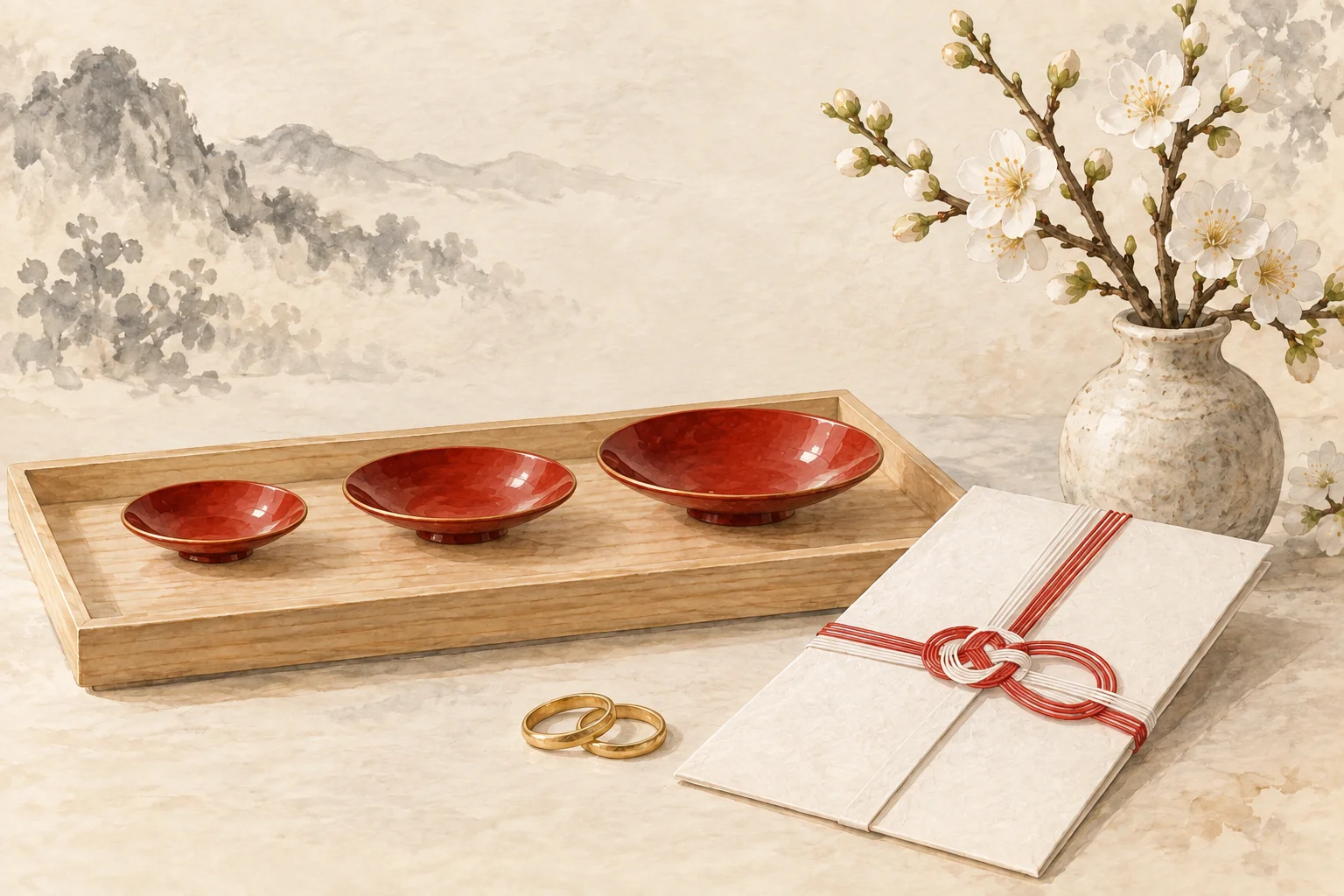
In short: no. Pre-modern Japanese marriage rituals — whether the elite samurai-class shinzen-shiki at a household altar, the samurai-class buke-style banquet, or the agricultural community's village-recognised union — had no equivalent of the Western ring exchange. The binding act was san-san-kudo, the three-cups-nine-sips sake ritual, exchanged between the couple (and in some traditions, with the families). The visible markers of marriage for a woman were the change of hairstyle (from shimada to marumage), the blackening of teeth in some periods (ohaguro), and the shift in clothing — not a band of metal on the fourth finger.
The Japanese wedding ring tradition entered the country in two waves. The first was the late Meiji era, when Western diplomatic and merchant families introduced engagement rings to a tiny urban elite. The second, and far more decisive, wave came after the Second World War, when American occupation-era influence and a domestic department-store retail boom made the diamond engagement ring and the platinum wedding band aspirational symbols of modernity. By the 1970s, rings had become standard at most urban Japanese weddings. By the 2000s, the question "do Japanese wear wedding rings" had a near-universal yes for couples married after the Heisei era. So when we discuss "traditional Japanese wedding rings," we are really discussing a tradition that is roughly seventy years old — younger than the average grandparent.
Yubiwa-no-Gi — The Ring Exchange in Modern Shinto Weddings
If you attend a Shinto wedding (shinzen-shiki) at a shrine today, you will almost certainly see a ring exchange inserted into the ceremony. The Japanese term is yubiwa-no-koukan-no-gi (指輪の交換の儀), commonly shortened to yubiwa-no-gi. Strictly speaking, this is not part of the canonical Shinto ritual order — which traditionally moves from sanshin-no-gi (procession) through shubatsu (purification), norito (priest's invocation), san-san-kudo, seishi (the couple's pledge), tamagushi-hairei (sakaki branch offering), and shinzoku-hai (the family cup) without any ring exchange. But because rings are now culturally expected, most shrines and shrine-affiliated ceremony halls accommodate yubiwa-no-gi as an inserted element, usually placed between seishi (the pledge) and tamagushi-hairei (the sakaki offering).
The mechanics are straightforward. The miko (shrine maiden) or the officiant brings forward a small lacquered tray bearing the rings. The groom places the band on the bride's ring finger; the bride does the same in return. There is no spoken vow at this moment — the seishi pledge has already been read aloud. The act is silent and brief, which suits Shinto's preference for gesture over speech. Some couples request that yubiwa-no-gi be omitted entirely to keep the ceremony purely traditional; this is perfectly acceptable and your officiant will not object. Others incorporate it because the wedding photographs of a ring being placed on a kimono-clad bride's hand have become an iconic image in Japanese bridal media.
If you are planning a kimono pre-wedding photoshoot rather than a ceremony, the ring exchange is often staged for the camera. Discuss timing with your photographer so the rings are visible in close-up frames without disrupting the broader portrait sequence — see our notes on shrine etiquette during photoshoots for context.
Engagement Ring (Konyaku Yubiwa) vs Wedding Band (Kekkon Yubiwa)
Japanese couples typically own two rings, just as Western couples often do, and the vocabulary distinguishes them clearly. The engagement ring is konyaku yubiwa (婚約指輪), often informally rendered as "engage ring" in Japanese marketing. The wedding band is kekkon yubiwa (結婚指輪), informally "marriage ring." A separate set of customs governs each.
Konyaku yubiwa is almost always a solitaire diamond, given by the groom at the proposal or at the yuino (formal engagement gift exchange). The diamond engagement ring tradition in Japan was popularised by a sustained De Beers campaign that ran in Japan through the late 1970s and 1980s, which introduced the now-familiar phrase "kyuuryou no san-kagetsu-bun" — three months' salary as the appropriate budget. That figure has softened considerably; modern Japanese couples often spend around one month's salary, with many spending less. The engagement ring is worn until the wedding day and then, by convention, set aside or stacked with the wedding band.
Kekkon yubiwa is the everyday band. Japanese couples wear it daily, in contrast to konyaku yubiwa which is reserved for formal occasions. Wedding bands are purchased as a pair (pair-ring or "marriage ring set") and the design is coordinated rather than identical — the women's band may have a small accent diamond while the men's is plain platinum, for example. This pair-purchase culture is one of the defining features of Japanese wedding ring shopping: couples almost always visit the jeweler together, try rings side by side, and buy as a matched set.
Which Hand and Finger — The Japanese Convention
Japan follows the Western convention: wedding bands are worn on the fourth finger of the left hand (kusuri-yubi, literally "medicine finger"). The folk explanation cites the old European belief in the vena amoris running from that finger directly to the heart; the explanation is taught earnestly in Japanese bridal magazines even though the anatomical claim has no medical basis. The convention is so settled that no one questions it.
The engagement ring sits on the same finger before the wedding. After the ceremony, conventions vary: some women wear the engagement ring on the right ring finger; others stack both rings on the left fourth finger with the wedding band closest to the hand (the older "guard ring" arrangement); a growing number simply keep the engagement ring at home and wear only the wedding band day to day. There is no etiquette infraction in any of these choices.
One note for international couples: in Japanese photography conventions, the ring hand is almost always shown left-side-out, often resting on the bride's lap or on the groom's hand. If you are doing a kimono shoot, mention to your photographer that you want clear ring-detail shots — the ring will be partially obscured by the long kimono sleeves unless framed deliberately.
Iconic Japanese Wedding Ring Brands
Japan has a deeply developed bridal jewelry market, and certain brands carry cultural weight that international couples often don't realise. The quick reference table below summarises the major names; detailed notes follow.
Brand | Founded | Position | Signature Aesthetic | Typical Pair Price | Best For |
|---|---|---|---|---|---|
Mikimoto | 1893 | Foundational prestige | Restrained platinum, small pavé bands | From ¥500,000 (~$3,300) | Couples honoring established Japanese craft |
Tasaki | 1954 | Modern luxury | Minimalist, architectural platinum | ¥300,000–¥600,000 (~$2,000–$4,000) | Couples wanting contemporary prestige |
Niwaka | 1990 | Japanese-design specialist | Hammered finishes, kimono-textile motifs | ¥300,000–¥600,000 (~$2,000–$4,000) | Couples wanting specifically Japanese design |
Tanzo (category) | Various ateliers | Hand-forged craft | Hammered tsuchime, dense forged metal | ¥300,000–¥700,000 (~$2,000–$4,700) | Couples valuing handcraft and longevity |
Star Jewelry | 1946 (Yokohama) | Mid-market with character | Star and celestial motifs, pavé settings | ¥150,000–¥300,000 (~$1,000–$2,000) | Couples in their twenties and thirties |
I-Primo | 1999 | Bridal-specific chain | Wide range, strong customisation | ¥150,000–¥300,000 (~$1,000–$2,000) | Couples wanting selection and accessibility |
Mikimoto is the foundational name. Founded in 1893 by Kokichi Mikimoto, the pioneer of cultured pearls, the brand operates flagship bridal salons in Ginza and major cities. Mikimoto is the most prestigious traditional choice and the brand most often associated with mothers and grandmothers — choosing Mikimoto signals a respect for established Japanese craft. Their wedding bands are typically restrained platinum designs, often with a small pavé band of melee diamonds.
Tasaki (founded 1954, originally as a pearl wholesaler in Kobe) has repositioned itself in the last two decades as a contemporary luxury house with a strong architectural design language. Their bridal collections feature cleaner, more minimalist platinum bands than Mikimoto's classical work. Tasaki is often chosen by couples in their thirties who want something prestigious but contemporary.
Niwaka (俄, founded 1990 in Kyoto) has become arguably the most distinctive Japanese-design bridal brand. The collections draw explicitly on Japanese aesthetic concepts — "tsukikage" (moonlight), "hatsuhana" (first blossom), "koharu" (early winter sun) — and the rings often feature subtle Japanese motifs: hammered surfaces, asymmetric curves, tiny engraved patterns referencing kimono textiles. Niwaka is the brand most often chosen by couples who want their wedding bands to feel specifically Japanese rather than internationally generic. The Kyoto atelier remains the design heart of the brand and is worth a visit if you are in the city.
Tanzo (鍛造) is not a single brand but a category — handmade-hammered bands forged from a single ingot of platinum. Several ateliers specialise in this approach (the term tanzo means "forged"). Tanzo rings have a denser molecular structure than cast rings and develop a unique surface character with wear. Couples who value craft and longevity gravitate toward tanzo workshops; the bands are slightly more expensive than cast equivalents and require a longer lead time (typically six to eight weeks).
Star Jewelry (founded 1946 in Yokohama) is the long-standing mid-market choice for couples drawn to celestial design — its bridal collections lean on star, moon, and constellation motifs alongside more conventional bands. The brand sits at an accessible price point and is popular with couples in their twenties and early thirties.
Other names worth knowing: Ginza Tanaka (deeply traditional, gold-focused), 4°C (mid-market, popular with younger couples), and Ginza Diamond Shiraishi (a diamond-specialist chain known for in-store selection). International luxury brands — Cartier, Tiffany, Bulgari — also have a strong presence in Japan but compete in a slightly different segment.
Materials and Aesthetics — Platinum Dominance, Subtle Engraving
The defining material choice in Japanese wedding bands is platinum. Industry estimates suggest a significant majority — around 80 to 90 percent — of wedding bands sold in Japan are platinum, far higher than the share in the US or European markets, where gold remains the dominant choice. The cultural reasoning is partly aesthetic — platinum's cool tone reads as "pure" and "permanent" in the Japanese visual vocabulary — and partly practical, since platinum is more hypoallergenic and does not tarnish.
Design language tends toward restraint. Compared to Western bridal markets, Japanese wedding bands are typically narrower (2-3mm for women, 2.5-4mm for men), with low-profile settings and minimal stone work. When stones do appear, they are small melee diamonds set flush or in a delicate pavé band rather than a single large stone. The aesthetic priority is sukoshi tsutsushimi — a small modesty, a quiet beauty. A ring that is too flashy will read as nouveau riche or insensitive.
Inside-band engraving (uchi-bori) is nearly universal. Japanese couples engrave the wedding date in Western numerals, their initials, or a short phrase ("forever," "with you," a kanji character like 愛 or 結). Couples occasionally engrave a single kanji each chose for the other. The engraving is part of the ring-fitting appointment and is included in the price.
Pricing Norms

Japanese wedding ring pricing varies widely by brand and material, but rough ranges help calibrate expectations. A pair of mid-market wedding bands (Star Jewelry, 4°C, I-Primo) typically falls in the ¥150,000–¥300,000 range (roughly $1,000–$2,000 USD or €950–€1,900). A pair from established brands like Niwaka or Tasaki usually sits at ¥300,000–¥600,000 (roughly $2,000–$4,000). Mikimoto and luxury international brands often start at ¥500,000 (roughly $3,300) and climb past ¥1,000,000 (roughly $6,700) for pavé-set or designer pieces. Hand-forged tanzo bands sit in the ¥300,000–¥700,000 range depending on the atelier.
Konyaku yubiwa — the engagement ring — is typically purchased separately and carries the diamond cost. Mainstream engagement ring budgets in Japan today run roughly ¥250,000–¥500,000 (roughly $1,700–$3,300), with high-end couples spending ¥800,000 (around $5,300) and above. These figures are general market norms; we deliberately avoid quoting specific brand prices, which change with metal markets and brand seasons. USD conversions assume an exchange rate near ¥150 to the dollar and will shift with the yen.
One practical note: most Japanese bridal salons require an appointment, and the appointment includes a long consultation, ring sizing, and often a complimentary refreshment. The salon experience is slow and considered — budget at least 60-90 minutes per visit. International couples are welcome, and most flagship stores in Ginza, Marunouchi, and Kyoto have English-speaking staff available with advance notice.
How Do Japanese Wear Their Rings Day-to-Day?
Daily wear conventions for Japanese wedding bands are largely the same as in Western markets, with some local nuances. Working professionals wear the band continuously in most office environments; medical professionals and food-industry workers remove it during shifts, as elsewhere. Men in physical-labor trades often forgo the daily band and wear it only on formal occasions.
Two cultural notes are worth flagging. First, traditional Japanese hot springs (onsen) and certain ryokan baths require all jewelry to be removed before bathing — your ring will go in a small basket at the changing room. Second, attending a funeral in Japan, wearing the wedding band is acceptable but the engagement ring should be removed; bringing flashy jewelry to a Buddhist funeral is considered insensitive. Couples planning extended travel in Japan may want to bring a small ring pouch for these occasions.
Japanese couples also tend to remove rings for sleep — partly to avoid wear, partly because traditional futon bedding catches on raised settings. This is a small habit but consistent enough that bridal magazines mention it in their ring-care guides.
Japanese-Style Rings for Western Couples
For international couples drawn to Japanese-inspired wedding rings, several design directions translate well without venturing into cultural caricature. The first is tsuchime — the hammered finish. Tsuchime bands have a faceted, slightly irregular surface created by hand-hammering the metal. The texture catches light differently than a polished band and develops a softer patina over time. Many tanzo ateliers specialise in tsuchime, and several Niwaka collections feature it. The look reads as quietly Japanese without being literal.
The second is cherry blossom motifs, which can be incorporated tastefully when done subtly — a single small sakura flower engraved on the inside of the band, or a pavé pattern arranged to suggest petals. Avoid large external sakura sculpting, which reads as costume jewelry. The Japanese aesthetic instinct here is restraint: the motif should be discoverable, not announced.
The third is Japanese-style wedding rings in mixed-metal designs — combinations of platinum and rose gold inspired by mokume-gane, the centuries-old metalworking technique that produces wood-grain patterns by layering and forging different metals. True mokume-gane bands are made by a small number of master craftsmen and command premium prices, but they are an authentic option for couples drawn to traditional Japanese metalcraft. A handful of Kyoto and Kanazawa ateliers make them to commission.
For couples shopping in Japan during a pre-wedding trip, the practical approach is to book appointments at two or three bridal salons in the same district (the Ginza, Aoyama, or Karasuma areas all work) and compare in person. International shipping is available from most brands. If you are also planning a kimono photoshoot, see our visa and entry guide and our seven-day itinerary for trip-planning notes.
A Wedding Planner's Note on "Japanese Inspired" Rings
There is a category of "Japanese inspired wedding rings" sold internationally — often by Western jewelers — that feature heavy-handed kanji engraving, oversized sakura, or stylised "samurai" motifs. From a planner's perspective, these tend to age poorly and read as costume rather than fine jewelry. If the Japanese aesthetic appeals to you, the more reliable route is to either work with a Japanese atelier directly (Niwaka and several tanzo workshops ship internationally) or to commission a Japanese-trained designer in your home country. Restraint, hand-craft, and surface texture are the hallmarks of authentic Japanese ring design — not graphic symbols.
Frequently Asked Questions
Are wedding rings part of traditional Japanese weddings?
No. Traditional Japanese wedding rituals — including san-san-kudo and the Shinto ceremony — historically had no ring exchange. The custom is a post-war import and is now ubiquitous, but it is not part of the canonical Shinto ritual order.
What is yubiwa-no-gi and can it be omitted from a Shinto ceremony?
Yubiwa-no-gi is the inserted ring-exchange portion of a modern Shinto wedding, usually placed between the couple's pledge (seishi) and the sakaki branch offering (tamagushi-hairei). It is a recent addition to the ceremony and can be omitted entirely if you prefer a strictly traditional service — your officiant will not object.
Which Japanese wedding ring brands are most prestigious?
Mikimoto carries the most cultural prestige as the foundational Japanese bridal house. Niwaka is the leading contemporary Japanese-design brand. Tasaki occupies a modern luxury tier. Tanzo (forged) workshops are favored by couples valuing handcraft and surface texture.
Are there generational differences in how Japanese couples shop for rings?
Yes — quite distinctly. Couples in their twenties tend toward mid-market chains like Star Jewelry, I-Primo, and 4°C, often with celestial or playful motifs. Couples in their thirties more often choose Niwaka or Tasaki for contemporary prestige. Couples marrying later, or those for whom family expectation matters, gravitate to Mikimoto — the brand most associated with parents and grandparents.
What metal are most Japanese wedding bands made of?
Platinum dominates — industry estimates suggest 80 to 90 percent of wedding bands sold in Japan are platinum. Yellow and white gold are the minority, and rose gold remains a recent trend rather than a default choice.
Can international couples buy Japanese wedding rings during a trip to Japan?
Yes. Major brands (Mikimoto, Niwaka, Tasaki) have English-speaking staff at flagship salons in Ginza, Aoyama, and Kyoto. Appointments are typically required, and most brands offer international shipping for engravings completed after you return home.
What is a tsuchime ring?
Tsuchime (槌目) is the hand-hammered finish on a forged platinum or gold band. The surface has a faceted, slightly irregular texture that catches light differently than a polished band. It is one of the most recognisably Japanese ring aesthetics and translates well to international taste.
Are there regional differences in Japanese wedding ring shopping?
The flagship bridal districts are Ginza in Tokyo, Karasuma in Kyoto, Umeda in Osaka, and Sakae in Nagoya — each carries every major brand. Kyoto skews toward Niwaka's home atelier and traditional craft workshops; Kobe still carries Tasaki's pearl heritage; Tokyo offers the widest international-brand selection. Most couples shop locally rather than travelling for rings, but Kyoto attracts pilgrimage visits for tanzo and mokume-gane ateliers.
Plan Your Japanese Wedding Photography
The bridal salons in Ginza, Aoyama, and Karasuma run on appointment-only schedules and book up weeks in advance during cherry-blossom and autumn-foliage seasons — line your jewellery appointments up alongside your photography day and the rest of your trip will fall into place. Browse our directory of vetted kimono wedding photographers for studios that can stage ring-detail shots alongside full portrait sequences. For broader trip planning, our complete guide to Japanese weddings covers culture, ceremony, and logistics in one place, and our guide to Japanese wedding proposals covers the engagement-ring side of the same conversation.
Related reading: shiromuku vs iro-uchikake bridal kimono, men's kimono for wedding photos, and 2026 kimono photo cost guide.
Related guides
 Style guide
Traditional Japanese Wedding Costumes: Who Wears What
Illustrative image · Unsplash. Not a photo of the specific people, places or services discussed.
Traditional Japanese wedding costumes for the bride, groom, family and guests: how formality ranks, what to avoid, and which garments you can actually rent.
Read the guide Style guide
Montsuki Kimono: The Japanese Groom's Formal Wedding Attire
Illustrative image · Unsplash. Not a photo of the specific people, places or services discussed.
Montsuki kimono explained for grooms: what the crests signal, kuro- versus iro-montsuki, the full outfit, what studios charge, and what to check before booking.
Read the guide Style guide
Family Crests (Kamon) on Wedding Kimono
Illustrative image · Unsplash. Not a photo of the specific people, places or services discussed.
Kamon (家紋) are family signatures stitched into formal kimono — five, three, or one crest in fixed positions. Here is how the system works, what rental studios actually provide, and what couples with Japanese heritage should research before the ceremony.
Read the guide