Kasuga Taisha
Kasuga Taisha is a place to understand the relationship between shrine buildings, lanterns and a sacred mountain. It is also a working place of worship with unusually specific rules for couples: wedding attire, including Japanese bridal dress, may not be photographed here unless the couple is marrying at the shrine, even for personal enjoyment. The official photography policy and boundary map should be read before choosing clothes, a photographer or a location.
A medieval painting explains the sacred landscape
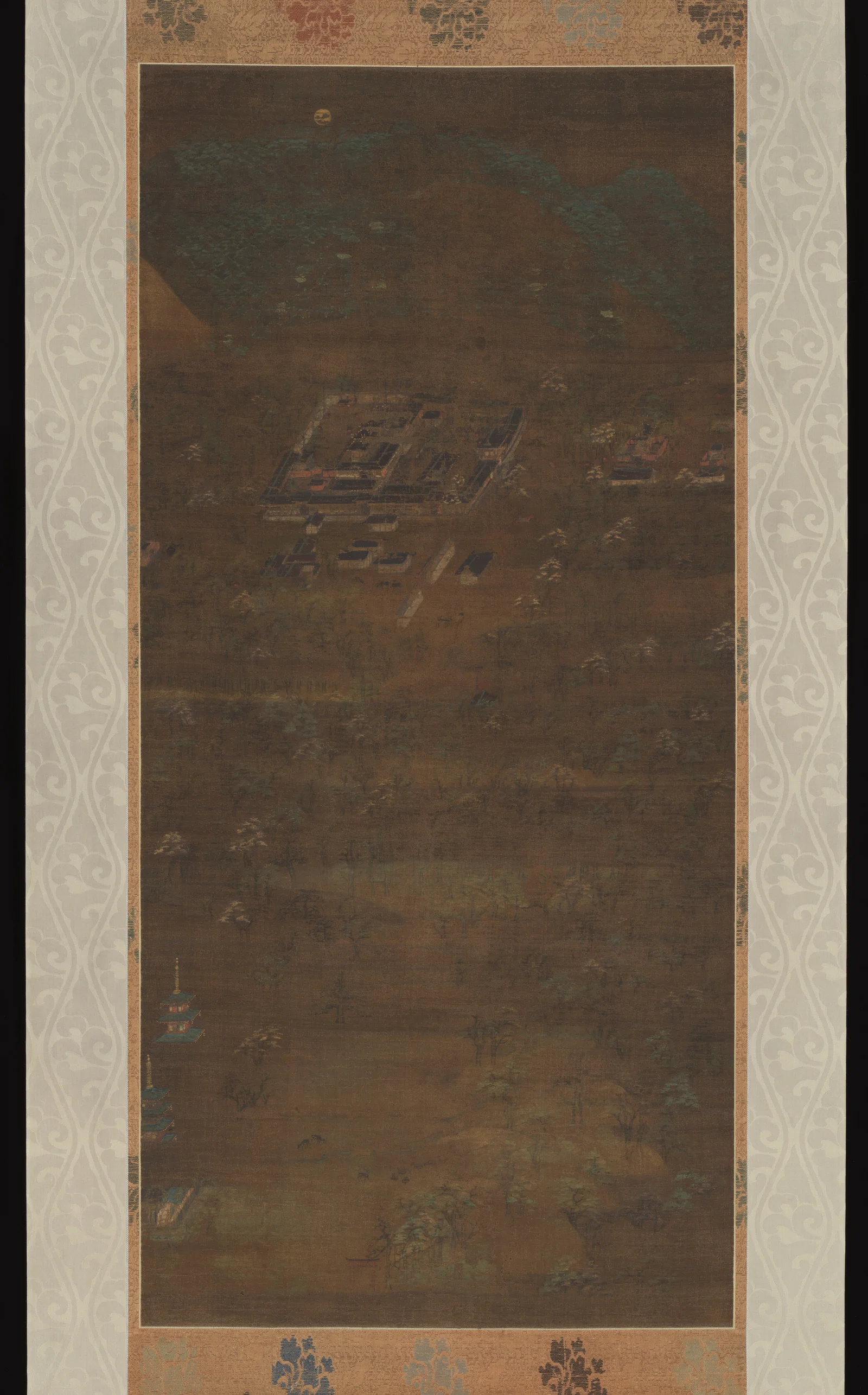
The image above is a thirteenth-century Kasuga Shrine Mandala in The Metropolitan Museum of Art, not a contemporary photograph. The museum’s curatorial account explains that a bird’s-eye view of the shrine and Mount Mikasa could serve as a virtual pilgrimage. This gives the forested setting a religious meaning beyond a picturesque background. Look for the mountain above the buildings and the paths leading towards them.
The Agency for Cultural Affairs’ architectural record identifies the main sanctuaries as four buildings in Kasuga-zukuri, with cypress-bark roofs; the first sanctuary’s record dates the present building to 1863. Periodic renewal should not be read as a claim that all the standing buildings were completely rebuilt at the last ceremony. Nor does a special-worship ticket mean entry inside the sanctuaries.
Choose the part of Kasuga you want to visit
Regular visitor information checked on 5 November 2026. Each paid area has its own admission.
Area | Regular cost and time | What it adds |
|---|---|---|
Main public worship area | No admission fee. March–October 06:30–17:30; November–February 07:00–17:00. | A visit to the public worship area, without assuming access to every inner space. |
Special worship | ¥700; reception 09:00–16:00, subject to ritual closures. | Corridors, the view from before Chumon and Fujinami-no-ya. |
Kasugataisha Museum | Regular adult ¥700; 10:00–17:00, last admission 16:30. Exhibition prices can differ. | A separate visit to the shrine’s treasures and exhibition. |
Manyo Botanical Garden | Adult ¥700; 09:00–16:30, last admission 16:00. | Plants connected with the Man’yoshu; closed Tuesdays June–March, with holiday exceptions. |
The official basic information lists full-day and partial-day exclusions for special worship. For example, the mornings of the 1st, 11th and 21st are normally excluded; do not assume a 09:00 start is available on every date. If two adults choose all three paid areas at the regular ¥700 rate, the admissions total ¥4,200, before travel or a differently priced exhibition. This is a sightseeing calculation, not a wedding or photography fee.
Distinguish the lantern room from the lantern festival
The shrine’s corridor guide describes Fujinami-no-ya as an indoor recreation of the atmosphere of Mantoro, using a former priests’ room. It is not evidence that all the outdoor lanterns are illuminated every evening. The guide associates the full Mantoro observances with Setsubun and 14–15 August. Check the current event notice if illumination is the reason for travelling.
Why the second mandala is not a visitor map
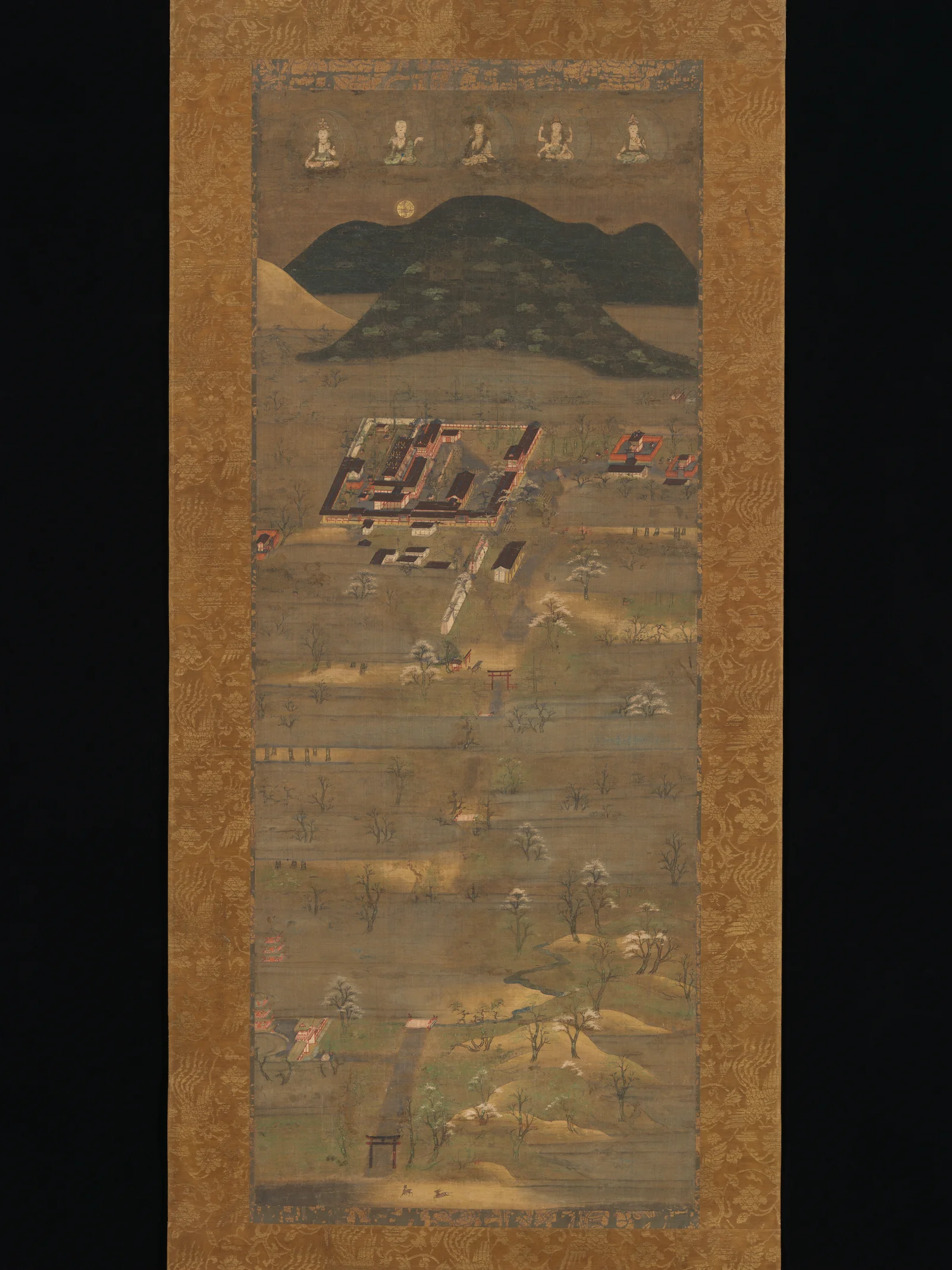
The second mandala, dated to the early fourteenth century, uses a different composition to place the shrine beneath the mountain. The museum explains that shrine mandalas combine Buddhist mandala concepts with Japanese painting. Read the elevated figures and landscape as religious imagery, not a scaled map or a promise of today’s vegetation, colours or access.
The boundary matters as much as the clothing
The photography-policy PDF specifically includes Tobihino, the botanical garden, museum, shrine woodland and detached shrine grounds. It states that Tobihino is shrine land, not part of Nara Park. A photographer’s permission for a nearby park cannot automatically be carried across that boundary. The map in the same PDF is the useful reference; the historical paintings on this page are not permit maps.
If you are considering an actual shrine wedding
Read the reservation conditions together with the ceremony rules. The distinction is precise: designated providers alone may photograph during the rite. An outside photographer’s separately agreed role concerns permitted snapshots before or after the ceremony and post-ceremony group photographs, not the rite itself. Paying a published outside-provider charge does not create a standalone pre-wedding-shoot permit.
- Confirm whether you are booking worship, a wedding ceremony or photography; these are different arrangements.
- Tell the shrine exactly what clothing and equipment you intend to use and where you hope to go.
- For a wedding party needing mobility assistance, discuss the many steps and assistance required; do not assume an entirely step-free route.
- Confirm ritual closures and current weather arrangements before finalising transport and dressing times.
Source review: shrine photography policy, basic information, corridor guide and wedding conditions; national architectural record; two Public Domain museum collection records. Checked 5 November 2026. No independent wedding-shoot permission or provider endorsement is implied.
Maps & official planning tools
Check the entrance, route and conditions with the place’s manager before your visit. Some official resources are in Japanese.
Planning guides
 General guide
Kyoto Honeymoon Guide: Morning and Evening Spots for Two and Itineraries by Trip Length
Illustrative image · Unsplash. Not a photo of the specific people, places or services discussed.
Where to spend mornings and evenings as a couple in Kyoto, from morning walks in Higashiyama and Arashiyama to Gion at night and dinner on the Kamogawa riverside platforms (noryo-yuka). See 2-, 3-, and 4-night sample itineraries, where to stay, ryokan and accommodation tax, kimono photo shoot prices and places where wedding-attire shoots are not allowed, when to go, and Gion etiquette.
Read the guide General guide
Japan Honeymoon Destinations: 10 Places for Couples by Season
Illustrative image · Unsplash. Not a photo of the specific people, places or services discussed.
Explore 10 Japan honeymoon destinations by type: historic cities, hot springs, sea and islands, and Tokyo. Compare experiences for couples, good times to go, and travel times in one at-a-glance table.
Read the guide Location deep dive
The 15 Best Kimono Wedding Photo Locations in Japan, Ranked (2026)
Illustrative image · Unsplash. Not a photo of the specific people, places or services discussed.
A ranked guide to the 15 best shrines, temples and gardens for a kimono pre-wedding photoshoot in Japan — from Fushimi Inari's torii tunnels to Miyajima's floating gate, with honest notes on where shoots are permitted.
Read the guideFind your kimono wedding photographer
Compare listings by area, style and price, then ask the studio to confirm language support, package details and availability.
Browse photographers →