Rainy Season Kimono Photoshoot: June Tsuyu Strategy
A planner's guide to the rainy season kimono photoshoot in Japan — June tsuyu pricing, hydrangea backdrops, morning slots, and vermillion umbrella strategy.

Illustrative image · Unsplash. Not a photo of the specific people, places or services discussed.
Check current prices, availability and venue rules with the relevant studio or venue before booking.
Mid-June to mid-July is Japan's tsuyu — the rainy season — and the photo industry's least-booked window. Studios that quote two-month lead times for cherry blossom season often hold open slots two weeks out in late June. For couples willing to plan around afternoon showers, build in an indoor backup, or treat a vermillion umbrella as a styling decision rather than damage control, tsuyu offers the cheapest, least-crowded shooting calendar in Japan — plus hydrangeas. Here is how we walk couples through the trade-offs.
The Tsuyu Calendar by Region
Tsuyu is not a single national event. It moves from south to north over roughly six weeks, skips Hokkaido entirely, and ends earlier in some years than others. The Japan Meteorological Agency publishes annual start and end dates, but the historical averages are stable enough to plan against.
Region | Typical tsuyu window | Notes |
|---|---|---|
Okinawa | Early May to late June | Earliest in Japan; ends as Honshu begins |
Kyushu (Fukuoka) | Early June to mid-July | Heaviest rainfall totals nationally |
Kansai (Kyoto, Osaka) | Mid-June to late July | High humidity; afternoon thunderstorms common |
Kanto (Tokyo, Kamakura) | Mid-June to late July | Mornings often dry; rain concentrates 14:00-19:00 |
Tohoku (Sendai) | Mid-June to early August | Cooler, shorter, less intense |
Hokkaido | No tsuyu | The alternative if rain is a deal-breaker |
The practical implication: if you book Kyoto for late June, you are not booking "the rainy season" in the abstract — you are booking a calendar week where roughly half the days see meaningful rain, mostly in the afternoon, with morning windows usable about 70% of mornings. That is bookable. It is not, in our experience, a coin flip on whether your shoot can happen.
Why Most Couples Avoid It (Crowded Studios, Rain Risk)
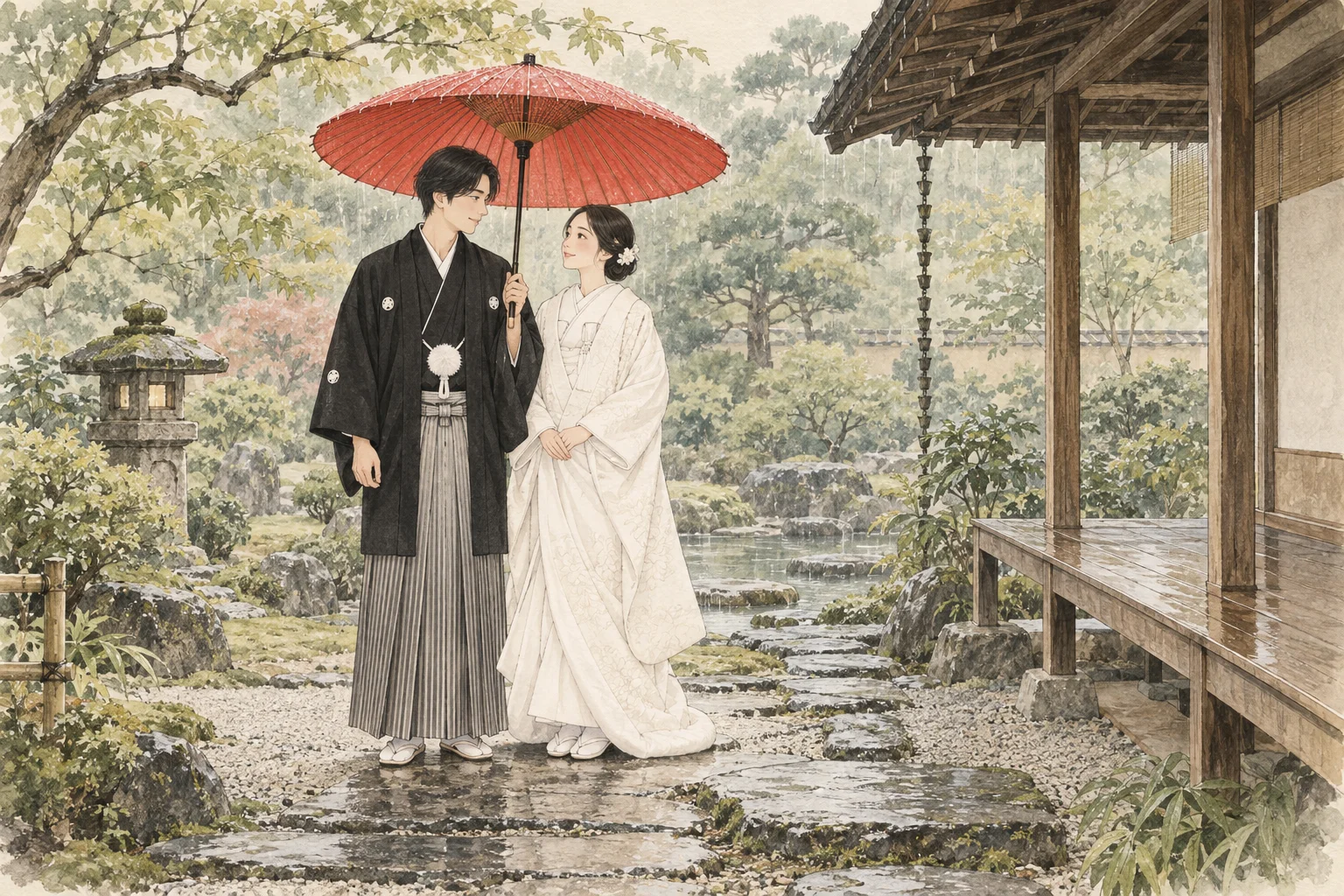
The reasons couples skip tsuyu are real and we don't talk anyone out of them.
Humidity damages hair and makeup. Bridal hair set in shimada or tsunokakushi-compatible styles relies on heavy pinning and product. At 80% humidity, a 4-hour shoot will look different at hour one and hour four. Studios anticipate this by scheduling touch-up windows, but the effect is unavoidable.
Outdoor backdrops lose color. Overcast skies flatten the contrast between vermillion shrine gates and surrounding greenery. Photographs taken in flat tsuyu light look softer and quieter than the high-contrast spring or autumn alternatives. For some couples that's the appeal; for others it's the problem.
Schedule risk feels uncomfortable from abroad. If your only trip dates are fixed and the studio can't reschedule into your trip, a heavy rain day means losing the slot or shifting to a fully indoor backup. Booking from overseas with no flexibility raises the stakes.
Wedding Planner's Notes: Couples who cancel because of rain risk almost always describe it as "we didn't want to gamble on the weather." But the gamble is smaller than it looks. About 60-70% of tsuyu mornings in Tokyo and Kyoto stay dry enough for a 2-hour outdoor session. The bigger risk is sustained heavy rain across consecutive days, and even that is what reschedule clauses are built for. The couples we see regret tsuyu are the ones who didn't read their reschedule clause before signing.
Why Some Couples Choose It (Pricing, Hydrangea, Empty Locations)

The arguments in favor are equally concrete.
Pricing. Many studios offer 10-25% discounts during tsuyu — sometimes called "off-season" or "rainy-day" packages, sometimes simply quoted lower without label. A Kyoto shoot that costs ¥220,000 in early April may quote ¥180,000 in late June. The discount is real because demand collapses; studios fill calendar gaps rather than hold out for full-price bookings that won't come.
Empty locations. Fushimi Inari at 8:00 in late June can have the lower torii corridor functionally empty for 10-15 minutes at a stretch. The same location in early April will have a continuous stream of visitors. For couples who want isolated frames at famous shrines without a 5:30 call time, tsuyu mornings deliver what cherry blossom season cannot.
Hydrangea season. See the dedicated section below. Ajisai (hydrangea) is the photographic gift that makes June worth shooting in.
Shorter studio waits. Studios that quote 8-10 week lead times in spring and autumn often confirm bookings 2-3 weeks out in tsuyu. If your travel plans firmed up late, June is the calendar that says yes.
Morning Slot Strategy (Before Afternoon Showers)
Tsuyu rain follows a pattern in most of Honshu: convective afternoon storms triggered by daytime heating, often peaking between 14:00 and 18:00. Mornings — particularly 7:00 to 11:00 — see substantially less rainfall.
The booking strategy that follows from this:
- First slot of the day. Ask for the studio's earliest start. Many shrine-permit shoots begin at 7:30 or 8:00 in tsuyu specifically because the weather window is more reliable.
- Compress timeline. A 3-hour outdoor + 1-hour studio shoot becomes 2-hour outdoor + 2-hour studio. You finish outdoor work before the weather turns.
- Avoid late-afternoon "golden hour" plans. The 16:00-18:00 window that works in autumn is the highest-risk window in tsuyu. Plan around it, not into it.
- Confirm rescheduling cutoffs. Most studios decide go/no-go by 6:30 or 7:00 on the morning of the shoot. Hair and makeup start at 5:30. The decision window is narrow; clarify who makes the call and on what criteria.
Wedding Planner's Notes: The hour you save by starting at 8:00 instead of 9:00 is the hour that saves the entire shoot. Couples sometimes push back on "too early" — but in tsuyu, that hour is the difference between dry shrine pavement and rainwear in every frame. We rarely book tsuyu shoots after 10:00.
Vermillion Umbrella as Styling Tool
The traditional vermillion (shu-iro) wagasa — a Japanese paper umbrella with red lacquered ribs — is the styling decision that turns rain from problem into asset. Most kimono studios in Kyoto, Asakusa, and Kamakura carry one or two for the rainy season; some include it free as part of an off-season package.
The umbrella works visually because:
- The red echoes the vermillion of shrine torii gates and bridges, creating intentional color repetition
- It frames the bride's face from above, softening the overcast light
- It signals "this is a planned wedding portrait" rather than "we got caught in the rain"
- It works for both bride-solo and couple-together framing
Ask whether the studio's umbrella is genuine paper (wagasa) or modern nylon styled to look traditional. Both photograph well; the paper version has more texture but cannot tolerate sustained heavy rain, while the nylon version is more durable and almost indistinguishable in photos. For shoots where the umbrella will be used in light drizzle only, paper is the better visual choice. For shoots where the umbrella may take real rain, nylon is the safer call.
Indoor Backup Options — Hotel Tea Rooms, Studio Sets
Every tsuyu booking should include an indoor fallback. Three options work well:
Hotel tea rooms. Properties like the Hotel Gajoen Tokyo, the Hoshinoya Kyoto, and traditional ryokan with chashitsu (tea ceremony rooms) rent these spaces for portraits. Rates run ¥30,000-¥80,000 per hour depending on the property, and the space photographs as authentically Japanese — tatami, shoji screens, ikebana — without any of the weather risk. Some kimono studios pre-negotiate corporate rates with specific hotels for tsuyu bookings.
Shrine pavilions with covered roofs. Many shrines have haiden (worship halls) or kagura-den (sacred dance pavilions) with deep eaves. A photographer working under permit can shoot from inside the covered area looking out at the rain-darkened grounds — the contrast often reads beautifully. This is a compromise option that keeps you on shrine grounds without exposing the kimono.
Studio sets. Most major kimono photography studios in Kyoto and Tokyo maintain indoor sets — painted backdrops, mock shrine gates, tatami platforms with seasonal props. These were built specifically for rainy days and winter shoots. The photographs read as "studio" rather than "location," but a skilled studio with proper lighting can deliver work indistinguishable in quality from outdoor frames.
Confirm in writing which backup the studio will deploy and at what additional cost (often included; sometimes ¥20,000-¥40,000 surcharge for hotel rooms).
Hydrangea (Ajisai) Wedding Photoshoot — June's Photographic Gift
Ajisai (hydrangea) blooms across Japan from mid-June to mid-July — the same window as tsuyu. This is not coincidence. The flowers thrive on humidity and rain. For photographers, hydrangea is what cherry blossom is to early April: the seasonal flower that makes the calendar week shootable.
Hydrangea-famous locations across Japan:
Location | Region | Notes |
|---|---|---|
Meigetsu-in (明月院) | Kamakura | ~2,500 plants; "Meigetsu-in blue" cultivar; peak mid-June |
Hase-dera (長谷寺) | Kamakura | ~2,500 plants on hillside walking path |
Mimuroto-ji (三室戸寺) | Uji, Kyoto | ~20,000 plants across 50 varieties |
Hakusan Jinja (白山神社) | Tokyo (Bunkyo) | Quiet alternative within Tokyo metropolitan area |
Toshogu | Nikko | Cooler microclimate; peak slightly later (late June-early July) |
For kimono couples, Kamakura is the strongest hydrangea pairing: a samurai-era town with shrine and temple permits, a 50-minute train from Tokyo, and two of Japan's most famous hydrangea temples within a single shoot day. The combination of vermillion umbrella, blue hydrangea, and white shiromuku is one of the seasonal compositions Japanese photographers genuinely look forward to. For background on Kamakura logistics, see our Kamakura kimono guide.
Hokkaido Alternative (No Tsuyu)
Hokkaido is the geographic exemption. The island sits north of the polar front during the tsuyu period and experiences none of the rainy season pattern. Mid-June through July is, in fact, Hokkaido's high tourist season precisely because it offers reliable dry weather while the rest of Japan is wet.
For couples whose dates fall in late June or July and who are unwilling to plan around rain, the workaround is to shift the shoot location north. A Hokkaido kimono photoshoot — Sapporo's Hokkaido Jingu, Otaru canal area, or the lavender fields of Furano — gives you summer kimono weather with shrine and outdoor location access that mainland Japan cannot provide in the same week.
The cost: Hokkaido shoots are slightly more expensive than Tokyo or Kyoto baseline (studios are smaller, permits at major shrines have different fee structures), and travel time from Tokyo is a 90-minute flight plus 40-minute airport transfer. For couples already routing through Tokyo, adding Hokkaido as a 3-day side trip is the most reliable way to guarantee dry weather in late June. See our Hokkaido kimono guide for details.
Insurance and Cancellation Policy for Rain Day
Most reputable kimono photography studios in Japan include rain-day reschedule clauses in their tsuyu-season contracts. The standard structure:
- Free reschedule within trip dates. If rain forces cancellation on the booked day, the studio will reschedule into any open slot within your stay at no charge.
- Partial refund if no slot available. If your trip ends before a dry day opens, you typically receive 50-70% refund — minus hair and makeup costs already incurred and minus shrine permit fees if non-refundable.
- Indoor backup substitution at no charge. Most studios will offer to convert to a studio-only shoot at the original price rather than refund — and many couples accept this rather than lose the booking entirely.
The clauses that matter most to read carefully:
- Who decides go/no-go. Studio or client. Studio is usually better — they have the experience to call marginal weather correctly.
- What time the decision is made. Usually 6:30-7:00 on the morning of. Anything later than 7:30 is too late given hair and makeup timelines.
- What counts as "rain." Some contracts specify "heavy rain" (more than 5mm/hr); some are at studio discretion. The vaguer the language, the more important the studio's reputation.
- Travel insurance interaction. Standard travel insurance does not cover weather-cancellation of a photoshoot. If you want financial protection beyond the studio's clause, you need event-specific cover, which is rarely worth the premium for a single shoot.
For deeper coverage of contract terms, see cancellation and rescheduling policies and photographer contracts and insurance.
Frequently Asked Questions
Can a kimono get wet in the rain?
Light drizzle under a vermillion umbrella will not damage a rental kimono. Sustained or heavy rain can stain the silk, and most studios charge a damage fee (¥30,000-¥80,000 for moderate water damage). The umbrella is mandatory in any active rain. Studios will refuse to send the kimono outdoors if rainfall exceeds light drizzle.
Do hair and makeup hold up in 80% humidity?
For 2-3 hour shoots, yes — Japanese stylists working in tsuyu use stronger setting products and tighter pinning specifically because they expect humidity. Beyond 4 hours, expect visible softening of the style. Schedule the most important shots (formal portraits, shrine arrivals) in the first 90 minutes after styling completes.
Is Okinawa a better tsuyu alternative than Hokkaido?
No. Okinawa's rainy season runs early — most of May through late June — so the southern islands are wettest exactly when you'd hope to escape there. Hokkaido is the better dry-weather alternative in June and July. Okinawa works best in March-April or September-November.
What's the cheapest Japan location for a tsuyu kimono shoot?
Kamakura tends to be the best price-to-quality ratio in tsuyu — strong studio competition, hydrangea bonus season, and lower base prices than Kyoto. Budget-conscious couples book Kamakura in mid-June at 15-20% below their April quote.
Will my photographer cancel if it rains lightly?
Reputable studios proceed in light rain with the umbrella, modify the shot list to favor covered shrine areas, and only cancel for sustained heavy rain. If your studio has a reputation for canceling at the first sprinkle, you have the wrong studio for tsuyu. Ask explicitly about their rain threshold before signing.
Can I shoot at Kyoto Fushimi Inari during tsuyu?
Yes — and it's one of the best windows of the year for that specific shrine because the torii corridor is far less crowded. Wet vermillion paint photographs particularly well against tsuyu light. Book the 8:00 slot, accept that you may finish by 10:30 instead of 11:00, and plan a studio set for afternoon.
How far in advance should I book a tsuyu shoot?
2-4 weeks is typical, versus 8-10 weeks for cherry blossom season. The shorter lead time is real, but the best photographers in each city still book out — don't assume you can decide the week of.
Book a Rain-Ready Kimono Photographer
Tsuyu is the calendar week where photographer experience matters more than location list — the right studio reads marginal weather correctly, has the indoor backup pre-negotiated, and treats the vermillion umbrella as a portrait choice rather than a panic prop. Our directory filters for studios with active tsuyu-season experience and confirmed rain-day policies.
Browse our curated directory of English-speaking kimono photographers in Japan — or continue planning your seasonal shoot with Spring vs Autumn: Which Kimono Photoshoot Season Wins? and our complete guide to choosing the right season for your kimono photoshoot.
Related guides
 Season
Wedding Day Rain Backup Plan in Japan: Tsuyu & Typhoon Reschedule
Illustrative image · Unsplash. Not a photo of the specific people, places or services discussed.
A practical wedding day rain backup plan for Japan: the four-tier framework studios use (umbrella shoot, covered interior, reschedule, full cancellation), tsuyu and typhoon-season realities, cost sharing norms, and how to build a 1-3 day buffer into your itinerary.
Read the guide Season
Autumn Foliage Kimono Photoshoot in Japan: Best Spots & Timing
Illustrative image · Unsplash. Not a photo of the specific people, places or services discussed.
Plan an autumn foliage kimono shoot in Japan: peak colour windows for Kyoto, Nikko and Kamakura, permit fees, and how far ahead to book.
Read the guide Season
Snow Wedding Photoshoot in Japan: Hokkaido, Nikko & Shirakawa-go
Illustrative image · Unsplash. Not a photo of the specific people, places or services discussed.
Plan a snow kimono shoot in Japan: most reliable snow windows in Hokkaido, Nikko, Shirakawa-go and Kanazawa, plus cold-weather logistics.
Read the guide