Vietnamese Couple Kimono Photoshoot Japan: Visa & Studio Guide
Vietnamese couple kimono photoshoot in Japan: visa requirements, 5.5hr Hanoi/HCMC flights, ao dai pairing, Vietnamese-speaking studios, and Confucian etiquette overlap.

Illustrative image · Unsplash. Not a photo of the specific people, places or services discussed.
Check current prices, availability and venue rules with the relevant studio or venue before booking.
Roughly 1,000-1,800 Vietnamese couples travel to Japan each year for kimono photoshoots, a number that has roughly doubled since 2022. The market sits behind Thailand by volume but moves faster on conversion: Vietnamese inquiries close in 11-14 days on average, the shortest cycle of any Southeast Asian segment. The drivers are practical — a 5.5-6 hour direct flight, single-entry tourist visa processing under three weeks, and a Confucian family framework that maps onto Japanese wedding etiquette in ways most first-time visitors find easier to navigate than Western couples do.
Why Vietnamese Couples Choose Japan
For Vietnamese couples between 26 and 34 — the dominant segment booking from Hanoi, Ho Chi Minh City, and Da Nang — Japan reads as the cultural prestige destination of East Asia. The choice often comes down to three factors: the flight is short enough to do over a long weekend if needed, the aesthetic vocabulary (kimono silhouette, shrine architecture, garden composition) is genuinely foreign enough to feel like a memory worth making, and the price point sits below Paris or New York but above Bangkok or Seoul.
The Vietnamese middle class hit a inflection point around 2023, when outbound leisure travel to Japan recovered past pre-pandemic levels and then exceeded them. Wedding-related travel — prewedding photoshoots, honeymoons, and anniversary trips — represents the highest-spending sub-segment of this outbound flow.
Wedding Planner's Notes: Vietnamese couples ask earlier and book faster than most segments we work with. The typical pattern: a Facebook or Instagram inquiry referencing a specific image (often Hanoi-based or HCMC-based influencer wedding content), three rounds of WhatsApp or Zalo messages confirming pricing and locations, and a deposit within two weeks. The shoot itself usually happens 4-7 months out, timed to a lunar-calendar auspicious date.
Direct Flights: Hanoi and HCMC to Tokyo
Direct flight options from Vietnam to Tokyo are mature. Vietnam Airlines, ANA, and Japan Airlines all operate daily nonstops on the Hanoi (HAN) and Ho Chi Minh City (SGN) routes. VietJet Air added Tokyo Narita service in recent years as a lower-cost option.
Origin | Destination | Flight Time | Carriers |
|---|---|---|---|
Hanoi (HAN) | Tokyo Narita (NRT) | 5hr 30min | Vietnam Airlines, ANA, JAL, VietJet |
Hanoi (HAN) | Tokyo Haneda (HND) | 5hr 30min | Vietnam Airlines, ANA |
Ho Chi Minh City (SGN) | Tokyo Narita (NRT) | 6hr | Vietnam Airlines, ANA, JAL, VietJet |
Ho Chi Minh City (SGN) | Osaka Kansai (KIX) | 5hr 30min | Vietnam Airlines, JAL |
Da Nang (DAD) | Tokyo Narita (NRT) | 5hr 45min | Vietnam Airlines (seasonal) |
The flight is short enough that Vietnamese couples can — and frequently do — fly in on a Thursday evening, shoot Friday and Saturday, and return Sunday. This is the tightest itinerary we see executed routinely, and it works because the time difference between Vietnam (ICT, UTC+7) and Japan (JST, UTC+9) is only two hours. Jet lag is essentially nonexistent.
For couples bringing parents, the longer 7-10 day itinerary becomes more common. See our 7-day Japan wedding itinerary and guide to bringing parents to a Japan kimono photoshoot for the standard structure.
Visa Application: Three-Week Processing, Single Entry
Vietnamese passport holders require a visa to enter Japan. The standard tourist visa (短期滞在) is single-entry, valid for 90 days from issuance, and permits a stay of up to 15 days. Processing through the Embassy of Japan in Hanoi or the Consulate-General in Ho Chi Minh City takes approximately three weeks from the date of complete submission — though we recommend planning for four to allow buffer for document corrections.
The application requires:
- Passport valid 6+ months past intended return date
- Visa application form (downloaded from MOFA Japan website)
- Photograph (45mm × 35mm, taken within 6 months)
- Daily schedule of stay in Japan (with hotel confirmations)
- Round-trip flight reservation or ticket
- Proof of financial standing — typically 3-month bank statement showing balance equivalent to your planned spend
- Employment confirmation letter (or business registration if self-employed)
- Family register (hộ khẩu) copy for marriage verification if applying as a married couple
Most reputable Vietnamese travel agencies in Hanoi and HCMC handle the full application for a service fee of ~2,500,000-4,000,000 VND. The consular fee itself is currently 580,000 VND for a single-entry visa. Vietnamese-capable Japanese photoshoot studios will provide a "shoot confirmation letter" specifying your photoshoot dates and locations — this is supporting documentation that strengthens your application.
Wedding Planner's Notes: We have not yet seen a tourist visa rejection for a couple traveling specifically for a documented prewedding photoshoot. The rejection pattern, when it occurs, is almost always tied to incomplete financial documentation or inconsistencies between the application form and supporting documents. Have your travel agent triple-check the schedule against your hotel and flight bookings.
East Asian Confucian Family Overlap
Vietnam and Japan share Confucian foundations — family hierarchy, eldest-son obligations, ancestral respect, and ceremonial seating order — that don't exist in Western frameworks. For prewedding photoshoot planning, this translates into three practical advantages.
First, family seating during group photos is intuitive. The Japanese kazoku-shashin (family photo) convention places parents at the center, eldest children flanking, married couples grouped, and youngest at the edges. This matches Vietnamese family photography convention closely enough that no explanation is needed. See our family photo positioning guide for the full framework.
Second, Vietnamese couples understand the concept of formal photographs as documentation for family elders — not just personal memory. This shapes the brief differently from Western inquiries: the request usually includes a formal portrait set for parents' display, not only the relaxed editorial frames.
Third, the gesture vocabulary translates. The slight bow upon entering a sacred space, the two-handed presentation of gifts or business cards, and the deferential posture in family group composition all read as natural to Vietnamese couples — no rehearsal needed. This saves 20-30 minutes on the shoot day that would otherwise go into coaching a Western couple through the same beats.
Vietnamese-Speaking Studios in Japan
Vietnamese-speaking kimono photoshoot studios in Japan are still rare. The current count sits at roughly two to three, all based in Tokyo, all of recent founding (2022-2024). The Vietnamese-speaking team member at each is typically a Japanese staff who studied in Vietnam or a Vietnamese national working at the studio under a specified-skill visa.
For couples whose Japanese language ability is limited and whose English is conversational but not fluent, the practical workaround in 2026 is bilingual brief documentation. Most Tokyo and Kyoto studios accept:
- Vietnamese-language pre-shoot brief sent via WhatsApp, Zalo, or email
- On-shoot communication via Google Translate (Vietnamese ↔ Japanese works well now)
- English-speaking studio coordinator as primary contact
For couples with stronger English, our guide to English-speaking kimono photographers is the broader reference. For multilingual production specifically, see multilingual wedding photography in Japan.
Wedding Planner's Notes: If having a Vietnamese-speaking team member matters to your decision, ask specifically: "Do you have a Vietnamese-speaking person on shoot day, or only during pre-shoot communication?" The latter is more common. Some studios offer a Vietnamese-speaking concierge for pre-shoot planning but a Japanese-only crew on the actual day.
Top Locations Among Vietnamese Couples
Vietnamese booking patterns show clear concentration. The Tokyo-Kyoto-Mt Fuji triangle accounts for 80% of bookings, with Hokkaido emerging as the winter alternative.
Tokyo: Modern and Traditional Mix
Vietnamese couples consistently favor Tokyo as the entry point. The combination of Meiji Jingu Shrine for traditional frames, Asakusa for textured-street kimono walking, and the Tokyo skyline for modern editorial frames covers a full visual range in two shoot days. See Asakusa kimono shoot guide and Meiji Jingu permit requirements.
Kyoto: Cultural Anchor
Roughly half of Vietnamese couples extend the Tokyo shoot with a Kyoto leg, taking the Shinkansen down for one or two additional days. Fushimi Inari, Gion, and Arashiyama dominate the request list. Our top Kyoto studios for 2026 piece covers the studio-side options.
Mt Fuji Backdrop
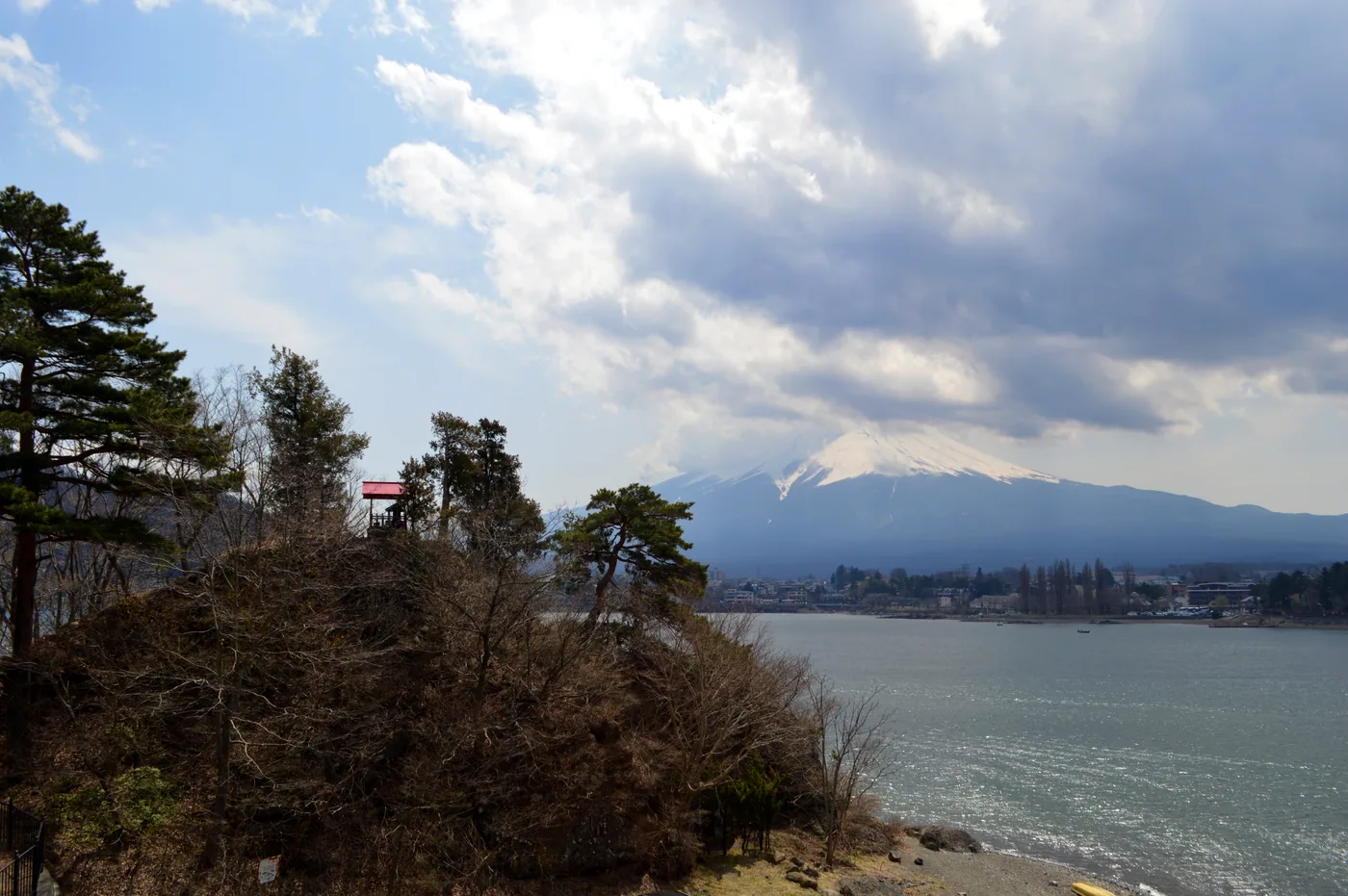
Mt Fuji frames are increasingly requested. The visit is structured as a day trip from Tokyo to Lake Kawaguchiko (1.5 hours by Limited Express), shooting from late morning when the mountain is most reliably visible. See Mt Fuji kimono photoshoot guide.
Ao Dai and Kimono Pairing
One of the most distinctive emerging trends among Vietnamese couples in Japan is the ao dai + kimono combined-shoot. The format alternates Vietnamese national dress (ao dai for the bride, áo gấm or western suit for the groom) with Japanese kimono in a single shoot day, often using shared locations.
The aesthetic logic works because both silhouettes are floor-length, both rely on hand-tailored fabric, and both photograph well in garden, shrine, and street settings. The structural distinction is sleeve form (ao dai tunic with fitted trouser vs. kimono enveloping silhouette) and color philosophy (ao dai favors bright primary colors, bridal kimono favors structured white shiromuku or richly patterned iro-uchikake).
Ao Dai (Bride) | Shiromuku Kimono | |
|---|---|---|
Silhouette | Fitted tunic + flowing trouser | Layered enveloping robe |
Dominant Color | Bright (red, pink, gold) | White (with red lining accent) |
Hair | Often loose or simple | Bunkin-takashimada updo, kanzashi |
Time to dress | 10-15 minutes | 60-90 minutes |
If both garments are planned for the same shoot day, schedule the ao dai frames first (faster to dress), then move to the kimono dressing room while shooting locations transition. The typical structure is 9:00 ao dai outdoor frames, 11:00 kimono dressing, 13:00 shrine and garden kimono frames. See shiromuku vs iro-uchikake comparison for kimono selection.
Lunar Calendar Wedding Date Considerations
Vietnamese couples often coordinate the Japan photoshoot to a lunar-calendar auspicious date — typically scheduled within a 30-day window of the wedding ceremony at home, or anchored to a date selected by family elders or a fortune teller (thầy phong thủy).
The Japanese rokuyō calendar — a separate six-day cycle that includes the well-known "taian" auspicious day and the "butsumetsu" inauspicious day — does not align with the Vietnamese lunar calendar. Couples occasionally request Japanese taian dates as a secondary auspiciousness layer, but this is optional and most studios accommodate either system.
The practical implication is that "available shoot dates" should be discussed early, before flight bookings are finalized. Auspicious dates on the Vietnamese calendar do not necessarily map to Friday-Saturday weekends in Japan.
Spend Tier: Mid-Range and Growing
Vietnamese couple spend on a Japan kimono photoshoot in 2026 averages JPY 280,000-450,000 for the standard half-day plus kimono rental package, rising to JPY 600,000-900,000 for full-day multi-location bookings. This sits below the Thai and US averages but above the Indonesian and Filipino tiers, with year-over-year growth of approximately 15-20%.
Premium packages — multi-day shoots with both Tokyo and Kyoto, both ao dai and kimono dressing, and parent involvement — sit at JPY 1,200,000-1,800,000. This tier is growing fastest, driven by HCMC-based couples in technology and finance.
For pricing benchmarks across all couple segments, see our kimono photo cost guide for 2026.
Family Involvement Expectations
Approximately 40% of Vietnamese photoshoot bookings include parents or extended family — higher than the Thai segment (25%) and lower than the Indian segment (60%). Parents typically attend as observers and group-photo participants, not as decision-makers on shoot details.
The family-photo block is usually scheduled at the start or end of the shoot day, with parents in formal Western or Vietnamese dress (not kimono). For parents who wish to wear kimono themselves, rental shops in Tokyo and Kyoto offer the formal black tomesode for mothers, though this requires advance reservation. See tomesode for mothers and mother's kimono for foreign guests.
Pre-Shoot Communication Languages

Vietnamese couples typically communicate with Japanese studios in:
- English — primary contact language for ~70% of bookings, used through email and platform chat
- Vietnamese via translator — used by ~20% of bookings, typically with a Vietnamese travel agent serving as intermediary
- Vietnamese direct — ~10% of bookings, only possible with the small number of Vietnamese-capable studios
For brief documentation, we recommend writing in your most comfortable language first, then having it translated. Vietnamese-to-English translation tools handle wedding terminology well; Vietnamese-to-Japanese is improving but still produces awkward output for technical terms (specific kimono types, shrine names, ceremonial vocabulary).
Related Southeast Asian Couples Coverage
For couples comparing Southeast Asian outbound destination wedding markets, see our parallel guides for Thai couples in Japan and Indian couples in Japan. The visa requirements, flight times, and cultural pairing notes differ meaningfully across segments.
FAQ
Can Vietnamese couples enter Japan without a visa for short stays?
No. As of 2026, Vietnamese passport holders still require a visa to enter Japan. The Japan-Vietnam visa waiver discussions continue but have not produced a formal agreement. Plan for the standard single-entry tourist visa application, three to four weeks before departure.
Can we combine the Japan kimono shoot with a Vietnamese ao dai shoot in the same day?
Yes, this is one of the most popular structures for Vietnamese couples. Schedule ao dai frames first (10-15 minute dressing), then kimono frames after lunch (60-90 minute kimono dressing). Most Tokyo studios will source ao dai if requested, though we recommend bringing your own from Vietnam for fit accuracy.
How early should we book a Vietnamese-speaking studio?
4-6 months ahead for cherry blossom season (late March to early April), 3-4 months for autumn (mid-October to late November), 2-3 months for other periods. Vietnamese-speaking team availability is the binding constraint, since only 2-3 studios offer it and their Vietnamese-speaking staff often have limited schedules.
Do Vietnamese couples need a separate marriage certificate translation for the shoot?
No, the photoshoot itself does not require legal marriage documentation. The Japanese visa application may request the family register copy (hộ khẩu) if applying as a married couple, but the shoot booking itself only needs your names and contact information.
Is direct Hanoi-Kansai service available for couples wanting to start in Kyoto?
Direct Hanoi-Kansai (Osaka) flights operate seasonally and at lower frequency than Hanoi-Narita. For most Vietnamese couples flying into Kyoto-region, the practical path is Hanoi-Narita, then JR Tokaido Shinkansen from Tokyo to Kyoto (2hr 15min). Direct Ho Chi Minh-Kansai service is more reliably scheduled.
Can we shoot at locations where ao dai is not commonly worn — like in formal shrine precincts?
Yes, ao dai is acceptable at most shrines as a respectful foreign garment. The same etiquette as kimono applies: no inappropriate poses, no blocking other visitors. Some shrines (Meiji Jingu, Fushimi Inari) have explicit permit policies — check shrine etiquette first.
How do payment and deposit logistics work for Vietnamese couples?
Most studios accept international card payments (Visa, Mastercard) for both deposit and final balance. Bank transfer in USD or JPY is the alternative; SWIFT transfers from Vietnamese banks take 1-3 business days. Cash payment in JPY on shoot day is acceptable at some studios for the final balance, but the deposit always requires a traceable transfer.
Are Tet (Vietnamese Lunar New Year) dates problematic for booking?
Late January and early February overlap with the Japanese New Year quiet period and cherry blossom shoulder. If you're trying to align a wedding photoshoot to a post-Tet auspicious date, the booking is feasible but flight prices peak — book 4+ months ahead.
Find a Vietnamese-Capable Studio
The Wasou Wedding Japan directory filters studios by language capability and segment experience. Use the Vietnamese-capable filter to narrow to the small set of Tokyo studios with verified Vietnamese-speaking pre-shoot support, or the broader English-capable filter for the full Tokyo and Kyoto market.
Browse the full directory at /en/photographers. For couples weighing alternative Southeast Asian destination wedding markets first, our Thai couple Japan kimono guide and Indian couple Japan kimono guide cover the parallel logistics.
Locations in this guide


Related guides
General guideKimono Wedding Photos for Foreigners: How It Works in Japan
Illustrative image · Unsplash. Not a photo of the specific people, places or services discussed.
Yes, foreign couples can have kimono wedding photos taken in Japan — no residency, ceremony or Japanese required. How booking, fittings, pricing and permits actually work.
Read the guide General guide
How to Book a Kimono Photographer in Japan from Abroad: Step-by-Step
Illustrative image · Unsplash. Not a photo of the specific people, places or services discussed.
A complete step-by-step guide for foreign couples booking a kimono pre-wedding photographer in Japan from overseas. Contracts, payments, communication.
Read the guide General guide
Multilingual Wedding Photography Japan: Beyond English
Illustrative image · Unsplash. Not a photo of the specific people, places or services discussed.
A planner's audit of which languages — Korean, Mandarin, Spanish, French, JSL — Japanese kimono studios actually support, plus interpreter costs and when to hire one.
Read the guide