Thai Couple Kimono Photoshoot in Japan: Bangkok Direct Guide
A planner's guide to Thai couples booking Japan kimono shoots: visa window, language coverage, Buddhist resonance, budget tier, and key locations.

Illustrative image · Unsplash. Not a photo of the specific people, places or services discussed.
Check current prices, availability and venue rules with the relevant studio or venue before booking.
Thai couples represent a growing annual cohort bringing a distinct planning profile to Japan kimono shoots. The 6-hour direct flight from Bangkok is shorter than what most Western couples face, the shared Buddhist heritage creates a natural resonance with temple shoots, and the 15-day visa-free window forces a trip envelope tighter than the 30-day stays Australian or American couples often plan. The result is a compact, temple-heavy itinerary that rewards careful sequencing more than it rewards a wide location sweep.
Why Thai Couples Choose Japan
Three factors recur across Thai client briefs. The first is travel time: Bangkok to Tokyo is shorter than Bangkok to Sydney or Bangkok to most European capitals, which keeps the trip feasible inside a standard Thai annual leave allowance. The second is seasonal contrast — Bangkok has effectively two seasons (hot/wet, hot/dry), so the appeal of cherry blossom in April or snow in January-February is genuine novelty rather than a familiar cycle. The third is shared Buddhist visual vocabulary: temple gates, incense, prayer beads, and bell-ringing all register as familiar reference points even when the specific sect differs.
Thai couples also tend to plan multi-purpose trips. A kimono shoot is rarely the sole reason for the trip — it pairs with shopping (Tokyo Ginza, Shinjuku, Osaka Shinsaibashi), winter sports for couples from cooler-month bookings, and food tourism. Studios that understand this and propose a half-day or single-morning shoot timing — rather than insisting on a full-day block — tend to win Thai bookings more reliably.
Direct Flight (Bangkok BKK/DMK → Tokyo 6hr)
Direct flights run from both Bangkok airports — Suvarnabhumi (BKK) for full-service carriers and Don Mueang (DMK) for low-cost — to Tokyo Narita (NRT) and Haneda (HND). Flight time is approximately 6 hours. Thai Airways, ANA, JAL, AirAsia X, and Thai VietJet all operate routes; weekly frequency averages 30+ flights across carriers in peak season.
Six hours is short enough that a Thai couple can reasonably fly overnight, land morning, and shoot the next day. This is different from American or European couples, who typically need a full rest day to recover from 10-12 hour flights before facing a 7am hair-and-makeup call. For planners, this means Thai itineraries can compress: arrival day, shoot day, and one or two buffer days within the 15-day visa window.
Visa Reality (15 Days Standard, 30 Days Special)
Thai passport holders receive visa-free entry to Japan for 15 days for tourism purposes. This is shorter than the 90-day visa-free allowance granted to most Western passports and tighter than the 30 days available to several other ASEAN nations. The 15-day window starts on the date of entry, not the date of arrival in country versus departure — careful date counting matters.
A 30-day visa is available by application through Japanese embassies and consulates in Thailand, but it requires more documentation (bank statements, employment letter, itinerary, return ticket) and adds 1-2 weeks of processing time. Most Thai couples planning kimono shoots stay inside the 15-day window because the application cost-benefit favors the shorter trip. The visa constraint shapes itineraries in practical ways:
- Tokyo-only or Tokyo-plus-Kyoto trips are the norm — broader multi-city tours don't fit comfortably
- Shoot day is usually scheduled in the first half of the trip to leave buffer days for weather rescheduling
- Reception or post-shoot family travel through Japan is uncommon — the home reception happens back in Bangkok
Wedding Planner's Notes: The 15-day window also means cancellation flexibility matters more for Thai couples than for couples on 90-day visas. If weather forces a reschedule and the couple is already on day 10 of 15, there may not be another shoot day available within the window. Studios that offer rescheduling within a tighter buffer — or who price weather contingency into the original booking — handle Thai bookings better. See our cancellation and rescheduling guide for the standard policies.
Shared Buddhism — Theravada vs Mahayana
Thailand is predominantly Theravada Buddhist; Japan is predominantly Mahayana Buddhist (with strong Shinto integration). The two traditions diverged roughly 2,000 years ago and emphasize different sutras, monastic structures, and lay practices. For wedding photography purposes, the divergence shows up in three ways.
First, monk visual identity. Thai monks wear saffron robes and shave their heads; Japanese Buddhist monks wear black, gray, or specific sect-colored robes and may or may not shave. Couples expecting to see "monks like at home" should be prepared for visual difference. Second, temple aesthetics. Thai temples feature gold-leaf detail, mythological figures (Garuda, naga serpents), and bright color palettes. Japanese Buddhist temples — particularly the Zen and Shingon traditions frequently featured in wedding photography — favor restrained dark wood, raked gravel, and muted color. Third, ritual practice. Thai couples are accustomed to monk blessings (involving holy water, sai sin string, and chanting); Japanese Buddhist wedding ceremonies are uncommon outside of specific sect membership, and most Japanese weddings are conducted Shinto-style — see our Shinto wedding ceremony guide for the typical format.
What this means for shoots: temples register as familiar visually for Thai couples, but the specific rituals do not transfer. A Thai couple shouldn't expect a Japanese monk to perform a wedding blessing in the Thai style, and shouldn't assume sai sin string or holy water elements will be available. The shoot is photography at a Buddhist setting, not a Buddhist ceremony.
Thai-Speaking Studios in Japan (~3-5)
Studios with Thai-language staff are a small set — currently three to five in operation, all concentrated in Tokyo and Osaka. None operate in Kyoto or Kanazawa, which means Thai couples shooting in those cities will typically work in English or through an interpreter the studio arranges.
This is a thinner network than what Chinese, Korean, or Taiwanese couples find. For Thai couples, this means three practical implications:
- English fluency is often the working language. Most Thai couples planning international travel have functional English; studios reciprocate by offering English-language coordination even when Thai-speaking staff isn't available
- Visual references travel further than verbal description. Pinterest boards, sample portfolio shots, and itinerary mockups in image form bridge language gaps faster than email chains
- On-shoot interpreters can be arranged. Tokyo and Osaka studios sometimes coordinate with Thai-speaking guides for the shoot day itself, even when their core team works in English-Japanese
See our multilingual wedding photography guide for how studios typically structure language coverage.
Top Locations Among Thai Couples

Kyoto (Temple Density)
Kyoto is a frequently-requested location for Thai couples, driven by temple density rather than shrine preference. Kiyomizu-dera, Kinkaku-ji, and Ginkaku-ji are familiar by name to Thai travelers; the temple atmosphere transfers without explanation. Photography policy varies — some major temples restrict commercial photography or kimono-styled shoots near peak visitor hours — see our Kyoto studios guide for studios operating within current policy. Thai couples shooting in Kyoto typically pair it with a Tokyo arrival/departure, using shinkansen for the 2.5-hour transfer.
Asakusa (Senso-ji Buddhism)
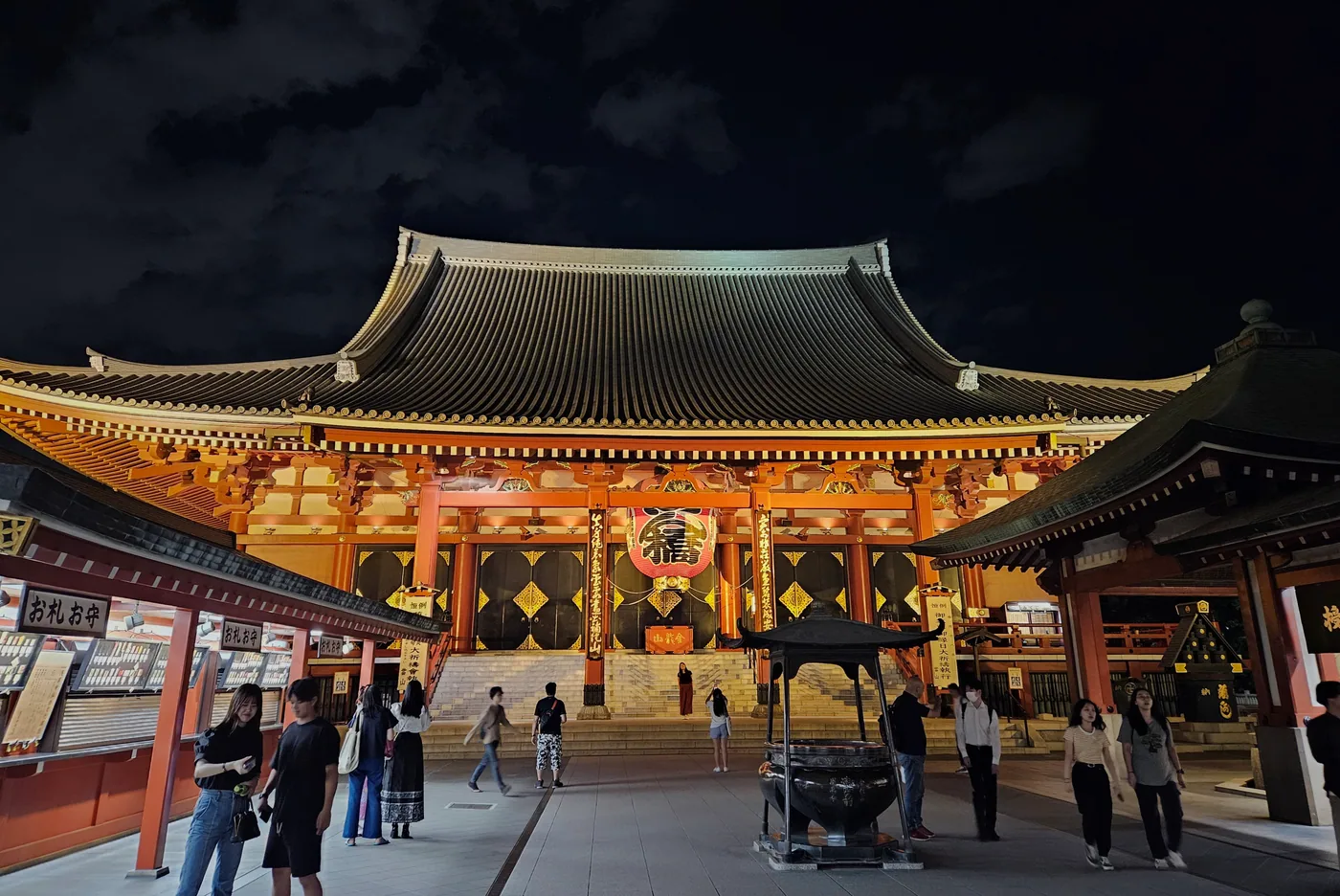
Senso-ji in Asakusa is a major Tokyo Buddhist temple and a common Tokyo location for Thai kimono shoots. The Nakamise shopping street, the Kaminarimon gate, and the five-story pagoda all photograph well in early morning before the crowds arrive. See our Asakusa kimono shoot guide for the typical 7am-9am window most studios use.
Mt Koya (Shingon Buddhist Pilgrimage)
Koyasan (Mt Koya) is the headquarters of Shingon Buddhism, founded in 819. It's a working monastic mountain — couples can stay in shukubo (temple lodgings), eat shojin ryori (Buddhist vegetarian cuisine), and shoot at Okunoin cemetery in the cedar forest. This is the closest Japanese equivalent to a serious Buddhist pilgrimage destination and resonates with Thai couples whose home practice is more devotional than tourist-Buddhist. See our Koyasan Buddhist kimono guide. Access is 2 hours from Osaka by train + cable car; an overnight stay is recommended over a day trip.
Spend Tier and Per-Couple Budget Range
Thai couples sit in a growing but more constrained spend tier than US or Australian couples. Typical per-couple budgets for a Japan kimono shoot package — covering kimono rental, hair/makeup, photographer, location fees, and digital delivery — fall in the USD 1,500 to USD 3,500 range for a half-day shoot. Full-day shoots and premium studios push toward USD 4,500-6,000 but are less common than in higher-spend markets.
This is meaningful for planners: a Thai couple's budget is closer to a domestic Japanese couple's shoot budget than to an American destination wedding budget. Studios pricing in the USD 8,000-12,000 range — which works for the US market — typically don't convert Thai inquiries. See our 2026 kimono photo cost guide for the package tiers most studios offer.
Wedding Planner's Notes: The lower per-couple spend doesn't mean lower quality expectations. Thai couples — particularly those traveling internationally for the shoot — bring strong visual reference standards from social media and Bangkok wedding photography (which has a sophisticated domestic scene). The package needs to be priced for the market without dropping technical quality. Studios that handle this well tend to offer a tighter shoot timing (3-4 hours rather than 6-8), a single kimono rather than two, and digital-only delivery without printed album upsell.
Pre-Shoot Communication (English Often Preferred)
Most Thai couples booking Japan shoots communicate in English with the studio, even when Thai-speaking staff is available. There are two reasons. First, English communication keeps the studio's full team in the loop — if Thai routes through one staff member, scheduling and revisions slow down. Second, English aligns with how most Thai couples coordinated their wedding venue, attire, and trip logistics — adding Thai-language steps adds workflow rather than removing friction.
Studios working with Thai couples typically use:
- Email and LINE messenger for initial inquiry — LINE is the dominant Thai messaging app
- Pinterest boards or shared Google Drive folders for visual references
- Zoom or Google Meet for one pre-shoot consultation, 2-4 weeks before arrival
- WhatsApp or LINE for shoot-week coordination
Bangkok is in GMT+7, two hours behind Japan (GMT+9). This makes scheduling video calls easier than the 12-15 hour gaps American couples deal with.
Cultural Notes — Wai Greeting vs Japanese Bow
Thai couples will instinctively wai (palms together, slight bow) when meeting studio staff, priests, or temple monks. Japanese protocol is a bow with hands at sides or palms on thighs. Neither is wrong; both register as respectful. For photography purposes, the planner should brief the couple on three specific points before the shoot day.
First, at Shinto shrine visits (if combining shrine and temple settings), the protocol is bow and clap rather than wai — see shrine etiquette guide. Second, at temple visits, palms-together is acceptable but should be paired with a Japanese-style bow rather than the Thai full-wai stance. Third, when greeting the photographer or studio staff, either gesture works fine but mixing both — wai-then-bow — looks awkward in photographs and on video.
This is a small thing, but it matters in the candid frames that make up the documentary portion of the shoot. A briefed couple looks natural; an unbriefed couple often looks uncertain, which the camera captures.
Bangkok Outbound Agency Partnerships
Some Tokyo and Osaka studios have working relationships with Bangkok wedding planners and travel agencies. The agency handles the trip itinerary, hotel, transfers, and translation; the studio handles the shoot. For couples who prefer turnkey planning, this is the cleanest path.
The agency model adds 15-25% to the base shoot cost but removes the planning load. For couples comparing direct studio booking against agency packages, the trade-off is cost vs. workload. Couples comfortable with English and Pinterest-style reference boards typically book direct; couples wanting a Thai-language single point of contact route through agencies.
For booking direct from abroad, see our guide to booking a Japan kimono photographer from abroad and the booking platform comparison.
FAQ
Do I need a visa to visit Japan from Thailand for a kimono photoshoot?
No, Thai passport holders receive visa-free entry for tourism for 15 days. The 15-day window includes the entry and exit day. If your trip requires longer than 15 days, you'll need to apply for a 30-day tourist visa through the Japanese embassy or consulate in Bangkok, which takes 1-2 weeks of processing time and requires supporting documentation.
Can a Japanese Buddhist monk perform a wedding blessing for us like in Thailand?
Generally no. Japanese Buddhist weddings are uncommon and typically only available within specific sect membership. The visual setting of a Japanese Buddhist temple is available for photography, but the ritual (sai sin string, monk chanting, holy water) is not a service Japanese temples typically offer to visiting couples. A Shinto-style ceremony with san-san-kudo is the more common ceremony option — see our san-san-kudo sake ritual guide.
Are there Thai-language studios in Kyoto?
Currently no. The 3-5 studios with Thai-speaking staff are concentrated in Tokyo and Osaka. Kyoto shoots for Thai couples typically run in English or through an interpreter that the studio arranges for the shoot day. Many Thai couples find this acceptable given their English fluency and Pinterest-board communication.
Is LINE messenger commonly used by Japanese studios?
Yes — LINE is the dominant messaging app in Japan as well as Thailand, with over 95 million users in Japan. Most Tokyo and Osaka studios are reachable via LINE for inquiry and shoot-week coordination. This is a workflow advantage Thai couples have over Western markets, where studios often prefer email-only.
What is the best season for Thai couples specifically?
January through early March is increasingly popular because the temperature contrast from Bangkok (cold weather as novelty) and the option of snow shoots in Hokkaido or northern Honshu register as bigger experience differentiators than cherry blossom (which Thai couples can also see in Chiang Mai). Cherry blossom (late March-early April) remains a heavily-booked season globally and fills up first. See our seasonal comparison guide.
Do we need to be Buddhist to shoot at Koyasan or Senso-ji?
No. Both are open to all visitors for kimono photography, subject to the same conduct rules that apply to other tourists. Koyasan, being a working monastic mountain, asks for quieter behavior in inner precincts; Senso-ji is fully public and tourist-heavy. Religious identity is not gatekept at either location.
Can our parents travel with us for the shoot?
Yes — and many Thai couples bring parents, particularly mothers, as part of a multi-purpose family trip. The 15-day visa applies to parents on Thai passports as well. For shoot logistics, see our bringing parents guide.
Find a Thai-Speaking Studio
The Thai-Japan kimono photography corridor is growing but still under-served by language coverage outside Tokyo and Osaka. Most Thai couples find that English-language coordination with strong visual references closes the gap, but couples wanting Thai-language single-point-of-contact service will want to start their search with the small Tokyo/Osaka studio set or with Bangkok outbound agencies that have studio partnerships.
Browse our directory of vetted Japan kimono photographers to see which studios advertise multilingual coverage and which work primarily in English-Japanese. For neighboring market comparisons, see our guide for Vietnamese couples and our guide for Indian couples — both share some of the visa-window and language-coverage dynamics Thai couples face.
Related guides
 General guide
Kimono Wedding Photos for Foreigners: How It Works in Japan
Illustrative image · Unsplash. Not a photo of the specific people, places or services discussed.
Yes, foreign couples can have kimono wedding photos taken in Japan — no residency, ceremony or Japanese required. How booking, fittings, pricing and permits actually work.
Read the guide General guide
How to Book a Kimono Photographer in Japan from Abroad: Step-by-Step
Illustrative image · Unsplash. Not a photo of the specific people, places or services discussed.
A complete step-by-step guide for foreign couples booking a kimono pre-wedding photographer in Japan from overseas. Contracts, payments, communication.
Read the guide General guide
Multilingual Wedding Photography Japan: Beyond English
Illustrative image · Unsplash. Not a photo of the specific people, places or services discussed.
A planner's audit of which languages — Korean, Mandarin, Spanish, French, JSL — Japanese kimono studios actually support, plus interpreter costs and when to hire one.
Read the guide