Japanese Wedding Makeup and Bridal Hair for Shiromuku
Choose makeup, bridal hair and a headpiece for your shiromuku photoshoot. Compare fitting needs and package inclusions, with a message to send your stylist.

Illustrative image · Unsplash. Not a photo of the specific people, places or services discussed.
Check current prices, availability and venue rules with the relevant studio or venue before booking.
Japanese wedding makeup does not have to mean an opaque white face. With shiromuku — the all-white bridal kimono ensemble — you can discuss a traditional water-based finish or contemporary bridal makeup. Hair, headpiece and makeup are related choices, but booking a white kimono does not tell the stylist which finish you want.
For a photoshoot arranged from overseas, settle three things before paying a deposit: the look, the products and fitting needed to create it, and what the quote includes. This guide explains the terms and gives you a message you can adapt for your stylist. A photo-only session and a ceremony may have different requirements; confirm ceremony styling with the venue as well.
What traditional Japanese wedding makeup means
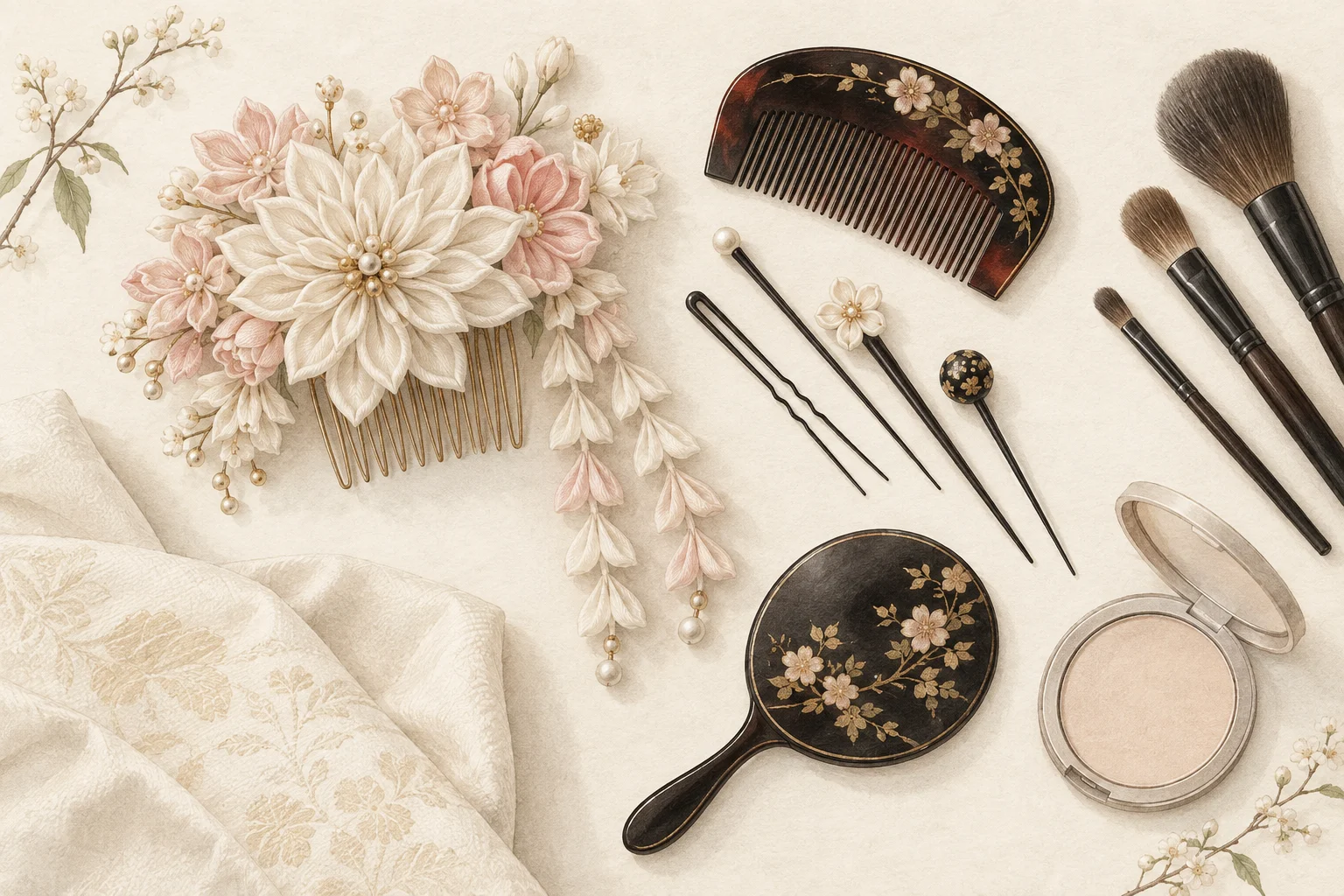
Traditional bridal makeup can use mizugeshō (水化粧), a water-based finishing technique. It is not a single prescribed shade or a requirement to erase the natural shape of the face. Oshiroi (白粉) is a term you may encounter for face powder or white makeup; the word alone is not a reliable brief for a bridal look.
A cosmetics manufacturer's professional bridal makeup method combines a base, blush and shading, highlights, a thin water-mixed finish, and eye, brow and lip work. Its instructions are a professional example, not a rule for every bridal artist.
Ask to see the finish, not just its name. If you request “traditional Japanese wedding makeup,” attach a bridal reference and specify whether you want a lighter base or a match to your usual skin tone.
Contemporary makeup also appears in an official shrine wedding venue's styling options, alongside full wigs, partial wigs and modern hairstyles. This confirms that alternatives exist; it does not establish what your chosen photographer provides.
Describe the look in separate choices
Give the stylist a choice for the base, eyes, lips and hair rather than one adjective such as “natural.” A reference photograph can show the finish you like, while your own photograph shows the features and hair the stylist will work with.
Choose | Tell the stylist | Confirm before booking |
|---|---|---|
Base | Skin-matched or deliberately lighter; light or fuller coverage | Products and shade options; how face, neck and visible skin will be coordinated |
Brows and eyes | Your preferred brow shape, liner and lashes | Whether the reference suits the planned finish; any lash charges |
Lips | A color reference and matte or glossy finish | Whether you want to keep your natural lip outline |
Second outfit | Whether you will also wear colored kimono or a dress | A shared makeup look or a scheduled change, with its time and price |
Do not accept a look you dislike on the promise that it will automatically look right in photographs. Ask when you can check it in a mirror and whether a test photograph is possible.
Tell the team whether close portraits, full-length pictures or both are important to you; lighting and framing can change how the makeup appears.
If you want to check the complete look during your stay, use our hair and makeup trial checklist to prepare the appointment.
Confirm skin-tone matching and product preferences
Ask your assigned artist about shade matching before booking. A studio's country, website language or directory entry cannot tell you which products the artist carries or how they will work on your skin.
Send your usual foundation brand and shade if you use one, plus a recent unfiltered photograph in daylight. A photograph helps the discussion but does not replace checking a product on your skin. If you want to bring your own foundation, ask whether the artist can use it with the planned products and finish.
- Share known cosmetic allergies or past reactions.
- Name products you want to use or avoid.
- Ask whether a trial can fit into your travel dates.
A lighter traditional finish is a style choice, not a substitute for discussing your skin tone or product compatibility. If you have a skin condition or a history of serious reactions, seek appropriate medical advice about products rather than relying on a stylist's reassurance.
Choose the headpiece and hairstyle together
A wataboshi (綿帽子) is the rounded bridal hood associated with shiromuku. A tsunokakushi (角隠し) is a white band worn around traditional Japanese bridal hair. Their fitting requirements differ, so send a photograph of the hairstyle and headpiece together.
Headpiece | Usual pairing | What to check |
|---|---|---|
Wataboshi | Shiromuku with traditional hair or a compatible modern hairstyle | The correct hood, support fitting and someone to fit it |
Tsunokakushi | Traditional Japanese hair or a suitable wig; white or colored bridal kimono | The exact hairstyle and headpiece combination the stylist can provide |
Hair ornaments without a hood or band | Your agreed hairstyle | Ornament rental or purchase, attachment and any venue rules |
An official headpiece guide distinguishes wataboshi made for wigs and modern hairstyles, and pairs tsunokakushi with wigs or Japanese hair rather than a Western updo. Treat that as a fitting question to resolve, not an accessory to add at the last minute.
For a modern hairstyle, a wataboshi keeper is a support used to shape the hood. One rental provider's fitting guidance explicitly says the keeper is not supplied by that rental service and must be discussed with the hair-and-makeup artist. Renting the hood therefore does not automatically arrange the equipment or fitting.
If the hood and hair come from different suppliers, ask who is responsible for the complete fitting. For the garments and headpieces themselves, see our headpiece comparison.
For accessory ideas, see our guides to kanzashi hair ornaments and tsumami-zaiku fabric flowers. Confirm the size and attachment with your stylist before arranging an ornament.
Japanese bridal hair: full wig, partial wig or your own hair
Bunkin-takashimada (文金高島田) names a traditional bridal hairstyle, not a requirement to wear a wig. Ask whether your reference would be created with a katsura (full wig), a han-katsura (partial wig) or your own hair. Yōhatsu (洋髪) means Western-style hair, such as a modern updo.
A full wig needs a fitting discussion. Ask about its size, the visible hairline, ornaments and when you would try it on. Do not assume that a fitting requires another day, or that it can always happen on the shoot morning.
A partial wig uses some of your own hair. Ask how its color and hairline will be blended and what the artist needs to see in advance.
Your own hair needs an individual assessment. Send current front, side and back views, and mention extensions or treatments. There is no useful universal promise that a particular length or texture can reproduce every reference.
If you want two hairstyles: ask whether both are achievable within the booking and whether removing a wig, changing the headpiece or rebuilding your hair adds a charge. Agree the order with the stylist.
Our bridal hair consultation guide has further questions for discussing your own hair and reference photographs.
Is hair and makeup included in the photoshoot price?

Only the quote for your chosen plan can answer that. Separate hair, makeup, kimono rental and dressing: the word “package” does not establish that all four are included, or that extras apply to both partners.
Quote item | Ask for a clear answer |
|---|---|
Hair and makeup | For whom, which look, and how many changes? |
Kimono and dressing | Which outfits, accessories and dressing services? |
Wig or headpiece | Rental, fitting, support equipment and ornaments? |
Trial | Available on which date, and included or separately charged? |
Outdoor support | Does a stylist accompany the shoot, and what touch-ups are included? |
Completion | Changing back, hair takedown and makeup removal? |
Compare written totals in JPY for the same choices, with tax and extra charges identified. A general starting price is not a quote for traditional makeup, a wig and two outfits. If an item is absent, ask whether it is included, optional or unavailable rather than treating an empty field as “no.”
Plan the appointment from arrival to leaving
Ask for separate times for preparation, dressing, travel, photography and changing back. A plan's “shooting time” may describe only photography; it should not be used as the total appointment length without confirmation.
- Confirm arrival and any earlier fitting or trial.
- Agree when you can check the finished look.
- Include outfit changes and travel between locations.
- Confirm the finishing time, including removal.
Follow the salon's instructions on arriving with or without makeup and how to prepare your hair. Ask about clothing that can be changed without disturbing the finished style. If you have dinner or a train afterward, explain that deadline before the schedule is agreed.
For an outdoor shoot, arrange how you will handle touch-ups and breaks. Ask what happens if weather changes the schedule, and who will help if the stylist does not accompany you. For removal, follow instructions for the actual products used; there is no single cleanser rule for every bridal base.
A message to send before you book
Send the same brief to the studios you are comparing, then compare their answers item by item. Our suggested message below separates the look you want from the services needed to create it. Replace the brackets and attach references you are entitled to share.
Hello, we are planning a shiromuku photoshoot on [date] in [city]. It will be [photos only / a ceremony and photos]. Our available dates in Japan are [dates].
I prefer [skin-matched / a lighter traditional finish] with [brow, eye and lip preferences]. I have attached the makeup and hairstyle references, a current hair photograph, and the headpiece I would like.
My usual foundation is [brand and shade, if used]. Please let me know whether you can match it and whether I may bring my own products. My product restrictions or known reactions are [details, if relevant].
Can the assigned stylist create this hair and headpiece combination? Would it use a full wig, partial wig or my own hair? Please confirm fitting arrangements and any support equipment.
We plan to wear [outfits]. Please itemize hair, makeup, rental, dressing, changes, trial, touch-ups and removal in the total JPY quote, including tax.
Which language can I use directly with the stylist on the day? If an interpreter is needed, who arranges one? Please confirm the arrival and finishing times, including changing back.
An English-language booking reply does not by itself confirm that the assigned stylist speaks English. Ask who will communicate with you during styling and how you can request changes. Keep the agreed references and written answers available on the day.
Frequently asked questions
Do I have to wear white makeup with shiromuku?
White makeup is not mandatory with shiromuku. Agree the finish with your stylist and check any ceremony requirements with the venue.
Can I wear a tsunokakushi with a modern updo?
A tsunokakushi usually pairs with Japanese bridal hair or a suitable wig. For a modern updo, ask about a wataboshi with shiromuku and its support fitting.
Is hair and makeup included in a kimono photoshoot?
Hair and makeup inclusions depend on the plan. Request separate lines for styling, kimono rental and dressing, plus any wig, trial and touch-up charges.
Can I bring my own foundation?
Using your own foundation needs the artist's agreement. Send the brand, shade and product restrictions before booking so compatibility can be discussed.
Compare the plan and the stylist's answers
Start with the shiromuku photographer directory, then confirm the details directly. A useful reply explains the actual look, the fitting and the full price. Choose only after the answers match your priorities; neither a directory label nor a reassuring message replaces an agreed plan.
To compare destinations, start with Kyoto or Asakusa in Tokyo, or browse all photographer listings.
Source pages checked October 4, 2026; publication dates are not stated on the linked pages. The references describe particular methods and services, not their prevalence across Japan. The comparison questions and message template are editorial guidance, not a guarantee of a provider's service.
Related guides
 General guide
Hair & Makeup Trial for Foreign Brides in Japan: Worth It?
Illustrative image · Unsplash. Not a photo of the specific people, places or services discussed.
Hair makeup trial for foreign brides Japan: why kimono studios skip trials, when paid pre-trial (¥10K-30K) is worth it, and trial-free workarounds.
Read the guideStyle guideHair Styling for Foreign Brides in Kimono: Curly, Fine & Short
Illustrative image · Unsplash. Not a photo of the specific people, places or services discussed.
Practical hair styling for kimono foreign brides — curly, fine, pixie cut, extensions, and dyed hair. What to communicate before your shoot.
Read the guideStyle guideTsunokakushi vs Wataboshi: Japanese Bridal Headpieces Explained
Illustrative image · Unsplash. Not a photo of the specific people, places or services discussed.
Tsunokakushi vs wataboshi: the two traditional Japanese bridal headpieces worn with shiromuku — meaning, when to wear each, and photo tips.
Read the guide