Haori Bridal Coat Styling: Cool-Season Layered Looks
Haori bridal coat styling guide: hikifurisode haori for brides, kuromontsuki for grooms, lengths, patterns, rental costs, and cool-season layering.

Illustrative image · Unsplash. Not a photo of the specific people, places or services discussed.
Check current prices, availability and venue rules with the relevant studio or venue before booking.
A haori — the outer coat layered over a kimono — is optional gear that transforms cool-season portraits. For grooms in formal wedding form, the black kuromontsuki haori with five family crests is the defining piece. For brides, a coordinated hikifurisode haori adds dimension, weight, and a modern layered silhouette that reads well in shrine grounds, gardens, and any October-through-March outdoor shoot. This guide covers when haori earn their place in your styling, the pattern and length options, what rental costs look like, and where they hurt rather than help.
What the Haori Is and When to Wear It
A haori is a hip-length or knee-length open jacket worn over kimono. It is not closed with an obi sash — instead, two cord ties called himo hold the front loosely together at chest level, leaving the kimono and obi visible underneath. The garment originated as samurai-class outerwear and became a formal accessory across genders by the Edo period.
For wedding photography, the haori does three things: it adds visual weight to the silhouette, it provides warmth without bulking the kimono itself, and it introduces a second pattern layer that the camera reads as depth. Grooms wear it in nearly every formal wedding portrait. Brides wear it selectively — most often for cool-season outdoor shoots, modern editorial styling, or compositions where the photographer wants flowing fabric movement.
The general rule planners use: if the shoot is outdoors between October and March, a haori earns its keep. If the shoot is a summer studio session in air conditioning, skip it.
Bridal Haori Options
Bridal haori are a relatively modern styling choice. Traditional bridal silhouette uses the uchikake — a heavy embroidered overcoat that functions similarly to a haori but is structurally different (longer, trailing on the ground, worn loose over a base kimono). The hikifurisode haori is a lighter, contemporary alternative used over a hikifurisode base kimono.
Hikifurisode Haori (Light Flowing, Color-Coordinated)
This is the most common bridal haori format. It is cut from softer silk than the heavy embroidered uchikake — closer in weight to a furisode kimono itself — and falls to about hip or upper-thigh length. Colors are typically coordinated to either match or deliberately contrast the base kimono. A pale cream hikifurisode with a soft sakura haori reads very differently from the same kimono with a deep crimson haori over it.
Wedding Planner's Note: A hikifurisode haori is the right choice when you want the visual weight of a layered look without the formality (or weight, or restricted movement) of a full uchikake. It moves with you when you walk, which gives the photographer more options for motion shots — turning, hand-in-hand walks down a torii path, glances over the shoulder. An uchikake locks the bride into a slower, more static pose vocabulary.
Pattern Coordination with Main Kimono
Two coordination strategies work well in photographs. The first is tone-on-tone: the haori shares the kimono's color family but uses a different pattern scale. A kimono with small repeating florals pairs with a haori carrying a larger single motif — a crane in flight, a flowing pine bough — so the eye reads them as a deliberate layered set rather than competing busyness.
The second is contrast: the haori is a deliberate visual counterpoint. A soft white-and-pink shiromuku-style base kimono with a deep navy or black-ground haori over it creates the strongest editorial framing. Photographers reading portfolios for modern bridal work will recognize this as a recurring choice in 2024-2026 styling.
Avoid two large competing motifs on both layers. If the kimono has a single dramatic peacock pattern across the back, the haori should carry small geometric work or be near-solid.
Groom's Kuromontsuki Haori (Black with Five Crests)
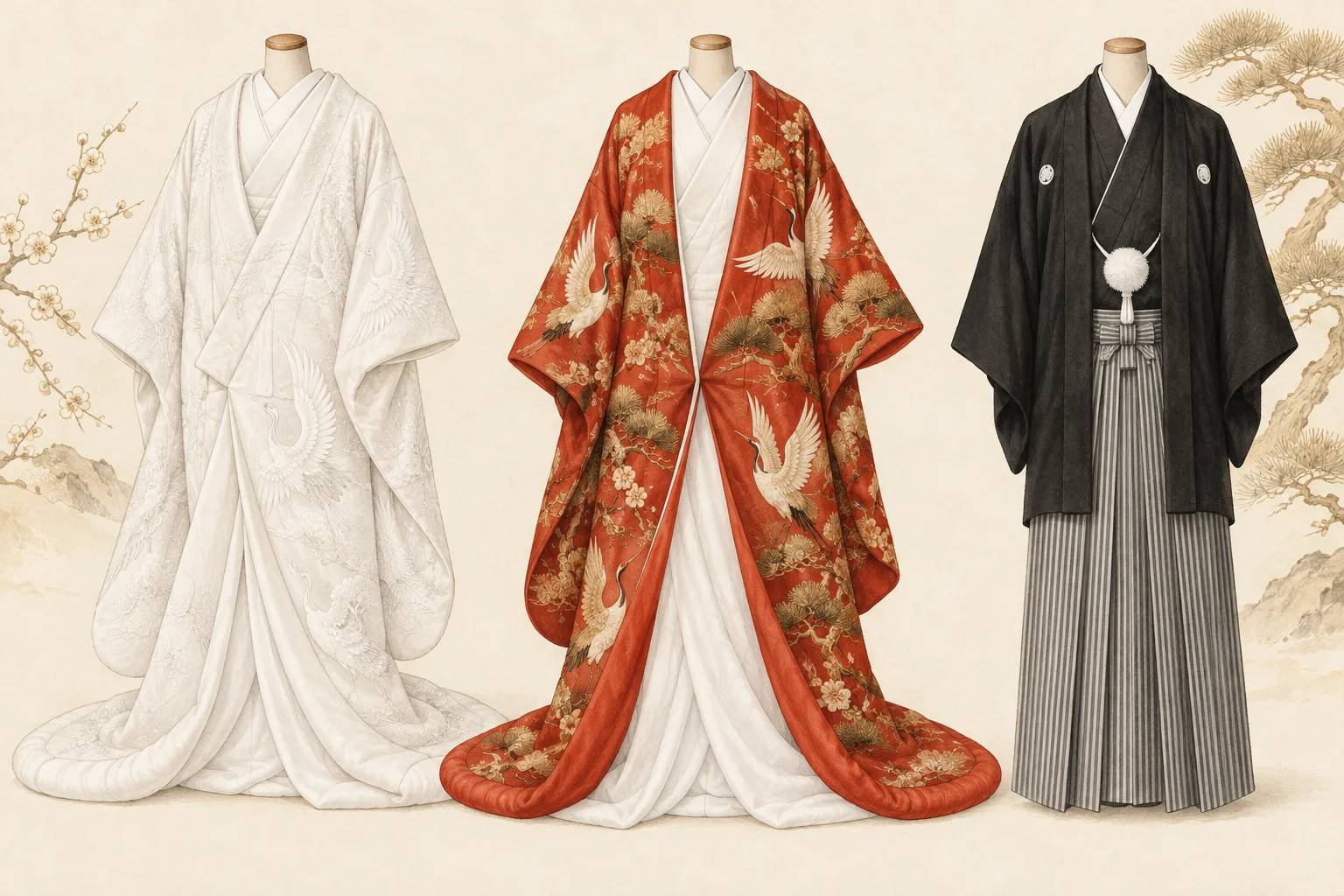
The standard groom's wedding form is kuromontsuki haori-hakama: black silk haori bearing five family crests (kamon), worn over a white under-kimono, paired with a striped sendaihira hakama. This is the single most formal traditional menswear in modern Japan and the expected groom's outfit for any formal Shinto ceremony or formal portrait session.
The five crests sit at fixed positions: one centered on the back below the collar, two on the back of the sleeves near the shoulder seams, and two on the chest at the breast points. If the groom does not have a registered family crest, rental shops supply the generic maru ni kuginuki or go-san no kiri default kamon. This is widely understood — it is not a faux pas for a foreign groom to use a rental house crest.
The black is true black with a subtle silk sheen — not matte. In bright sun, it reads as a slightly muted dark surface; in soft indoor or overcast light, it has more dimension. Photographers shooting in noon shrine light will sometimes ask the groom to shift position to catch the sheen rather than the flat black.
Wedding Planner's Note: A common mistake is assuming the kuromontsuki haori is interchangeable with a Western black suit. It is not. The cut, the cord ties, the visible white under-kimono collar, and the hakama beneath all contribute a different silhouette in photographs. If you want a Western-looking groom in some frames, plan a separate suit change — do not modify the haori to make it more "suit-like."
Length Choices (Knee vs Hip)
Bridal and casual haori come in roughly three lengths.
Length | Drop from collar | Best use |
|---|---|---|
Hip-length (短丈) | ~70 cm | Modern editorial styling, summer casual yukata-haori pairings, hands-in-cord-tie close-ups |
Knee-length (中丈) | ~90-100 cm | Default bridal hikifurisode haori — flatters most body types and matches obi placement |
Long (長丈) | ~110-120 cm | Tall brides, snow shoots, when wind movement is wanted in shots |
Groom's kuromontsuki haori is fixed length — knee to mid-thigh — and is not a styling decision. The fixed length sits about 5-10 cm above the hakama waistband and is the standard formal cut.
For brides, the practical question is whether the haori covers the obi knot on the back. A knee-length haori usually does. A hip-length haori leaves the obi musubi visible. If you have invested in an elaborate fukura-suzume bridal obi knot, the hip-length haori preserves it as a visible design element. If the obi is simpler, the longer haori is the more dramatic frame.
Seasonal Patterns
Shochikubai (Pine-Bamboo-Plum)
The shochikubai trio — pine, bamboo, plum — is the most universally appropriate bridal pattern. Pine signifies longevity, bamboo flexibility and strength, plum first bloom of the new year. It works in any season, carries no specific timing implication, and is the safest choice for couples who do not want to research seasonal correctness.
Visually, the three plant motifs tend to be rendered in deep greens, ivory, and red-pink. They photograph well against shrine wood (Meiji Jingu, Yasaka), against stone garden walls (Kenrokuen, Ryoanji), and against snow.
Crane-Tortoise
The crane (tsuru) and tortoise (kame) pair signifies long marriage life — cranes mate for life, tortoises live a thousand years in folklore. The crane is the dominant photographic motif; tortoises appear as smaller medallion patterns or wave-based shapes. A single large flying crane across the back of the haori is one of the strongest possible bridal images.
This pattern is seasonless but reads strongest in autumn and winter shoots where the dark haori ground contrasts foliage or snow.
Seasonal Florals
Specific flowers carry specific timing. If you choose a strongly seasonal motif, you should shoot in that season — wearing a maple-leaf momiji haori in March or a cherry-blossom haori in November will read as a styling mistake to anyone reading the image with cultural literacy.
Pattern | Season | Best shoot months |
|---|---|---|
Sakura (cherry blossom) | Spring | Late March to mid-April |
Fuji (wisteria) | Late spring | Late April to mid-May |
Botan (peony) | Late spring / early summer | May to early June |
Asagao (morning glory) | Summer | July to August |
Kiku (chrysanthemum) | Autumn | October to November |
Momiji (maple) | Autumn | Mid-November to early December |
Yuki (snow) / camellia | Winter | December to February |
Year-round neutral options — shochikubai, crane-tortoise, geometric — let you ignore this calendar entirely.
When to Wear / When to Skip (Indoor Reception vs Outdoor Shoot)
The haori is a styling decision that should be tied to the shoot environment.
Wear it for outdoor shoots from October through March, particularly at temperatures below 15°C. Wear it for cool-morning shoots in shoulder seasons. Wear it for grooms in any formal Shinto ceremony. Wear it for modern editorial bridal styling where the layered silhouette is the photographic point.
Skip it for indoor summer studio shoots, for traditional uchikake-format bridal looks (the uchikake is itself an outer layer — adding a haori is redundant and structurally awkward), for tea-house compact-space shoots where the extra fabric catches on architecture, and for any session focused on the obi knot as the visual centerpiece.
Wedding Planner's Note: Brides sometimes book a haori thinking it will keep them warm, then remove it for every shot. If that is the plan, the haori is just rental cost — book it only if you actually want it visible in the photographs. For pure warmth, a thermal layer under the kimono and hand warmers in the obi are more practical and the photographer will not need to manage adding and removing the haori across the shoot.
Cost (¥15,000-¥60,000 Rental Add-On)
Haori is almost always a rental add-on on top of the main kimono rental. Standalone purchase rarely makes sense for international couples.
Tier | Add-on cost | What you get |
|---|---|---|
Standard bridal hikifurisode haori | ¥15,000-¥30,000 | Common shochikubai or crane patterns, knee-length, machine-woven silk blends |
Premium bridal hikifurisode haori | ¥30,000-¥60,000 | Hand-dyed silk, seasonal florals, antique or designer pieces |
Groom's kuromontsuki haori (rental house crests) | ¥15,000-¥35,000 (often bundled with full hakama set ¥30,000-¥80,000) | Standard black silk, generic kamon |
Groom's kuromontsuki haori (custom family crest) | ¥40,000-¥80,000 add-on | Hand-applied kamon at five positions — requires 4-6 weeks lead time |
Most international couples take the standard tier for both bride and groom. Custom family crests are worth the add-on only if the family has a documented kamon and the couple wants it visible in the formal images.
Photo Composition with Layered Outline
Photographers approach a haori-styled bride differently than an uchikake-styled bride or a single-layer kimono bride. Three composition patterns recur.
Walking shots from behind show the haori in motion. The garment is open at the front and tied loosely with cords — when the bride walks, the haori flares out behind, framing the obi knot. This is one of the few bridal compositions where the back of the figure is the main subject, and a haori dramatically improves it.
Three-quarter portrait with hands at the cord ties is the classic editorial framing. The bride faces the camera at a slight angle, hands resting at the himo cords. The haori falls open enough to show the kimono underneath. This works well for shrine entrance shots and is the cover-image composition for most modern Japanese bridal portfolios.
Couple shots with both wearing haori — bride in hikifurisode haori, groom in kuromontsuki — create silhouette parity. Without haori, the groom's kimono is visually lighter than the bride's layered bridal look. With haori on both, the visual weight balances and the couple reads as a styled unit rather than a primary bride plus accessory groom.
Tell the photographer in advance that haori is part of the styling — many will adjust the shot list to include haori-specific compositions rather than treating it as an accessory that just sits in some frames.
Frequently Asked Questions
Can I bring my own haori from outside Japan?
Yes, but coordination becomes harder. Japan studios will style around what you bring, but a haori bought online or inherited from a relative may clash with the rental kimono palette. If you have a meaningful family piece, send a photograph to the studio 4-6 weeks before the shoot so they can match a base kimono and obi to it rather than the reverse.
Do brides ever wear the kuromontsuki haori instead of grooms?
Modern editorial styling sometimes places a bride in a black haori with five crests for an androgynous portrait set. This is a deliberate style statement and reads as contemporary rather than traditional. It is not appropriate for a formal Shinto ceremony but works for prewedding studio sessions and modern outdoor editorial shoots.
Can I wear a haori over a Western wedding dress?
Not in any traditional sense — the cut, the cord ties, and the proportions are designed around kimono silhouettes. Some fusion stylists experiment with this for specific editorial concepts, but it is outside any standard styling vocabulary and most kimono dressers will not be set up to do it.
How heavy is a haori — will I struggle to walk in it?
A standard hikifurisode haori weighs 1-2 kg — much lighter than the 5-8 kg uchikake. Most brides move freely in it. The kuromontsuki groom's haori is similarly light. Weight is not a concern for a haori-only outer layer; weight only becomes restrictive with the uchikake.
Will my hair and makeup need to change because of the haori?
Generally no. The neckline of a haori sits open and shows the kimono collar underneath, so updo styles, kanzashi ornaments, and bridal nape makeup remain visible. If you choose a high-collar haori variant (less common), the stylist may shift the hair higher to keep the nape line clean.
Can the groom wear a colored haori instead of black?
Yes, for less formal or contemporary shoots. Dark navy, deep gray, and dark green haori all exist and read as semi-formal. They are not appropriate for a traditional Shinto ceremony but work well for prewedding photoshoots and modern outdoor editorial sessions. Some grooms use a colored haori for the prewedding shoot and switch to a kuromontsuki for the actual ceremony.
How far in advance do I need to confirm the haori choice?
For standard rental tier, 2-4 weeks before the shoot is enough. For a custom-crested kuromontsuki haori or a specific premium hikifurisode haori from a limited collection, 4-8 weeks. If you want to coordinate haori pattern with seasonal flowers at the shoot location, decide at booking time so the studio can hold the piece.
Find a Studio That Handles Haori Layering Well
Not every kimono studio carries a deep haori inventory — some treat it as a single-tier add-on with only generic options. For couples planning a layered bridal look or a formal groom's kuromontsuki, the studio's haori range matters as much as its main kimono catalog. Browse studios in our directory with detailed wardrobe notes, and pair this guide with our companion pieces on hakama for the formal groom and bridal obi tying styles to complete your styling brief.
Related guides
 Style guide
Naga-Juban Bridal Under-Kimono: The Hidden Layer at Cuffs
Illustrative image · Unsplash. Not a photo of the specific people, places or services discussed.
Naga juban bridal under kimono explained: pure white silk, red trim at cuffs and collar, han-eri customization, rental cost ¥5K-¥30K, photographing the detail.
Read the guide Style guide
Obi Musubi for Bridal Kimono: Knot Styles That Define the Back
Illustrative image · Unsplash. Not a photo of the specific people, places or services discussed.
Obi musubi bridal kimono guide: maru-obi vs fukuro-obi, taiko, bunko, and fukura-suzume knot styles, kitsuke-shi requirements, and photo composition impact.
Read the guide Style guide
Bridal Tabi Socks Etiquette Japan: White Silk & Kohaze Guide
Illustrative image · Unsplash. Not a photo of the specific people, places or services discussed.
Bridal tabi socks etiquette japan: pure white silk standard, 4-5 kohaze hook closures, hand-wash care, sizing for foreign brides, and zori coordination.
Read the guide