Family Crests (Kamon) on Wedding Kimono
Kamon (家紋) are family signatures stitched into formal kimono — five, three, or one crest in fixed positions. Here is how the system works, what rental studios actually provide, and what couples with Japanese heritage should research before the ceremony.

Illustrative image · Unsplash. Not a photo of the specific people, places or services discussed.
Check current prices, availability and venue rules with the relevant studio or venue before booking.
The crests stitched into a Japanese wedding kimono are not decoration. They are a household's formal signature — five of them on the most ceremonial garments, three or one on slightly less formal versions, each placed in a fixed position that has not changed in centuries. For most foreign couples renting from a Tokyo or Kyoto studio, the crest you wear belongs to the rental house, not your family. If you carry Japanese heritage, the calculation changes. Here is how the system actually works, and what your options are.
What Kamon Are
Kamon (家紋) are family identification symbols developed by the Heian court aristocracy from the 12th century, then adopted by samurai houses in the Kamakura period (1185-1333) as battlefield identifiers, then extended to merchant and farming families in the Edo period (1603-1868). By the late Edo period, virtually every Japanese household had a registered crest. Often called simply 家紋 (kamon) in everyday speech, the term refers to the same family mark whether it appears on a kimono, a roof tile, or a gravestone. On a wedding kimono, the crest is rendered in white on black or coloured silk, either embroidered or paste-resist dyed.
The number of crests on a single garment signals its formality rank. The placement is fixed: back centre, two outer sleeves, two chest fronts. A garment is named by its crest count — itsutsu-mon (5-crest), mitsu-mon (3-crest), hitotsu-mon (1-crest) — and that count determines where it can be worn.
The Three Formality Tiers
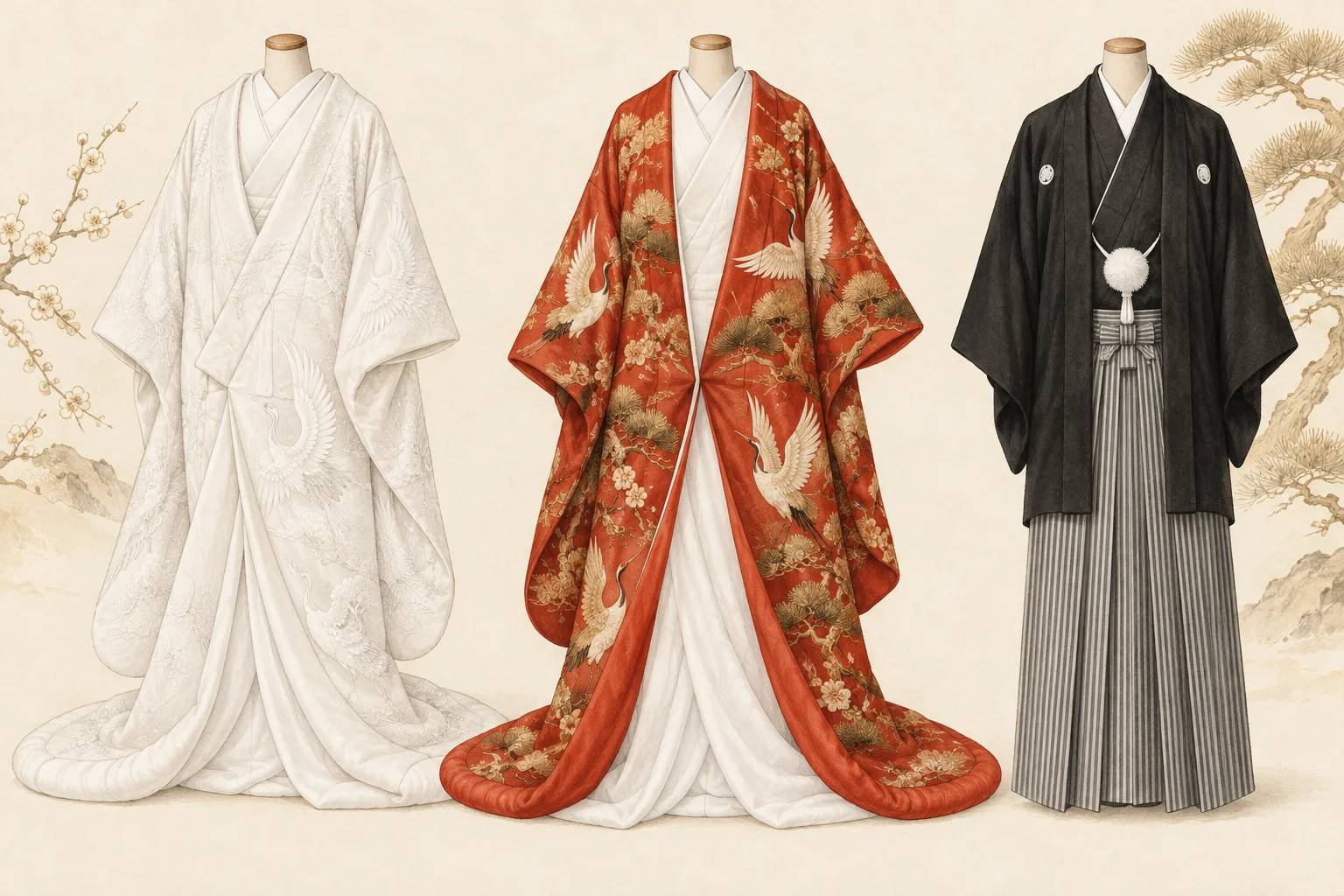
Kuromontsuki (5 Mon — Most Formal)
Kuromontsuki (黒紋付) literally means "black with crests attached." Five crests are placed in the prescribed positions, all in white. For the groom, this is the most formal Japanese wedding garment: a black kimono with white crests, worn under a haori coat and hakama trousers. For the bride, the 5-crest format appears on the kuromontsuki haori worn over the kakeshita, or on the bridal kimono itself in some traditional variants.
The five-crest count (go-mon) is reserved for the highest ceremonial occasions: weddings, funerals, formal court appearances, New Year visits to senior family. Outside these contexts the garment is considered overdressed and is not worn casually.
3 Mon (Semi-Formal)
The three-crest version places crests on the back centre and the two outer sleeves, omitting the chest fronts. This is read as semi-formal: appropriate for most wedding-adjacent events — engagement meetings, post-wedding family meals, formal receptions where the 5-crest garment would be too heavy. Many modern rental studios stock 3-crest versions as their standard wedding inventory because the formality registers correctly for the ceremony without committing to the most ceremonial rank.
1 Mon (Hitotsumon) — Casual Formal
The single-crest version (hitotsumon) places one crest on the back centre only. This is the lowest formal rank — still ceremonial enough to register as a "crested" garment, but appropriate for less formal contexts: tea ceremonies, daughter's school entrance ceremonies, semi-formal visits. A 1-mon garment is not normally worn by the bride or groom at the wedding ceremony itself; it appears in the trousseau for later use.
A note on terminology: nashiji is a separate concept — it refers to a pear-skin silk weave texture, not to crest count. A 1-mon garment may or may not use a nashiji weave; the two attributes are independent. Some studios pair the casual-formal 1-mon rank with a nashiji-woven silk, which is where the conflation tends to arise.
Crest Placement on the Kimono
The positions are fixed and have not changed in roughly 400 years. A kimono maker who places a crest in the wrong location has produced a defective garment.
1 on Back Centre
The primary crest sits at the centre of the back, between the shoulder blades, roughly 5cm below the collar seam. This is the crest that reads from behind during the shrine procession, when the priest and the wedding party walk in single file. Every formal kimono — 5-crest, 3-crest, 1-crest — carries this one. The back crest is photographed in the standard rear-three-quarter composition during the shrine sequence.
1 Each on Outer Sleeves
Two crests sit on the outer (back-facing) panels of each sleeve, roughly 10cm above the sleeve hem. These are visible from the side and during the san-san-kudo sake exchange, when the bride's sleeves rest forward as she lifts the cup. The sleeve crests appear on 3-crest and 5-crest garments.
1 Each on Chest Front
The final two crests sit on the chest, one on each lapel front, roughly 15cm below the collar fold. These are visible only from the front and are read as the most formal additions — present on 5-crest garments only. During the san-san-kudo and the formal portrait, the chest crests frame the bride's face on either side.
Common Crest Symbols
Of the roughly 20,000 registered Japanese family crests, a small handful appear repeatedly because they were used by historically influential households. Studios typically stock kimono carrying these widely-recognised motifs because they read as "appropriately Japanese" to viewers without prompting specific historical associations.
Aoi (Hollyhock — Tokugawa)
The triple-hollyhock crest (mitsuba-aoi) is the household mark of the Tokugawa shogunate, the family that ruled Japan from 1603 to 1868. The crest is three stylised hollyhock leaves arranged in a circle, points inward. Outside Tokugawa-descended families, the crest is sometimes considered too historically loaded to use casually, but it appears on rental kimono frequently as a generically "samurai-era" motif.
Kiku (Chrysanthemum — Imperial)
The sixteen-petal chrysanthemum is the crest of the Japanese imperial family and appears on Japanese passports, government documents and chrysanthemum-throne contexts. Use of the exact 16-petal version is restricted; rental kimono use a 12 or 14-petal variant that reads as "kiku motif" without claiming imperial connection. The chrysanthemum more broadly is a popular kimono crest symbolising longevity.
Kiri (Paulownia — Toyotomi)
The paulownia crest (kiri-mon) was used by Toyotomi Hideyoshi, the warlord who unified Japan in the late 16th century, and is still used as the official crest of the Japanese Prime Minister's office. The motif shows three paulownia flowers above three leaves. A common rental crest, read as historically dignified without modern political connotation.
Ume (Plum)
The plum blossom crest is widely used by households without specific shogunal connections. Variants include the five-petal plum, the eight-petal plum, and the plum-and-bamboo combination. Ume symbolises perseverance through winter (the plum blossoms in February when snow still falls) and is considered an auspicious wedding motif. Common on both bridal and groom rental kimono.
Tsuru (Crane)
The crane crest, in various stylised forms (single crane, paired cranes, crane in a circle), symbolises longevity and marital fidelity — cranes were believed to mate for life. The motif is particularly common on bridal kimono and on the uchikake outer robe even when it is not technically a family crest. The crane is also a frequent woven or embroidered design motif separate from its use as a kamon.
Rental Kimono Crest Default (Studio's Choice)

If you are renting your wedding kimono from a Tokyo, Kyoto or Kanazawa studio — as the vast majority of foreign couples do — the crest already on the garment is the studio's chosen motif, typically one of the five symbols above. It is not your family's crest, and it is not advertised as such. The studio selects crests that read as elegant and appropriately formal without making historical claims.
Wedding Planner's Note: Couples occasionally arrive at the studio assuming the crest will be customised. It will not. The studio's standard rental inventory carries pre-selected crests, and changing them requires a custom embroidery order (see below). For most foreign couples, this is a non-issue — the rental crest reads correctly in photos and no Japanese viewer will register it as "wrong." Only mention it to the studio if you have a specific heritage reason to care.
For Couples with Japanese Heritage — Research Your Kamon
If one or both partners have Japanese family heritage, your family almost certainly had a registered kamon at some point. Three research routes:
Family records. Older Japanese relatives — grandparents, great-aunts — often know the household crest by sight. The crest appears on family graves (墓石 boseki), on family Buddhist altars (butsudan), on koseki family register documents at the city hall of registration, and on formal family kimono kept in storage. A grandparent may be able to sketch the crest from memory.
Surname databases. Several Japanese kamon research services match surname to commonly-associated crests. These give a probabilistic answer — your surname Tanaka may correspond to one of a dozen crests, depending on which Tanaka lineage your family descends from. Useful for narrowing the field but not for definitive identification.
Family boseki (gravestone). The most reliable answer. If you can visit the family grave or get a photograph, the crest is normally engraved on the front of the headstone or on the side panel. The gravestone crest is the household's registered mark and is correct.
Allow 2-3 months for this research if you are doing it from outside Japan. Coordinate the result with your shrine and studio at the same time you confirm the ceremony details, so the production timeline aligns with your wedding date.
Custom Crest Embroidery (6-Month Lead Time)
If you want your researched family crest on your wedding kimono, the studio can commission custom embroidery — but the lead time is real. Standard production:
Stage | Time | Notes |
|---|---|---|
Crest confirmation | 2-4 weeks | Studio verifies crest design against standard reference |
Embroidery design | 2-3 weeks | Sized and proofed for kimono panel |
Crest application | 4-8 weeks | Hand embroidery or paste-resist dye |
Final fitting | 1 week | Pre-wedding kimono check |
Total: typically 4-6 months from crest confirmation to wedding date. Costs range ¥50,000-¥200,000 per garment depending on crest complexity, embroidery vs dye, and whether the studio is modifying an existing rental garment or producing a custom piece. Most studios will only modify a higher-tier rental garment, not their standard inventory.
Wedding Planner's Note: A custom crest is a meaningful gesture for couples with documented Japanese heritage and a clear family connection. It is rarely worth the cost and complexity for couples without that heritage — the crest reads correctly to Japanese viewers only when paired with a real family story, and most foreign couples find the standard rental crest serves the photographs equally well.
For Foreign Couples Without Japanese Heritage — Options
If you do not have Japanese family ancestry, you have three reasonable approaches:
Accept the studio's default. The simplest choice and the one the substantial majority of foreign couples make. The rental crest reads as appropriately Japanese and photographs cleanly. No viewer will question it.
Request a specific motif you find meaningful. If you know in advance you prefer the crane (longevity) or the plum (perseverance) over the studio's default, ask during your initial consultation. Studios will often have multiple kimono in their inventory carrying different common crests, and selecting from the existing range is free. Specifying "I would like a crane crest if available" is a reasonable request; specifying "I would like the Tokugawa hollyhock" reads as historically presumptuous.
Commission a custom personal symbol. A small number of foreign couples commission a custom embroidered symbol — sometimes a stylised version of their own family symbol from European heraldry, sometimes a custom motif designed for the couple. This is artistically interesting but is not a kamon in the traditional sense; it is a custom embroidery using kamon-style technique. Studios that offer this service treat it as bespoke design work, with pricing in the ¥100,000-¥300,000 range and 4-6 month lead time.
Photographing the Crest Detail
Whichever crest sits on your kimono, the detail shot belongs in the album. Standard kamon detail shots include: the back crest framed in the rear-three-quarter walking shot during the shrine procession; the chest crests visible during the front-facing san-san-kudo composition; an isolated macro of the embroidery showing thread texture and crest detail; and a side composition showing both sleeve crests during the seated portrait sequence. A photographer who is briefed in advance that the crest is meaningful will compose specifically to feature it; an unbriefed photographer will capture it incidentally but may not isolate it.
For couples with custom or family crests, the detail shot becomes the most meaningful single image in the album — the visible link between the photographed ceremony and the household lineage it represents. See the full detail shot checklist for kimono albums for the standard sequence.
Frequently Asked Questions
Can I bring my own kimono with my family's kamon to the shoot?
Yes, and many studios accept owner-supplied kimono for the shoot. Disclose this at booking — the studio may charge a reduced styling fee rather than a full rental fee, and the kitsuke (dressing) team will need to confirm the garment is in wearable condition and has the appropriate undergarments. Inspect the kimono with the studio 4-6 weeks before the wedding.
What if our two families have different kamon — whose goes on the bride's kimono?
Traditionally the bride wears her parents' household crest until the wedding ceremony, then transitions to her husband's family crest afterwards. In practice for a single-day photo shoot, the bride's family crest is the conventional choice. Some couples place each partner's family crest on their respective garments — bride's family crest on her kimono, groom's family crest on his — which is the cleaner solution for modern weddings.
Does the groom's kimono also carry a kamon?
Yes. The groom's kuromontsuki kimono carries five crests in the same placement positions as the bridal version. The groom's haori coat worn over the kimono also carries crests, typically in matching count. For rental, the groom's crest is the studio's choice, the same as the bridal version.
Are there kamon that are considered bad luck or inappropriate for a wedding?
No specific crest is taboo for weddings, but certain crests carry strong historical associations that may register as odd in context. The chrysanthemum 16-petal imperial crest reads as presumptuous when worn by non-imperial families. The Tokugawa hollyhock reads as historically loaded in some contexts. Stick to the auspicious motifs — crane, plum, paulownia, generic floral — and the crest will read correctly.
Will Japanese guests at our wedding notice the kamon?
Older Japanese guests may identify the crest and ask about it — particularly if it reads as a specific historical family mark. Younger guests typically register it as "a formal kimono" without identifying the specific crest. If you are using a rental crest, a brief explanation ("this is the studio's standard motif") satisfies anyone who asks. If you have a researched family crest, the explanation is more meaningful and worth preparing in advance.
Can the crest colour be changed from white?
The standard kamon is white on dark kimono, which is the most formal and historically correct rendering. Coloured crests (red, gold, embroidered in multiple thread colours) exist but read as less formal — appropriate for kimono for tea ceremony or casual semi-formal contexts, not the most formal wedding garment. For the wedding kimono, white-on-black or white-on-coloured-silk is the standard.
What happens to the kamon after the wedding if we commissioned a custom version?
The custom-embroidered kimono is normally the couple's property and ships home with you after the shoot. Storage requires acid-free tissue, sealed paulownia chest (tansu), and infrequent airing — the same conditions as any silk garment. Some couples leave the kimono with the studio for archival storage and seasonal photography sessions.
Find a Studio with Crest Options
If the crest detail matters to your album — because of family heritage, photographic intent, or both — choose a studio that handles kamon work as part of its standard service rather than treating it as a special-case add-on. The studios with the longest formal kimono histories normally have multiple crests in inventory and established relationships with embroidery houses for custom work.
Browse the Wasou Wedding Japan curated directory for studios that offer crest selection and custom embroidery service. For the ritual sequence in which the crest will be visible, see harae purification before the wedding ceremony and the naorai post-ceremony meal where formal kimono are worn through to the close of the day.
Related guides
 Style guide
Montsuki Kimono: The Japanese Groom's Formal Wedding Attire
Illustrative image · Unsplash. Not a photo of the specific people, places or services discussed.
Montsuki kimono explained for grooms: what the crests signal, kuro- versus iro-montsuki, the full outfit, what studios charge, and what to check before booking.
Read the guide Style guide
Hakama Groom Japanese Wedding: Formal Styles & Fit Guide
Illustrative image · Unsplash. Not a photo of the specific people, places or services discussed.
A planner's guide to the hakama groom Japanese wedding look — montsuki, sendaihira stripes, haori, rental costs, and fitting tips for foreign grooms.
Read the guide Style guide
Men's Kimono Wedding Photoshoot: Montsuki & Hakama Guide
Illustrative image · Unsplash. Not a photo of the specific people, places or services discussed.
Men's wedding kimono in Japan: montsuki, haori, hakama components, color rules, accessories, and what foreign grooms typically wear.
Read the guide