Korean Couple Kimono Photoshoot Japan: Cultural Guide
A planner's guide to korean couple kimono photoshoot japan trips: hanbok-kimono comparison, Korean-speaking studios, family logistics, costs vs Seoul.

Illustrative image · Unsplash. Not a photo of the specific people, places or services discussed.
Check current prices, availability and venue rules with the relevant studio or venue before booking.
Roughly 3,000 to 4,000 Korean couples book kimono photoshoots in Japan each year — the second-largest international segment after Greater China, and the fastest-growing inbound group since cheap LCC flights and K-wedding influencer posts normalized the trip. Most pairs arrive having already done a Seoul studio session in hanbok and treat the Japan kimono shoot as the second leg of a two-country wedding album. Planning logistics, Korean-language capacity, and family expectations all shift accordingly. This guide explains how to plan that trip without the friction Korean couples most often report.
Why Korean Couples Choose Japan Kimono Shoots
Three structural reasons drive the volume. First, distance and cost: Seoul to Tokyo is roughly 2.5 hours by air, with LCC return fares often under 200,000 KRW when booked 2-3 months out. A Tokyo or Kyoto kimono weekend costs less than a domestic Jeju resort wedding for many couples. Second, the wedding photo album culture in Korea — where pre-wedding studio shoots are near-universal and budgets often exceed the ceremony itself — translates directly to demand for premium Japan locations as a "second album" or "honeymoon prologue" project.
Third, K-wedding social media has built a visual canon. Instagram and Naver blog posts from 2023 onward made Kyoto Higashiyama, Asakusa Sensoji, and Kamakura's Hokokuji bamboo grove instantly recognizable Korean-bride aesthetics. Couples now arrive knowing exactly which locations they want, often with mood boards saved from Korean wedding influencers.
Wedding Planner's Notes: Korean couples typically know more about specific Japan locations than they know about specific Japan studios. Don't assume the reverse. A Seoul bride may name three temples by Korean transliteration but ask the studio to suggest the photographer — the inversion of what Western couples usually do, where they pick the photographer first and ask where to shoot.
Hanbok vs Kimono — Aesthetic Comparison
The two garments share East Asian silk-craft origins but differ structurally enough that the photoshoot experience diverges sharply. A short comparison helps couples brief the photographer on the contrast they want between their Korean and Japanese albums.
Element | Hanbok (Korea) | Kimono (Japan) |
|---|---|---|
Silhouette | High-waist jeogori jacket + voluminous chima skirt — volume sits at hips and below | Straight column from shoulder to ankle — volume comes from layered fabric, not skirt |
Color palette | Saturated jewel tones (royal blue, magenta, jade), pastels for traditional bridal | White (shiromuku) or rich brocade in red/gold/peacock (iro-uchikake) |
Movement on camera | Flowing — chima fabric reads beautifully in motion shots | Restrained — kimono is photographed for stillness, posture, fabric layering |
Headpiece | Jokduri (small crown) or hwagwan (ornate crown), no veil | Wataboshi (white hood) or tsunokakushi (white silk band); kanzashi pins |
Shoes | Beoseon socks + kkotsin (embroidered shoes) | Tabi + zori sandals |
Walking range | Free, full stride possible | Restricted — 20-30 cm stride; planner walks alongside for outdoor moves |
The two registers complement rather than compete. Korean couples who do both typically pair a vibrant hanbok studio shoot in Seoul (Bukchon, Gyeongbokgung, or Insadong) with a quieter, more architectural kimono outdoor shoot in Japan. The narrative arc — color and motion in Korea, stillness and texture in Japan — gives the dual album a deliberate rhythm.
Read the traditional Japanese wedding dress guide and shiromuku vs iro-uchikake comparison for kimono selection. Both are translated in Korean inside several studios' booking materials.
Combining Hanbok + Kimono Shoots in One Trip
A growing number of Korean couples ask whether they can shoot hanbok in Japan as well. Two patterns work in practice. The first is to bring your hanbok with you and hire a Japanese photographer for a Tokyo or Kyoto location shoot in Korean dress — purely for the cultural-crossover aesthetic of hanbok against Japanese architecture. The second is to do hanbok separately in Seoul before flying out, then book kimono in Japan with the same color-grade and post-production style for visual continuity.
The continuity approach requires telling both photographers the plan at booking. A Tokyo studio that color-grades for warm film tones won't match a Seoul studio that delivers high-contrast clean digital — and you'll have a disjointed album. The simplest fix: send each photographer 5-10 reference images from the other, before either shoot. Most Japan studios accommodate this if you give them 3-4 weeks lead time.
Wedding Planner's Notes: Don't try to do hanbok and kimono on the same day in Japan. The hair-and-makeup reset between the two takes 90 minutes minimum (kimono updo is harder to install on hair that just held a hanbok crown). Split across two days even if it costs a second-day studio fee.
Korean-Speaking Studios in Japan
Korean-language capacity varies sharply by city. Tokyo and Osaka have the deepest bench because of Shin-Okubo (Tokyo Koreatown) and Tsuruhashi (Osaka Koreatown) — staff turnover from those neighborhoods has put Korean-speakers in mid-tier bridal studios since the late 2010s. Kyoto is thinner but has 5-6 studios with dedicated Korean coordinators. Kamakura, Kanazawa, and regional cities typically require an interpreter add-on.
Three tiers exist. Tier 1: studios with native Korean speakers on staff handling booking, fitting, and shoot day — flat all-Korean experience, usually ¥250,000-¥400,000 per couple. Tier 2: English-fluent studio with on-call Korean interpreter (¥30,000-¥50,000 per shoot day add-on) — works for couples comfortable in English as a fallback. Tier 3: Japanese-only studio with KakaoTalk translation app workflow — viable for relaxed shoots, problematic when fitting questions or shrine etiquette need precise answers.
Our multilingual wedding photography guide covers the broader question of language capacity across studios, including Mandarin, Cantonese, and Spanish. For English-led couples who want a fallback, the English-speaking photographers directory overlaps significantly with Korean-capable studios in Tokyo and Osaka.
Translation Etiquette and Cultural Notes
Two etiquette points come up often. First, Korean couples accustomed to studio shoots in Seoul sometimes expect the photographer to direct heavily — call out poses, adjust micro-expressions, manage the bride's smile. Japanese photographers, especially in the documentary or editorial register, direct less and observe more. Tell the studio at booking which register you want. "More direction please" is a normal request and most photographers adjust without pushback.
Second, shrine etiquette differs from Korean temple visits in small but visible ways. At Meiji Jingu, Sensoji, and most Shinto shrines, photography in inner sanctuary areas is restricted; the chozuya (purification fountain) ritual is two bows, two claps, one bow — not the Korean Buddhist temple bow. The shrine etiquette guide is worth reading once before the shoot day, especially if older family members will be present.
Family Involvement (Korean Wedding Customs at Japan Shoot)
Korean weddings are family-led to a degree even Japanese couples find intense — parents often make studio decisions, fund the trip, and travel along. Three structural adjustments help when bringing Korean family to a Japan kimono shoot.
Parents typically want their own kimono or hanbok photo with the couple. Most Japan studios offer parent-kimono rental (montsuki for fathers, tomesode or houmongi for mothers) at ¥15,000-¥30,000 per parent. Book this at the same time as the couple's package — same-day add-ons are sometimes refused due to dressing-room capacity. The bringing parents guide covers logistics including hair-makeup capacity and meal breaks.
Korean wedding photo etiquette often includes a formal parent-bowing shot (pyebaek-style) where the couple bows to seated parents. Japanese studios accommodate this if you describe it in advance — it's not a default frame in their shot list. Send the studio 2-3 reference images and ask whether the location supports a seated parent setup (Hokokuji bamboo grove benches yes; Kinkakuji walking path no).
Gift exchange between Korean parents and Japanese vendors is another small adjustment. A small souvenir from Korea (Korean tea, traditional sweets, calligraphy fan) given to the studio coordinator at first meeting is appreciated and reads as politeness — not bribery — in Japanese business etiquette.
Top Locations for Korean Couples
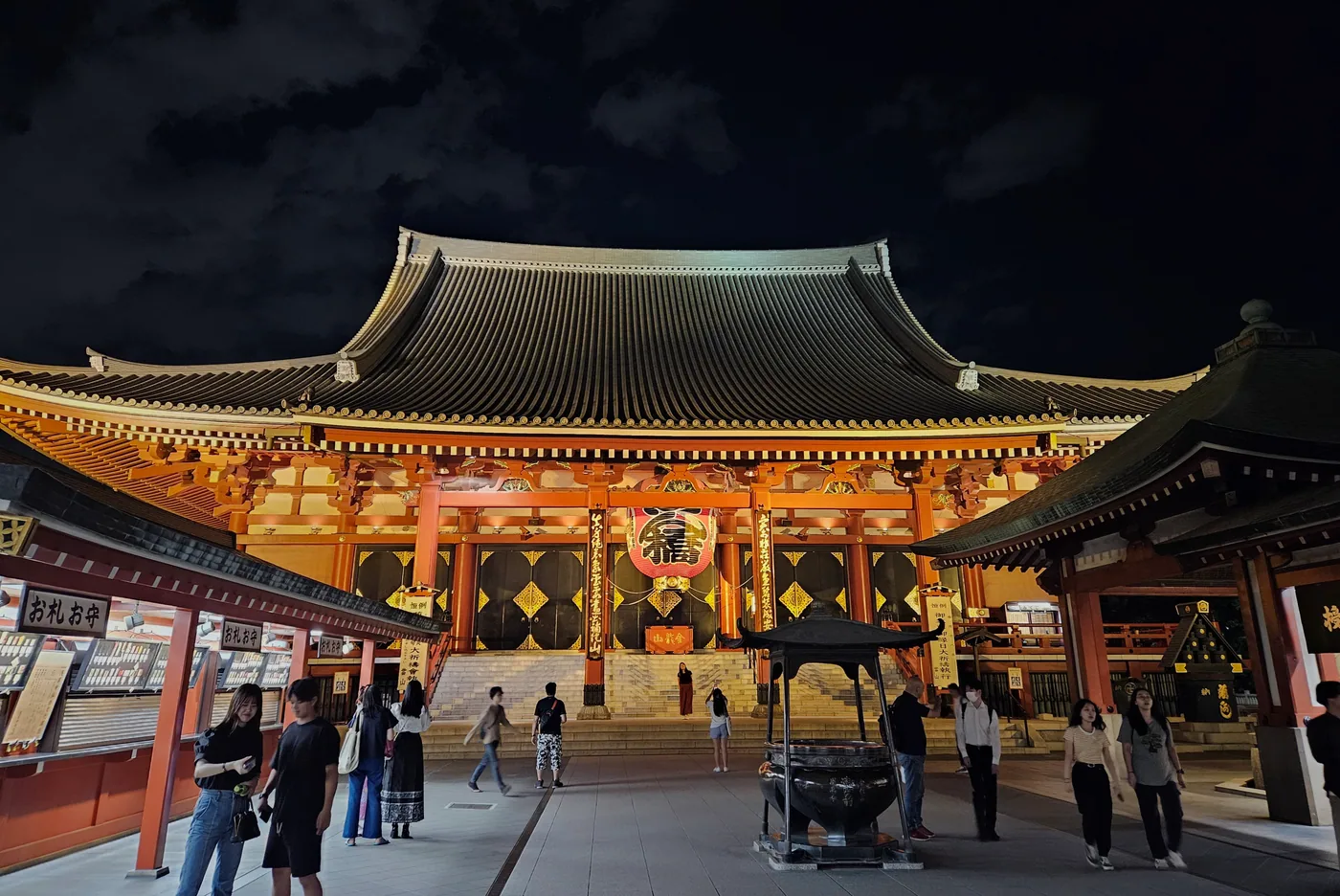
Three locations dominate the Korean-couple booking volume. Each works for slightly different reasons.
Asakusa (Tokyo)
Sensoji temple, Nakamise shopping street, and the Sumida riverfront form a 90-minute walking shoot route within Tokyo's most internationally-known traditional district. Direct subway from Haneda, Narita Express plus transfer from Narita. For Korean couples flying into Tokyo for a long weekend, Asakusa is the default first-day shoot — high visual recognition from Instagram, dense backdrop variety, and several Korean-speaking studios within a 10-minute walk of Sensoji. The Asakusa kimono shoot guide covers timing, crowd-management, and outfit recommendations.
Kyoto Geisha District
Gion Shinbashi, Ponto-cho, and Yasaka Shrine surroundings deliver the densest period-architecture density in Japan. Korean couples who film K-drama-aesthetic content gravitate here. The trade-off is crowd density — Gion's Hanamikoji street has had filming restrictions since 2019, and the Yasaka area is overcrowded by 9 AM. Most Kyoto studios schedule Korean-couple sunrise shoots (5:30-7:00 AM start) to bypass this. The Kyoto studios directory and Kyoto vs Kanazawa comparison help refine the choice.
Kamakura
An hour south of Tokyo by JR Yokosuka line, Kamakura offers Daibutsu (Great Buddha), Hokokuji bamboo grove, and the Tsurugaoka Hachimangu approach. For Korean couples who want forest and ocean in one shoot — a contrast hanbok-only Seoul cannot provide — Kamakura is the strongest pick. The Kamakura kimono photoshoot guide and Tokyo vs Kamakura comparison cover the logistics of day-trip booking from Tokyo.
Booking from Korea (Travel Logistics)
The booking workflow from Seoul, Busan, or Daegu is straightforward but has a few non-obvious steps.
Flight selection. ICN-NRT, ICN-HND, GMP-HND, and ICN-KIX (Osaka) are the four main routes. GMP-HND (Gimpo to Haneda) is the most convenient — Gimpo and Haneda are both city-airport, saving 2 hours of ground transfer per direction. Book at least 6 weeks ahead for weekend departures; LCC fares spike inside 4 weeks.
Studio deposit. Japanese studios typically require a 30-50% deposit via international wire transfer or Wise. Korean credit cards work at most Tokyo studios; some Kyoto studios are cash-only on shoot day. Confirm payment method at booking, not on arrival.
Visa. Korean passport holders enter Japan visa-free for up to 90 days as tourists. A kimono photoshoot does not change this — you are visiting Japan to take personal photos, not as a commercial model. The Japan prewedding visa guide covers the rare edge cases (commercial-use shoots, large group productions) that do require additional paperwork.
Hotel timing. Book hotel within 1.5 km of the studio for shoot-day morning. Korean couples often arrive Friday night, shoot Saturday, and fly back Sunday — a tight schedule that breaks if the studio is 30 minutes from the hotel. The 7-day itinerary guide covers longer trip planning if you want to add Kyoto or Kamakura.
Cost Compared to Korean Photo Studios

Korean pre-wedding studio packages run roughly 3,000,000 to 8,000,000 KRW (¥330,000 to ¥880,000 at 2026 rates) for the full Seoul studio + dress + hair + album bundle. Tokyo and Kyoto kimono shoots typically run ¥180,000 to ¥450,000 for an outdoor location half-day with full kimono rental, hair, makeup, and digital delivery — comparable mid-range, cheaper than Seoul premium tier.
The cost calculus changes when you add flight, hotel, and trip duration. A 2-night Tokyo trip for two with shoot included typically lands at 1,500,000 to 2,500,000 KRW total — less than a Seoul premium studio package and with international travel built in.
For deeper cost breakdown including hidden costs (parent kimono, second outfit changes, video add-on, hair trial), the 2026 kimono photoshoot cost guide walks line-by-line through typical packages.
Frequently Asked Questions
Do Korean couples need a marriage certificate to shoot kimono in Japan?
No. The shoot is a private photo session, not a legal ceremony. Most studios do not ask for documentation. The couple's status (married, engaged, dating, anniversary) does not change the booking process.
Can we shoot hanbok at a Japanese shrine?
Most shrines do not restrict the type of traditional dress — Sensoji, Meiji Jingu, Yasaka, and Hokokuji have all hosted hanbok shoots. Confirm with the studio at booking; some smaller shrines prefer kimono for cultural-context reasons but will not refuse hanbok.
Will my Korean parents be able to communicate at the studio?
At Korean-staffed Tier 1 studios, yes — fully. At interpreter-add-on studios, the interpreter is present for fitting and shoot day but typically not at hotel pickup. Plan a translation app on a parent's phone for hotel-to-studio transit.
Are there Korean-speaking hair and makeup artists?
Less common than Korean booking coordinators. Most studios pair a Japanese stylist with a Korean coordinator who translates preferences (hairline, brow color, lip tone). If you have specific Korean beauty references (Park Hyung-sik wedding stylist, particular K-beauty brand), bring photos.
Should we tip in Japan after the shoot?
No. Tipping is not customary in Japan and can be politely refused. A small gift (Korean snacks, traditional fan) given before or after the shoot is appreciated and culturally appropriate. See the Japan wedding tipping etiquette guide.
Can we shoot in winter snow?
Yes, but Tokyo and Kyoto get reliable snow only 3-5 days per year. For guaranteed snow, route to Kanazawa, Hokkaido, or Tohoku. The snow kimono photoshoot guide covers timing.
How far ahead should we book from Korea?
For peak season (cherry blossom late March-early April, autumn foliage November), book 6-8 months ahead. Off-peak weekends, 8-12 weeks is sufficient at most studios. Korean-speaking studios fill faster than English-only studios in equivalent tiers.
Find a Korean-Speaking Photographer
The studios we feature with Korean coordinator capacity are concentrated in Tokyo, Kyoto, and Osaka. Browse the full Wasou Wedding Japan photographer directory filtered by language. For the broader language-capacity question across all major studios, read the multilingual wedding photography guide. If you want a side-by-side of Tokyo and Kyoto for the location decision, the Tokyo vs Kyoto comparison walks through both as the next planning step.
Locations in this guide


Related guides
 General guide
Kimono Wedding Photos for Foreigners: How It Works in Japan
Illustrative image · Unsplash. Not a photo of the specific people, places or services discussed.
Yes, foreign couples can have kimono wedding photos taken in Japan — no residency, ceremony or Japanese required. How booking, fittings, pricing and permits actually work.
Read the guide General guide
How to Book a Kimono Photographer in Japan from Abroad: Step-by-Step
Illustrative image · Unsplash. Not a photo of the specific people, places or services discussed.
A complete step-by-step guide for foreign couples booking a kimono pre-wedding photographer in Japan from overseas. Contracts, payments, communication.
Read the guide General guide
Multilingual Wedding Photography Japan: Beyond English
Illustrative image · Unsplash. Not a photo of the specific people, places or services discussed.
A planner's audit of which languages — Korean, Mandarin, Spanish, French, JSL — Japanese kimono studios actually support, plus interpreter costs and when to hire one.
Read the guide