Tipping Etiquette Japan Wedding: Don't Tip Vendors
Tipping etiquette Japan wedding: a planner's honest guide. Why you should not tip photographers, hair stylists, or kitsuke dressers — and what to do instead.

Illustrative image · Unsplash. Not a photo of the specific people, places or services discussed.
Check current prices, availability and venue rules with the relevant studio or venue before booking.
Roughly a third of the foreign couples we onboard ask the same question within the first week: "How much do I tip the photographer?" The honest planner answer is that you do not tip your Japanese wedding photographer, hair stylist, or kimono dresser. Tipping is not customary in Japan, gratuity is not built into wages the way it is in North America, and pressing cash into a vendor's hand at the end of a shoot is more likely to create awkwardness than express thanks. This guide explains exactly why — and what to do instead.
Why Japan Doesn't Have a Tipping Culture
Japanese service work is built on a different economic and cultural assumption than the United States: the price you are quoted is the price the worker is paid through. There is no "tipped minimum wage" loophole. Service staff — including wedding photographers, hair and makeup artists, kitsuke (kimono dressing) specialists, and reception venue waitstaff — receive a normal salary or invoice from their employer or studio, and the package fee you pay covers their labor in full.
Culturally, the term often invoked is omotenashi — the principle that hospitality is offered without expectation of reward beyond the service relationship itself. Adding cash on top of the agreed fee can read as suggesting that the service was somehow incomplete, or that the worker did not deserve the agreed price and needs supplementation. Neither is the message you intend to send. In a hospitality culture that prizes precision in the transaction, the cleanest expression of gratitude is paying on time, showing up on schedule, and writing a thoughtful review.
What about hotels and tour guides?
You may have read travel blogs that mention tipping exceptions for international-facing hotel concierges or private tour guides who serve foreign clients. These exist, but the wedding vendor category — photographers, stylists, dressers, venue staff — is one of the most uniformly no-tip categories in Japan, alongside restaurants and taxis.
What's Included in Japanese Service Pricing

A Japanese wedding photo package fee is what we call an all-inclusive quote. Unlike a US wedding budget where gratuity is a line item, the Japanese studio's quoted price already covers the photographer's labor, the assistant's labor (if present), studio overhead, equipment depreciation, post-production hours, and the studio's profit margin. Couples often ask whether there is a hidden "service charge" the studio is rolling in — the answer is no. The number on the contract is the number you pay, and 100% of the worker compensation comes out of that.
This is true across most Japanese wedding service categories:
Vendor type | Gratuity expected? | How they are paid |
|---|---|---|
Photographer / studio | No | Full package fee |
Hair & makeup artist | No | Included in studio package or invoiced fee |
Kitsuke (kimono dresser) | No | Included in rental or styling fee |
Reception venue waitstaff | No | Hotel/venue salary |
Shrine priest | No — but hatsuhoryo offering | Set ceremony donation, given separately |
Taxi / driver | No | Metered fare only |
The only line item that can look like a "tip" but functions differently is the shrine ceremony hatsuhoryo offering — a set donation (typically ¥30,000-¥100,000 depending on the shrine) presented to the shrine office, not to an individual priest. This is a formal religious offering, not gratuity, and the amount is stated upfront by the shrine.
Photographer — Don't Tip
Your Japanese wedding photographer does not expect, want, or comfortably receive a tip. We have seen couples try to hand over a ¥10,000 note at the end of an Asakusa shoot, and the photographer's reaction is typically polite but visibly uncertain — they may refuse outright, accept reluctantly, or attempt to return the money to the agency. None of these are good outcomes for what you intended as a kind gesture.
If the studio uses a coordinator or English-speaking liaison, the same applies — they are salaried staff being paid through the package fee. Pressing cash on the liaison at the end of the day puts them in an awkward compliance position with their employer, who likely has explicit no-gratuity policies.
Wedding Planner's Notes: The single most common mistake we see is foreign couples handing the photographer a sealed envelope of cash at the end of the shoot, thinking it is a discreet way to tip. The photographer reads the sealed envelope as a contract addendum or an irregular payment, not gratuity, and may feel obligated to report it back to the studio. If your aim is gratitude, skip the envelope.
Hair & Makeup Artist — Don't Tip
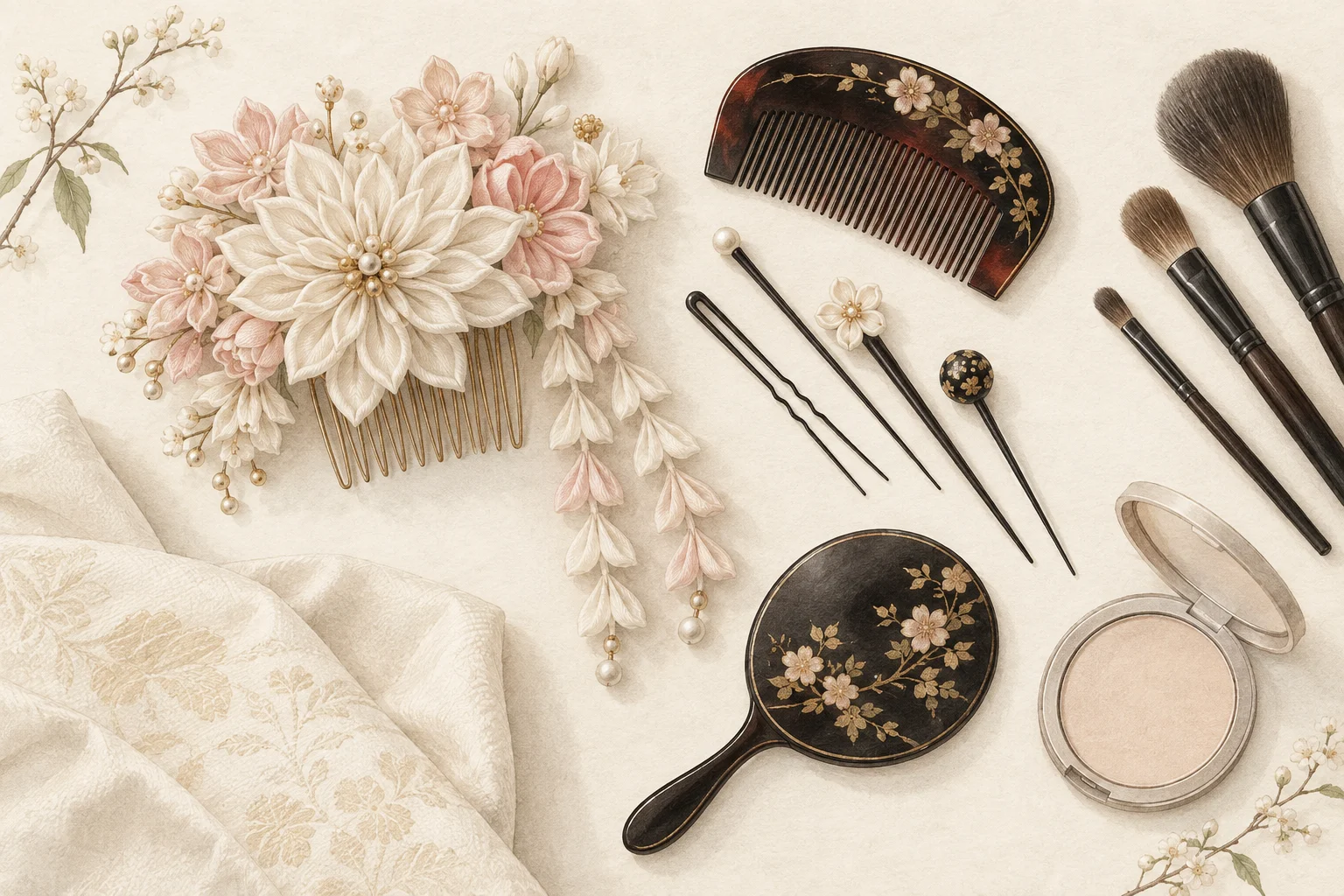
The hair and makeup artist working your kimono shoot is either employed directly by the photo studio, contracted through a specialist HMUA agency, or freelance under a daily rate that the studio has paid in full. In all three cases, the line item is closed when the studio is paid. Adding ¥5,000 at the end of a 90-minute styling session does not flow to the artist's take-home; in many studio arrangements it has to be turned back in or it complicates the tax record the studio keeps on the artist.
This is also true of the trial styling session if you book one in advance. Trial fees (¥10,000-¥25,000 typical) are full payment, not partial payment expecting topping up.
Kimono Dresser (Kitsuke) — Don't Tip
Kitsuke specialists are the most invisible-to-foreigners role in your shoot, and the one couples feel most guilty about not tipping — the dresser spends 40-60 minutes physically arranging the kimono on you, often the closest physical service of the day. The cultural rule still holds: do not tip. Kitsuke is a licensed craft profession in Japan with formal pricing structures, and the dresser is paid by the studio or rental shop through the package.
If you want to express gratitude to the dresser specifically — and this is reasonable, because their work is often invisible to foreign couples — say it directly: "Arigatou gozaimashita. Kirei ni shite kudasatte, hontou ni ureshikatta desu." (Thank you very much. I am genuinely happy that you made me look beautiful.) A spoken acknowledgment from the bride at the end of dressing is the culturally appropriate currency.
Hotel Staff — Acceptable in Service Charge Form
The one wedding-adjacent context where something tip-like exists is at high-end international hotels. Luxury properties (think Park Hyatt Tokyo, Aman Tokyo, Ritz-Carlton Kyoto) often add a 10-15% service charge to your bill automatically. This is not a tip — it is a fixed surcharge that the hotel distributes through its compensation system. You do not tip on top of it.
For bellhops who handle multiple heavy kimono garment bags or for the concierge who arranges last-minute shrine logistics, a small extra (¥1,000-¥2,000) is acceptable but not expected. If you choose to offer it, hand it discreetly in a clean envelope. Crumpled bills handed across the counter are not appropriate; this is one place where the envelope convention matters.
Restaurant — Don't Tip (Including Wedding Reception Venue)
Restaurants in Japan do not accept tips. This includes the kaiseki dinner you booked for your post-shoot celebration, the omakase sushi counter you treated your parents to, and the wedding reception venue if you are hosting a small kaishoku meal after the ceremony. Some servers will physically chase you out the door to return cash left on the table, interpreting it as forgotten change.
The venue captain or banquet manager at a hotel wedding reception is paid through your venue contract. If they did exceptional work coordinating a difficult timeline, the appropriate response is a written thank-you note to the hotel's wedding director after the event — this also benefits the captain by going into their personnel file. Cash does not.
If You Really Want to Show Gratitude — Alternative Gestures
Foreign couples often need somewhere to direct the impulse to thank vendors materially. There are culturally appropriate channels:
- Written review. A specific, named, English-language review on Google Maps or the studio's listing page is genuinely valuable to the photographer's business and reaches future foreign clients researching them. This is the single highest-impact gesture.
- Small gift from your home country. If you brought a thoughtful small item — wrapped chocolate, a regional specialty, a small souvenir from your city — these are accepted graciously and read as a cultural exchange, not a tip. Hand it at the end of the shoot with both hands and a brief explanation.
- Social media tag and credit. If you post your photos on Instagram, tag the studio and photographer's professional account. Foreign-couple endorsement is marketing currency for Japanese studios serving international clients.
- Referral. Recommending the studio by name to engaged friends planning Japan trips is durable goodwill. The studio will remember.
- Spoken thanks at the moment. A direct verbal "thank you" — in English is fine, in Japanese is appreciated — at the conclusion of the shoot, addressed to each crew member individually, is the closest cultural equivalent to a tip.
Cash in an Envelope — Sometimes Misread
One last warning, because this is the failure mode we see most often. In Japan, cash in a formal envelope (noshibukuro) has specific contractual meanings: it is how you give a shrine offering, how you pay for ceremonies, how you give condolence money or wedding gift money. Pressing a cash-filled envelope into your photographer's hand at the end of a shoot can be read as anything from an irregular payment they need to declare, to a coded request for off-the-books work, to a misunderstood gift requiring formal acknowledgment.
If gratitude is your goal, the envelope is the wrong vehicle. Use words, a review, or a small wrapped item from your country. The cash envelope channel in Japan carries weight that does not translate cleanly from American tipping culture.
Frequently Asked Questions
What if the photographer accepts the tip — does that mean it's actually fine?
A photographer accepting a tip handed to them in person is usually being polite under social pressure, not signaling that gratuity is welcome. Japanese professionals will often accept rather than create an awkward refusal scene, then privately treat the cash as a complication. Refusal-by-acceptance is not the same as expectation.
Is it different if I'm working with a Western expat photographer based in Japan?
Slightly. Some Western expat photographers operating in Japan have absorbed local pricing norms and also will not expect tips. Others may be comfortable with optional gratuity in the 5-10% range if you genuinely want to give one. Ask discreetly via email beforehand — never on the day.
Do I tip the assistant or second shooter separately?
No. The assistant is paid by the studio out of your package fee. The same logic applies — there is no separate gratuity line. A specific verbal thank-you to the assistant by name at the end of the shoot is appreciated.
What if the shoot goes over the contracted time — should I tip for the extra hours?
No, but you should ask the studio whether overage fees apply and pay those formally if so. Most contracts specify per-hour overage rates (¥15,000-¥30,000 typical) that are invoiced through the studio. Slipping cash to the photographer for "the extra time" creates the bookkeeping problem the formal overage system is designed to avoid.
Do I tip the shrine for the ceremony?
You pay hatsuhoryo — a formal ceremony offering — to the shrine office, not to individual priests. The amount is set in advance by the shrine (commonly ¥30,000-¥100,000 depending on the shrine and ceremony tier). This is religious offering, not tipping, and is presented in a formal noshibukuro envelope to the shrine reception desk, not handed to the officiating priest.
Is a thank-you gift okay instead of cash?
Yes — a small wrapped item, particularly something from your home country, is the most graceful alternative. Keep the value modest (under ¥3,000 equivalent so it doesn't feel obligation-inducing), wrap it cleanly, and present it at the end of the shoot with brief thanks.
What about for the makeup trial weeks before the wedding?
Same rule: no tip. The trial fee is full payment. If the trial result didn't match what you wanted, raise it directly with the studio so they can adjust for the actual shoot day — that feedback is more useful than gratuity.
Plan a Shoot Without the Tipping Anxiety
The best protection against awkward end-of-shoot moments is booking with a studio whose pricing is transparent and whose foreign-client process is well-documented. Browse our curated directory of kimono wedding photographers — every listed studio is vetted for clarity on what the package fee covers, so you arrive on shoot day knowing the number on the contract is the complete number. For further reading, our guide to reading a photographer's portfolio covers the signals that separate well-run studios from improvised setups, and our breakdown of kimono photoshoot costs in 2026 shows you exactly what is and isn't included at each price tier.
Related guides
 General guide
Goshugi: Japanese Wedding Gift Money & Envelope Etiquette
Illustrative image · Unsplash. Not a photo of the specific people, places or services discussed.
Complete guide to the japanese wedding gift (goshugi): how much to give, the shugi-bukuro envelope, new bills, fukusa wrapping, and reception presentation.
Read the guideGeneral guideGoshugi-Bukuro Gift Money Envelopes: Patterns & Etiquette
Illustrative image · Unsplash. Not a photo of the specific people, places or services discussed.
Goshugi-bukuro gift money envelope guide: shochikubai vs awabi-musubi knots, odd-number amounts, crisp bills, calligraphy rules, and foreign guest etiquette.
Read the guide General guide
Hikidemono: Japanese Wedding Return Gifts Explained
Illustrative image · Unsplash. Not a photo of the specific people, places or services discussed.
Hikidemono japanese return gifts explained: three-item structure, catalog gifts, budgets, logistics, and what international couples and guests need to know.
Read the guide