Yukata Couple Photoshoot in Japan: Summer Festival Style
A wedding planner's guide to yukata couple photoshoots in Japan — when to choose yukata over formal kimono, how to coordinate as a couple, the best locations and timing, accessory details, and how to include sparklers or festival atmosphere in your summer shoot.

Illustrative image · Unsplash. Not a photo of the specific people, places or services discussed.
Check current prices, availability and venue rules with the relevant studio or venue before booking.
A yukata couple photoshoot is the casual summer alternative to a formal kimono session — lighter on the body, breathable in July and August humidity, and visually tied to Japan's festival season in a way that no other outfit replicates. Couples request it for two reasons: they are traveling in midsummer when full silk kimono is genuinely uncomfortable, or they want imagery that reads as relaxed and seasonal rather than ceremonial. As a wedding planner, this is one of the frequently shortlisted shoots from June through early September, and it is the right format more often than couples expect. Below is the practical guide to choosing yukata, coordinating as a couple, and selecting locations that suit the look.
Yukata vs Formal Kimono — When Yukata is the Right Choice
Yukata (浴衣) is a single-layer, unlined cotton kimono historically worn as bathhouse robes and now firmly established as Japan's summer leisure garment. Formal kimono — shiromuku, iro-uchikake, hikifurisode, and even the lighter komon — are layered silk garments with juban underlayers, obi structures, and accessories that add real weight and warmth. In a Kyoto August at 35°C with 70% humidity, the difference between yukata and a full bridal kimono is not stylistic; it is the difference between a comfortable two-hour shoot and a heat-management problem.
The Wedding Planner's Note: choose yukata when your visit falls between mid-June and early September, when you want imagery that feels seasonal and human rather than ceremonial, or when you are doing a second look alongside a primary shiromuku or iro-uchikake session. Choose formal kimono when the photoshoot is a stand-in for or supplement to your actual wedding ceremony, when you want imagery that reads as "Japanese wedding" to family at home, or when you are shooting in spring or autumn when the weather supports the heavier garment. For the complete seasonal logic, see our summer yukata kimono photoshoot guide and our broader notes on the best season for a kimono photoshoot.
One distinction worth flagging: a yukata couple photoshoot is not a "bridal" shoot in the formal sense. If your goal is wedding imagery your parents will frame, the conventional choice remains shiromuku or iro-uchikake. Yukata reads as engagement, anniversary, honeymoon, or pre-wedding lifestyle photography — beautiful, but stylistically a different register. Many couples book both: a 90-minute formal session in the morning, a 60-90 minute yukata session in the evening for sparklers and matsuri atmosphere.
Matching Yukata as a Couple — Color and Pattern Coordination
Yukata coordination for couples is more flexible than formal kimono pairings, but a few principles make the difference between imagery that feels styled and imagery that looks like two strangers in cotton. The traditional matsuri convention is that men wear yukata in dark indigo, navy, charcoal, or muted earth tones with restrained geometric or wave patterns (seigaiha, asanoha, kasuri). Women wear yukata across a wider palette — indigo, white, soft pink, mint, deep red, mustard — with floral or seasonal motifs (asagao morning glory, kingyo goldfish, hanabi fireworks, kiku chrysanthemum).
Three coordination approaches work well on camera:
- Tonal pairing. Both yukata in the same color family — for example, his navy with a fine wave pattern and her indigo with white asagao. A photographically forgiving option and the closest to authentic matsuri convention.
- Complementary contrast. His charcoal or deep brown paired with her warm coral, mustard, or soft pink. Reads cleanly in evening light and against summer greenery.
- Pattern echo. Different colors but a shared motif — both yukata feature hanabi (fireworks), both feature water-based patterns, or both reference the same seasonal flower. Subtle, and looks intentional in close-up.
What to avoid: identical "his and hers" matching sets sold to tourists, which tend to look costume-shop on camera. Also avoid putting her in a heavily ornamented furisode-style yukata next to him in a plain summer jinbei — the formality mismatch is jarring. If your photographer or rental studio offers a styling consultation, take it; coordinating across two body types and skin tones is exactly where their experience earns its fee.
Locations That Work for Yukata Shoots
Yukata reads as casual summer, and the strongest locations reinforce that register rather than fight it. Four location types consistently produce strong yukata couple photoshoot results.
Matsuri grounds and shrine festivals
Shooting at an actual matsuri (summer festival) is the most cinematic option but the hardest to execute. The well-known festivals — Gion Matsuri in Kyoto, Tenjin Matsuri in Osaka, Sumida River Hanabi in Tokyo, Nebuta in Aomori — draw crowds in the hundreds of thousands. Professional shoots inside the festival itself usually mean tight 30-minute windows, restricted angles, and a photographer who knows the grounds intimately. Many photographers will instead suggest shooting at the festival's edges — adjacent streets with lanterns up, approach paths to the shrine, or the morning of the festival before the crowds arrive. This is almost always the better practical choice.
Riverside and bridge approaches
Kamogawa in Kyoto, Sumidagawa in Tokyo, and the canal districts of Kurashiki and Yanagawa produce strong yukata imagery in summer evening light. Water reflects lanterns and city light cleanly, and most riverside paths allow informal portrait work without permits. Sunset to one hour after sunset (the "blue hour") is when yukata against city water looks its best on camera.
Ryokan and hot spring towns
Towns like Kinosaki Onsen, Kurokawa Onsen, Hakone, and Arima are essentially purpose-built for yukata. Guests walk between bathhouses in their inn-provided yukata, lanterns line the streets, and the entire town reads as period-appropriate background. Couples staying at a ryokan can usually arrange a 60-90 minute shoot in their accommodation's own yukata, often coordinated through the inn's concierge or a local photographer the inn has worked with. This is the lowest-friction location category and one we frequently recommend.
Old town districts
Higashiyama in Kyoto, Kawagoe in Saitama, the bukeyashiki streets of Kanazawa, and the canal districts of Hida-Takayama work year-round but particularly well in yukata. Wooden townhouses, tile roofs, and stone-paved alleys give a styled background without requiring a festival to be in progress. For Kyoto specifically, our notes on top Kyoto studios include several that handle yukata sessions in Higashiyama and Pontocho.
Timing — Festival Season vs Off-Festival
Festival season runs roughly mid-July through late August, with regional variation. The advantage of shooting during festival weeks is genuine: lanterns are hung, stalls are set up, the cultural register is unmissable. The disadvantages are equally real — accommodation prices rise 30-60%, photographer availability tightens, and you compete with both tourists and locals for the location.
Off-festival summer (mid-June, early July, early September) is the planner's frequent recommendation. The yukata is still seasonal and correct, locations are uncrowded, photographers have flexible scheduling, and you avoid the heat peak of mid-August. The trade-off is that you cannot guarantee lanterns and stalls — that atmosphere has to be either constructed (with sparklers, see below) or found at one of the ryokan towns that maintain festival decoration through the summer regardless of the calendar.
Three timing notes for the day itself:
- Rainy season (梅雨). Mid-June to mid-July across most of the country. Build a half-day weather buffer into your itinerary.
- Heat management. Schedule for 6-9 AM or 5-8 PM. Midday shoots in August are uncomfortable for everyone including the photographer.
- Obon week (mid-August). A domestic travel peak. Locations are crowded, photographer rates rise, and bookings should be made 3-4 months out.
Accessories — Geta, Kinchaku Bag, Sensu Fan, Hair Ornaments
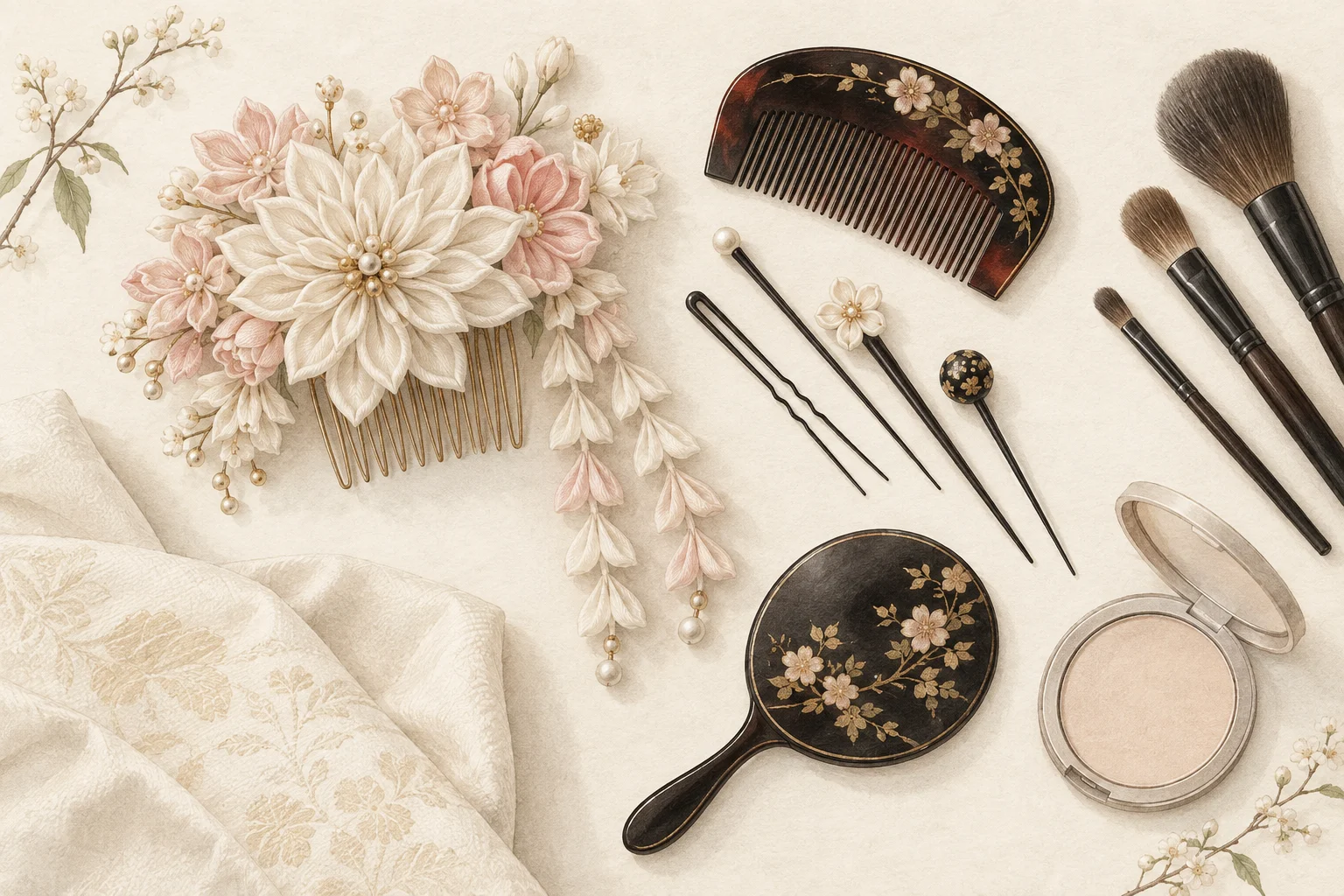
Yukata is structurally simpler than formal kimono, but the accessory layer is what carries the styling on camera. Most rental studios include the core set, but it is worth confirming what is included in your fee and what is rented separately.
The standard yukata accessory set:
- Geta (下駄). Wooden platform sandals worn barefoot. Walk in them for ten minutes before your shoot starts — they take some getting used to, and blisters from the hanao (thong) are common in the first hour. Tell your studio if you have wider feet; geta sizing runs narrow.
- Han-haba obi (半幅 obi). The narrower obi worn with yukata, tied in simpler bows than formal kimono obi. Common knots include bunko, chocho (butterfly), and kainokuchi. Your dresser will usually offer two or three options based on your back length and what photographs well.
- Kinchaku (巾着). A small drawstring pouch carried in place of a handbag. Cotton or silk, often patterned to complement the yukata. Useful for carrying lip color, tissues, and a phone during the shoot.
- Sensu (扇子) or uchiwa (団扇). Folding fan or rigid fan. A signature yukata accessory — held in the obi when not in use, opened in the hand for movement and breeze in close-ups. Uchiwa with festival branding or seasonal motifs are particularly photogenic in matsuri shots.
- Hair ornaments. Simpler than formal kanzashi for shiromuku. Summer flowers (asagao, kingyo motifs, small fabric flowers), tortoiseshell combs, or simple lacquered sticks. For more on bridal kanzashi at the formal end, see our notes on kanzashi hair ornaments.
For the gentleman, the accessory set is leaner: geta, a simple kaku-obi (stiff narrow obi), and occasionally a sensu folded into the obi. A traditional juzu or pocket watch tucked into the obi works as a low-key prop in close-ups if your photographer suggests it.
Studio vs Outdoor for Yukata
For yukata specifically, outdoor is almost always the right answer. The whole point of the garment is summer atmosphere — humidity-softened skin, evening light, lanterns, water, festival sound — and a studio set struggles to replicate any of it convincingly. The exceptions are narrow and worth naming.
Studio yukata sessions make sense when the weather collapses (a typhoon week, three days of solid rain), when you have very limited time and need a controlled environment, or when you are doing a yukata session as the casual second look after a formal studio shiromuku shoot and the photographer is already set up. Some Kyoto and Tokyo studios offer fixed sets — a matsuri lantern wall, a ryokan engawa veranda, a riverside background — that work credibly for yukata if outdoor is genuinely off the table.
For most couples, the recommendation is: book outdoor, build a one-day weather buffer into your itinerary, and have your photographer pre-identify a covered location (a shrine's outer hall, a temple corridor, a covered shotengai shopping street) you can pivot to if rain arrives mid-shoot. Our full notes on the trade-off are in the studio vs outdoor kimono photoshoot guide.
Including Sparklers or Festival Lights in the Shoot
Sparklers (senko hanabi, 線香花火) are a frequently requested yukata couple photoshoot addition, and for good reason — they produce imagery that reads instantly as Japanese summer, they create lighting your photographer can use to light the couple's faces in evening shots, and they give couples something to do with their hands. The execution is more constrained than it looks.
The practical notes:
- Senko hanabi vs sparkler sticks. Senko hanabi are the traditional Japanese version — a twisted paper stem with a small ball of gunpowder at the tip that produces a slow-falling cascade of sparks lasting about 30-60 seconds. Western-style sparkler sticks burn faster and brighter. For Japanese summer aesthetic, senko hanabi is correct; for sustained light over a long exposure, sparkler sticks are easier to work with. Many photographers carry both.
- Legal locations. Open flame is restricted at most shrines, temples, and public parks. Riverside areas, beaches, and rented private courtyards are typically the only legal options. Your photographer will know the specific permitted spots in their city — defer to them on location.
- Timing. Sparklers need genuine darkness to photograph well. Plan for 45-60 minutes after sunset. In Tokyo and Kyoto in August, that means starting the shoot around 6 PM and reaching sparkler time around 7:30 PM.
- Provided or BYO. Some photographers include sparklers in their summer package; others ask the couple to purchase from a convenience store or Don Quijote the day of. Confirm at booking.
Festival lights — paper lanterns (chochin), strings of bulbs at matsuri grounds, illuminated stalls — are environmental rather than props. If you want a shot under specific lanterns at a specific festival, tell your photographer at booking. They may suggest shifting the date by a day or pivoting to a different festival with the same atmosphere but a more workable location.
Frequently Asked Questions
How much does a yukata couple photoshoot typically cost in Japan?
For a 60-90 minute outdoor session with rental, dressing, hair, photography, and 30-50 retouched files, plan for the lower end of the kimono photoshoot range — yukata rentals are roughly half the price of formal kimono rentals, which brings the package total down meaningfully. Our detailed breakdown is in the kimono photoshoot cost guide.
Can we shoot yukata in winter or spring?
Technically yes — most rental studios stock yukata year-round — but the imagery will read as off-season to any Japanese viewer, and the photographer will work harder to make outdoor cold-weather yukata look intentional. We recommend mid-June through early September. If your trip is outside that window, consider cherry blossom or autumn foliage shoots with proper season-appropriate kimono instead.
Will we be uncomfortably hot during a summer yukata shoot?
Less than you fear, more than you hope. Yukata is single-layer cotton and breathes well, but August in Kyoto or Tokyo is genuinely difficult. Schedule the shoot for the first two hours after sunrise or the last two hours before sunset, bring a hand fan, and accept that the photographer's air-conditioned car or your hotel lobby is part of the shoot's logistical plan.
Do we have to wear traditional underwear under yukata?
Most studios provide a simple cotton hadajuban (underlayer) for the woman; the man typically wears a thin cotton undershirt of his own. Couples often ask about regular underwear under yukata — modern Japanese practice accepts standard underwear; it is comfort, not tradition, that matters for the shoot.
Can we walk through a real festival during our yukata shoot?
Sometimes, with caveats. Smaller neighborhood matsuri can accommodate a discreet 20-30 minute walking shoot if the photographer has scouted the route. Major festivals (Gion, Tenjin, Nebuta) are too crowded for portrait work during peak hours; the workaround is to shoot in the early morning of the festival day, when lanterns are up but crowds have not arrived, or in the streets adjacent to the festival grounds.
Is a yukata shoot appropriate for our pre-wedding album?
Yes — and it pairs well with a formal kimono session as a contrasting second look. Many couples book a half-day combination: shiromuku or iro-uchikake in the morning at a shrine, yukata in the evening at a riverside or matsuri location. The two looks together tell a stronger story than either alone, and reproductive cost is lower than two full separate sessions. See our prewedding vs ceremony notes for the broader framing.
What if one of us is much taller than typical Japanese sizing?
Yukata sizing is more forgiving than formal kimono sizing because the garment is shorter and the obi is narrower. Most studios stock yukata up to 185-190cm for men and 175cm for women. For taller or larger-framed visitors, flag your measurements at booking — the studio can pre-pull stock that will fit and confirm before you arrive.
Can we keep our yukata after the shoot?
If you rent, no — rentals return to the studio that evening. If you want to keep the yukata, ask the studio about a "buy out" or purchase option, which most will accommodate for a per-garment fee, or buy ready-made yukata sets at department stores (Takashimaya, Mitsukoshi) and specialty shops in summer. Bringing a purchased yukata to a photographer for the shoot is also accepted by most studios; confirm in advance.
Find a Yukata-Friendly Photographer
Not every kimono photographer takes on yukata work — some prefer to keep their portfolio focused on formal bridal, and others are at their best in summer riverside and matsuri settings. The Wasou Wedding Japan photographer directory notes which studios accept yukata sessions and which specialize in summer outdoor work; the listings cover Kyoto, Tokyo, Kanazawa, ryokan-town specialists, and English-speaking teams suitable for international couples.
If you are still narrowing the shoot's broader shape, the related guides that pair most directly with yukata planning are our summer yukata kimono photoshoot guide, our English-speaking photographers shortlist, and our shoot duration notes for couples deciding between a single yukata session and a combined formal-plus-yukata day.
Related guides
 Style guide
Zori Bridal Footwear Japan: Platform, Straps, Foreign Sizing
Illustrative image · Unsplash. Not a photo of the specific people, places or services discussed.
Zori bridal footwear in Japan: platform sole height, embroidered thong straps, white vs red coordination, and sizing for foreign brides. Planner-led guide.
Read the guide Style guide
Kimono Fitting for Foreign Brides: Tall, Curvy & Petite
Illustrative image · Unsplash. Not a photo of the specific people, places or services discussed.
Kimono fitting for foreign bride body types: how tall, curvy, plus-size, and petite brides find studios with extended sizing and skilled kitsuke teams.
Read the guide Style guide
Hair Styling for Foreign Brides in Kimono: Curly, Fine & Short
Illustrative image · Unsplash. Not a photo of the specific people, places or services discussed.
Practical hair styling for kimono foreign brides — curly, fine, pixie cut, extensions, and dyed hair. What to communicate before your shoot.
Read the guide