Tsumami-Zaiku Bridal Hair Ornaments: Folded-Silk Craft
Tsumami-zaiku bridal hair ornament guide: Edo-period folded-silk craft, petal technique, coordinated kanzashi sets, Tokyo and Kyoto workshops, costs ¥5K-¥200K+.

Illustrative image · Unsplash. Not a photo of the specific people, places or services discussed.
Check current prices, availability and venue rules with the relevant studio or venue before booking.
Tsumami-zaiku (つまみ細工) — the Edo-period folded-silk craft that produces hand-assembled floral hair ornaments — sits at the top of the bridal kanzashi hierarchy. A single tsumami-zaiku hairpin runs ¥5,000-¥20,000. A coordinated bridal set with multiple matching pieces ranges ¥30,000-¥200,000+. Understanding what your stylist is actually placing in your hair — squares of silk folded petal-by-petal, then assembled into miniature flowers — changes how you discuss options, set budget, and value the detail shots your photographer captures.
What Tsumami-Zaiku Is
Tsumami-zaiku translates literally as "pinched work." The craft uses small squares of silk — typically habutae (smooth silk) or chirimen (crepe silk) — cut to uniform size, then folded by hand with tweezers into petal shapes. Petals are dipped briefly in starch to hold form, then assembled around a central base to build complete flowers. Flowers are mounted on hairpin bases (kanzashi) ranging from single-stem ornaments to elaborate dangling pieces with silk strands and seasonal embellishments.
The category sits within the broader kanzashi tradition, alongside lacquered, glass, and metal ornaments. What distinguishes tsumami-zaiku: every petal is folded individually by a human, no two pieces are exactly alike, and the silk surface catches light differently than lacquer or glass. For bridal use, this hand-made quality is part of what justifies the cost tier.
Wedding Planner's Note: When stylists describe tsumami-zaiku as "handmade silk flower ornaments," ask specifically whether the petals are folded individually or whether the piece uses pre-made silk components glued to a base. Both exist in the market; only the former is genuine tsumami-zaiku, and the cost reflects the labor.
The Folded-Silk Petal Technique
The technique looks deceptively simple — a square of silk, a fold, a pinch. In practice, skilled tsumami-zaiku artists train for years before producing bridal-grade work. The three phases below describe what happens between raw silk and the finished hairpin sitting in your hair.
Square Silk Cutting
Silk is cut into precise squares, typically 1.5 cm to 3 cm per side depending on the final flower size. Bridal pieces often use 2.5 cm squares for visible weight. The silk used is either habutae (smooth, lustrous, holds dye saturation) or chirimen (textured crepe, more dimensional). Color combinations are planned at this stage — a single peony might require 30-40 squares in two to four graduated tones to achieve depth.
Hand-Folding Into Petal Shapes
Two primary fold techniques dominate: maru-tsumami (round-petal fold, producing soft cherry-blossom petals) and ken-tsumami (pointed-petal fold, producing chrysanthemum or pine-needle shapes). Each square is folded multiple times with tweezers, then briefly dipped in starch solution to hold form. The artist works at a small table with the silk, tweezers, starch, and a heated tile to set the fold. Speed varies: an experienced maker produces 60-80 petals per hour for simple shapes, fewer for complex multi-fold variants.
Assembly Into Floral Compositions
Petals are assembled around a small fabric or paper base, typically 5-8 petals per flower depending on the design. Multiple flowers are then mounted on a hairpin shaft (typically lacquered wood or metal), often with silk strands (bira-bira), tiny brass leaves, and seasonal embellishments. A full bridal set might include one large central piece, two flanking pieces, and three to five smaller side ornaments — all assembled to coordinate as a single visual composition.
Edo-Period Origins and Modern Practice
Tsumami-zaiku developed in the Edo period (1603-1868), initially as a hobby craft among samurai-class women and later commercialized by professional makers serving merchant-class and geisha clients. Production centered in Edo (modern Tokyo) and Kyoto, with regional variations in folding technique and color preference. The craft survived the early 20th century by adapting to bridal-industry demand — particularly as commercial wedding photography grew in the 1950s-60s and elaborate kanzashi became a signature element of the shiromuku presentation.
Modern practice retains the hand-fold technique but has integrated some efficiencies. A few workshops use templates to standardize petal size; some bridal-grade pieces incorporate machine-cut silk with hand-folded assembly. True traditional tsumami-zaiku — every square cut by hand, every petal folded individually, no template — is now produced by a small number of certified makers, primarily in Asakusa, Yanaka, and the Gion district of Kyoto.
Use in Bridal Kanzashi
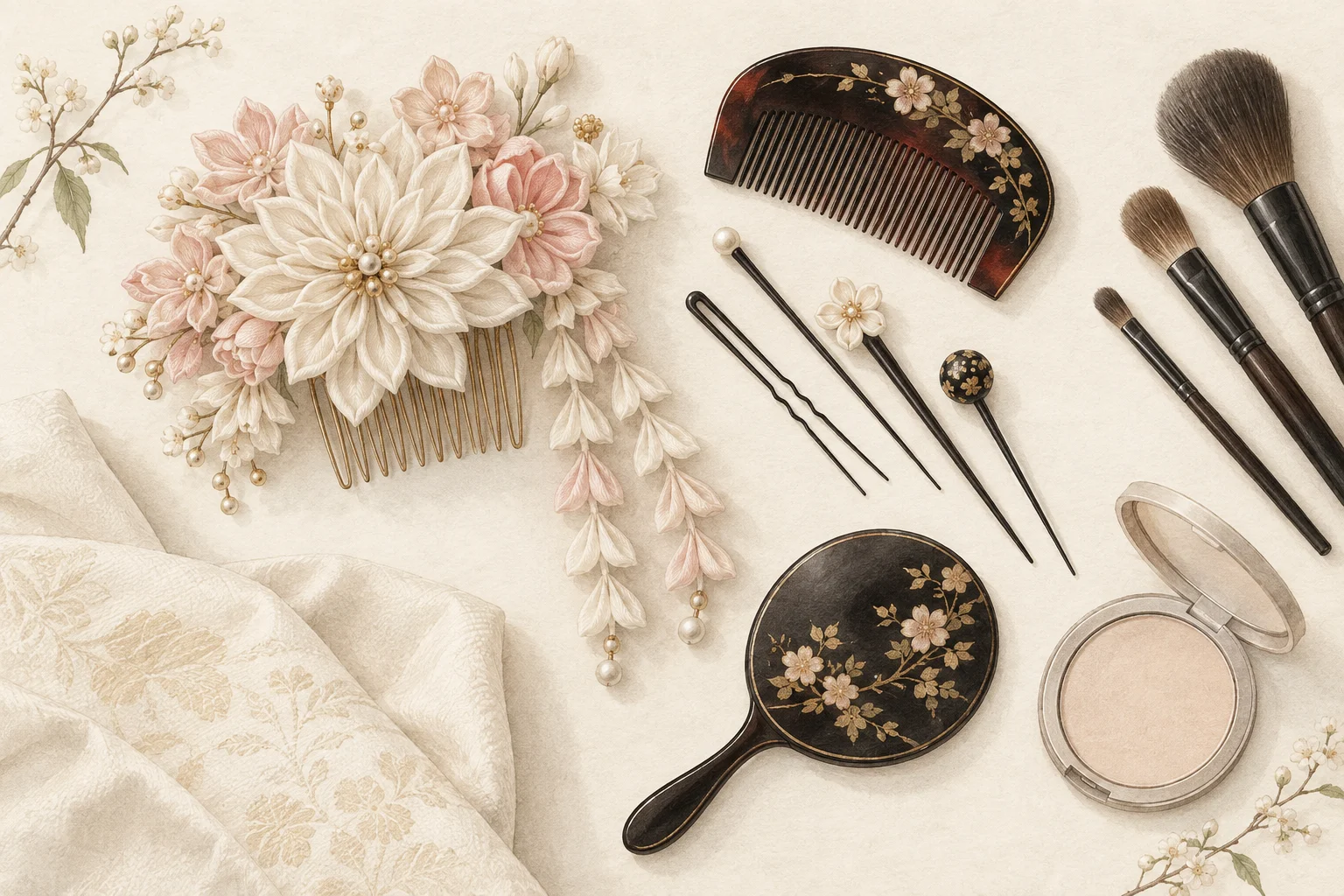
For Japanese traditional weddings, tsumami-zaiku appears most prominently with the shiromuku (white kakeshita over white uchikake) and color uchikake presentations. The white-on-white aesthetic of shiromuku allows tsumami-zaiku to add the only major color in the bridal silhouette — typically a coordinated cherry-blossom or peony set in pink, red, or white. With color uchikake, tsumami-zaiku is selected to either match or contrast with the uchikake's dominant color.
The wataboshi (white silk hood) and tsunokakushi (white silk headpiece) covers most or all of the hair, so tsumami-zaiku is usually visible only at specific moments: ceremony arrival, hood-removal segment of the photo session, and post-ceremony portrait time. Plan with your stylist when the ornaments will be visible and which photographs should feature them. See the broader kanzashi guide for the full ornament hierarchy.
Common Floral Designs
Sakura (Cherry Blossom)
The most popular bridal design. Five-petal flowers in graduated pink-to-white tones, typically assembled in clusters of 3-7 flowers per piece. Symbolism: renewal, beauty, transience. Seasonal preference: spring weddings (March-May), but appropriate year-round. Cost: ¥8,000-¥40,000 for a coordinated set.
Peony (Botan)
Heavier, more dimensional. Single large flowers (20-40 petals each) in deep pink, red, or coral. Symbolism: prosperity, honor, bravery. Often paired with gold-leaf accents on the petal tips. Cost: ¥15,000-¥80,000 per coordinated set. Recommended for couples wanting maximum visual presence.
Plum Blossom (Ume)
Smaller, more delicate than sakura. Five round petals, often in white or pale pink with a yellow center. Symbolism: endurance, perseverance (plum blooms in late winter snow). Seasonal preference: winter and early spring weddings. Cost: ¥6,000-¥30,000 per coordinated set.
Chrysanthemum (Kiku)
Uses the ken-tsumami pointed-petal fold to create the distinctive chrysanthemum silhouette. Often in white, gold, or deep purple. Symbolism: longevity, imperial association (chrysanthemum is the Japanese imperial crest). Seasonal preference: autumn weddings (September-November). Cost: ¥10,000-¥50,000 per coordinated set.
Bridal Set Coordination (Multiple Pieces)
A complete bridal tsumami-zaiku set typically includes three categories of pieces: a central main ornament (positioned at the front-top of the hair), two flanking pieces (positioned at the temples or sides), and three to five smaller side ornaments (placed throughout the styled hair). Every piece in the set is designed to coordinate — same flower species, same color palette, same scale relationships.
The visual logic mirrors floral arrangement principles: one focal point, balanced flanking elements, smaller supporting pieces that fill the composition without competing. Skilled stylists position the set on your styled hair so the silhouette reads as a unified composition rather than scattered ornaments.
Coordination extends to the kimono. A tsumami-zaiku set with pink peonies pairs with red or pink color uchikake; a white-and-gold chrysanthemum set complements shiromuku and gold-thread embroidery. Discuss the kimono selection first, then choose the tsumami-zaiku set that bridges the kimono palette into the hair styling.
Active Tsumami-Zaiku Workshops
Tokyo (Asakusa, Yanaka)
Asakusa hosts several long-established tsumami-zaiku ateliers, some operating from the same family for three to four generations. Yanaka, the preserved old-town district in northeast Tokyo, has a smaller cluster of contemporary makers — often combining traditional technique with modern color experimentation. Bridal-grade pieces from Tokyo ateliers tend toward classical color palettes (red, pink, white, gold) suited to shiromuku and traditional color uchikake. Many ateliers offer custom commissions for bridal sets, typically requiring 2-3 months lead time. Some accept rentals through bridal kimono studios.
Kyoto (Gion)
Kyoto's Gion district is closely associated with maiko and geiko, whose elaborate seasonal kanzashi are produced by the same makers who serve bridal clients. Kyoto tsumami-zaiku is often more refined in petal scale and color subtlety than Tokyo work, with stronger emphasis on seasonal accuracy (specific flowers for specific months). For couples planning a Kyoto ceremony or photoshoot, sourcing tsumami-zaiku from a Gion atelier creates a coherent regional aesthetic. See our Kyoto studios guide for studios that maintain Gion atelier relationships.
Cost Range (¥5K Single to ¥200K+ Full Set)

Tier | Composition | Cost | Use Case |
|---|---|---|---|
Single hairpin | One small flower or cluster | ¥5,000-¥15,000 | Accent piece, casual kimono |
Three-piece set | Central + 2 flanking | ¥20,000-¥60,000 | Mid-range bridal, color uchikake |
Five-piece set | Central + 2 flanking + 2 side | ¥50,000-¥120,000 | Standard bridal, shiromuku or color uchikake |
Full bridal set | 7-10 coordinated pieces | ¥100,000-¥200,000+ | Premium shiromuku presentation |
Custom commissioned set | Designed for specific kimono | ¥150,000-¥500,000+ | Couples sourcing antique uchikake |
Rental options: many Tokyo and Kyoto kimono studios stock tsumami-zaiku sets and include them in bridal kimono packages. Rental cost typically runs 20-30% of purchase price. Purchase makes financial sense only if you plan to retain the pieces as heirlooms — they hold their value if stored correctly and can pass to future generations.
Workshop Tours and DIY Classes
Several Tokyo and Kyoto ateliers offer workshop tours (typically 60-90 minutes, ¥3,000-¥8,000) where you observe the folding process and learn the basic technique. DIY classes (2-3 hours, ¥5,000-¥15,000) let you fold petals and assemble a small finished piece — usually a single hairpin, not a bridal set. These experiences are popular as pre-wedding cultural activities; some couples include a workshop visit in their 7-day Japan itinerary as a meaningful cultural touchpoint.
Wedding Planner's Note: A DIY workshop produces a wearable but visually casual piece — not bridal-grade. Treat it as a cultural experience and souvenir, not as your wedding-day ornament. The bridal piece should still come from a certified maker or your kimono studio's stock.
Comparing to Modern Glass and Lacquer Kanzashi
Style | Visual Character | Cost | Photography |
|---|---|---|---|
Tsumami-zaiku | Soft, textured, dimensional | ¥5,000-¥200,000+ | Excellent in soft light, complex detail shots |
Lacquered wood | Glossy, sharp lines | ¥8,000-¥80,000 | Strong specular highlights, simpler shots |
Glass (tonbo-dama, kiriko) | Translucent, catches light | ¥10,000-¥150,000 | Strong color saturation, light play |
Metal (gold-plated, silver) | Reflective, formal | ¥15,000-¥300,000 | Hard highlights, formal portraits |
Coral / pearl | Solid, traditional | ¥30,000-¥500,000+ | Rich tones, heirloom presentation |
Many bridal sets combine materials — tsumami-zaiku flowers with small pearl or coral accents, or glass dewdrops added to silk petals. The combination amplifies visual interest in close-up photography.
Photographing Tsumami-Zaiku Detail
Tsumami-zaiku rewards close-up photography. The folded silk surface reads as soft-edged petals rather than the hard reflective surfaces of lacquer or glass. Photographers comfortable with editorial detail work will allocate 10-15 minutes for ornament close-ups during the shoot timeline — often combined with kimono fabric details, obi knot composition, and bouquet (if used). See the broader detail-shot checklist for the full coverage list.
Lighting matters: soft natural light from a north-facing window or open shade reveals the petal texture cleanly. Harsh direct sun flattens the dimensionality. Discuss with your photographer whether they'll shoot ornament details in studio (controlled light) or outdoors during the location segment. Many couples request a dedicated 5-minute "ornament-only" sequence in the studio for archival close-ups.
Frequently Asked Questions
Can I bring my own tsumami-zaiku pieces inherited from family?
Yes. Most kimono studios will incorporate heirloom pieces into the styling, provided the hairpin base is structurally sound. Bring the pieces to your hair-and-makeup trial (typically 1-2 weeks before the shoot) so the stylist can assess condition and plan placement. If the silk has discolored or the base is fragile, ask the stylist whether the piece can be safely worn or whether it should be photographed separately as a heritage object.
Are tsumami-zaiku pieces fragile during travel?
Moderately. The silk and starch construction is sensitive to humidity and pressure. If you purchase a set in Japan to take home, store each piece in the original box with the supplied tissue paper, and pack inside a hard-shell case in your carry-on (never checked luggage). Avoid storing in humid bathrooms long-term; ideal storage is a dry closet with silica gel packets.
Can foreign-bride hair textures hold tsumami-zaiku ornaments securely?
Yes, with proper styling preparation. The hairpin bases insert into the styled hair structure, not directly into individual strands, so hair texture is less of a factor than hair styling. Discuss with your stylist during the hair-and-makeup trial — they may use additional pins or backcombing techniques to secure the structure for fine or straight hair types.
Should I match tsumami-zaiku color to my bouquet or my kimono?
Kimono first, then bouquet as secondary coordination. The kimono is the dominant visual element and stays consistent throughout the shoot; the bouquet often changes between segments or is absent in many traditional shots. Coordinate tsumami-zaiku to the kimono's secondary color (not the dominant color) for a layered palette rather than a matching one.
Do men wear tsumami-zaiku?
Not in traditional bridal styling. The groom's montsuki and hakama do not use hair ornaments — male presentation centers on the kaku-obi and the haori-himo cord. Tsumami-zaiku is exclusively part of the bridal styling tradition.
How far in advance should I commission a custom tsumami-zaiku set?
Three to four months minimum for a five-piece bridal set; six months if you want a full coordinated set with seven or more pieces. Skilled makers maintain limited production capacity, and bridal seasons (spring and autumn) book up early. If you're planning a shoot within three months and want tsumami-zaiku, rent from your kimono studio's stock or purchase a ready-made set.
Can I customize the color of a ready-made set?
Limited. Once silk is folded and assembled, recoloring is not possible. Some makers will swap individual flowers within a coordinated frame, but full color customization requires commissioning a new set. For couples wanting specific color matching, plan for the longer commissioned timeline rather than expecting modifications to ready-made stock.
Find a Studio with Tsumami-Zaiku Sources
The tsumami-zaiku tradition is deeply integrated with the established kimono studios in Tokyo and Kyoto — most premium studios maintain in-house stock, relationships with certified makers, and stylists trained to position the pieces correctly. Browse our directory of vetted kimono photographers and filter for studios with documented tsumami-zaiku partnerships. For complementary reading on bridal styling craft, see our guides to chirimen crepe silk used in bridal kimono and the kaku-obi for the groom's montsuki — together these three craft elements (silk fabric, men's obi, women's hair ornaments) form the structural foundation of the traditional Japanese wedding aesthetic.
Related guides
 Style guide
Japanese Wedding Makeup and Bridal Hair for Shiromuku
Illustrative image · Unsplash. Not a photo of the specific people, places or services discussed.
Choose makeup, bridal hair and a headpiece for your shiromuku photoshoot. Compare fitting needs and package inclusions, with a message to send your stylist.
Read the guide General guide
Hair & Makeup Trial for Foreign Brides in Japan: Worth It?
Illustrative image · Unsplash. Not a photo of the specific people, places or services discussed.
Hair makeup trial for foreign brides Japan: why kimono studios skip trials, when paid pre-trial (¥10K-30K) is worth it, and trial-free workarounds.
Read the guideStyle guideHair Styling for Foreign Brides in Kimono: Curly, Fine & Short
Illustrative image · Unsplash. Not a photo of the specific people, places or services discussed.
Practical hair styling for kimono foreign brides — curly, fine, pixie cut, extensions, and dyed hair. What to communicate before your shoot.
Read the guide