Wedding Day Rain Backup Plan in Japan: Tsuyu & Typhoon Reschedule
A practical wedding day rain backup plan for Japan: the four-tier framework studios use (umbrella shoot, covered interior, reschedule, full cancellation), tsuyu and typhoon-season realities, cost sharing norms, and how to build a 1-3 day buffer into your itinerary.

Illustrative image · Unsplash. Not a photo of the specific people, places or services discussed.
Check current prices, availability and venue rules with the relevant studio or venue before booking.
A wedding day rain backup plan in Japan is not optional planning. June through mid-July is tsuyu — the rainy season — when Tokyo and Kyoto receive measurable rain on roughly 14-18 days per month. September and October bring typhoons that can shut down outdoor shoots with 24-48 hours of warning. The standard four-tier framework — umbrella shoot, covered interior, reschedule within buffer, full cancellation with insurance — handles nearly every scenario, but only if you confirm which tier the studio will trigger, and at what threshold, before the deposit clears.
Why Japan Weather Disruption Is Real
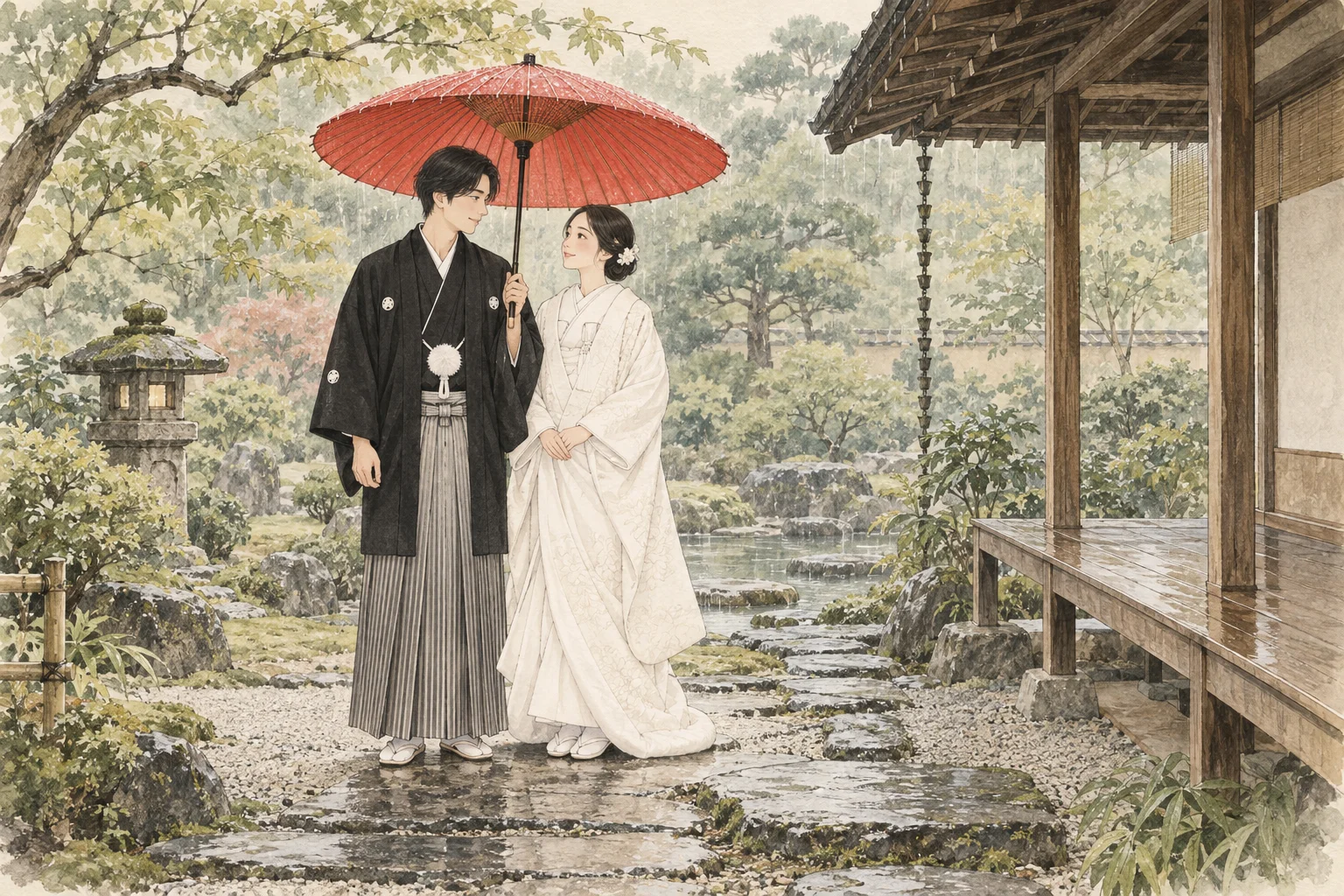
Japan sits in a temperate monsoon zone with two distinct disruption seasons that affect outdoor wedding photography. Tsuyu runs from early June to mid-July across Honshu, with the rain front pushing north from Okinawa in late May to Hokkaido by late July. Average June rainfall in Tokyo reaches 167mm; Kyoto records 214mm. Rain falls on the majority of days, often as light drizzle or short heavy bursts rather than full-day downpours.
The second disruption window is typhoon season, peaking late August through October. Japan is hit by an average of three typhoons per year that make landfall, with another 6-8 passing close enough to disrupt weather across western and southern Japan. Typhoons forecast 5-7 days out, but the exact track can shift within 48 hours of landfall, which is the window most outdoor shoots become unviable.
The remaining months carry lower but non-zero risk. April cherry-blossom shoots occasionally face cold spring rain. November and December are statistically the driest months in central Japan but bring early snow risk in Kyoto's northern hills and Hokkaido. No date is fully weather-proof, which is why the contingency framework matters more than chasing a "safe" month.
The Four Standard Contingency Tiers
Most experienced kimono studios operate from a four-tier framework. The threshold between tiers depends on rainfall intensity, wind, the specific shrine or location, and the couple's tolerance for compromised compositions. Confirm with your studio in advance which tier triggers at which forecast condition.
Tier 1: Light Rain + Umbrella Shoot
Light drizzle and intermittent rain up to about 2-3mm per hour rarely cancels a shoot. Most studios proceed with traditional wagasa (oiled-paper umbrellas) as both protection and prop. Wet stone paths, glistening shrine roofs, and saturated greenery often produce stronger photographs than dry days, particularly at temples where the moss reads more vivid. The bride's shiromuku stays dry under the wagasa; the photographer uses a rain cover on the camera body and continues normally.
Tier 2: Covered Interior (Shrine Hall, Ryokan Garden Room)
Steadier rain (5-10mm per hour) or sustained wind makes outdoor compositions difficult. Tier 2 moves the shoot into covered space: a shrine's haiden hall interior, a ryokan room with garden view through opened shoji screens, a hotel chapel or traditional washitsu room. Compositions are more limited — typically formal portraits, san-san-kudo recreation, and dressing-room moments — but the image quality remains high. Studios with established shrine relationships often have pre-arranged interior access for this scenario.
Tier 3: Reschedule Next Available Day (1-3 Day Buffer)
Heavy rain (over 10mm per hour), typhoon warnings, or shrine-imposed cancellations trigger a reschedule. This requires a buffer day in your Japan itinerary — most planners recommend 1-3 days of flexibility. Studios typically reserve a backup slot 24-72 hours after the original shoot date during high-risk seasons. Hair and makeup, kimono dressing, and shrine permits all need to shift in sync, so the buffer needs to align with all suppliers' availability, not just the photographer's.
Tier 4: Full Cancellation + Insurance Claim
When no reschedule is feasible — couples flying out the next day, typhoon shutting down all rail and road access, or a multi-day weather system — the shoot cancels entirely. This is where photography insurance (covered below) makes the difference between losing deposits and recovering a meaningful share of costs. Tier 4 is rare: most shoots fall into Tiers 1-3.
Wedding Planner's Notes: The most common mistake foreign couples make is treating Tier 2 as the default backup. A shrine hall interior shoot is a real photograph, but it is not the photograph most couples imagined when they booked Japan. If your dream image is Mt Fuji or a torii gate path, a reschedule (Tier 3) within a 2-3 day buffer almost always produces a better final album than an interior fallback. Build the buffer first; treat Tier 2 as the gracious fallback, not the plan.
Tsuyu Rainy Season Reality (June-July)
Tsuyu is statistically the wettest window of the Japanese year but rarely cancels shoots outright. Most tsuyu rain is intermittent — a 30-minute shower followed by two hours of overcast sky, then another shower. Photographers familiar with the season plan around the breaks: morning shoots before the afternoon convection cells form, indoor sequences during peak rain, outdoor exteriors during the 2-3 hour windows of overcast-but-dry conditions.
June is also the lowest-price month of the kimono wedding calendar. Studios discount 15-25% for tsuyu-window shoots; shrines have wide availability; hydrangeas peak at temples like Meigetsu-in (Kamakura) and Mimuroto-ji (Uji). Couples who accept the weather tradeoff often produce the most distinctive albums — green, saturated, atmospheric — rather than the standard sunny-day cherry-blossom set.
Autumn Typhoon Season (September-October)
Typhoons differ from tsuyu in scale: a single typhoon can shut down Tokyo or Kyoto entirely for 24-48 hours, with rail networks suspended and shrine grounds closed. The October typhoon window overlaps with autumn-foliage shoot season, so the planning question becomes binary: do you book peak koyo color with typhoon risk, or shift to November once the typhoon season has passed but the foliage may be turning brown?
Forecasting helps. The Japan Meteorological Agency (JMA) issues typhoon tracks 5-7 days out with reasonable accuracy at the 72-hour mark. Most studios make the reschedule call 48-72 hours before the shoot date, which is enough time to shift hair, makeup, kimono, and shrine permits if the buffer is built into the itinerary. The couples who get caught are those who book the shoot for the last day of their Japan trip.
Studio Rain-Day Cost Sharing (50-80%)
Standard industry practice in Japan is that the studio absorbs or shares the cost of weather-related rescheduling. Most contracts specify: if rain forces a reschedule and the couple still has trip-window availability, the studio absorbs 50-80% of incremental costs — kimono re-rental fees, hair and makeup re-booking, and the photographer's slot. The couple typically covers shrine fees that have been paid forward (which are sometimes non-refundable) and any hotel rebooking costs.
If the studio cancels (rather than the couple choosing to cancel a borderline-shootable day), full deposit refunds are standard at most premium studios. Lower-priced and discount studios sometimes shift this risk to the couple, which is a key clause to read before signing. Ask the studio directly: "If rain forces a reschedule and we have no buffer day, who absorbs the kimono and hair-makeup rebooking?" The answer reveals whether the studio operates at the professional or budget tier.
Photography Insurance Add-On (1-3% of Shoot Cost)
A small number of Tokyo and Kyoto studios offer optional weather-insurance add-ons priced at 1-3% of the shoot cost. The mechanism varies — some studios self-insure (the add-on is essentially a deposit-protection fee), others partner with travel insurance providers. Coverage typically includes full deposit refund if the shoot cancels for verified weather reasons, and partial reimbursement of incremental costs (kimono, hair, makeup) if a reschedule isn't viable.
This is most useful for couples on short trips (5-7 days in Japan) who cannot build a 2-3 day buffer. For longer trips, the buffer is cheaper than the insurance. International travel insurance occasionally covers wedding photography under "trip activity disruption," but the policies require verification — most standard policies exclude this. If you're flying from Europe or North America for a single shoot date, the small insurance premium often makes sense.
Umbrella as Photo Prop (Tier 1 Approach)
Most kimono studios maintain a stock of wagasa — oiled-paper umbrellas in red, gold, deep blue, or natural bamboo — specifically for rain-day shoots and as a styling element on dry days. The wagasa is large enough to shelter the bride's shiromuku or uchikake completely, photographs beautifully against shrine architecture, and is a culturally appropriate prop in a way Western black umbrellas are not.
Confirm before the shoot date that the studio includes wagasa in the kimono package or has them on standby for weather. Some smaller studios charge a ¥3,000-¥5,000 wagasa rental fee; established studios include it. Bring one foldable Western umbrella in your travel bag as backup — the wagasa is the photograph, but a Western umbrella is faster to deploy if you're caught between locations.
Interior Shrine Hall Shoots — What Works
Tier 2 interior shoots have a smaller compositional range than outdoor shoots, but the image quality at top-tier locations can be exceptional. Shrine haiden halls offer formal portrait setups against gold leaf or vermillion backdrops. Temple tatami rooms with shoji-filtered light produce some of the most refined formal portraits in the genre. Ryokan suites with garden views allow framing the garden through opened sliding doors — the bride and groom in dry interior, rain falling on moss outside.
The constraint is access. Not all shrines permit interior photography even for couples who have paid for ritual access. Studios with established shrine relationships often have pre-negotiated interior permits, which is one of the practical reasons to book through a directory or planner rather than independently. Confirm Tier 2 access in advance — knowing the shrine will allow interior use is the difference between a graceful reschedule call and a scramble on the morning of.
Reschedule Window — Building 1-3 Day Buffer Into Itinerary
A high-leverage planning move is building a reschedule buffer into your Japan trip. For June and October shoots, 2-3 days is the standard recommendation; for low-risk months (November, March), 1 day is usually sufficient. The buffer needs to be in your photography city — if you fly Tokyo-Kyoto-Tokyo, the buffer day needs to be in the shoot city, not in transit.
Coordinating the buffer with all suppliers takes advance planning. Hair and makeup artists, kimono rental staff, and shrine permits all need shift availability for the same backup date. Studios typically pre-arrange this — when you book, ask explicitly: "If we need to reschedule, which dates are held as backup, and who has confirmed availability?" If the answer is vague, the studio has not built the buffer; you'll be relying on luck.
Full Cancellation Process
If full cancellation becomes necessary, the process at most professional studios runs: studio calls the cancellation 24-72 hours before the shoot date, confirms with the couple by email or video call, processes deposit refund or partial refund per contract terms within 5-15 business days, files insurance claim if the couple has opted in. For weather-driven cancellations verified by JMA warnings or shrine closure notices, most studios refund 70-100% of pre-paid costs. Discretionary cancellations (couple chooses to cancel a borderline-shootable day) typically forfeit 30-50%.
Document everything in writing. Email confirmation of the cancellation decision, the weather data triggering it, and the refund amount creates the paper trail needed for travel insurance claims and credit-card chargeback protections. Photo evidence of the weather conditions on the original shoot date is occasionally requested by insurers.
Linking to Cancellation Policy Guide
Weather-driven cancellations are only one category of cancellation, and the contractual mechanics differ from couple-initiated cancellations. The standard refund timelines, contract clauses to read before signing, and dispute resolution paths for any kimono wedding photography cancellation are covered in our Cancellation and Rescheduling Policy Guide for Japan Photo Shoots. Read both before signing any deposit contract — the weather contingencies above sit inside the broader cancellation framework that guide explains.
Weather Decision Timeline (Morning-of Communication)
The reschedule decision typically follows a defined timeline. T-minus 5 days: monitor JMA forecasts; flag any developing weather systems. T-minus 72 hours: studio and photographer confer on initial call (proceed, reschedule, or hold). T-minus 48 hours: confirm with couple if reschedule is being considered. T-minus 24 hours: final call on reschedule; suppliers notified. Morning of: final go/no-go based on actual conditions, typically by 7am for morning shoots.
Most studios have a designated single point of contact for weather calls — usually the lead photographer or studio coordinator. Confirm in advance whom you'll hear from and through which channel (email, LINE, WhatsApp). International couples should explicitly request notifications via a channel they'll see at Japan time, not their home time zone.
Frequently Asked Questions
What rainfall rate cancels an outdoor kimono shoot in Japan?
There is no universal threshold. Most studios proceed under 3mm per hour with wagasa, move to interior under 10mm per hour, and reschedule above 10mm per hour or under typhoon warnings. Wind matters as much as rain — sustained winds over 30 km/h make kimono and hair difficult regardless of rainfall.
Can we shoot the day a typhoon makes landfall?
Almost never. Rail networks suspend, shrines close grounds, and JMA issues evacuation advisories that effectively shut down outdoor commercial photography. Studios call reschedule 48-72 hours before predicted landfall as standard practice.
Does travel insurance cover wedding photography weather cancellations?
Standard travel insurance rarely covers wedding photography specifically. Some policies include "tour or excursion cancellation due to weather," which photography sometimes qualifies under, but verify with the insurer in writing before relying on it. Photography-specific add-ons from the studio (1-3% of shoot cost) are more reliable.
Are interior shrine shoots cheaper if we trigger Tier 2?
No. The shoot cost is fixed at booking. Some couples expect a partial refund for the more limited interior shoot; most contracts do not provide this because the studio has already committed all resources (photographer, kimono, hair, makeup). The interior shoot is delivered at full contracted price.
How do we decide whether to book June tsuyu or wait for November?
June pricing runs 15-25% below peak season with strong hydrangea and moss-shrine compositions; November offers reliable dry weather with autumn foliage but at higher cost and tighter availability. Couples prioritizing pricing and willing to accept rain risk choose June; couples prioritizing weather reliability choose November. Both produce strong albums when planned correctly.
What happens if our flight home is the day after the original shoot?
Without a buffer day, you have no Tier 3 reschedule option. The shoot either proceeds in current conditions (Tier 1 or 2) or cancels entirely (Tier 4). This is the highest-risk itinerary structure for outdoor shoots — strongly consider buying photography insurance or shifting your flight by one day.
Does the studio decide unilaterally, or do we have input on rescheduling?
Reputable studios consult the couple before triggering Tier 3 or 4. If conditions are borderline, the studio presents options and lets the couple choose. If conditions clearly exceed Tier 1 capacity, the studio recommends the call but does not force it without consultation — unless safety or shrine access has been formally withdrawn.
Discuss Rain Plan with Your Studio
The rain backup framework above only protects you if it's confirmed in writing with your specific studio, for your specific shoot date, with your specific itinerary buffer mapped out. Generic contracts often leave the contingencies vague — the studios that take weather seriously walk you through the tier framework during the initial consultation. Browse our directory of curated kimono wedding photographers across Japan to start that conversation with studios who handle weather contingencies professionally.
For the procedural side that sits behind the rain plan, our guide on the shrine permit application process explains how permits handle reschedule scenarios. For the timeline question on the back end of any shoot, see our guide on editing turnaround time for Japan photographers to understand how a rescheduled shoot date affects final delivery.
Related guides
 Season
Autumn Foliage Kimono Photoshoot in Japan: Best Spots & Timing
Illustrative image · Unsplash. Not a photo of the specific people, places or services discussed.
Plan an autumn foliage kimono shoot in Japan: peak colour windows for Kyoto, Nikko and Kamakura, permit fees, and how far ahead to book.
Read the guide Season
Snow Wedding Photoshoot in Japan: Hokkaido, Nikko & Shirakawa-go
Illustrative image · Unsplash. Not a photo of the specific people, places or services discussed.
Plan a snow kimono shoot in Japan: most reliable snow windows in Hokkaido, Nikko, Shirakawa-go and Kanazawa, plus cold-weather logistics.
Read the guide Season
Best Time of Year for a Kimono Photoshoot in Japan: Seasons Compared
Illustrative image · Unsplash. Not a photo of the specific people, places or services discussed.
A month-by-month guide to the best seasons for a kimono wedding photoshoot in Japan, comparing cherry blossoms, summer greenery, autumn foliage, and winter snow.
Read the guide