American Couple Kimono Photoshoot Japan: East vs West Coast
American couple kimono photoshoot Japan: East vs West Coast patterns, flight times, spend tiers, top locations, and studio communication norms.

Illustrative image · Unsplash. Not a photo of the specific people, places or services discussed.
Check current prices, availability and venue rules with the relevant studio or venue before booking.
American couples make up roughly 2,000 to 3,500 of Japan's annual international kimono bookings — making the United States the single largest source market by volume. But "American couples" is not a useful planning category on its own. East Coast and West Coast couples book different flight routes, pair Japan with different honeymoon destinations, choose different studios, and arrive with markedly different cultural baselines. This guide breaks down the patterns we see across regional cohorts, spend tiers, and studio-fit decisions.
The East Coast vs West Coast Split
Studios that handle American clients regularly notice the regional split within three or four exchanges. East Coast couples often arrive having already booked London or Paris segments; West Coast couples are more likely treating Japan as a standalone destination or pairing it with Hawaii on the return leg. These are not stereotypes — they reflect real differences in flight economics, vacation length, and what "international travel" means by default in each region.
East Coast (NYC, Boston, DC) — Europe-Multi-City Pattern
NYC, Boston, and DC couples frequently treat the kimono shoot as one stop in a multi-country honeymoon. The default pattern is Japan + a European leg — Paris, London, Italy, or sometimes the Balkans for couples wanting something less expected. Flights from JFK or EWR to Tokyo (Haneda or Narita) run 13 to 14 hours direct, and East Coast couples who already plan 10-day European honeymoons are comfortable extending to two or three weeks total. The kimono shoot itself is typically a 2-3 day allocation in a longer 16-20 day trip. This means scheduling is tight — studios get less flexibility on date moves because European hotel and rail bookings are already locked.
Wedding Planner's Notes: East Coast couples ask the most detailed questions about delivery timelines because they need final files before printing wedding albums or thank-you cards back home. If you're coming from this cohort, lock RAW or final JPEG delivery dates contractually — not "approximately six weeks." Specific calendar dates only.
West Coast (LA, SF, Seattle) — Hawaii or Japan-Only Pattern
LA, SF, and Seattle couples fly direct to Tokyo in 10.5 to 11.5 hours — closer to Sydney's travel time than to New York's. This shorter flight, combined with Hawaii as a natural geographic neighbor, produces two distinct West Coast patterns. The first is Japan-only: a 10-14 day itinerary covering Tokyo, Kyoto, and often a third location like Kanazawa or Hakone, with the kimono shoot embedded in the Kyoto leg. The second is Japan + Hawaii: couples fly Tokyo to Honolulu on the return, adding 5-7 beach days at the end. Both patterns mean West Coast couples typically allocate more total days to Japan itself than East Coast equivalents — 8 to 11 days rather than 4 to 6 — and have more scheduling flexibility for studio reschedules within Japan.
Spend tier on the West Coast skews higher on average for studio fees because tech-industry couples (Bay Area especially) sit at the top of the American spend distribution. LA couples are split between entertainment-industry premium and broader mid-tier bookings.
Direct Flight Options & Times (11-13 hours)
American couples have more direct flight options to Tokyo than any other international cohort. Standard routes:
Origin | Destination | Direct flight time | Carriers |
|---|---|---|---|
JFK / EWR (NYC) | HND / NRT (Tokyo) | 13.5 hours | ANA, JAL, United, American |
BOS (Boston) | NRT | 13 hours | JAL, Japan Airlines codeshare |
IAD / DCA (DC) | HND / NRT | 13.5 hours | ANA, United |
ORD (Chicago) | HND / NRT | 12.5 hours | ANA, JAL, United, American |
LAX (LA) | HND / NRT | 11.5 hours | ANA, JAL, Delta, American |
SFO (SF) | HND / NRT | 11 hours | ANA, JAL, United |
SEA (Seattle) | HND / NRT | 10.5 hours | ANA, Delta |
Haneda (HND) is meaningfully more convenient than Narita (NRT) for couples staying in central Tokyo — the airport is 30-40 minutes from Shibuya versus 60-90 minutes from Narita. If you have a choice of flight, pay the small premium for Haneda arrival. For Kyoto-first itineraries, consider flying into KIX (Kansai International) directly if your origin offers it — currently LAX, SFO, and ORD have direct Kansai service.
Visa-Free 90 Days
US passport holders enter Japan visa-free for up to 90 days as tourists. No paperwork required in advance beyond a passport valid for the duration of stay (Japan does not require six-month validity beyond return date for US citizens, though airlines occasionally do — check your carrier). At immigration you'll receive a 90-day landing permission stamp automatically.
For couples wondering whether a professional kimono photo shoot counts as "tourism" or "work" — it falls under tourism. You're the subject, not the worker. The photographer is the working party, not you. No commercial visa is required. The only edge case is if you're being paid by a US brand to promote the shoot on social media as paid content — that would technically require a different status, though enforcement is essentially nonexistent for casual influencer use.
See our visa requirements guide for the full breakdown across passport nationalities.
Cultural Awareness Variance
American couples arrive in Japan with the widest cultural-awareness range of any source market. Studios regularly handle clients who have read four books on Japanese tea ceremony and clients who have never removed their shoes indoors before. Both are normal. Neither is a problem — but both require different preparation from the studio.
The high-awareness end (often academics, anime/manga adult fans who've studied formally, second-generation Japanese-American couples) typically arrives ready for the shoot with terminology questions: shiromuku versus iro-uchikake, tsunokakushi versus wataboshi, which obi-musubi suits a petite frame. These couples are easy to brief because they ask precise questions and act on precise answers.
The lower-awareness end (often suburban couples who chose Japan because it photographed well on Pinterest) needs broader onboarding. Studios that work with US clients regularly send pre-shoot videos covering: shoe removal on tatami, walking pace in kimono (short steps, no large strides), how to sit in seiza or modified positions, how to handle the trailing fabric of an uchikake. None of this is hard — but it's the difference between a smooth 3-hour shoot and a stressed 4-hour shoot.
Wedding Planner's Notes: If you're booking a studio that explicitly markets to American clients, ask whether they send a pre-shoot orientation video or document. This is the single best filter for studio-fit when you're uncertain about your own preparedness level. Studios accustomed to US bookings will already have this material.
Pre-Shoot Studio Communication (Over-Explanation Helpful)
American couples often expect higher communication volume during booking than Japanese studios traditionally provide. The gap is real and worth understanding before you book.
A Japanese studio's default communication cadence is: booking confirmation, payment confirmation, two-week-before logistics email, day-before reminder. Four touchpoints. A US-default expectation tends to be closer to weekly updates from booking forward, sometimes more. Neither cadence is wrong — they're just different cultural norms about appropriate professional contact.
Studios that handle American couples well have adjusted by adding: a 30-day-before check-in, a 14-day weather and outfit confirmation, a 7-day timeline walkthrough, and a 24-hour pre-shoot summary. If you're booking and the studio's stated cadence is light, you can explicitly request additional touchpoints — most will accommodate. Don't assume silence means problems. It usually means the studio considers everything on track.
Top Locations Among American Couples
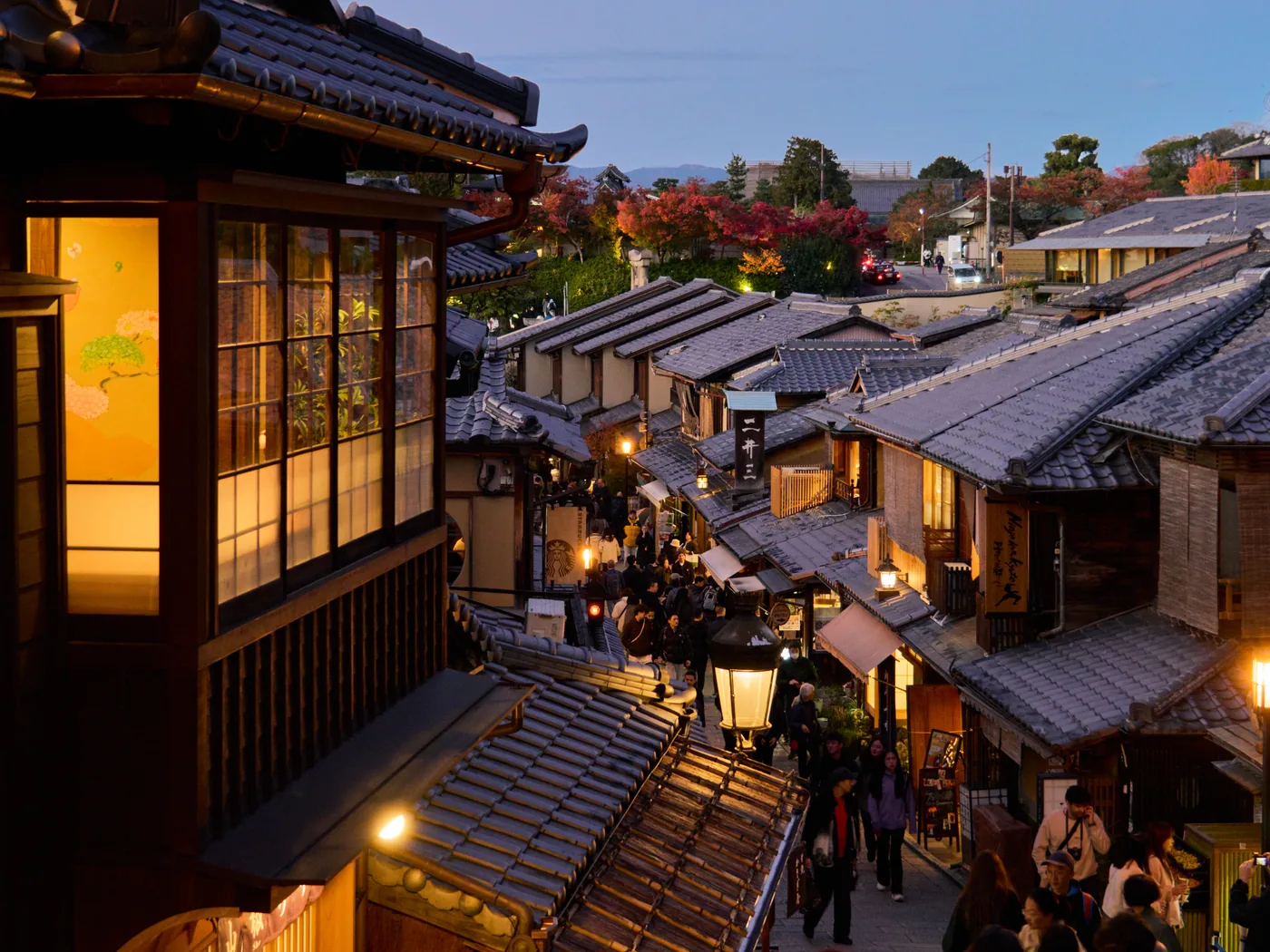

American booking data clusters around three location archetypes: Kyoto's temple circuit, Tokyo's modern-plus-Asakusa contrast, and Mt Fuji as backdrop. Other locations (Kanazawa, Kamakura, Nara) appear in itineraries but rarely as primary shoot locations for first-time US visitors.
Kyoto Temple Circuit
Kyoto is the modal American kimono shoot location — roughly 55-60% of US bookings center on Kyoto. The standard shoot covers a 2-3 hour outdoor circuit through Higashiyama (Yasaka Pagoda, Ninenzaka, Sannenzaka) or a single-temple deep session at Kodaiji, Shoren-in, or one of the less-trafficked sites. Pure photo permits at Kinkaku-ji and Kiyomizu-dera are restricted — read our shrine etiquette guide for current realities. See top Kyoto studios for 2026 for shortlisted options.
Tokyo Modern + Asakusa Traditional
Tokyo bookings split between Asakusa (Senso-ji backdrop, kimono-friendly streets) and modern Tokyo (Meiji Jingu shrine in Shibuya/Harajuku for traditional, then optional Shinjuku skyline shots for editorial contrast). Asakusa is the easier entry point for first-time visitors — denser walking circuit, easier photographer logistics, and stronger backdrop variety in a small radius. See Asakusa kimono shoot guide for the full breakdown.
Mt Fuji Backdrop (Bucket-List Photo)
American couples request Mt Fuji backdrop shots more than any other cohort — roughly 18-22% of US Tokyo bookings add a Fuji day. The standard option is Lake Kawaguchiko (2-3 hours from Tokyo by train + shuttle) with the Chureito Pagoda or lakefront as foreground. Fuji is reliably visible only on clear days; statistically, October-February has the highest visibility rate. See Mt Fuji kimono guide for shooting windows and backup plans.
Spend Distribution (Extremely Wide Range)
American spend on kimono photo packages varies more than any other source market. The realistic 2026 range:
Tier | Typical spend (USD) | Typical inclusions |
|---|---|---|
Entry | $800-$1,500 | 2-hour shoot, 1 kimono rental, 20-40 edited JPEGs |
Mid | $1,500-$3,500 | 3-4 hour shoot, 2 kimono changes, hair/makeup, 60-150 edited JPEGs |
Premium | $3,500-$7,000 | Full-day shoot, antique uchikake, multiple locations, 200+ files, album option |
Luxury | $7,000-$15,000+ | Multi-day, private shrine arrangements, second photographer, video, full album |
Tech-industry couples from the Bay Area and Seattle cluster in the premium and luxury tiers. Couples from the broader US average sit firmly in mid-tier. For the full 2026 cost breakdown across nationalities, see 2026 kimono photoshoot cost guide.
Wedding Planner's Notes: The single most common American booking mistake is overpaying at the entry tier and underpaying at the premium tier. At entry, couples buy from package aggregators that markup 30-50% on local studio rates — book direct when possible. At premium, couples underestimate antique kimono rental costs (¥80,000-¥250,000 for an authentic antique uchikake versus ¥30,000-¥60,000 for studio-grade) and end up with mid-tier garments at premium prices.
Cancellation Policy Awareness
American couples occasionally arrive expecting US-style 24-48 hour cancellation flexibility. Japanese studios typically operate on 30-day, 14-day, and 7-day cancellation tiers with escalating penalties — often 30%, 50%, and 100% respectively. This is not predatory; it reflects the labor and scheduling reality of holding a shoot slot that cannot be re-sold on short notice.
Before booking, confirm: cancellation tier percentages, force majeure language (typhoon, illness, family emergency), partial-refund options for partial-completion (e.g., shoot starts but rain forces early termination), and reschedule fees if available. See our cancellation and rescheduling guide for the full framework, including the standard language to request before signing.
Insurance Considerations
Travel insurance for the trip is standard — US-issued policies through carriers like Allianz, Travel Guard, or credit-card-included coverage typically handle medical, trip interruption, and lost-baggage scenarios well enough. What's less obvious is photographer-side insurance: whether the studio carries liability coverage for kimono damage, location-permit incidents, or equipment failure that causes delivery delay.
Premium and luxury-tier studios will produce a liability certificate on request. Mid-tier studios usually carry minimum coverage. Entry-tier studios occasionally carry none. The risk is not enormous — kimono damage during a shoot is genuinely rare — but if you're carrying a $4,000-plus uchikake rental, confirm the studio's coverage scope. See photographer contracts and insurance guide for the standard certificate language to request.
Frequently Asked Questions
Can we get married legally in Japan during the trip?
Yes, but the legal process is separate from the photo shoot. Foreign couples can register marriage at a city office (kuyakusho) with apostilled documents from the US. The process takes 1-2 days and produces a Japanese marriage certificate that can be translated for US recognition. Most US couples instead handle legal marriage at home and treat the Japan trip as ceremonial. See getting married in Japan for foreigners.
How does jet lag affect a Day 1 or Day 2 shoot?
Significantly. East Coast couples flying west cross 14 time zones and typically need 3-4 days to reset for clean morning energy. West Coast couples cross 16-17 zones (eastward) and often hit a hard wall on day 3. Schedule the shoot for day 4 or 5 of the trip if possible. Avoid day 1-2 absolutely — your photos will reflect the fatigue.
Do we need to arrange our own hair and makeup separately?
No. Most kimono studios include or bundle Japanese-style hair and makeup (typically called kitsuke for kimono dressing plus hair and makeup as separate line items). Confirm at booking whether Western-style makeup is available — some studios offer both options. Foreign brides occasionally prefer hybrid styling. See hair and makeup for shiromuku.
Should we tip the photographer or kimono dresser?
No. Japanese service culture treats tipping as awkward at best and offensive at worst. Service charges are built into pricing. A thank-you card or small gift from your home country (chocolate, tea) is appropriate and appreciated. See tipping etiquette in Japan.
What if we have tattoos visible in the kimono?
Most shrines and temples have softened tattoo policies in recent years but enforcement varies. Major Kyoto temples (Kodaiji, Shoren-in) and Tokyo shrines (Meiji Jingu) generally do not check, but it remains officially restricted in some venues. Studios will know the current policy at their preferred locations. See tattoo policy at shrine photoshoots.
Can our American parents or family join the shoot?
Yes — bringing parents to a kimono shoot is increasingly common. Family kimono rentals add ¥30,000-¥80,000 per person, and most studios will photograph a family group either at the start or end of the session. Plan for an extra 60-90 minutes total session time. See bringing parents to a Japan kimono shoot.
How far in advance should we book the shoot from the US?
For cherry blossom or autumn foliage peak weeks, 12-14 months ahead. For shoulder seasons (May, late September, November), 6-9 months ahead. Standard weeks, 3-5 months. For luxury-tier studios with limited slots, add 3-4 months to any of these figures. See how to book from abroad.
Is it worth pairing the shoot with a separate Japan-based ceremony?
For most American couples, no. A standalone kimono photo shoot delivers the visual memory without the logistical cost of a full ceremony abroad (officiant, venue, guest travel coordination, legal documentation). Couples wanting a ceremonial element can add a small Shinto blessing at certain shrines — see Shinto wedding ceremony guide for what's involved.
Find an American-Couple-Experienced Studio
The American booking volume is high enough that most established kimono studios in Tokyo and Kyoto handle US clients regularly. The differentiator is not whether they accept American couples — it's whether they've built workflow around US expectations: pre-shoot orientation materials, weekly communication cadence, clear delivery timelines, and adjusted cancellation language. Browse our curated photographer directory filtered for studios with documented US client history.
If you're still narrowing down nationality-by-nationality patterns, our companion guides for Australian couples and British couples in this Phase 8 series cover the comparative patterns side-by-side.
Locations in this guide
Related guides
General guideKimono Wedding Photos for Foreigners: How It Works in Japan
Illustrative image · Unsplash. Not a photo of the specific people, places or services discussed.
Yes, foreign couples can have kimono wedding photos taken in Japan — no residency, ceremony or Japanese required. How booking, fittings, pricing and permits actually work.
Read the guide General guide
How to Book a Kimono Photographer in Japan from Abroad: Step-by-Step
Illustrative image · Unsplash. Not a photo of the specific people, places or services discussed.
A complete step-by-step guide for foreign couples booking a kimono pre-wedding photographer in Japan from overseas. Contracts, payments, communication.
Read the guide General guide
Multilingual Wedding Photography Japan: Beyond English
Illustrative image · Unsplash. Not a photo of the specific people, places or services discussed.
A planner's audit of which languages — Korean, Mandarin, Spanish, French, JSL — Japanese kimono studios actually support, plus interpreter costs and when to hire one.
Read the guide