Tattoos at Japanese Shrines: Honest 2026 Photoshoot Guide
A planner's honest 2026 guide to tattoos at Japanese shrine photoshoots — which precincts are relaxed, four cover-up methods that work under a kimono, and when to stop hiding.

Illustrative image · Unsplash. Not a photo of the specific people, places or services discussed.
Check current prices, availability and venue rules with the relevant studio or venue before booking.
If you have visible tattoos and you are planning a kimono shoot in Japan, this is almost always the first question you raise with the planner — and rightly so. The honest, current answer in 2026 is that the rules vary site by site, mood by mood, and a well-prepared couple has very little to worry about. This guide walks through how Japan actually views tattoos today, how each major shrine handles them, the cover-up strategies that work under a kimono, and the small but growing trend toward showing ink with confidence.
How Japan Views Tattoos — Cultural Context
Tattoos in Japan carry a complicated history. For most of the twentieth century they were strongly associated with organized crime, and that association produced the blanket "no tattoos" signs you still see at public baths, gyms, and some hotel pools. The picture has shifted markedly over the past decade. Younger Japanese now get small tattoos themselves, foreign visitors with visible body art have become routine, and the rise of inbound tourism has forced many businesses to draw a clearer line between "we welcome everyone" and "we are still cautious about appearances."
Shrines sit on the religious side of this conversation, not the public-order side. The concern at a shrine is purity (kiyome) of the precinct rather than a guess about your character. In practice, that means most shrines do not actively police tattoos at the entrance — they ask only that you behave respectfully. For a deeper look at shrine conduct, read our shrine etiquette guide for couples; the rules around bowing, hand-washing, and noise are the same whether or not you have ink.
It is worth separating three different settings. A shrine precinct (outdoor approach, torii gate, main hall exterior) is governed by general respectful conduct. An onsen or public bath is governed by the proprietor's house rules and is more restrictive. A professional photoshoot within a public shrine is a third category — the photographer may need a permit, and that permit conversation almost never references tattoos.
Shrine-by-Shrine Reality
Policies are not uniform. Below is a frank, planner-side summary of how the most photographed shrines treat visible tattoos in 2026. Where a shrine has not published a formal policy, we describe what we have seen in practice across hundreds of bookings — not an official position.
Shrine | Tattoo posture | Practical note |
|---|---|---|
Meiji Jingu (Tokyo) | Notably welcoming in practice | The precinct draws an enormous international crowd and we have not encountered tattoo-related issues at the outer approaches. No published policy either way; respectful dress is the only expectation we observe. |
Fushimi Inari (Kyoto) | Quiet acceptance | No published policy; in practice the torii path is busy and visitors with ink pass without comment. |
Yasaka Jinja (Kyoto) | Generally relaxed | Outdoor approaches are fine. Avoid disrobing or rearranging clothing inside the precinct. |
Tsurugaoka Hachimangu (Kamakura) | Case by case | Larger tattoos visible across the chest or back can attract attention; cover for ceremony-style shoots. |
Itsukushima (Miyajima) | Tourist-friendly | Outdoor torii area: no issue. The shrine interior itself is more conservative. |
Kasuga Taisha (Nara) | Generally relaxed | Forest paths and stone-lantern routes are unrestricted. Cover at the inner gate. |
Smaller local shrines | Highly variable | A single priest sets the tone. Your photographer should phone ahead if you are bringing a permit. |
Wedding Planner's Notes: The pattern you can rely on across the country is that the further you move from foot-traffic and into the inner sanctuary, the more conservative the expectation becomes. The outer torii and approach paths — which is where 90% of your photographs will be taken anyway — are almost never a problem. The concern fades the moment you understand that you are photographing the approach, not the altar.
Cover-Up Strategies
For couples who would rather not have the question come up at all — or who are photographing at a more conservative venue — there are four tested ways to manage visible tattoos under a kimono. Your studio will know each of these; your job is to flag the location and size of your tattoos in advance.
Long-Sleeve Juban (Under-Layer)
The juban is the white under-kimono worn beneath the outer robe. Standard juban sleeves end at the wrist (sode length around 49 cm on a women's size), but specialty studios stock long-sleeve juban — sometimes called nagajuban with extended sode — that reach roughly 55 to 58 cm, covering the wrist to the base of the hand. For arm tattoos this is the most elegant solution because nothing is taped to your skin and the silhouette stays clean. It also handles back-of-hand or forearm tattoos that would otherwise peek out when you adjust your hair.
If your studio does not stock long-sleeve juban, ask whether they can hem a longer sleeve onto a standard one. A reputable studio will not charge for this; it takes a tailor about an hour. Discuss it on the booking form, not on the morning of the shoot.
Cover-Up Makeup
Theatrical-grade cover-up makeup — the kind dancers and competitive swimmers use — blends tattoos into the surrounding skin within five to ten minutes. The product names you will hear most often from Japanese cover-up artists are Dermablend, Kryolan Dermacolor, and Mehron Tattoo Cover; all are silicone-based, sweat-resistant, and rated for several hours of wear. This is the right choice for tattoos on the neck, behind the ear, on the chest above the kimono collar, or on the foot near the tabi line.
Two cautions. First, the makeup transfers to white silk if you brush against the collar in the first ten minutes after application — sit still while it sets. Second, dark tattoos take two thin layers, not one thick one; budget the time. A hair-and-makeup artist used to shiromuku styling will understand the timing.
Skin-Tone Cohesive Bandage
Skin-tone cohesive bandages — flesh-coloured self-adhering athletic wrap, sold in Japanese pharmacies and pro-sports shops in shades close to East Asian and a couple of Caucasian skin tones — are a quick fix for medium-sized tattoos on the wrist, ankle, or back of the neck. They photograph as a neutral band, which is acceptable in candid frames but obvious in close portraits.
The use case is limited but real. Cohesive bandage is best when (1) you are at a more conservative venue, (2) the tattoo is small, and (3) you only need cover for a fifteen-minute interval — for instance during a brief shrine entry — after which you can remove it. It is not a substitute for proper cover-up makeup on a full-day shoot, and the colour match is rarely close for darker or paler skin tones.
Skin-Tone Sleeves
For full-sleeve tattoos that run from shoulder to wrist, the most discreet option is a pair of thin flesh-tone compression sleeves worn under the juban. Cycling and golf brands make these in several shade ranges; you bring your own pair matched to your skin tone. They are nearly invisible under the kimono and solve the full-sleeve problem in a single step.
The trade-off is heat. In summer photoshoots, layered compression under a silk kimono is uncomfortable. If you are planning a July or August shoot with full sleeves to cover, weigh whether an indoor studio session might be the kinder choice on the day.
Studio vs Outdoor — Studio Is Always Open
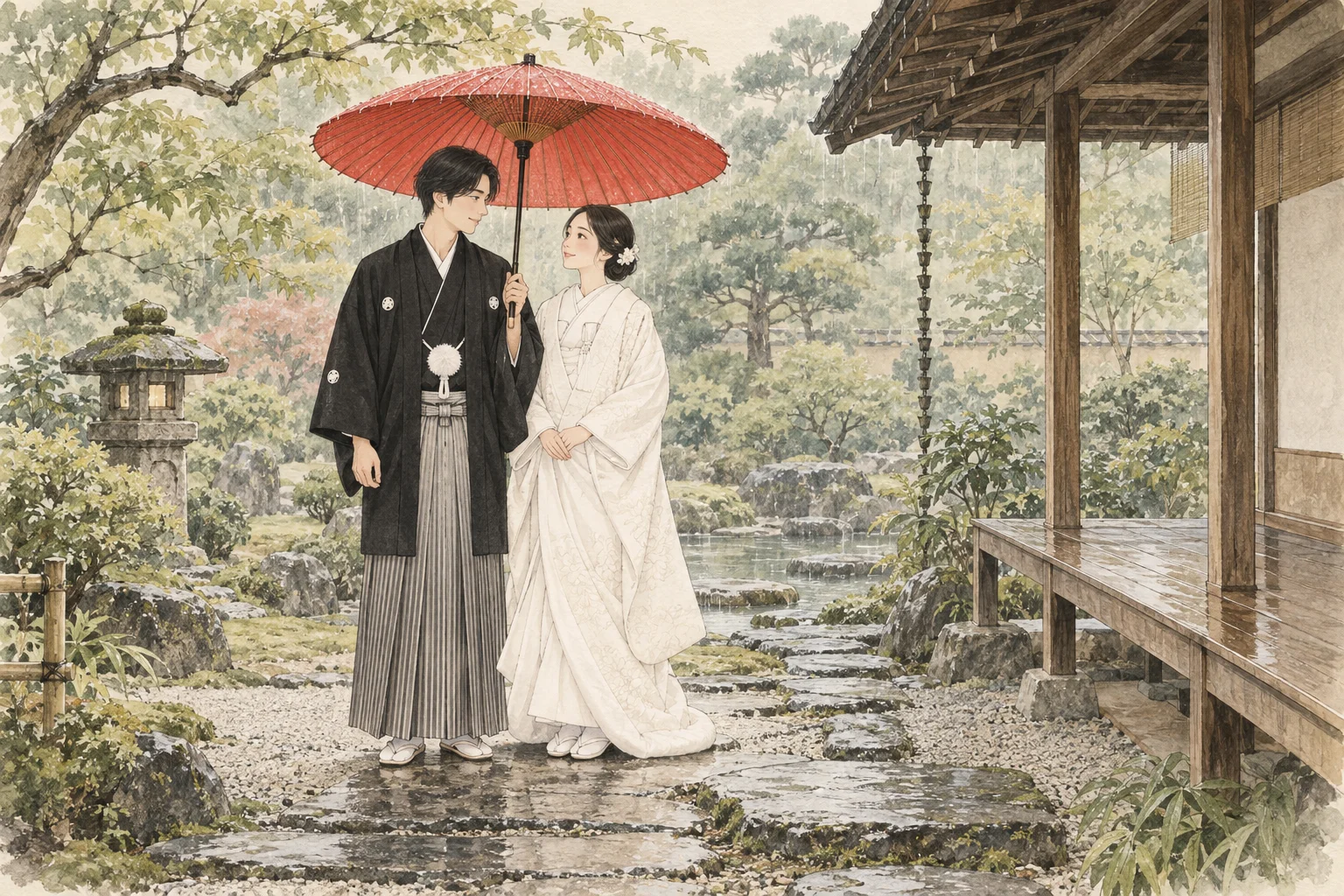
The cleanest answer for couples with extensive body art — or simply no desire to think about it — is to book a studio session. Indoor studios, whether the heritage machiya studios in Kyoto or the modern glass-floor studios in Tokyo, have no tattoo policy. The proprietor is your photographer, not a priest. You can show what you want, hide what you want, and the lighting is fully controlled.
If you are torn between settings, our companion piece on studio versus outdoor kimono photoshoots walks through the practical differences. For tattooed couples in particular, the studio route gives you the option of an "ink-on" portrait — a deliberately styled shot where the tattoo is part of the composition — which would be socially awkward at a shrine and unrepeatable in a hotel garden.
Many couples split the day: studio in the morning for the formal kimono portraits with full cover, then an outdoor walking shoot in a less restrictive setting (a park, a riverbank, a private garden) for relaxed frames where cover is optional.
Onsen Considerations
Onsen rules are stricter than shrine rules and have not loosened at the same pace. Public bathhouses still post "no tattoos" signs widely, and ryokan with shared baths may ask you to use a private bath instead. For a wedding trip this matters when (a) you have booked a ryokan stay built around the kimono shoot, or (b) you want a steaming-onsen frame in your gallery.
The workable plan is to book a ryokan with kashikiri (private bath) reservations or in-room rotenburo (open-air bath) options. These are common in higher-end ryokan precisely because they side-step the policy question. For the photograph itself, your photographer will typically shoot the onsen as an environmental frame — you in a yukata on the engawa veranda outside the bath — which avoids the rule entirely. Read our note on yukata couple sessions for the styling logic.
When NOT to Hide — Trend Toward Acceptance
There is a quietly growing editorial preference, especially among photographers under forty, for letting tattoos appear in the frame rather than camouflaging them. The reasoning is straightforward: the tattoo is part of who you are, the kimono is a costume you have chosen, and a thoughtful photographer can compose the two together with more honesty than a heavily covered version.
This works best in three contexts. First, in studio sessions, where there is no third-party concern. Second, in outdoor city or garden settings away from religious sites — Yokohama's Sankeien, a Kyoto private machiya, an Asakusa back-alley, a Hokkaido lakeside. Third, in candid walking shots at neutral venues where the tattoo is incidental rather than central.
The reframe we offer many couples is this: covering a tattoo for a shrine bow is courtesy to a host, not a verdict on your body. Once you step away from the shrine precinct, there is no reason to keep the cover-up in place. Some of the strongest galleries we see have a deliberate arc — shrine frames with discreet cover, then a costume change into a more relaxed kimono or yukata for outdoor frames where the ink reads beautifully against the textile.
Pre-Trip Conversation with the Photographer
The single best thing you can do is brief your photographer specifically and early. A useful message includes: a clear description of where each tattoo sits (forearm, calf, ribs, neck, hand), rough size, and your preference for the day. "I would like to cover for shrine frames and reveal for studio frames" is a sentence every booking team can plan around. "I'm not sure, what do you recommend?" is also fine — but say it before the deposit, not the morning of.
If you are booking from overseas, our overseas booking guide covers the email cadence. Add a tattoo paragraph to your first inquiry email. Studios that respond with concrete proposals — "we stock long-sleeve juban in 56 cm sode", "we recommend our partner makeup artist for cover-up" — are the studios that have done this many times. Studios that go quiet or reply vaguely are signaling that you should look elsewhere.
A few specifics worth confirming in writing:
- Whether the studio stocks long-sleeve juban in your size.
- Whether the venue permit they have arranged carries any tattoo restriction (almost never, but worth a line in the contract).
- Whether the hair and makeup team includes cover-up makeup as standard or as an add-on.
- Whether there is a private changing space at the outdoor location, in case you need to top up cover-up mid-shoot.
- What happens to gallery selection — does the studio quietly remove frames where tattoos peek out, or share everything so you choose?
This same documentation discipline serves you well in adjacent situations. Couples reading our guides on a same-sex kimono wedding shoot or a kimono shoot during pregnancy face slightly different conversations but with the same underlying pattern: a frank brief at booking saves a difficult conversation on the day.
Frequently Asked Questions
Will I be turned away from Meiji Jingu for visible tattoos?
Not in our experience. Meiji Jingu does not publish a formal tattoo policy either way, but the precinct draws an enormous international crowd and we have not encountered tattoo-related issues at the outer approaches. Respectful dress and quiet conduct are the only expectations we have observed. The same general posture applies at Yasaka Jinja in Kyoto and at the Itsukushima outdoor torii on Miyajima.
What about Fushimi Inari and Kiyomizu-dera?
Neither publishes a formal tattoo policy. In practice both are tourist-heavy and visitors with visible ink pass without comment. The senbon torii path at Fushimi Inari is a public thoroughfare in everything but name.
Are smaller, less famous shrines stricter?
They can be. A single resident priest sets the tone and may be more conservative than a famous tourist shrine. If you are photographing at a small local shrine, your photographer should phone ahead. This is one reason curated directory studios — who maintain working relationships with their venues — are easier to work with than freelance bookings.
Do the same restrictions apply at non-religious photo locations?
No. Parks, gardens, riverbanks, machiya streets, and most public photography permits carry no tattoo concern. The restriction discussion applies almost exclusively to religious precincts and onsen.
Will the cover-up process disrupt my hair and makeup timing?
Not if you flag it at booking. The cover-up artist works in parallel with hair styling — your face is being done while your arms are being treated. The total prep window extends by perhaps fifteen to twenty minutes, which a senior studio will simply build into the call time.
Can I show my tattoos for some shots and hide them for others?
Yes, and this is the most common plan we recommend. Cover for shrine frames using long-sleeve juban or makeup, then change into a less formal kimono or yukata for outdoor or studio frames where the ink is welcome in the composition. Build the costume change into the schedule from the start.
What about Japanese-style irezumi tattoos?
The same rules apply. The shrine concern is visible ink generally, not the style or origin of the tattoo. A traditional irezumi sleeve covered under a long juban photographs the same as a small Western piece covered under makeup. We do find that older priests at small countryside shrines can be more sensitive to irezumi specifically — another reason to have the photographer phone ahead at smaller venues.
Is there any venue where tattoos are explicitly required to be covered for permit purposes?
Not in our experience with the shrines and gardens our directory studios work in. Permits typically govern equipment, footprint, and timing — not the appearance of the subjects. If a venue did add such a clause, your photographer should flag it before you sign the contract.
Book a Tattoo-Friendly Photographer
Every studio in our directory has been briefed on the tattoo question and stocks at least one cover-up option, whether that is long-sleeve juban, in-house makeup, or a tested makeup partner. Browse the curated photographer directory and mention your tattoos in the first inquiry email — the studios that respond with specifics are the ones who have planned this shoot many times before.
For related planning reading, see our shrine etiquette guide, the studio versus outdoor comparison, and our notes on the full kimono shoot day timeline. For couples planning around other personal circumstances, the companion pieces on a same-sex kimono wedding photoshoot and a pregnant bride kimono photoshoot share the same direct, planner-led approach.
Locations in this guide
Related guides
 General guide
Shrine Etiquette in Japan: A Step-by-Step Kimono Guide
Illustrative image · Unsplash. Not a photo of the specific people, places or services discussed.
The purification steps as Japan's shrine authority describes them, what to do when there is no ladle, and the photo rules for a paid kimono shoot.
Read the guide General guide
Shrine Permit Application Process: Japan Wedding Photo Guide
Illustrative image · Unsplash. Not a photo of the specific people, places or services discussed.
Shrine permit application process for Japan wedding photography: studio-handled timelines, Meiji Jingu and Kyoto fees, equipment restrictions, and lead times.
Read the guide Location deep dive
Meiji Jingu Wedding Photography: Permit Rules Guide
Illustrative image · Unsplash. Not a photo of the specific people, places or services discussed.
Meiji Jingu wedding photography permit guide. Permit fees, available plans, what foreign couples can shoot, and how to book the inner sanctuary.
Read the guide