Japanese Proposal Guide: Yuino, Aisatsu & Engagement Rings
How a Japanese proposal actually works — the quiet ring reveal, yuino engagement gifts, the family aisatsu visit, and what foreign partners get wrong.

Illustrative image · Unsplash. Not a photo of the specific people, places or services discussed.
Check current prices, availability and venue rules with the relevant studio or venue before booking.
A Japanese proposal is rarely the public spectacle Western films suggest. It is a quiet ring reveal at the end of a months-long alignment between the couple — and a careful prelude to a structured family introduction that still acknowledges parents, lineage, and formality.
The Modern Japanese Proposal — Surprise vs Mutual Decision
In Japan, the proposal — called puropozu (プロポーズ) — almost universally involves a ring. But the cultural framing is more restrained than in the United States or the United Kingdom. The most common setting is a private dinner at a restaurant, a hotel night, or a quiet moment at home. Flash-mob proposals, jumbotron proposals, and public-square spectacles exist but are statistical outliers, often viewed with mild embarrassment rather than admiration.
A second cultural nuance: many Japanese proposals are not surprises in the strict sense. Couples discuss marriage seriously for months before the proposal, and agree in principle on timing, living situation, and parental introduction. The proposal itself is the formal, romantic ratification of that decision, built around a ring reveal. Couples sometimes describe this as jijitsukon-style alignment (couples already living as partners) culminating in a deliberate puropozu moment.
This matters for international couples: if you are the foreign partner, a true cold-surprise proposal in Japan without any prior conversation can feel premature to a Japanese partner, especially if family introduction has not yet occurred. The expected sequence is: serious conversation about marriage, ring purchase, proposal, family aisatsu (introduction), and yuino or yuinokin.
There Is No Legal Engagement in Japan
One detail that surprises international couples: Japan has no konyaku-todoke or legal engagement registration. There is only the marriage registration form (konin-todoke 婚姻届) submitted at the municipal ward office. Engagement in Japan exists as a social and familial status — recognized by both families, marked by yuino or kao-awase, evidenced by the ring — but not as a legal one.
The practical consequence: there is no waiting period, no published banns, and no government acknowledgment of your engaged status. Visa officers, employers, and landlords do not recognize "engaged" as a category. If the engagement breaks down, there is no formal process to dissolve it. This is why the aisatsu visit and yuino exchange carry the social weight that paperwork carries elsewhere — they are the binding acts.
Engagement Rings (Konyaku Yubiwa) — Customs and Common Brands
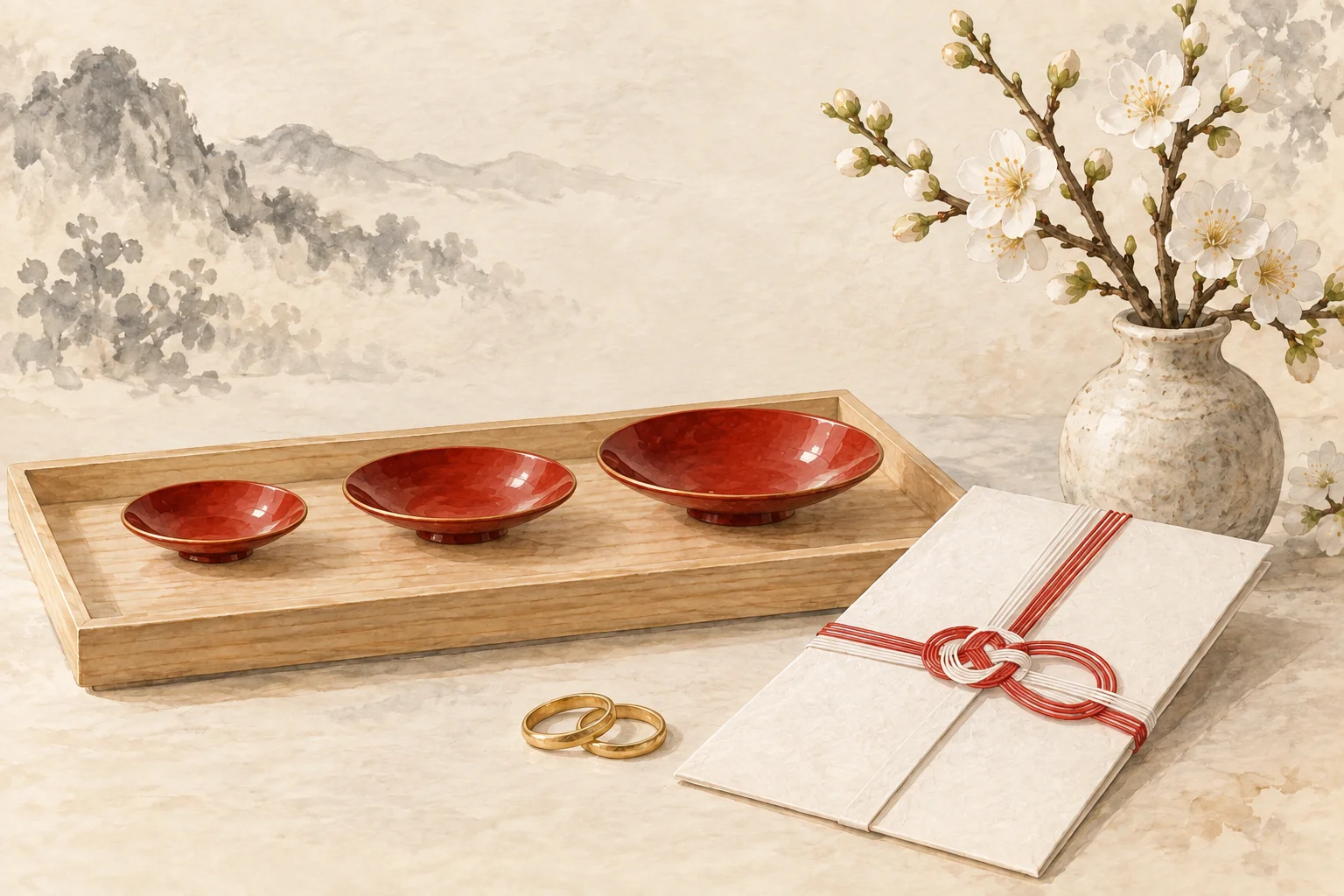
The engagement ring is called konyaku yubiwa (婚約指輪) and is a relatively modern import — it became mainstream in Japan only in the postwar era, accelerated from the late 1960s onward by De Beers's Japan-specific "diamond is forever" campaign. Today a diamond solitaire is by far the most common style, though pavé and three-stone designs are also popular.
Japan has a well-developed domestic bridal jewelry market. Brands you will encounter repeatedly when researching include Mikimoto, Tasaki, Niwaka (known for nature-inspired Kyoto designs), I-Primo (Japan's largest bridal-specialist chain), Ginza Diamond Shiraishi, and Ponte Vecchio. International brands — Tiffany & Co., Cartier, Bvlgari, Harry Winston — are also widely available and carry strong status signaling in Japan.
There is no rigid spend rule. The older "three months' salary" guideline is obsolete; the contemporary median konyaku yubiwa price sits around ¥300,000–¥500,000, with significant variation. Couples increasingly purchase the engagement ring and the two wedding bands (kekkon yubiwa) as a coordinated set ring from the same brand.
Wedding Planner's Notes: If you plan to propose in Japan but live abroad, give yourself at least four to six weeks of lead time. Japanese bridal jewelers require sizing appointments and may not stock the exact ring you want — many designs are made to order, and engraving (kokuin) adds another one to two weeks. Hotel concierge teams at major properties (Imperial, Okura, Peninsula) can coordinate after-hours appointments at flagship boutiques in Ginza and Omotesando, which is the discreet way to handle a surprise ring purchase while your partner is in the same city.
Yuino (結納) — The Formal Engagement Gift Exchange
Yuino is the formal Japanese engagement ceremony — the moment two families exchange symbolic gifts to acknowledge the impending marriage. Historically it was the central engagement event; today it is observed in fewer than half of marriages, and even when held, it is usually a simplified version. Understanding yuino still matters, because families that skip the full ceremony often perform a streamlined version, and the vocabulary continues to shape Japanese wedding etiquette.
Traditional Yuino — Nine Items
The classical full yuino involves nine symbolic items (kyuhin) presented on lacquered trays. The exact list varies by region (Kanto and Kansai traditions differ), but a representative set includes:
Item | Japanese | Symbolism |
|---|---|---|
Folding fan | 末広 (suehiro) | Widening fortune |
Long strand of dried abalone | 長熨斗 (naganoshi) | Longevity |
Dried bonito | 勝男武士 (katsuobushi) | Masculine strength |
Dried cuttlefish | 寿留女 (surume) | Long-lasting marriage |
Konbu seaweed | 子生婦 (kobu) | Fertility / healthy children |
Hemp thread | 友白髪 (tomoshiraga) | Growing old together |
Sake | 家内喜多留 (yanagidaru) | Family happiness |
List of gifts | 目録 (mokuroku) | Formal record |
Money envelope | 金包 (kinpou) | Engagement cash |
Each item's kanji is read in a way that puns on a marriage-positive concept — classic Japanese ceremonial wordplay. The full version is now most often seen in old-line families, regional ceremonies, or when one family explicitly requests the traditional form.
Modern Yuinokin — Cash Gift Versions
The contemporary majority practice is yuinokin (結納金) — a cash engagement gift from the groom's family to the bride's family, presented in a decorative envelope (shugi-bukuro-style) tied with mizuhiki cord. Common amounts cluster at ¥500,000 or ¥1,000,000, with wide regional and family-by-family variation. The bride's family returns a portion (the yuino-gaeshi), around 10% in eastern Japan and up to 50% in western Japan.
Many modern couples skip yuino entirely and host a kao-awase (顔合わせ) instead — a meal where both families meet, in a restaurant or hotel private room. The kao-awase has no ceremonial gift exchange; it functions as a warm introduction over kaiseki or French cuisine, sometimes including a brief speech from the fathers.
Meeting the Families — Aisatsu (挨拶)
Whether or not you do yuino, the formal family greeting — kekkon no aisatsu (結婚の挨拶) — is essentially mandatory in Japanese culture. The structure is highly ritualized, and skipping it is read as a serious social misstep.
The standard sequence is: (1) the partner visits the bride's family home first to formally request her hand and seek her father's blessing, (2) then both visit the groom's family home for the same purpose, and (3) once both families consent, the couple may announce the engagement and begin wedding planning. Visits are by appointment, never spontaneous. Guests bring a manner-gift (tebiyage) and dress conservatively — suit and tie, modest dress.
There is a specific phrase to use when asking for the parents' blessing: "Ojousan to no kekkon o oyurushi kudasai" (お嬢さんとの結婚をお許しください) — "Please permit me to marry your daughter." It is asked of the father, in the parents' home, after the initial pleasantries and tea.
Wedding Planner's Notes: Three rules govern the tebiyage that nobody tells foreign partners. First, never bring a famous specialty from the host family's own region — bringing Tokyo Banana to a Tokyo family reads as careless. Choose something from a different prefecture, ideally your own home region or a respected confectionery from Kyoto or Kanazawa. Second, the budget is ¥3,000–¥5,000 — going higher signals obligation, going lower signals indifference. Third, ask the shop to wrap it in their own paper (kakegami) at purchase; never re-wrap it at home, and never remove the shop bag until you are at the door. Hand it over with both hands after stepping into the genkan, not before.
How Foreign Partners Should Approach a Japanese Proposal

If you are the non-Japanese partner planning to propose to a Japanese partner — in Japan or abroad — a few practical considerations will save friction.
Calibrate the surprise downward. Cold-surprise proposals are riskier in Japan than in the United States, especially if family approval has not been discussed. Most Japanese partners would prefer to know that marriage is being seriously considered before a ring appears. A soft-preview conversation — timelines, parental introduction, living arrangements — followed by a planned proposal moment is the safer pattern.
Schedule aisatsu within months, not years. Even if your partner's family lives in Japan and you live abroad, schedule the aisatsu visit within a few months of the proposal. Bring a tebiyage. Wear a suit. Sit seiza if you can; if not, ask politely. Learn the request phrase, even if your Japanese is otherwise basic — making the effort is highly valued.
Decide yuino jointly. If your partner's family is traditional, ask early whether they expect yuino or yuinokin. If they are modern, suggest a kao-awase instead. Either way, treat the conversation as a joint decision; this is not a moment for unilateral choices.
Plan photography early. Many Japanese couples book an engagement photo session or a kimono pre-wedding shoot shortly after the proposal — both to mark the moment and to use the images in wedding announcements, save-the-dates, and wedding-day décor. If you are planning a kimono shoot in Japan, our visa requirements guide and how to book from abroad are practical starting points.
For broader cultural context on the wedding itself, see our companion guides to Japanese wedding traditions and customs and to omiai (arranged introductions), which sit alongside the modern love-marriage proposal as parallel paths into Japanese marriage culture.
Frequently Asked Questions
Is it rude to propose in public in Japan?
Not rude, but socially conspicuous in a way most Japanese partners find uncomfortable. Flash-mob and jumbotron proposals exist but are read as performative rather than romantic. A restaurant proposal at a quiet two-top table or a hotel room with a view is the cultural default. Rooftop and shrine-grounds proposals are increasingly popular among photographer-led couples but are arranged so few strangers are present.
Who pays for the engagement ring in Japan?
The groom traditionally pays for the konyaku yubiwa alone. The bride's gift in return is usually a watch, a wallet, or a suit — at roughly half the ring's value, called han-gaeshi (半返し). Modern couples often split or skip the return gift, but the underlying expectation is that the groom's payment is acknowledged with a smaller reciprocal item.
Do you need parental approval before a Japanese proposal?
Strictly, no. The legal marriage age in Japan is 18 for both partners since the 2022 民法改正 (Civil Code revision), and adult consent is sufficient. Culturally, however, the formal aisatsu visit is treated as essentially mandatory, and proceeding without it is read as disrespect. Most modern couples discuss marriage with their partner first, propose, then perform the aisatsu visits together — the order of operations matters less than completing all three.
What do I bring to a Japanese family aisatsu visit?
A tebiyage gift (¥3,000–¥5,000, from a region other than the host family's), a conservative suit and tie, a notebook of your work history and family background prepared in case the parents ask, and the request phrase memorized. Do not bring flowers — they read as romantic rather than respectful. Do not bring alcohol unless you know the family drinks. Confectionery from a respected Tokyo or Kyoto patisserie is the safest choice.
Is there an engagement registration form in Japan?
No. Japan has no legal engagement registration. The only form is the konin-todoke (婚姻届), the marriage registration submitted at the ward office on the day you legally marry. Engagement in Japan exists as a social and familial status, not a legal one — which is why yuino and aisatsu carry the social weight that paperwork carries elsewhere.
Can foreigners propose in Japan and legally marry there?
Yes. Foreign nationals can marry in Japan provided they meet documentation requirements at the municipal office, typically including a certificate of legal capacity to marry from your embassy. Many international couples propose in Japan, marry abroad in their home country, and return to Japan for a kimono pre-wedding photoshoot — see our prewedding vs ceremony guide for that distinction.
Plan Your Wedding Photos After the Proposal
The proposal is the private moment between two people; the kimono photoshoot is how you make it visible to everyone who could not be in the room. Once both families have given their blessing, the next planning step for most international couples is a pre-wedding shoot in Tokyo, Kyoto, or a regional location with personal meaning. Start with our directory of curated kimono wedding photographers in Japan, and read our Tokyo vs Kyoto comparison when you are deciding where the camera should be.
Related guides
 General guide
Shrine Permit Application Process: Japan Wedding Photo Guide
Illustrative image · Unsplash. Not a photo of the specific people, places or services discussed.
Shrine permit application process for Japan wedding photography: studio-handled timelines, Meiji Jingu and Kyoto fees, equipment restrictions, and lead times.
Read the guide General guide
Editing Turnaround Time: Japan Wedding Photographer Delivery
Illustrative image · Unsplash. Not a photo of the specific people, places or services discussed.
Editing turnaround time for Japan wedding photographers runs 4-6 weeks standard, with peak season delays, express options, and album binding adding more.
Read the guide General guide
Naorai Post-Ceremony Meal Japan: Sacred Sequel Guide
Illustrative image · Unsplash. Not a photo of the specific people, places or services discussed.
Naorai post ceremony meal japan wedding guide: the 30-60 minute shared kaiseki and sake ritual that closes a Shinto wedding before any reception begins.
Read the guide