Hakone Kimono Photoshoot: Lake Ashi, Mt Fuji & Onsen
Hakone kimono photoshoot guide: Lake Ashi pirate boats, Mt Fuji vantage points, Owakudani sulfur valley, ryokan gardens. Access, seasons, and planner notes.

Illustrative image · Unsplash. Not a photo of the specific people, places or services discussed.
Check current prices, availability and venue rules with the relevant studio or venue before booking.
Hakone is the only Tokyo-adjacent location that packages four distinct kimono backdrops within a twenty-kilometer radius: Lake Ashi pirate-boat decks with Mt Fuji behind the prow, the sulfur-yellow Owakudani valley, the vermilion lakeside torii at Hakone Shrine, and private ryokan gardens with shoji-screened tea rooms. The Odakyu Romance Car puts you at Hakone-Yumoto in ninety minutes from Shinjuku, which makes a single overnight enough to cover three locations and return to Tokyo the next afternoon. Below is how planners actually structure the day.
Why Hakone for a Kimono Photoshoot
Hakone earns its spot in the Tokyo-region rotation for three reasons: density, variety, and the Mt Fuji factor. Within a thirty-minute drive of Hakone-Yumoto Station you can shoot a lakeside torii, an active sulfur valley, an Edo-era checkpoint reconstruction, and a hot-spring ryokan garden — backdrops that would require three separate prefectures to assemble elsewhere. The Fuji Five Lakes side (Kawaguchiko, Yamanakako) offers more reliable Fuji visibility, but Hakone wins on transit access and ryokan infrastructure that has been built around foreign travel for over a century.
The other reason planners route couples here is the ryokan kimono-shoot package model. Several Hakone ryokan partner with kimono-rental studios and resident or visiting photographers, which lets you check in, change into a hikifurisode in your room, and shoot in a private garden without leaving the property. This sidesteps the public-permit logistics that complicate Tokyo shrine bookings.
Wedding Planner's Notes: Hakone is best treated as a one-to-two-night extension of a Tokyo itinerary, not a stand-alone destination. We usually pair Hakone Day 1 with Asakusa or Meiji Jingu Day 0 so you arrive Yumoto by mid-afternoon, shoot golden hour at Lake Ashi, sleep at a ryokan, and use the Day 2 morning for a garden shoot before the train back. Compressing Hakone into a day trip wastes the location.
Top Locations
Lake Ashi (Ashinoko) Pirate-Style Boats
Lake Ashi is the postcard frame of Hakone. The three operating sightseeing boats — modeled after eighteenth-century galleons in red, gold, and royal blue — run between Hakone-machi, Moto-Hakone, and Togendai roughly every forty minutes. For kimono photography the relevant shots are: the bride and groom on the upper open deck with Mt Fuji behind the prow (on clear days), the boat docked at Moto-Hakone with the vermilion torii in the same frame, and walk-up shots on the pier itself.
A standard single-passage ticket runs ¥1,200 and gives you roughly thirty minutes onboard. The boat is open to the public, so private styling is not realistic — most planners use the boat for two or three exterior frames rather than a full set, then move ashore for the bulk of the shoot. Note that the boat operates rain or shine but cancels in high winds; in January-February confirm operations the morning of.
Mt Fuji from Lake Ashi (Clear-Day Realities)
The Mt Fuji vantage from Moto-Hakone is genuinely the iconic Hakone shot — the lakeside torii of Hakone Shrine in the foreground, the lake in the middle ground, and Fuji-san behind. The hard truth is that you will see Fuji clearly on roughly thirty to forty percent of winter days (December-February, when the air is driest) and five to ten percent of summer days. Spring and autumn sit in between. Couples who travel to Japan specifically for the Fuji-with-kimono frame should build at least two morning windows into the trip — one in Hakone, one near Kawaguchiko — to hedge weather.
Wedding Planner's Notes: The clearest Fuji views are typically the first two hours after sunrise, before convection clouds build. We routinely schedule a 5:30am hair-and-makeup call so that the couple is dressed and at the lakeside torii by 7am. If the morning is overcast, the same location works in soft diffused light — the torii alone with the lake reflection is a strong frame even without Fuji.
Owakudani Sulfur Valley
Owakudani is the active volcanic crater above Hakone, reached by the Hakone Ropeway. The hillsides are stained yellow with sulfur deposits and steam vents the entire ridge — visually striking, and a complete tonal opposite to the lakeside frames. The contrast of a white shiromuku against rust-yellow volcanic ground is one of the more distinctive looks available anywhere in Japan.
Two caveats. First, Owakudani periodically closes to public access during volcanic activity warnings — this happened for extended periods in 2015 and 2019 and shorter periods since. Confirm operating status three to four days before the shoot. Second, the sulfur smell is strong; couples with respiratory sensitivity should keep this leg short. Most photographers budget twenty to thirty minutes at the upper station for shots, then descend.
Hakone Shrine Vermilion Torii
Hakone Shrine sits in cedar forest above Moto-Hakone, with the famous lakeside torii (the Heiwa-no-Torii or "Torii of Peace") standing in the water below. The torii itself draws long queues of tourists during daylight — wait times of forty minutes to an hour for an unobstructed individual photo are normal in cherry blossom and autumn foliage seasons. Pre-sunrise (5-6am) is the only consistently quiet window.
The upper shrine grounds are calmer and offer cedar-lined approach paths for kimono shots. As with most major shrines, formal photo permits for the shrine grounds proper require advance application through the shrine office. The lakeside torii itself, being on a public lake edge, does not require a shrine permit but does have city-managed access rules that change seasonally. Your photographer will know current conditions.
Hakone Open-Air Museum
The Hakone Open-Air Museum is a sculpture park combining modern outdoor installations (Henry Moore, Niki de Saint Phalle, a permanent Picasso collection inside) with mountain backdrops. For kimono photography it is the contemporary-art counterpoint to the traditional shrine and lakeside frames — a bridal kimono against a Henry Moore bronze reads as deliberate cultural collage rather than incongruity. Entry is ¥1,800 per person, and the museum permits non-commercial photography but does require notification for formal wedding photography. Budget two hours if you include this stop.
Private Ryokan Gardens
The strongest argument for staying overnight in Hakone is the ryokan garden frame. Several established ryokan in Gora, Sengokuhara, and Yumoto offer private gardens with stone basins, koi ponds, maple and pine plantings, and tea-house structures — environments that simply cannot be replicated in a public location. As an in-house guest you can shoot in these gardens with no public foot traffic, no permit process, and weather-protected interior fallbacks (shoji-screened tatami rooms, lantern-lit corridors) if rain or wind interferes.
Ryokan Kimono-Shoot Packages (On-Site Photographer)
The ryokan kimono-shoot package is a Hakone-specific operational model worth understanding. The standard structure is: one or two-night stay at the ryokan, in-room kimono dressing by a kitsuke-shi (professional dresser) booked through the property, and a two to three-hour shoot in the ryokan's private garden plus optional excursion to one external location. Bookings are coordinated by the ryokan concierge rather than by you contacting photographers directly.
Typical package pricing ranges from ¥250,000 to ¥600,000 per couple all-in (room, meals, kimono rental for one or two changes, dressing, hair and makeup, photographer for the contracted hours, edited digital files). Premium packages with album add-ons and external location transport reach ¥800,000 to ¥1,200,000. Two practical notes: First, the photographer assigned by the ryokan may not match the style you would choose independently — request portfolio review before confirming. Second, kimono inventory at ryokan-partnered studios is usually smaller than at dedicated Tokyo or Kyoto bridal kimono houses, so if you have specific shiromuku or iro-uchikake preferences, confirm availability before booking.
Wedding Planner's Notes: The package model trades flexibility for convenience. You give up some choice of photographer and kimono selection in exchange for not having to coordinate three vendors, three locations, and ground transport yourself. For couples on a tight Japan trip, this is usually the right trade. For couples whose primary goal is a specific photographer's body of work, book the photographer first and treat the ryokan as accommodation.
Best Seasons
November (Autumn Foliage)
Hakone peaks visually in mid to late November. Maple foliage at Hakone Shrine, the museum forest paths, and ryokan gardens turns red and gold across roughly a ten-day window, typically November 10-25 depending on the year. Lake Ashi reflections during foliage week are the strongest still-water shots in the Tokyo region. Crowds are heavy on weekends — schedule a weekday shoot if at all possible.
January-February (Snow Possibility)
Hakone receives intermittent snowfall in January and February — not predictable, but more frequent than central Tokyo. When it lands, the sulfur valley, the shrine torii, and ryokan gardens transform completely. Practical issues: temperatures can sit at zero to five degrees Celsius, which requires thermal layers under the kimono (silk crepe juban plus a heat-tech under-layer is standard), and outdoor shoots must be kept short, twenty-five to thirty-five minutes per set with warming breaks. Compare with our snow wedding photoshoot guide for layering specifics.
April (Cherry Blossom at Mt Fuji View)
The cherry blossom window at Hakone's elevation runs roughly April 5-20, slightly later than Tokyo. The combination of bloom plus Fuji is what couples come for, and weekday April mornings are the highest-demand booking window of the year — block dates four to six months ahead. The shrine approach paths and the lakeside walks both offer bloom frames; the Fuji-plus-bloom shot requires you to walk slightly south of the torii to align all three elements.
Combining Hakone with Mt Fuji Backdrop Shoots
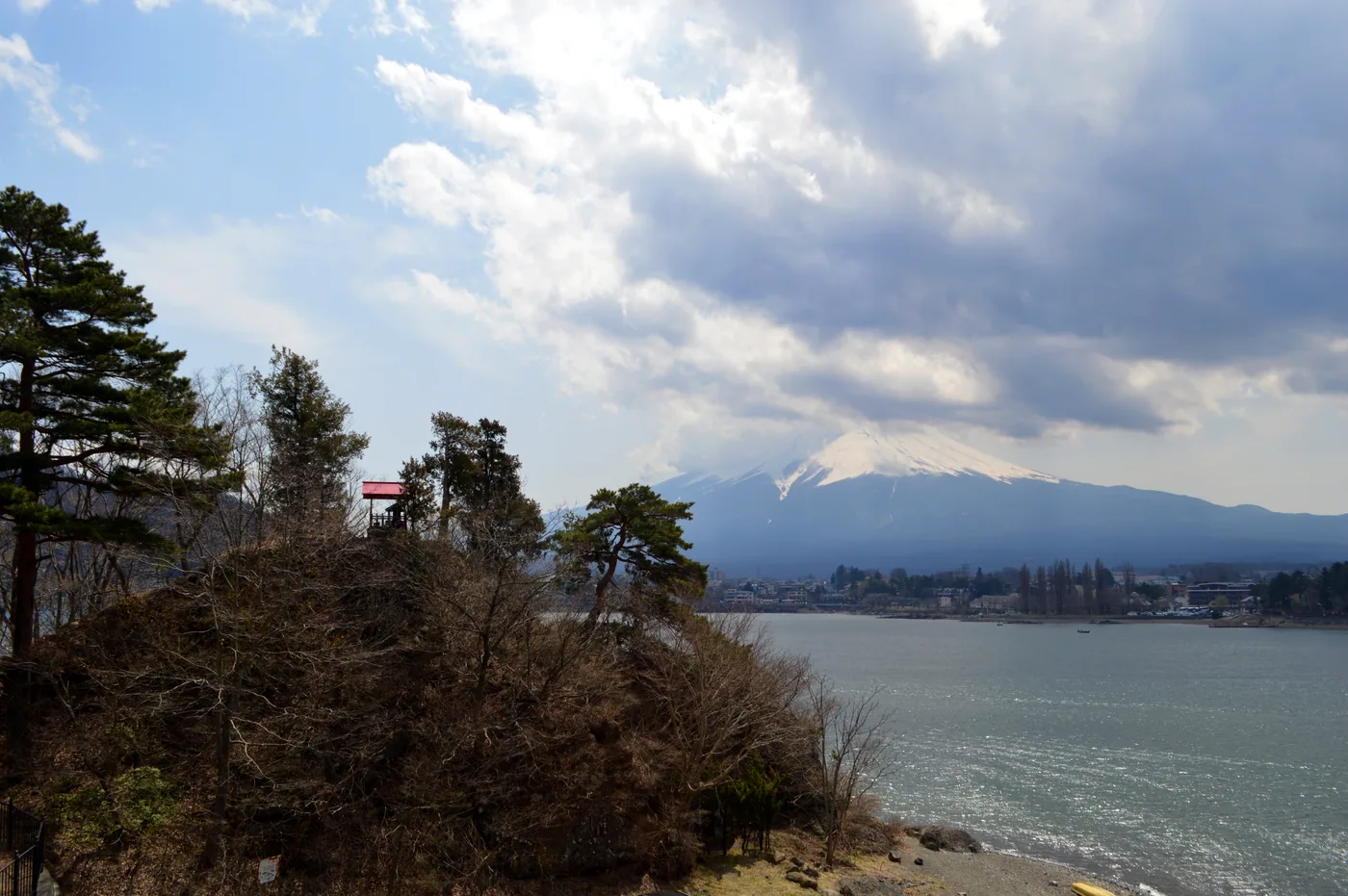
Hakone is the southeastern flank of the Mt Fuji-viewing region. If Fuji is the priority shot of your trip, the natural extension is a one or two-day add-on around Lake Kawaguchiko or the Shizuoka coast, both of which offer more reliable open Fuji vantages. Our Mt Fuji and Shizuoka kimono photoshoot guide covers the alternative vantage points and how to sequence them with Hakone.
A common three-day itinerary: Day 1 evening into Hakone-Yumoto, ryokan check-in. Day 2 morning at Lake Ashi torii, afternoon at Owakudani and Open-Air Museum, second ryokan night. Day 3 transfer west to Kawaguchiko (1.5 hours by rental car or bus), afternoon shoot at Chureito Pagoda or Oishi Park, return to Tokyo via Otsuki on the JR Chuo Line.
Access from Tokyo (Odakyu Romance Car 90min)

The Odakyu Romance Car (Limited Express) runs from Shinjuku Station to Hakone-Yumoto in roughly 85 to 95 minutes, with hourly departures throughout the day. Single fare is approximately ¥2,470 (basic fare plus limited-express surcharge). Reserved seating only, advance booking recommended on weekends and in autumn foliage and cherry blossom seasons. From Hakone-Yumoto, the Hakone Tozan Railway switchback line continues up to Gora (40 minutes), and a network of cable car, ropeway, and bus completes the loop around the lake.
For groups of four or more, or for early-morning sunrise shoots that precede train service, a hired car from central Tokyo runs roughly ¥35,000-¥55,000 one-way depending on vehicle class. Sunrise shoots at Lake Ashi (5-6am arrival) effectively require either an overnight ryokan stay the night before or a hired car — the first train doesn't reach Yumoto until after 7am.
Photographer & Studio Availability
Hakone does not have a dense local photographer community comparable to Tokyo or Kyoto. The working pattern is: Tokyo-based bridal kimono photographers travel out for half-day or full-day Hakone assignments, charging a location travel premium of ¥30,000-¥60,000 on top of their standard rate. Ryokan-partnered photographers based in Odawara or Hakone itself are available through ryokan concierge bookings as described above.
English-speaking photographer availability is limited at Hakone-resident level — most couples planning around language ease bring an English-comfortable Tokyo photographer with them. See our English-speaking kimono photographer directory for vetted options. Kimono rental and dressing is best arranged either through the ryokan partnership or through a Tokyo studio with delivery to Hakone — there are no major bridal kimono houses based in Hakone itself.
Wedding Planner's Notes: Hakone's photographer and styling logistics are the genuine trade-off against the location quality. If you want the strongest possible photographer for your trip, book that photographer in Tokyo and add Hakone as a travel day; if you want the simplest possible logistics, accept the ryokan package model. Trying to optimize for both at once usually fails.
Frequently Asked Questions
Can we do Hakone as a same-day round trip from Tokyo without an overnight?
Technically yes — the Romance Car schedule supports a 7am departure, four to five hours of shooting, and a return by early evening. In practice this only works if you skip the sunrise Fuji frame (which is the strongest Hakone shot) and accept that you will be rushed at every location. Overnight is recommended for any couple traveling specifically for the Mt Fuji-plus-torii image.
Is Owakudani safe for a kimono shoot?
When the area is open to public access it is operationally safe — the visitor zones are above active vents and sulfur exposure is well below health limits. The two practical issues are unpredictable closures (which can cancel your shoot day-of) and that strong sulfur smell can cling to silk kimono if you stay long. Limit Owakudani exposure to twenty to thirty minutes and confirm open status the morning of the shoot.
What is the dress code for guests if we host a small ceremony at a Hakone ryokan?
Ryokan ceremonies typically follow standard Japanese wedding-guest convention. Female guests wear formal dresses, kimono, or in mother-of role tomesode; male guests wear dark suits. International guests are not expected to source kimono — a formal Western suit or dress is fully acceptable. See our Japanese wedding guest attire guide for full conventions.
Does Hakone allow drone photography over the lake or torii?
No. The Hakone Shrine grounds and the immediate lakeside torii zone prohibit drone flight, and central Hakone-machi falls within densely-inhabited-district regulations under the 2022 amended Civil Aviation Law. Drones are technically permissible in some of the more remote ryokan property with owner permission and operator registration, but no major Hakone location supports drone-based wedding photography.
Can we book a Hakone shoot in the same trip as Kyoto?
Yes, and many couples do. Standard structure: arrive Tokyo, two to three days Tokyo and Hakone (Hakone overnight included), Shinkansen to Kyoto (Odawara to Kyoto is roughly 2.5 hours direct), three days Kyoto. The Odawara stop on the Hakone side connects directly to the Tokaido Shinkansen — no detour back to Tokyo required.
Are tattoos a problem at Hakone Shrine or the ryokan onsen?
For the shrine grounds, tattoos do not affect entry or photo permissions — the shrine itself has no tattoo policy. The onsen bath is the issue: most traditional Hakone ryokan baths still restrict tattooed guests, though several international-friendly properties (Hakone Ginyu, Gora Kadan, and others) accept tattooed guests or offer private in-room baths. See our tattoo policy guide for current practical advice.
How does Hakone compare to Sapporo or Takayama for a regional kimono shoot?
Different priorities. Hakone is the easiest Tokyo-region extension with the Mt Fuji draw. Sapporo offers winter snow shots and Hokkaido Shrine but requires a 90-minute flight from Tokyo. Takayama delivers an Edo-period preserved townscape with no Tokyo equivalent but is a 2.5-hour limited express from Nagoya. Choose Hakone if you want minimum trip days and Fuji; choose Takayama for old-town texture; choose Sapporo for snow.
Book Your Hakone Kimono Photoshoot
If you have decided Hakone fits your trip, the practical next step is to lock the ryokan and the photographer in that order. Ryokan availability in foliage and cherry blossom weeks closes four to six months out; photographer availability for the same windows closes three to four months out. We maintain a vetted directory of English-comfortable photographers covering the Hakone region — most are Tokyo-based with regular travel out.
Browse the Wasou Wedding Japan photographer directory for shortlisted options. If you are still weighing Hakone against other regional locations, our Sapporo kimono photoshoot guide covers Hokkaido as the snow-shoot alternative, and our Takayama old-town kimono photoshoot guide covers the Edo-preserved townscape option.
Locations in this guide


Related guides
 Location deep dive
The 15 Best Kimono Wedding Photo Locations in Japan, Ranked (2026)
Illustrative image · Unsplash. Not a photo of the specific people, places or services discussed.
A ranked guide to the 15 best shrines, temples and gardens for a kimono pre-wedding photoshoot in Japan — from Fushimi Inari's torii tunnels to Miyajima's floating gate, with honest notes on where shoots are permitted.
Read the guide Location deep dive
Kawaguchiko Kimono Photoshoot: Mt Fuji's Iconic Vista
Illustrative image · Unsplash. Not a photo of the specific people, places or services discussed.
Plan a kimono photoshoot at Lake Kawaguchi with honest clear-Fuji probability guidance, Chureito Pagoda and Oishi Park location logistics, seasonal trade-offs, and access from Tokyo via the Fujikyu Express.
Read the guide Location deep dive
Mt Aso Kimono Photoshoot: Asia's Largest Caldera Guide
Illustrative image · Unsplash. Not a photo of the specific people, places or services discussed.
Mt Aso Kumamoto kimono photoshoot guide: 25km active caldera, grassland plains, Aso-Gogaku peaks, susuki silver grass season, Aso Boy! train access.
Read the guide