New Zealand Couple Kimono Photoshoot Japan: Auckland Direct Guide
New Zealand couple kimono photoshoot Japan planning: Auckland 11hr direct flight, 90-day visa-free, NZD-JPY, Hokkaido pairing, and outdoor studio picks.

Illustrative image · Unsplash. Not a photo of the specific people, places or services discussed.
Check current prices, availability and venue rules with the relevant studio or venue before booking.
New Zealand couples planning a kimono photoshoot in Japan number roughly 300 to 600 a year. The volume is smaller than the Australian inbound, but the planning profile is close: an 11-hour direct flight from Auckland, 90-day visa-free entry, and a calendar that flips Southern Hemisphere summer into Japanese winter. That reverse-season alignment is the planning fact that matters most. New Zealand brides arriving in July land in the same wet rainy season most of Asia avoids; couples landing in January walk into the snow that Australians and Kiwis specifically come for. The route is short, but the seasons require attention.
Why New Zealand Couples Choose Japan
Three factors push New Zealand couples toward Japan over the more obvious Pacific options like Fiji, Bali, or Australia's east coast. First, the direct flight from Auckland to Tokyo is shorter than Auckland to Honolulu and roughly the same as Auckland to Singapore. Couples accustomed to long-haul travel can do Japan as a single-flight destination without backtracking through Sydney. Second, Japanese winter coincides with New Zealand summer holidays in December through February, which is when many couples take extended wedding leave. Third, the cultural distance from English-speaking Pacific destinations is substantial; couples who have already done Australia, Fiji, or Cook Islands for previous trips find Japan offers a genuinely different visual and ritual vocabulary.
The smaller volume compared to Australian inbound has a practical consequence at studios. Most Japanese photographers servicing English-speakers see Australian couples regularly and have NZ couples as an occasional case rather than a structured market. Studio communication remains English-default, but the in-house systems built for Australian-specific planning (AUD invoicing, mid-year winter expectations, Hokkaido package menus) generally apply to NZ couples too. Practical default: if you see a studio described as "Australian-friendly," assume that translates directly to "New Zealand-friendly."
Direct Flight (Auckland AKL to Tokyo 11hr)
Air New Zealand and Japan Airlines operate the direct Auckland (AKL) to Tokyo route, with flight times of approximately 11 hours northbound and 10.5 hours southbound depending on winds. Air New Zealand flies to Narita (NRT); JAL operates to Narita as well. Neither carrier currently flies AKL to Haneda direct, which means most couples arrive at Narita and connect by Narita Express train (60 minutes to central Tokyo) or limousine bus (90 minutes to major hotels).
Departure timing favors evening flights — typically 19:00-21:00 from Auckland, arriving Tokyo around midday the next day. Couples scheduling a shoot in the first 24 hours of arrival should account for one full day of timezone adjustment; Auckland is 3 hours ahead of Tokyo in NZ summer (NZDT) and 4 hours ahead in NZ winter (NZST), so the actual jet lag is mild compared to European or American arrivals. Most couples schedule their first shoot day 2-3 of the trip.
Wedding Planner's Notes: The 11-hour flight makes Japan a viable single-stop trip from NZ in a way that European destinations are not. Couples who would never consider Italy or France for prewedding (24+ hours travel time) often pick Japan because it is "only one flight." This is a real category advantage Japan has over European equivalents for the NZ market.
Visa-Free 90 Days
New Zealand passport holders receive 90 days visa-free entry to Japan under the short-term visitor waiver. No advance application is required. At immigration, you will be issued a "Temporary Visitor" landing permission, typically a 90-day duration. The standard customs declaration, biometric capture (fingerprints and photo), and a few questions about purpose of visit complete the entry process.
For wedding photography purposes, "tourism" is the appropriate declared purpose. Photography itself does not require a special visa as long as you are the subject of the shoot, not the working photographer. If you plan to combine your kimono shoot with a legal marriage registration in Japan, the marriage registration is a separate process at the municipal office and does not affect your visa status, but the documents required are substantial (apostilled birth certificate, single-status certificate from NZ Department of Internal Affairs, certified Japanese translations). See getting married in Japan as a foreigner for the document checklist.
The 90-day window comfortably accommodates a 2-3 week Japan trip with multiple shoot locations. Couples planning longer stays (working honeymoon, side projects, additional country pairings) should monitor the 90-day limit closely; extensions are not routinely granted from visa-free status.
Reverse-Season Advantage (NZ Summer = Japan Winter)
The single most distinctive planning element for NZ couples is the season reversal. New Zealand summer (December-February) is Japanese winter, and NZ winter (June-August) is Japanese summer and rainy season. This creates two genuinely different planning windows.
NZ Season | Japan Equivalent | Best For | Avoid |
|---|---|---|---|
NZ Summer (Dec-Feb) | Japan Winter | Hokkaido snow, plum blossom (Feb), clear-air Mt Fuji | December peak holiday surcharges |
NZ Autumn (Mar-May) | Japan Spring | Cherry blossom (late Mar-early Apr), mild weather | Cherry blossom price premium (30-50%) |
NZ Winter (Jun-Aug) | Japan Summer/Rainy | Lower studio rates, wisteria (May) | Rainy season (mid-Jun to mid-Jul), heat & humidity |
NZ Spring (Sep-Nov) | Japan Autumn | Autumn foliage (mid-Nov), comfortable weather | Mid-November koyo (autumn) price premium |
The NZ summer December-February window is the most actively used by NZ couples because it doubles as long Christmas holiday leave and aligns with Hokkaido's prime ski season. The trade-off is that late December and early January are Japan's most expensive travel weeks domestically; flight and hotel prices climb 30-50% above shoulder season. Couples who can shift to mid-January through February capture better rates while keeping the snow visual. See snow wedding photoshoot Japan for season-specific shoot planning.
Hokkaido Skiing + Snow Kimono Shoot
The Hokkaido pairing is the most common itinerary structure for NZ couples, mirroring the Australian pattern almost exactly. Niseko, Furano, and Rusutsu resorts attract NZ skiers in January-February, and shrine-and-snow kimono shoots are bookable within 1-2 hours of these ski bases. For the full breakdown of Hokkaido shoot logistics shared by Australian and NZ couples, see Australian couple Japan kimono photoshoot, which covers the Niseko-area studio access in detail.
The typical structure: 4-7 days skiing followed by 1-2 days of kimono shoot in Sapporo or surrounding shrines (Hokkaido Jingu, Hokkaido Shrine Tongu, smaller suburban shrines). Some couples pair Hokkaido with a brief Tokyo or Kyoto extension for a contrast shoot (snow + cherry-anticipating plum, or snow + neon city). The Hokkaido-only structure works for couples who prioritize the skiing more than the photography variety.
Wedding Planner's Notes: The "ski day + shoot day" sequencing matters. NZ couples sometimes ask if they can do skiing in the morning and shoot in the afternoon of the same day. Possible logistically, but not advisable — full-day skiing fatigue shows clearly on faces in shoot images, and the makeup application required for shiromuku is hard to schedule between ski-out and shoot start. Better practice: dedicate the shoot day to shoot.
Top Locations Among NZ Couples
Hokkaido (Snow Backdrop)
Hokkaido is the most chosen location for NZ couples by a clear margin, driven by the December-February overlap with NZ summer holidays. Sapporo's Hokkaido Jingu shrine offers a permit-friendly outdoor option with reliable winter snow; surrounding shrines including Hokkaido Shrine Tongu in Susukino provide urban alternatives. For couples basing in Niseko ski resort area, Kutchan-town shrines and Otaru historic district shoots add variety. See Hokkaido kimono photoshoot for shrine and location breakdown.
Mt Fuji Area
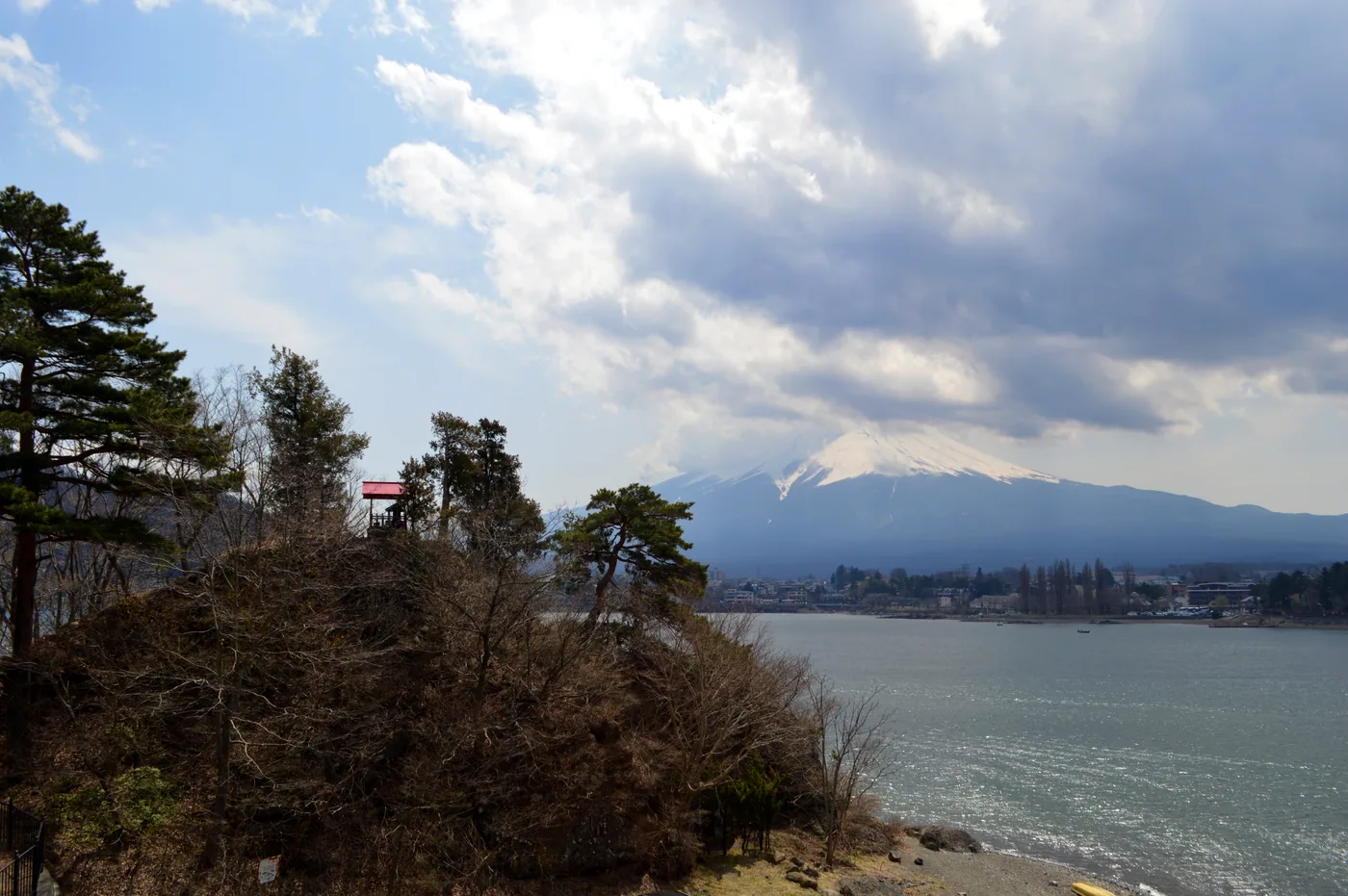
Mt Fuji is the second most common NZ couple choice, particularly the Kawaguchiko (Fuji Five Lakes) area on the north face. Winter offers the clearest Fuji visibility — humidity drops, atmospheric haze decreases, and the snow-capped summit is most photogenic from December through February. Combining Tokyo accommodation with a 2-3 day Kawaguchiko side trip is standard. See Mt Fuji Shizuoka kimono photoshoot for the south-face Shizuoka alternatives.
Kyoto Cultural Anchor
Kyoto serves as the cultural anchor for NZ couples who want at least one location that delivers traditional Japan: shrines, temples, geisha district streets, traditional architecture. Most NZ couples allocate 2-4 days in Kyoto within a 10-14 day total trip, with one shoot day at a permit-friendly shrine or studio. The honest constraint at Kyoto — heavy tourist density and strict commercial photography rules at top sites including Kinkaku-ji and Kiyomizu — applies equally to NZ couples; less-touristed shrine alternatives often serve better. See Tokyo vs Kyoto for the comparison framework.
NZD-JPY Exchange Rate Considerations
The NZD-JPY pair shows volatility similar to AUD-JPY but at lower absolute volume. NZD-JPY has fluctuated roughly 15-25% within 12-month windows over recent years, meaning the same JPY-quoted shoot package can vary by ¥50,000-¥100,000 in NZD terms depending on booking timing.
Practical approach: most Japanese studios quote in JPY. Couples paying via international credit card pay the card network's mid-market rate plus a 1-3% foreign transaction fee (Wise, Revolut, and some major NZ banks waive or reduce this). For larger packages above NZD 5,000 equivalent, an international wire transfer through a service like Wise often saves 1-2% compared to credit card. Studios accepting deposit + balance structures typically lock the JPY amount, so currency risk transfers to the couple between deposit and balance dates.
For budget planning, assume the NZD weakens 5-10% between booking and travel as a conservative buffer. The opposite scenario (NZD strengthening) is upside but should not be relied upon.
English-Default Communication
NZ couples interact with Japanese studios entirely in English. Universal English fluency among NZ couples means studios with intermediate English level can serve the market adequately, but the directory standard remains "fluent English at planning, shoot, and delivery stages." See best English-speaking kimono photographers for the curated subset.
One nuance: NZ English includes vocabulary and pronunciation patterns (Maori loanwords, NZ-specific terms) that occasionally surface in casual planning chat. Japanese studio English curriculum is typically standard American or UK English. This rarely causes real misunderstanding for wedding planning content, but does mean small clarifications occasionally needed — "togs" for swimwear, "chilly bin" for cooler, "togs" or "stubbies" type terms — though these rarely appear in shoot planning specifically.
Spend Tier (Similar to Australian Mid-Range)
NZ couples spend in roughly the same band as Australian mid-range couples, with typical total shoot budgets of NZD 3,000-NZD 6,000 for a half-day kimono prewedding at a single location. This translates to roughly ¥260,000-¥520,000 at recent exchange rates. Multi-location, multi-day, or full-wedding-coverage budgets scale to NZD 8,000-NZD 15,000 (¥700,000-¥1,300,000).
What this tier typically includes: one location, shiromuku + iro-uchikake change for the bride, montsuki-hakama for the groom, professional hair and makeup, 30-50 edited high-resolution images, online gallery delivery within 4-6 weeks. Add-ons that NZ couples commonly request: video coverage (NZD 1,200-2,500), second-location half-day extension (NZD 1,500-3,000), printed photobook (NZD 200-600).
Tier | NZD Range | JPY Range | Typical Inclusions |
|---|---|---|---|
Entry | 2,000-3,500 | ¥175,000-¥305,000 | 1 location, 1 kimono, basic edits |
Mid-range | 3,500-6,000 | ¥305,000-¥520,000 | 1 location, 2 kimono, hair & makeup, fuller editing |
Premium | 6,000-10,000 | ¥520,000-¥870,000 | 2 locations, multiple kimono, video, photobook |
Elopement package | 10,000-18,000 | ¥870,000-¥1,570,000 | Ceremony + shoot + reception |
Multi-Country Asia Pairings (Often with Bali)
NZ couples frequently pair Japan with one additional Asian destination on the same trip. The most common pairing is Bali — direct Auckland-Denpasar service operates seasonally on Air New Zealand and Indonesian carriers, and a Japan-then-Bali sequencing (cold Japan winter → warm Bali) reads as the more pleasant order than reverse. Typical structure: 7-10 days Japan, 5-7 days Bali, return to Auckland.
Less common but significant: Singapore (gateway hub, 1-2 day stopover), Thailand (Bangkok or Phuket), Hong Kong (transit + 2-3 day urban contrast), and Vietnam (Ho Chi Minh or Hanoi). Each adds variety to the honeymoon without adding excessive flight time when routed through Asian hubs.
For multi-country shoot consideration: most couples shoot only in Japan, treating Bali or other destinations as relaxation rather than additional photography. Couples interested in dual-location shoots (Japan kimono + Bali beach) are still uncommon among NZ inbound but doable with separate vendor contracts.
Outdoor-Focused Studio Preferences
NZ couples disproportionately prefer outdoor and natural-light studios over indoor-studio-only operations. This pattern reflects the New Zealand domestic photography market — landscape, environmental portraiture, and natural-light styles dominate NZ wedding photography culture. Couples bring those expectations to Japan.
Practical implications for selecting a studio:
- Portfolio composition: Look for studios whose recent portfolios show 70%+ outdoor/location work, not heavy studio-strobe indoor portraits.
- Permit experience: Outdoor shoots require shrine and park permit handling. Confirm the studio has handled the specific location you want.
- Weather contingency: Outdoor-focused planning needs explicit weather backup language in the contract — rainy day reschedule policy, indoor alternative venue, partial refund if weather makes shoot impossible.
- Lens kit: Studios doing outdoor work invest in fast prime lenses and natural-light grading. A studio whose listed kit is dominated by studio-strobe equipment signals a different aesthetic priority.
For garden-focused outdoor shoots, see Kanazawa kimono photoshoot (Kenrokuen garden) and Nara kimono photoshoot (deer park and Kasuga Taisha forest).
FAQ
Are direct flights from Christchurch or Wellington to Tokyo available?
No direct service operates from Christchurch (CHC) or Wellington (WLG) to Tokyo as of 2026. South Island and Wellington-based couples connect via Auckland (1.5 hours domestic) and then fly the AKL-NRT direct. Total travel time including connection is typically 14-16 hours door to door. Some couples instead connect via Sydney (SYD) or Brisbane (BNE) to Tokyo, which sometimes offers competitive total fares.
How does jet lag from Auckland to Tokyo compare to Europe or US trips?
Mild. Auckland to Tokyo is a 3-4 hour timezone shift westward depending on daylight saving, and the body adjusts in 1-2 days. By contrast, Auckland to London is a 12 hour westward shift requiring 4-6 days of adjustment. Most NZ couples schedule their first shoot day 2-3 days after arrival, which is sufficient recovery time.
Can we use New Zealand dollars at studios or restaurants?
No. Japan operates on yen (JPY) only at the consumer level. NZD is not exchangeable at point of sale anywhere. International credit cards work at major studios, hotels, and restaurants in cities; cash is needed for small shops, some shrines, and rural areas. Withdraw cash from 7-Eleven ATMs (universally accept foreign cards) or Japan Post ATMs.
Does Air New Zealand allow kimono or hakama as carry-on?
Couples generally do not transport their own kimono — Japanese studios provide all kimono, accessories, and dressing services as part of the package. There is no need to ship or carry traditional garments from NZ. Standard Air New Zealand carry-on allowance applies to personal items only.
Is travel insurance important for Japan kimono shoots?
Yes, comprehensive travel insurance is strongly recommended. NZ residents typically arrange policies through 1Cover, Southern Cross, AA, or similar providers. Coverage to confirm: medical (Japan medical costs are high without insurance), trip cancellation including shoot booking deposit non-refunds, weather-related rescheduling if shoot is postponed beyond your trip dates, and rental car coverage if you plan to drive in Hokkaido.
What is the best Japan region for NZ couples avoiding peak season prices?
Mid-January through early March hits the sweet spot: snow remains available in Hokkaido and Tohoku, Mt Fuji clarity is at peak, but the New Year holiday surcharge has cleared and cherry blossom premium has not yet started. Studios typically offer 10-20% lower rates in this window compared to late December or late March.
Can we combine our shoot with a legal marriage registration in Japan?
Yes, but the document requirements are substantial. NZ citizens need apostilled birth certificates, certificate of no impediment (from NZ Department of Internal Affairs), and certified Japanese translations of both. The registration itself takes 1-3 business days at the municipal office where you submit. Most couples complete legal marriage in NZ and use Japan for ceremonial/photographic purposes only, which is administratively simpler.
How does the NZ couple experience differ from Brazilian or Swedish couples?
Three differences: NZ couples have the shortest direct flight option (11 hours vs Brazilian 23-24 hours and Swedish 9-10 hours, though Brazilian routes require transit). NZ couples favor outdoor and snow shoots heavily; Swedish couples lean toward minimalist studio aesthetics; Brazilian couples often connect to Japanese-Brazilian heritage. See Brazilian couple Japan kimono photoshoot and Swedish couple Japan kimono photoshoot for parallel planning details.
Find an Outdoor-Capable Studio
Match your Auckland-to-Tokyo trip to a studio whose portfolio reflects the outdoor and snow-capable styles that NZ couples favor. Our directory at /en/photographers can be filtered by location capability, English-language service, and permit experience for Hokkaido, Mt Fuji, and Kyoto shoots. For couples comparing across Oceania and other inbound markets, read Australian couple Japan kimono photoshoot for the shared Hokkaido planning playbook, and Swedish couple Japan kimono photoshoot for a parallel Nordic-aesthetic comparison that some NZ couples find useful when shaping their visual brief.
Locations in this guide


Related guides
 General guide
Kimono Wedding Photos for Foreigners: How It Works in Japan
Illustrative image · Unsplash. Not a photo of the specific people, places or services discussed.
Yes, foreign couples can have kimono wedding photos taken in Japan — no residency, ceremony or Japanese required. How booking, fittings, pricing and permits actually work.
Read the guide General guide
How to Book a Kimono Photographer in Japan from Abroad: Step-by-Step
Illustrative image · Unsplash. Not a photo of the specific people, places or services discussed.
A complete step-by-step guide for foreign couples booking a kimono pre-wedding photographer in Japan from overseas. Contracts, payments, communication.
Read the guide General guide
Multilingual Wedding Photography Japan: Beyond English
Illustrative image · Unsplash. Not a photo of the specific people, places or services discussed.
A planner's audit of which languages — Korean, Mandarin, Spanish, French, JSL — Japanese kimono studios actually support, plus interpreter costs and when to hire one.
Read the guide