Brazilian Couple Kimono Photoshoot Japan: Routing & Nikkei
Brazilian couple kimono photoshoot Japan planning: São Paulo routing via Doha/Frankfurt/Dubai, visa-free 90 days, Nikkei family ties, Portuguese-capable studios.

Illustrative image · Unsplash. Not a photo of the specific people, places or services discussed.
Check current prices, availability and venue rules with the relevant studio or venue before booking.
Brazilian couples — roughly 400 to 900 per year — bring a distinct planning context to Japan kimono shoots. The flight from São Paulo to Tokyo runs 23 to 24 hours with no direct route, requiring a connection through Doha, Frankfurt, or Dubai. But Brazil holds the largest Japanese diaspora in the world (around 1.5 million Nikkei Brazilians), which means a meaningful share of bookings come from couples with family connections to Japan beyond pure tourism. The shoot is often the centerpiece of a broader heritage trip.
Why Brazilian Couples Choose Japan
Brazilian couples booking kimono shoots in Japan fall into two broad patterns. The first is the Nikkei heritage couple — one or both partners have Japanese ancestry through grandparents or great-grandparents who emigrated to São Paulo, Paraná, or Mato Grosso between 1908 and 1973. For these couples, the kimono shoot is layered with personal meaning: returning to the cultural homeland in formal dress that grandparents may not have worn themselves in Brazil. The second pattern is the non-Nikkei couple drawn by Japan's growing tourism profile, often as a one-time bucket-list trip during a multi-month sabbatical or extended honeymoon.
Both groups treat the trip as significant given the 23-hour flight commitment. Average stay length is 12 to 18 days, longer than Asian-market couples (5 to 8 days) but shorter than European couples (10 to 14 days). The kimono shoot typically falls in the middle of the trip, after jet lag clears but before fatigue from sightseeing accumulates.
Multi-Stop Routing: São Paulo → Tokyo
Unlike Australian or Singaporean couples who fly direct, Brazilian couples have no nonstop option to Japan. The three primary routing choices each carry distinct trade-offs.
Route | Total Time | Carrier | Layover |
|---|---|---|---|
GRU → Doha → HND/NRT | ~24 hr | Qatar Airways | 4-8 hr Doha |
GRU → Frankfurt → HND/NRT | ~23 hr | Lufthansa/JAL | 3-6 hr Frankfurt |
GRU → Dubai → HND/NRT | ~24 hr | Emirates | 4-7 hr Dubai |
GRU → LAX → HND/NRT | ~22 hr | Mixed | 3-5 hr LAX |
Qatar Airways via Doha is the most common booking for Brazilian honeymoon couples because of the strong Tokyo arrival reputation at Haneda (HND) and reliable luggage handling for fragile dress accessories. Lufthansa via Frankfurt suits couples already planning a European stopover. The LAX routing is preferred when couples are also visiting US relatives or pairing with a Hawaii leg.
Wedding Planner's Notes: The 23-hour duration matters for shoot scheduling. We never book a Brazilian couple's shoot on day one or day two — jet lag from a 12-hour time zone shift plus a 23-hour journey produces visible facial puffiness for 36 to 48 hours. Day three or four is the realistic earliest window. For premium album shoots, day five onward is safer.
Visa-Free 90 Days
Brazilian passport holders receive visa-free entry to Japan for stays up to 90 days, confirmed by passport stamp on arrival. No advance application is required. The 90-day allowance is generous compared to many Latin American passports and accommodates extended honeymoon planning easily — most Brazilian couples use 12 to 25 of the available days.
For Nikkei Brazilian couples with Japanese citizenship grandparents, we sometimes see questions about visa-free vs. ancestry-based long-stay options. The standard 90-day tourist entry is sufficient for any kimono shoot scenario. Long-stay heritage research visas exist but require separate application and are unrelated to the wedding photography process.
Bring printed proof of onward flight and hotel confirmations for the first 2-3 nights. Japanese immigration occasionally asks Brazilian arrivals for documentation given the longer typical stay.
The Nikkei Brazilian Connection
1.5M Japanese-Brazilian Diaspora
Brazil hosts the largest Japanese diaspora outside Japan — approximately 1.5 million Nikkei Brazilians, concentrated in São Paulo (Liberdade district), Paraná, and Mato Grosso do Sul. The migration began in 1908 with the first ship Kasato Maru and continued through 1973, totaling around 250,000 Japanese emigrants. The descendants now include fourth-generation (Yonsei) and fifth-generation (Gosei) Brazilians.
This diaspora creates a specific dynamic in kimono shoots. Many Nikkei couples grew up with partial Japanese cultural exposure — obon festivals, basic Japanese phrases from grandparents, Japanese food at family gatherings — but never wore formal kimono themselves. The Japan shoot becomes the first time they don shiromuku or iro-uchikake, often photographed in cities their grandparents left a century ago.
Family-Reconnection Trip Patterns
Around 35 to 45% of Brazilian couple bookings combine the kimono shoot with family-heritage research. Common itinerary elements include visiting the prefecture of origin (most commonly Kumamoto, Okinawa, Fukushima, or Hokkaido — the four largest emigration sources), meeting distant relatives still in Japan, or visiting the Japan Overseas Migration Museum in Yokohama.
For these couples, we often coordinate the kimono shoot to occur in or near the ancestral prefecture rather than defaulting to Tokyo or Kyoto. A Kumamoto-origin couple may book a shoot at a Kumamoto shrine with Kumamoto Castle as backdrop. An Okinawan-Brazilian couple may opt for Okinawan bingata or ryusou rather than mainland kimono.
Gunma Prefecture and Yokohama Heritage Sites
For couples interested in the emigration history itself rather than ancestral villages, two anchor sites matter. Yokohama hosts the Japan Overseas Migration Museum (Kaigai Iju Shiryokan) near Sakuragicho, documenting the Kasato Maru voyage and Brazilian emigration. Gunma Prefecture's Tatebayashi area was a major pre-emigration training center for Brazil-bound migrants in the early 20th century.
Neither site is conventionally used for kimono photography, but couples occasionally request a brief visit before or after the formal shoot for personal documentation. Most Brazilian-heritage couples ultimately choose Yokohama for the photoshoot itself when combining with the museum visit.
Portuguese-Speaking Studios (Limited)
Portuguese-capable kimono studios in Japan remain rare — fewer than five known studios offer Portuguese-language service, all of them concentrated in Tokyo and Kanagawa where Brazilian community ties run deepest. The studios that do offer Portuguese typically employ Nikkei Brazilian staff who returned to Japan as Dekasegi workers in the 1990s-2000s and stayed.
For most Brazilian couples, however, Portuguese capability is not strictly necessary. English fluency among urban Brazilian couples — particularly those who can afford the trip — is generally strong. Couples from São Paulo, Rio, Belo Horizonte, and Brasília typically conduct the consultation, fitting, and shoot in English without difficulty. We recommend filtering by English-speaking studios first and treating Portuguese capability as a preference, not a requirement.
Wedding Planner's Notes: Where Portuguese matters most is not the shoot day itself but the pre-trip email exchange. Subtle nuances around shiromuku styling preferences, family heritage backdrop choices, and ancestral prefecture coordination get clearer when written in Portuguese. We often suggest Nikkei couples request one Portuguese-fluent contact point at the studio for booking emails, even if the shoot day uses English.
English-Default at Most Studios
Across the 30 to 40 Tokyo studios that regularly serve foreign couples, English is the default communication language. Booking emails, contracts, fitting consultations, hair and makeup direction, and shoot-day photographer instructions all operate in English. Brazilian couples rarely encounter language friction once they confirm English-speaking studios.
The exception is shoot-day banter and emotional moments. When a couple is emotional mid-shoot — especially during san-san-kudo or a private vow exchange — Portuguese instinctively surfaces. Skilled foreign-couple photographers know to pause English direction and let the moment breathe in the couple's native language.
Top Locations Among Brazilian Couples
Tokyo Cultural Anchor
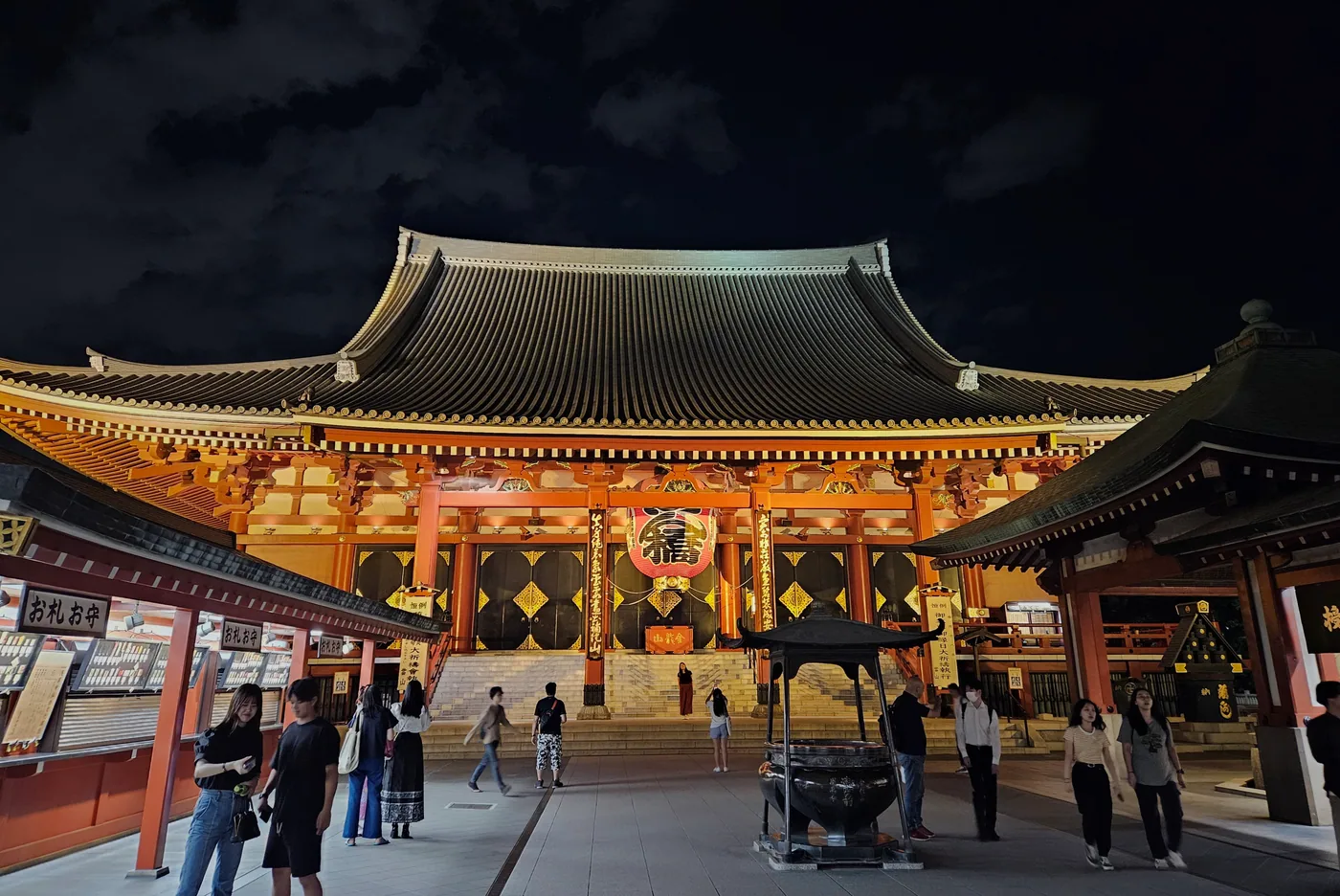
Tokyo serves as the entry point for around 70% of Brazilian bookings, primarily because flight arrivals concentrate at Haneda or Narita. Asakusa with Senso-ji Temple and the surrounding old-town streets is the most common Tokyo backdrop, followed by Meiji Jingu shrine for couples wanting a more formal Shinto setting. The recognizability of these locations matters — Nikkei couples often photograph in places their grandparents told stories about, even if those grandparents never lived in Tokyo.
Kyoto Temple Settings
Kyoto runs second at around 40% of bookings (with overlap — many couples shoot in both cities). Brazilian couples favor Kyoto for the temple density and traditional architecture, especially couples without specific ancestral ties to Japan. The shinkansen journey from Tokyo (2 hr 15 min) is treated as a sightseeing element rather than just transit. Top Kyoto studios serving foreign couples handle the volume.
Gunma and Yokohama Nikkei Sites
For Nikkei couples specifically tracking heritage, Yokohama bookings rise significantly (~25% of Nikkei Brazilian couples vs. ~8% of non-Nikkei). The Sakuragicho area near the Japan Overseas Migration Museum, combined with Yamashita Park's Hikawa Maru steamship and the Yokohama Chinatown district, creates a Meiji-era backdrop that resonates with emigration history. Yokohama kimono photoshoot logistics are straightforward — most Tokyo studios serve Yokohama with minimal travel surcharge.
BRL-JPY Exchange Rate Volatility
The Brazilian Real (BRL) to Japanese Yen (JPY) exchange rate carries higher volatility than most G7 currencies. Over the 2023-2025 window, BRL-JPY fluctuated by 15-25% within single 12-month periods. For couples budgeting 6-12 months ahead, this matters: a quoted ¥350,000 package could effectively cost between R$10,500 and R$13,500 depending on when payment occurs.
Practical mitigation: most studios accept payment in JPY via international card with the booking deposit (20-30%) locked in at near-current exchange rates, then the remainder paid on shoot day. Couples concerned about volatility can prepay in full at booking to lock the rate, though refund policies tighten significantly with full prepayment.
Package Tier | JPY | BRL Range (2024-2025) |
|---|---|---|
Standard 2-hour shoot | ¥250,000 | R$7,800-R$9,800 |
Premium half-day | ¥450,000 | R$14,000-R$17,600 |
Multi-location full-day | ¥800,000 | R$25,000-R$31,300 |
Hawaii / US West Coast Pairing Patterns
Around 25-35% of Brazilian couples pair the Japan trip with a Hawaii stopover or US West Coast leg, primarily because the GRU-LAX-HND or GRU-HNL-HND routings offer reasonable timing splits. Hawaii is especially common — the Honolulu hotel ecosystem caters well to Brazilian honeymooners, and the cultural bridge between Hawaiian-Japanese diaspora and Brazilian-Japanese diaspora creates an interesting parallel.
Pairing affects shoot timing in two ways. Couples coming from Hawaii to Japan arrive with less jet lag (Hawaii-Japan is only 19-21 hours total flight time and a smaller time zone differential) — these couples can shoot on day two or three. Couples doing US West Coast first arrive equally jet-lagged as direct routings — day three or four still applies. We ask about routing during the consultation specifically for this scheduling decision.
Spend Tier: Premium for Tier-1 City Couples
Brazilian couples booking from São Paulo (Jardins, Vila Madalena), Rio (Leblon, Ipanema), Brasília, and Belo Horizonte tend toward premium packages — the ¥400,000-¥800,000 range, often with full album printing and second-shooter add-ons. The economics make sense: given the 23-hour flight and 12-18 day trip, the marginal cost of premium photography is small relative to the trip total.
Smaller-city and Nikkei community-network couples (Maringá, Londrina, Bauru — Paraná and São Paulo state Nikkei concentrations) spread more broadly across the ¥250,000-¥500,000 range. Both groups invest meaningfully — Brazilian couples rarely book the lowest-tier packages given the trip commitment already made.
Multi-Generational Trip Patterns
A distinctive Brazilian pattern: around 20-30% of Nikkei Brazilian couples bring parents or grandparents on the trip, often for the parents'/grandparents' own first or second return visit to Japan. This creates a meaningful photography opportunity that we routinely flag to studios.
The standard arrangement: the couple does their formal kimono shoot solo for 2-3 hours, then the family (4-8 people including grandparents) joins for a 30-60 minute family portrait segment, often with the grandparents also in kimono. The grandparents'/parents' kimono can be lighter formal kimono (homongi or iromuji) rather than full bridal dress. Family photo positioning logistics need pre-discussion — multi-generational kimono shoots with elderly participants require slower pacing and seated options.
Wedding Planner's Notes: For Nikkei grandparents returning to Japan for the first time in 40-60 years, the emotional weight of seeing their grandchild in formal kimono in their homeland is significant. We recommend the photographer briefs in advance about this dynamic so they're prepared to capture quiet moments — the grandparent watching from a chair, a private exchange — without requiring direction. These often become the most-treasured frames in the final album.
Frequently Asked Questions
Do I need to bring my own kimono if I have a family heirloom from Brazil?
You can, but most studios prefer their rental inventory for several practical reasons: condition assessment, sizing fit, and shoot-day pressing. Heirloom kimono from Brazil may have humidity damage, fabric weakness, or sizing issues from a different generation. If you want to use the family kimono, schedule a fitting visit at least 48 hours before the shoot for inspection. Many couples bring the heirloom for one frame and use rental for the main session.
Can the photographer speak any Portuguese?
Rarely. Fewer than five Tokyo studios employ Portuguese-fluent staff, and the photographers themselves almost never speak Portuguese. Plan for English communication. If Portuguese is critical, request a Portuguese-fluent assistant from the studio for the consultation phase only — shoot-day photography direction will still be in English or Japanese.
Should we shoot in São Paulo before flying to Japan?
This is a personal choice rather than a logistical one. Some couples do a casual Brazilian wedding photo session in São Paulo for relatives who cannot travel, then the formal kimono shoot in Japan. Studios in São Paulo's Liberdade district occasionally offer kimono rental and shooting, but the rental quality, location authenticity, and photographer experience with kimono compose less than what you'd get in Japan. Most couples treat Japan as the singular kimono shoot.
Is winter or summer better for a Brazilian honeymoon?
Both work, with different trade-offs. Brazilian summer (December-February) aligns with Japanese winter — cold but clear, with snow possibilities in Hokkaido and Tohoku, ideal for shiromuku photography in crisp conditions. Brazilian winter (June-August) aligns with Japanese rainy season into summer — humid and unpredictable for shoots. Brazilian couples typically book January-March or October-November as preferred shoot windows.
How do I handle the 12-hour time difference for booking emails?
São Paulo is 12 hours behind Tokyo (11 hours during Brazilian summer time). Email response cycles take 24-36 hours per round-trip. Build this into your timeline — confirmations and minor changes take 3-4 days for full closure. WhatsApp is rarely used by Japanese studios; rely on email.
Can we pay in BRL or do we need JPY?
Most studios invoice in JPY and accept international credit card payment in your card's home currency at point of payment. Your card issuer handles BRL-JPY conversion. Few studios accept direct BRL transfer. Bank wire from Brazilian banks to Japan typically incurs 4-6% in conversion and fees — credit card is usually cheaper.
Are there cultural sensitivities specific to Nikkei couples we should know?
One nuance: traditional Japanese photography culture is more reserved about expression than Brazilian culture. The natural Brazilian wedding photo style — laughter, embracing, animated poses — works beautifully but requires explicit direction to the photographer. Without it, many Japan-trained photographers default to subdued portraits. Tell them during consultation that you want some animated, joyful frames mixed with the formal ones.
Find a Portuguese or English-Capable Studio
For Brazilian couples planning Japan kimono photography, prioritize confirmed English fluency over rare Portuguese capability, factor jet lag into shoot-day scheduling at day three or later, and decide early whether ancestral-prefecture locations or Tokyo/Kyoto anchors better suit your trip narrative. Browse our directory at /en/photographers filtered by English-capable studios in Tokyo, Yokohama, Kyoto, and ancestral-region cities. For comparable long-haul routing contexts, see our New Zealand couples Japan guide and Swedish couples Japan guide — both also navigate single-trip booking decisions from far-distance markets.
Locations in this guide


Related guides
 General guide
Kimono Wedding Photos for Foreigners: How It Works in Japan
Illustrative image · Unsplash. Not a photo of the specific people, places or services discussed.
Yes, foreign couples can have kimono wedding photos taken in Japan — no residency, ceremony or Japanese required. How booking, fittings, pricing and permits actually work.
Read the guide General guide
How to Book a Kimono Photographer in Japan from Abroad: Step-by-Step
Illustrative image · Unsplash. Not a photo of the specific people, places or services discussed.
A complete step-by-step guide for foreign couples booking a kimono pre-wedding photographer in Japan from overseas. Contracts, payments, communication.
Read the guide General guide
Multilingual Wedding Photography Japan: Beyond English
Illustrative image · Unsplash. Not a photo of the specific people, places or services discussed.
A planner's audit of which languages — Korean, Mandarin, Spanish, French, JSL — Japanese kimono studios actually support, plus interpreter costs and when to hire one.
Read the guide