Maku Curtain at Japanese Wedding Altar: Kohaku-Maku Guide
The maku curtain at a Japanese wedding altar uses a coded color system. Learn why kohaku-maku red-white signals celebration and kuromaku is funeral-only.

Illustrative image · Unsplash. Not a photo of the specific people, places or services discussed.
Check current prices, availability and venue rules with the relevant studio or venue before booking.
The maku (幔幕) — the striped decorative curtain you see at a Japanese wedding altar — uses a coded color system that foreign couples often misread in their reference photos. Red-and-white vertical stripes (kohaku-maku) signal a wedding or celebration. Black-and-white stripes (kuromaku) are funeral-specific and should never appear at your ceremony. The distinction matters at every shrine venue, hotel chapel, and traditional restaurant in Japan, and recognizing it before you book helps you read venue photographs correctly and avoid uncomfortable surprises on the day.
What the Maku Is
The maku is a wide, flat cloth curtain hung along the perimeter of a ceremony space, draped from a horizontal rope or rail at roughly head height to just above the floor. At a shrine wedding it typically encloses three sides of the altar area; at a hotel chapel it may hang from the ceiling as a decorative drape or frame the entrance to the ceremony hall. The cloth itself is heavy — silk in premium venues, polyester in standard ones — with vertical stripes alternating in two colors.
The function is both practical and symbolic. Practically, the maku visually defines the ceremony space and absorbs ambient noise. Symbolically, it marks a boundary between the everyday world (sokuse 俗世) and the sacred or formal world (seiiki 聖域) inside. For foreign couples, the most important thing to know is that the color combination tells you what kind of event is being held — and getting this wrong can cause genuine confusion.
Kohaku-Maku (Red-White) — Wedding Standard
Kohaku-maku (紅白幕) is the celebratory standard. The combination of red (kohaku 紅) and white (haku 白) appears across nearly all formal Japanese auspicious events — weddings, traditional New Year ceremonies, school graduations, opening ceremonies, and award presentations. At a Japanese wedding, you will see kohaku-maku at the shrine altar, often at the entrance gate to the ceremony hall, and increasingly as a decorative element at hotel chapels designed for Western-format weddings as well.
Vertical Stripe Pattern
The stripes run vertically, alternating red and white in equal widths of roughly 30-40 centimeters per panel. The pattern is highly recognizable in photographs — even a small section of red-white vertical stripes in the background instantly identifies an image as celebratory. When you are reviewing photographer portfolios, kohaku-maku visible in the corner of a frame is one of the clearest visual signals that the photograph was taken at a wedding rather than another shrine event.
Hung at Shrine Altar Perimeter
At a typical shrine wedding, the kohaku-maku is hung around the perimeter of the haiden (worship hall) where the ceremony takes place. It frames the altar (jin-dan 神壇) and forms the visual backdrop for the san-san-kudo sake ritual, the tamagushi offering, and the kashiwade ritual clapping. The curtain is usually present before you arrive in the hall and remains throughout the ceremony — it is not raised or removed at any point.
Hotel Chapel Use
Hotel chapels designed for Japanese-format ceremonies (jin-zen shiki 神前式 conducted on-site rather than at a shrine) routinely use kohaku-maku as part of the altar setup. Even Western-format chapel weddings sometimes feature a kohaku-maku drape near the entrance or in the reception hall, signaling the celebratory character of the day to arriving guests. If you are choosing a venue and the brochure shows red-and-white striped fabric, you are looking at intentional wedding decoration, not accidental colour choice.
Kuromaku (Black-White) — Funeral Only
Kuromaku (黒幕) — black-and-white vertical stripes — is the funeral standard. It appears at Buddhist funeral services, memorial halls, and traditional condolence visits. The color combination is so strongly associated with mourning in modern Japanese visual culture that any black-and-white striped curtain at a celebration would be read as a serious error. You should never see kuromaku at your wedding, and any vendor proposal that includes it has misunderstood the brief.
The relevance for foreign couples is mostly defensive: when researching Japanese ceremony imagery online, you may encounter black-and-white striped curtains in photographs and assume they are wedding-related because the format looks similar to kohaku-maku. They are not. If a Pinterest board or stock photograph shows kuromaku, the image is from a funeral or memorial service, and you should not use it as a reference for your wedding plan. Pointing this distinction out to your planner early demonstrates cultural awareness and reduces the chance of confusion during venue selection.
The Sacred-Mundane Boundary Symbolism
The deeper meaning of the maku, in either color scheme, is boundary-making. In Shinto thought, sacred space is created through visible markers — the torii gate, the shimenawa rope, and the maku curtain all function as physical thresholds that separate the kami's domain from the everyday world. When you walk past the kohaku-maku into the ceremony hall, you are symbolically entering a temporarily sacred space; when you leave, the space returns to ordinary use.
Wedding Planner's Notes: Foreign couples sometimes ask whether they need to bow, pause, or perform a specific gesture when crossing the maku threshold. The answer is no — unlike the torii gate at the shrine entrance, where a small bow is customary, the maku does not require a ritual acknowledgement. Simply walking through is correct. The planner-led ceremony rehearsal (gozen-renshu 御前練習) will cover all the gestures that do require action, so you do not need to memorize anything in advance.
Materials
The fabric grade of the maku reflects the formality and price tier of the venue. Most foreign couples will not be asked to choose maku material directly — it comes with the venue — but understanding the range helps you interpret what you are seeing in photographs and brochures.
Silk (High-End Venue)
Premium shrine venues and high-end hotel chapels use woven silk maku, sometimes with subtly embroidered family crests or shrine symbols in the white panels. The fabric drapes with weight, the color is deeper and more saturated than synthetic alternatives, and the texture catches light differently in photographs. Silk maku are typically owned by the venue and reused across many ceremonies, so the cost is bundled into the venue fee rather than charged separately. You will most often encounter silk maku at major shrines like Meiji Jingu, Heian Jingu, and Atsuta Jingu, and at luxury hotel chains.
Polyester (Modern Standard)
Standard hotel chapels, mid-range venues, and smaller shrines use polyester maku that look nearly identical to silk in most photographs but cost a fraction of the price. The functional symbolism is the same — the boundary is created regardless of fabric grade — and photographs taken in soft light will rarely reveal the difference. If you are budget-conscious and considering whether to upgrade to a silk-equipped venue, the practical answer is that the upgrade rarely changes the final photographs in a way you would notice.
Hanging Positions and Lengths
The same maku material appears in different configurations depending on the venue type. Recognizing the standard positions helps you plan photo composition and understand what your photographer will be working with.
Altar Perimeter
At a shrine wedding, the maku encloses the altar on three sides, leaving the front open where the priest officiates and the couple sits. Typical hanging height is from roughly 180 centimeters down to 30 centimeters above floor level. The total length around the perimeter varies by hall size but commonly runs 15-25 meters of continuous fabric. This configuration produces the classic shrine wedding portrait composition: couple in front of the altar, kohaku-maku as the vertical-striped backdrop, ceremony participants framed within.
Hotel Chapel Ceiling
Hotel chapels increasingly use maku as a decorative ceiling drape rather than a perimeter wall. The cloth hangs from a central point or runs along the ceiling line above the altar, creating a softer ambient effect. This configuration is more common at Western-format chapels that include some Japanese decorative elements, and it produces a different photographic mood — the maku reads as decoration rather than as ritual boundary.
Traditional Venue Entry Gates
Some traditional venues — particularly ryotei (high-end Japanese restaurants) hosting wedding receptions, or older shrines with formal gates — hang a smaller maku panel at the entrance archway. This signals to guests as they arrive that they are entering a celebratory event. The entry maku is typically 2-3 meters wide and serves more as a marker than as a full enclosure. It is a strong photo composition element for arrival shots and group photos taken at the venue threshold.
As a Photo Composition Element

For photographers, the kohaku-maku is one of the most recognizable visual identifiers of a Japanese wedding setting. The vertical stripes create a strong graphic background that frames subjects clearly without competing for attention. Experienced wedding photographers in Japan deliberately compose shots that use the maku as background — particularly the standard portrait of the couple seated in front of the altar, where the striped fabric provides clean visual structure.
If you are reviewing portfolios, the way a photographer handles kohaku-maku in their images is a useful skill marker. Strong work shows the stripes as a deliberate compositional element, not as background noise. Weaker work either ignores the maku entirely (cropping it out) or lets it dominate and distract from the subjects. For broader context on how to evaluate this and other photographic elements at Japanese venues, see our Japanese wedding photography guide and the detail shot checklist for kimono albums.
Coordinating Maku Color with Kimono Choice
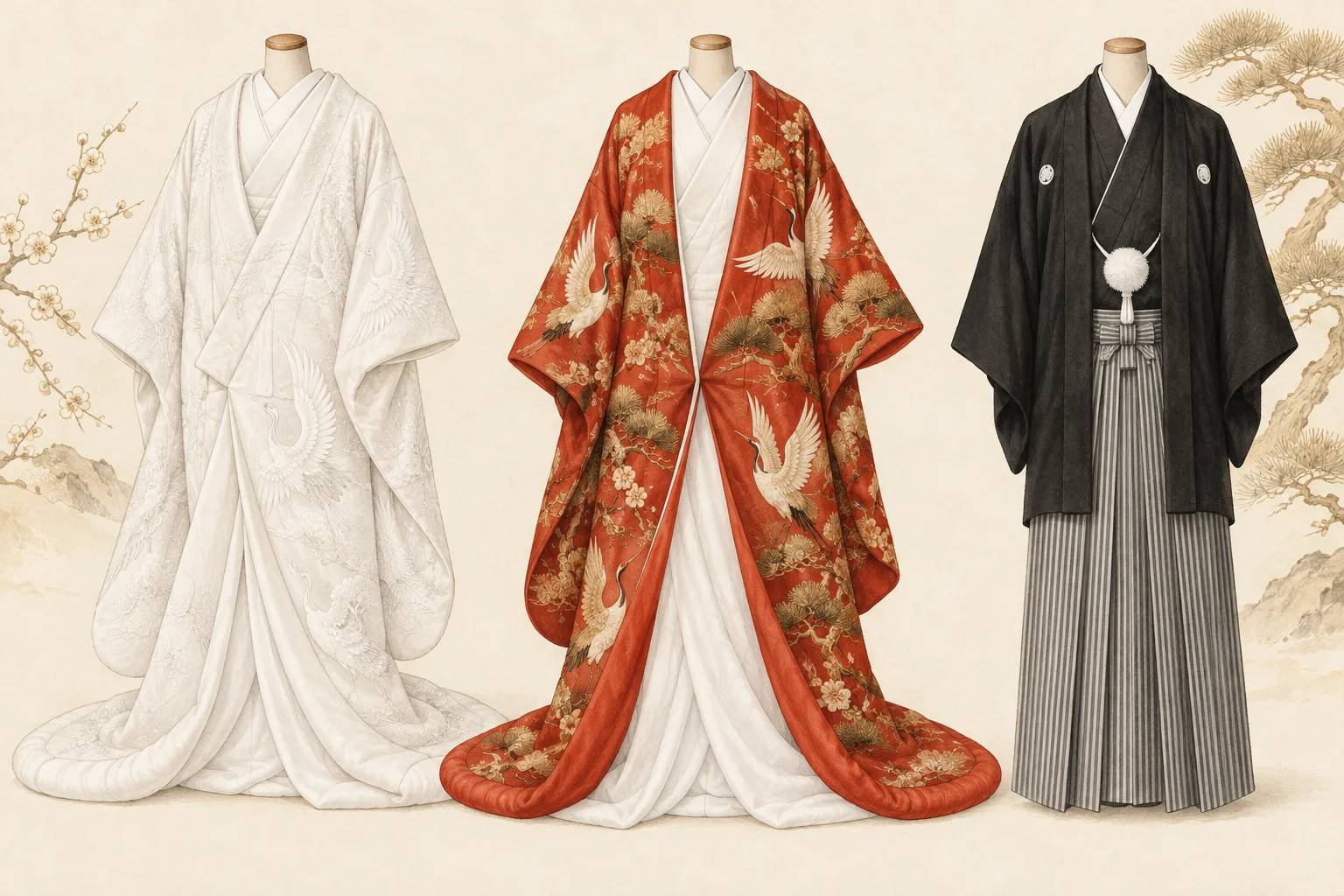
Because kohaku-maku is always red-and-white, the color coordination question is whether your kimono color choice complements or clashes with the backdrop. The two main bridal kimono options interact with the maku differently.
Kimono | Maku Interaction | Photo Effect |
|---|---|---|
Shiromuku (white) | Bride blends with white panels | Soft, monochromatic, classical |
Iro-uchikake (color) | Bride contrasts with red panels | High color contrast, dramatic |
Iro-muji solid color | Depends on color choice | Plan with stylist in advance |
Most foreign couples are not asked to make a maku-vs-kimono coordination decision — the venue's maku is fixed, and the kimono choice is yours. But if you are choosing between shiromuku and iro-uchikake, knowing that the maku is always present in altar portraits helps you anticipate the final photograph. For more on the kimono choice itself, see our shiromuku vs iro-uchikake comparison.
When the Maku Appears in Modern Hotel Chapels
Modern hotel chapels — even those marketed for Western-format weddings — increasingly incorporate kohaku-maku as a stylistic nod to Japanese tradition. You may see it as a partial wall drape behind the altar, as a ceiling accent, or as a framing element at the chapel entrance. This is a recent trend (roughly post-2018) reflecting demand from couples who want some traditional visual cues without committing to a full shrine ceremony.
For foreign couples choosing between ceremony formats, the presence of kohaku-maku in a chapel does not change the ceremony type itself. A Christian-format chapel with maku decoration is still a chapel ceremony, not a Shinto one. If you specifically want a Shinto ceremony, you should be asking about the officiant, the san-san-kudo ritual, and the tamagushi offering — not about the curtain. See our jin-zen, butsu-zen, and civil ceremony comparison for how to distinguish ceremony types when researching venues.
Custom Maku for Premium Weddings
At the high end of the market, some couples commission custom maku featuring family crests (kamon 家紋), shrine emblems, or personalized embroidery in the white panels. Cost typically runs 200,000-800,000 yen for a custom set, with 6-12 weeks of production lead time. The custom maku belongs to the couple after the wedding and is occasionally displayed at the reception venue or photographed as a standalone object for the album.
For most foreign couples, custom maku is not a realistic option — the production timeline alone makes it incompatible with the typical 3-6 month planning window from abroad. But the option exists for couples planning a year or more ahead, and the result is genuinely distinctive when included in album photography. If a custom approach interests you, ask the planner during your initial venue inquiry about timeline feasibility; standard maku will be the default for nearly all foreign-couple weddings booked within six months.
Frequently Asked Questions
Can the maku be removed for photography if it blocks a shot?
No. The maku is fixed for the duration of the ceremony and cannot be moved or removed for photography. Experienced photographers know this and plan composition around it rather than against it. If a photographer's portfolio shows altar shots with the maku visibly cropped or absent in a way that suggests it was moved, ask about how that shot was obtained — the answer should be lens choice or angle, not curtain removal.
Do guests need to do anything special when passing the maku?
No. Unlike the torii gate, which sometimes calls for a small bow, the maku does not require a ritual gesture from guests. They simply walk through the gap where the curtain is open. The only people performing ritual gestures during the ceremony are the couple, the priest, and (briefly) the immediate family during the san-san-kudo and tamagushi rituals.
Is the maku ever used in outdoor weddings?
Rarely. Outdoor weddings in Japan — beach, garden, or estate ceremonies — typically do not use maku because the cloth requires a hanging structure and is impractical in wind. If you are planning an outdoor ceremony at a venue that incorporates traditional elements, the planner may use a smaller maku panel at the entrance archway, but the full altar perimeter setup is essentially indoor-only.
Can we choose the maku color or pattern?
At standard venues, no — the maku is the venue's property and the color is fixed (kohaku-maku for weddings, always). Premium venues offering custom maku will discuss color and pattern choices, but the base format remains red-and-white vertical stripes. The cultural coding is too strong for venues to offer non-traditional alternatives, and any other pattern would read as either non-celebratory or simply confusing to Japanese guests.
What if there is no maku at the venue we like?
Not all venues use maku, particularly Western-format chapels designed primarily for Christian-style weddings. The absence of maku does not mean a venue is lower quality — it just means the venue is not following the Japanese altar setup convention. If having kohaku-maku in your photographs matters to you, confirm with the venue before booking. Some venues can add a rental maku for an additional fee (typically 30,000-80,000 yen).
Does the maku appear at the reception or only at the ceremony?
Primarily at the ceremony. At the reception, the maku is usually replaced by other decorative elements — flower arrangements, traditional folding screens (byobu 屏風), or modern lighting design. Some high-end ryotei reception venues do hang a small kohaku-maku at the entrance, but the main reception space rarely features the full ceremony-style setup. If your photographer is shooting both ceremony and reception, the maku will appear in ceremony images and disappear in reception images, which is normal.
How is the maku photographed in detail shots?
Detail shots of the maku focus on the fabric texture, the stripe geometry, and any embroidered crest if present. Common approaches include close-up of the silk weave catching light, the vertical line of the stripe creating a graphic compositional element, and the corner where two panels meet showing the construction. These detail shots are typically included in premium album packages alongside other ceremony-detail imagery.
Understand Your Venue's Maku Setup
Knowing how to read the maku at a Japanese wedding venue is one of those small details that shifts you from tourist to informed participant. When you tour venues or review brochures, the colour scheme of the striped curtain in the altar photographs tells you whether you are looking at a wedding venue setup or someone's stock photograph from a different event entirely. Your planner should be able to walk you through the maku configuration at any venue you are seriously considering.
Browse our directory of English-speaking kimono wedding photographers to find specialists who understand altar composition and can work cleanly within the kohaku-maku frame. For related ceremony and procession context, continue with the bridal procession (hanayome gyoretsu) and jin-zen, butsu-zen, and civil ceremony format comparison.
Related guides
 General guide
Post-Shoot Revision Rounds & Edit Policy: Japan Studio Rules
Illustrative image · Unsplash. Not a photo of the specific people, places or services discussed.
One round of color and exposure tweaks is included; further rounds run ¥10,000-¥30,000 each with a 5-10 photo cap; full re-grades are priced as new edit jobs (¥50,000-¥150,000). Lock your color grade at contract time to avoid expensive post-delivery revisions.
Read the guide General guide
Color Grading Styles in Kimono Photography: Choose Pre-Booking
Illustrative image · Unsplash. Not a photo of the specific people, places or services discussed.
Identify your photographer's color grade before booking — Japanese natural, film emulation, cinematic, editorial, or vintage — because re-grading after delivery costs ¥30,000-¥100,000 and some studios refuse entirely.
Read the guide General guide
Solo Bride Kimono Photoshoot Japan: Self-Portrait Sessions
Illustrative image · Unsplash. Not a photo of the specific people, places or services discussed.
Solo bride kimono photoshoot in Japan: bride-only self-portrait sessions, outfit choices, costs, and where to book. Planner-led guide for 2026.
Read the guide