Jin-Zen vs Butsu-Zen vs Civil Wedding in Japan: Which Format
Jin-zen, Butsu-zen, civil jinzen-shiki, and Western chapel — the four wedding ceremony formats in Japan, how Japanese couples choose between them, and which fits foreign couples planning a kimono wedding.

Illustrative image · Unsplash. Not a photo of the specific people, places or services discussed.
Check current prices, availability and venue rules with the relevant studio or venue before booking.
Most foreign couples planning a Japanese wedding ask for a "Shinto ceremony" without realising that Japan actually offers four distinct ceremony formats, and that the locals around them — the studio coordinator, the venue, the photographer — quietly assume one of the other three is the better fit. Jin-zen (Shinto) sits at roughly 40% of modern Japanese weddings, civil "jinzen-shiki" at 30%, Western chapel at 20%, and Butsu-zen (Buddhist) at the remaining 10%. Religious affiliation rarely drives the choice. This guide walks through the four formats the way a planner explains them to a client.
The Four Wedding Ceremony Types
Japanese ceremony formats are categorised by the entity the vows are offered to, not by the religion of the couple. Jin-zen (神前) means "before the kami" — the Shinto ceremony, conducted by a Shinto priest at a shrine or in a hotel shrine room. Butsu-zen (仏前) means "before the Buddha" — the Buddhist ceremony, conducted by a Buddhist priest at a temple. Jinzen-shiki (人前式) is a homophone using different kanji and means "before people" — a civil ceremony with no religious framework, where vows are recited to the assembled guests. Christian-style chapel (チャペル挙式) uses a Western chapel format, almost always for couples without Christian faith.
The market share by ceremony type has shifted considerably over the last two decades. Christian-style chapel weddings dominated through the 2000s at over 60% share, but have fallen back to roughly 20% as couples sought something more "Japanese." Jin-zen has correspondingly risen, and civil jinzen-shiki — the most flexible format — has grown fastest among couples in their early 30s who want a personal ceremony without religious framing.
Format | Setting | Officiant | Length | Modern share |
|---|---|---|---|---|
Jin-zen (Shinto) | Shrine or hotel shrine room | Shinto priest (kannushi) | 40-60 min | ~40% |
Butsu-zen (Buddhist) | Temple main hall | Buddhist priest (osho) | 30-45 min | ~10% |
Jinzen-shiki (civil) | Hotel hall or restaurant | None — guests witness | 20-30 min | ~30% |
Chapel (Western) | Hotel chapel or standalone chapel | Ordained minister or actor | 30-40 min | ~20% |
Wedding Planner's Notes: Foreign couples sometimes assume Jin-zen is the "authentic" choice and the others are dilutions. From inside the industry it's the opposite — all four are equally legitimate options that Japanese couples weigh on aesthetic, family politics, and venue availability. The "authentic" choice is whichever one matches the album you want to keep on the shelf.
Jin-Zen (神前 — Shinto Ceremony)
Jin-zen is the format most foreign couples picture when they imagine a "traditional Japanese wedding." The setting is a Shinto shrine or, more commonly for time-pressed couples, a shrine-style room (shinden) inside a hotel where a priest performs the ceremony at a portable altar. The structure has been formalised since the early 20th century — the modern Jin-zen format was largely standardised after the 1900 wedding of Crown Prince Yoshihito.
Format and Length (40-60 Min)
The ceremony runs through a fixed sequence: shubatsu (purification by the priest), norito-soujou (Shinto prayer recitation), san-san-kudo (three-three-nine sake exchange), seishi-soujou (vow recitation by the couple), yubiwa-kokan (rings — added in the 20th century), tamagushi-houten (sacred branch offering), kashiwade (ritual clapping), and shinshu-haisho (cup exchange between the two families). Total running time is 40 minutes at most hotels, 50-60 minutes at major shrines like Meiji Jingu or Heian Jingu.
San-san-kudo, Tamagushi, Kashiwade
Three rituals carry the visual weight of the ceremony. San-san-kudo is the sake exchange where the bride and groom each sip from three nested cups, three times each — the "three-three-nine" pattern. Tamagushi-houten is the offering of a sakaki branch (sacred evergreen) at the altar, requiring a specific bow-and-place sequence the priest will rehearse with you. Kashiwade is the ritual clapping — two claps after each tamagushi offering, with hands held briefly together before lowering. Photographers know to anticipate these three moments; for everything else, the bride's head is usually obscured by the wataboshi hood.
For foreign couples wanting to understand the ritual mechanics before showing up, our deep dives cover the three central rituals in detail: the full Shinto ceremony walkthrough, the san-san-kudo sake ritual, the tamagushi branch offering, and the kashiwade clapping.
Venue Options (Shrine, Hotel Chapel)
Real-shrine Jin-zen happens at Meiji Jingu (Tokyo), Heian Jingu (Kyoto), Yasaka Jinja (Kyoto), Kamigamo Jinja (Kyoto), Kasuga Taisha (Nara), Tsurugaoka Hachimangu (Kamakura), and several hundred smaller shrines that accept wedding bookings. The atmosphere is unmatched — cypress beams, the sound of cedar floors, often visible procession route. Trade-offs: weather risk (most processions cross outdoor terrain), strict commercial photography permits, fixed shrine schedule.
Hotel shrine-room Jin-zen happens at properties like the Imperial Hotel Tokyo, Hotel Okura, the Westin Tokyo, and most full-service wedding hotels. A priest is brought to a dedicated room with a portable altar. Atmosphere is more controlled — climate-controlled, predictable photography rules, smooth handover to the reception. Trade-offs: less photographic distinctiveness, the album won't show the recognisable shrine architecture.
Cost Range
Ceremony-only fees at real shrines run ¥80,000-¥300,000 (priest's honorarium, ritual fees, basic facility use). Premium shrines like Meiji Jingu charge ¥150,000-¥300,000 base. Hotel shrine-room Jin-zen typically runs ¥150,000-¥500,000 bundled into the hotel package. These are ceremony fees only — they exclude attire (¥150,000-¥500,000 per rental), hair-and-makeup (¥50,000-¥150,000), photography (¥150,000-¥600,000), and reception costs.
Wedding Planner's Notes: If you want shrine architecture in your photographs, book real-shrine Jin-zen. If you want the ceremony to disappear into a polished day with no logistical friction, book hotel shrine-room. Hybrid attempts — ceremony at a shrine, reception at a hotel 30 minutes away — work but cost an hour of buffer in your kimono changing room.
Butsu-Zen (仏前 — Buddhist Ceremony)
Butsu-zen is the rarest format at roughly 10% of modern Japanese weddings, but it remains the historically deepest. Buddhist weddings predate Shinto weddings in Japan by several centuries, since family Buddhist temples were the centre of life-event rituals before Meiji-era state Shinto promoted shrines. Today Butsu-zen is chosen by couples with strong family temple ties, by couples drawn to the contemplative aesthetic, and increasingly by foreign couples wanting an unusual photographic setting.
Format and Length
The Butsu-zen ceremony runs 30-45 minutes. Structure varies by Buddhist sect — Jodo Shinshu (Pure Land), Zen, Shingon, and Nichiren temples each have slightly different ritual sequences. Common elements: sutra recitation by the priest, incense offering by the couple (shoko), juzu (Buddhist rosary) exchange, vow recitation, and a closing chant. The ceremony is conducted before the temple's main Buddha image (honzon), giving it a darker, more intimate visual quality than the bright shrine setting.
Sutra Recitation and Juzu Exchange
The sutra recitation is the spiritual centre of the ceremony — the priest chants a specific sutra (often from the Amida Sutra or Kannon Sutra depending on sect) while the couple sits in seiza. Foreign couples often find this section longer-feeling than Shinto rituals because there's no participatory action; the chant simply runs for 5-10 minutes. The juzu (rosary) exchange replaces the ring exchange of other formats — the couple exchanges Buddhist prayer beads as the binding object of the union. Most modern couples also do a Western ring exchange afterwards.
Temple Venue Options
Temples that accept wedding bookings include Tsukiji Hongan-ji (Tokyo, Jodo Shinshu), Zojo-ji (Tokyo, Jodo), Sensoji-related sub-temples (Asakusa), Kennin-ji and other Kyoto Zen temples that selectively accept weddings, and the temple complex at Koyasan (Shingon) where overnight stays let couples build a full ceremony day. Family temples (bodaiji) — the temple where a couple's ancestors are interred — will also conduct Butsu-zen weddings for family members, often at lower cost. Our deep dive on the Buddhist wedding ceremony covers the sect-specific variations.
Cost Range
Temple ceremony fees range ¥100,000-¥400,000. Family temple ceremonies for members can be ¥50,000-¥150,000. Koyasan overnight packages including ceremony, lodging in a temple stay (shukubo), vegetarian shojin-ryori meal, and morning prayer service typically run ¥300,000-¥600,000 per couple. Photography permission inside the main hall is granted at most temples but with stricter restrictions than shrines — no flash, no movement during sutra recitation, fixed camera positions.
Wedding Planner's Notes: Butsu-zen photography is the most cinematic of the four formats — low light, candles, golden Buddha statue, incense smoke. If your photographer specialises in colour-graded film-style work, this is the format that rewards their craft. The trade-off is that the ceremony itself reads as quieter and less photogenic in real time; you're trading "moment" photography for "atmosphere" photography.
Civil Jinzen-Shiki (人前式 — Before-People Ceremony)
The civil jinzen-shiki — written with different kanji from the Shinto Jin-zen — is the fastest-growing format in Japan. It carries no religious framework: the couple recites vows before assembled guests, the guests act as witnesses, and a designated "ceremony leader" (often a hotel staff member, a friend, or a parent) facilitates. Couples choose this format when they want a personal ceremony, when religious affiliation feels imposed, when family tensions make a religious officiant awkward, or simply when they want the ceremony to run short.
Format and Length (20-30 Min)
Civil ceremonies run 20-30 minutes. The structure is flexible but typically follows: bride enters, couple stands at the front, witness vows or "seiyaku" recitation, ring exchange, marriage certificate signing in front of guests, applause, recessional. There's no purification, no sake exchange, no priest. Some couples add a san-san-kudo or sand-mixing or candle-lighting ritual borrowed from other traditions; others run a strictly secular sequence.
Vows Before Guests
The defining moment is the vow recitation. Modern couples write personal vows — sometimes in Japanese, sometimes bilingually for foreign in-laws — and read them to each other while the guests act as witnesses rather than spectators. After the recitation, all guests are asked to applaud or speak a witnessing phrase ("we have witnessed your vows" — "ririku no kotoba"), giving the ceremony its formal binding. Some couples invite a parent or close friend to give a short speech in the witness role.
Hotel or Chapel Venue
Civil ceremonies happen in hotel banquet halls converted for the moment, in standalone wedding chapel buildings (despite the name, most are run secularly), in restaurants, in private estates, in gardens, and at unusual venues like art museums and lakeside lodges. Because there's no religious requirement, the venue choice is purely aesthetic. The format also works at outdoor locations — beach, garden, terrace — where religious formats would be logistically impossible.
Cost Range
Civil ceremony fees are usually bundled into venue packages with low marginal cost — ¥50,000-¥200,000 for the ceremony slot itself. Total event cost depends on venue, attendance, and reception choices. The civil format is also popular for foreign couples getting legally married in Japan as a parallel symbolic ceremony.
Western Chapel Ceremony
The Western chapel ceremony was the dominant format in Japan from the late 1980s through the 2000s, peaking at over 60% market share before slipping back to roughly 20% today. The format is Christian-style — couple at the altar, minister officiating, hymns, vows, ring exchange, kiss — but almost always conducted for couples without Christian faith.
Format and Length
Chapel ceremonies run 30-40 minutes. The sequence borrows directly from Western Christian weddings: processional, opening prayer or blessing, scripture or vow reading, vow exchange, ring exchange, pronouncement, kiss, recessional. Many Japanese chapels add or remove elements based on couple preference — couples requesting a "lighter" version skip prayer elements; couples wanting a "fuller" version include hymn singing and a Bible reading.
Ordained Minister vs Actor
The officiant varies in legitimacy. Some chapels staff genuinely ordained Christian ministers — typically retired pastors moonlighting on weekends. Others hire trained "ceremony officiants" who play the role without ordination. Japanese law doesn't require religious ordination for marriage (legal marriage is handled separately at city hall), so both work for the ceremony itself. Foreign couples occasionally feel uneasy about the actor model; if it matters to you, ask the venue specifically whether the officiant is ordained.
Chapel-Style Hotel Venue
Chapel-style venues fall into three categories. Hotel chapels — built-in chapels inside major wedding hotels with stained glass and an organ. Standalone wedding chapels — dedicated buildings, often resort-style, popular for destination weddings within Japan. Resort chapels — Okinawa beachfront, Karuizawa forest, Hokkaido lakeside — usually paired with smaller ceremonies. The chapel-style format is the easiest to combine with a Western dress wedding; couples often choose chapel as the legal-symbolic ceremony and Jin-zen as the kimono ceremony, doing both in one or two days.
Why Japanese Couples Mix Religion and Ceremony
Foreign couples are often confused by the apparent mismatch between religious affiliation and ceremony format. A Japanese couple who identifies as nothing in particular will book a Christian chapel ceremony. A Buddhist family will hold a Shinto wedding. A devout Pure Land Buddhist might hold a civil ceremony to avoid sectarian politics. The pattern is not contradictory from inside Japanese culture — it reflects how Japanese religious life works.
Most modern Japanese identify with multiple religions simultaneously or none particularly. Shinto handles births, marriages, and shrine visits. Buddhism handles funerals and family rituals. Christianity handles Christmas and chapel weddings. Couples select the wedding format based on what they want the day to look and feel like, not based on what they "believe." This is why the question "which ceremony matches our religion" doesn't translate well — even Japanese couples rarely ask it.
For foreign couples, this means you have permission to choose freely. Catholic couples can do a Jin-zen ceremony without it being a religious statement; atheist couples can do a Butsu-zen ceremony without it being inauthentic. The decision is aesthetic, photographic, and logistical.
For Foreign Couples — Which Format to Choose

For foreign couples planning a Japan wedding ceremony alongside a photoshoot, the format that fits best depends on three variables: how visible you want the venue architecture to be in photographs, how much family is travelling, and how much logistical complexity you can absorb.
Choose Jin-zen at a real shrine if the shrine architecture in your album is non-negotiable, you have 8-15 family members travelling, and you can plan around shrine schedules (most shrines don't accept Tuesday-Thursday bookings, and weather contingency is on you).
Choose Jin-zen at a hotel shrine-room if you want the Shinto ritual but need predictability, climate control, and a smooth same-day reception. The album will show priest and ritual but not the vermilion shrine gates and outdoor procession route.
Choose Butsu-zen at a temple if you want the most cinematic, atmospheric album, you're comfortable with a slower ceremony, and the photographer you've hired specialises in low-light work. Koyasan is the best logistics-wise for the full atmosphere.
Choose a civil jinzen-shiki if you want flexibility in vow language (bilingual works best in this format), you have non-Japanese family who would feel excluded by a religious ceremony, and you'd rather spend ceremony budget on venue aesthetics than on priest fees.
Choose a chapel ceremony if you specifically want a white dress wedding visual and Japan is the destination but not the cultural centre of the wedding. Most foreign couples don't choose this — but for couples doing a Hawaii-style resort wedding in Okinawa or Karuizawa, it's the right fit.
Many foreign couples pair a ceremony format with a separate kimono photoshoot — for instance, a civil ceremony in a hotel garden plus a shiromuku photoshoot at a Kyoto temple the next morning. This gives you the legal-symbolic moment and the recognisable shrine and temple album shots without either constraint blocking the other. See our directory of English-speaking photographers for studios that handle both.
Combining Ceremony Type with Kimono Choice
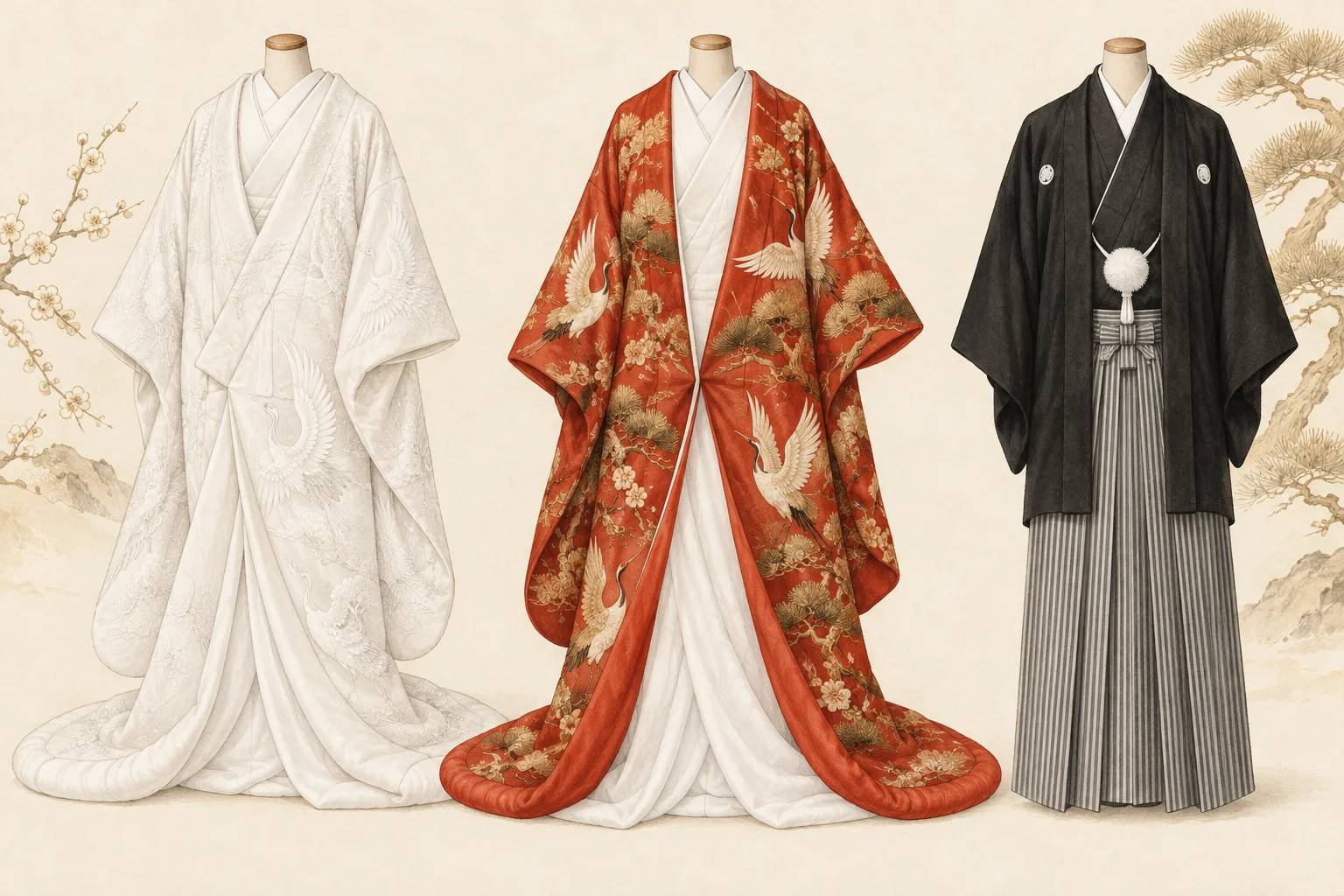
Ceremony format and bridal kimono choice are independent decisions, but certain pairings dominate. Jin-zen pairs most often with shiromuku (white kimono) for the ceremony itself and iro-uchikake (colored kimono) for the reception. Butsu-zen pairs with shiromuku or with a more subdued iro-muji (single-colour kimono). Civil jinzen-shiki has no convention — couples wear shiromuku, iro-uchikake, modern colour kimono, or Western dress as they prefer. Chapel ceremonies almost always pair with Western dress, with kimono reserved for a separate photoshoot.
The deep dive on shiromuku versus iro-uchikake walks through the visual and ritual implications of each choice. The fabric-level guides on Nishijin-ori and Yuzen-zome matter most for couples investing in premium bridal kimono.
Two related batch articles cover specific visual elements that recur in shrine ceremonies regardless of format: the maku curtain that frames the altar, and the hanayome gyoretsu bridal procession that precedes Jin-zen weddings at most major shrines.
Frequently Asked Questions
Can a foreign couple legally marry in Japan through any of these ceremonies?
No — none of the four ceremonies handles legal marriage. Legal marriage in Japan is processed at the local ward office (kuyakusho) by filing a marriage registration (konin-todoke) document. Foreign couples typically marry legally in their home country and treat the Japanese ceremony as symbolic. Couples wanting Japanese legal marriage need to submit additional paperwork through their embassy; the ceremony format is irrelevant to the legal process.
Do we need to be Shinto to have a Jin-zen ceremony?
No. Shinto has no formal conversion process and no membership requirement. Any couple of any background can book a Jin-zen ceremony at any shrine that accepts wedding bookings. Some smaller shrines prefer Japanese-language ceremonies, but major shrines and all hotel shrine-rooms handle international couples routinely.
Can we mix elements from different ceremony types?
Yes, particularly in civil ceremonies. Some couples add a san-san-kudo to a civil ceremony, or hold a brief Western ring-exchange after a Shinto ceremony, or add a juzu exchange to a civil event. Pure Jin-zen and Butsu-zen ceremonies are more structured and don't easily accept mixed elements without permission from the officiant.
How long ahead should we book?
Real-shrine Jin-zen and temple Butsu-zen at popular venues require 6-12 months booking ahead, especially for spring cherry blossom and autumn dates. Hotel shrine-rooms and civil ceremonies can sometimes be booked 2-3 months ahead at non-peak times. Premium shrines like Meiji Jingu fill cherry-blossom Saturdays 9-12 months in advance.
What's the typical cost for the ceremony alone, not the full wedding?
Ceremony-only fees: Jin-zen ¥80,000-¥500,000 depending on venue; Butsu-zen ¥100,000-¥400,000; civil jinzen-shiki ¥50,000-¥200,000; chapel ¥100,000-¥300,000. These exclude attire, hair and makeup, photography, reception, and travel — typically the ceremony itself is 5-15% of total wedding budget.
Are guests required to follow any religious protocol?
At Jin-zen and Butsu-zen ceremonies, guests are expected to bow at appropriate moments and clap during kashiwade if instructed. Guests don't need to know rituals in advance — the priest or coordinator briefs everyone before the ceremony. Foreign guests are not expected to perform unfamiliar rituals; sitting respectfully is sufficient.
Can we have the ceremony in English?
Jin-zen ceremonies are conducted in Japanese (Shinto liturgy is in classical Japanese), though some shrines provide English handout translations. Butsu-zen sutra recitation is in classical Japanese or Sanskrit. Civil jinzen-shiki can be conducted bilingually or entirely in English. Chapel ceremonies are routinely conducted in English by venues serving international couples.
Which format is best for a small wedding with under 10 guests?
Civil jinzen-shiki and chapel ceremonies handle small attendance most naturally. Jin-zen at hotel shrine-rooms works well for small parties (shrine rooms typically seat 20-40). Real-shrine Jin-zen can feel under-attended in a 100-person shrine hall with 8 guests. Temple Butsu-zen works well for very small parties — the intimate setting suits low attendance.
Choose Your Ceremony Type
The ceremony format is one of three foundational decisions for a Japan wedding — alongside venue location and kimono choice. Once you know whether you want Jin-zen, Butsu-zen, civil, or chapel, the rest of the planning sequence falls into place: photographer specialisation, kimono coordination, family logistics, and album style all flow from this single decision. Browse the curated photographer directory to find studios that match your ceremony format, then dig into our deep dives on Shinto ceremony ritual mechanics and the maku curtain altar setup that visualises the shrine environment in your album.
Locations in this guide
Related guides
 General guide
Buddhist Wedding Ceremony in Japan: Foreigner's Guide
Illustrative image · Unsplash. Not a photo of the specific people, places or services discussed.
Butsuzen-shiki explained for foreign couples: ritual order, juzu bead exchange, temple settings, sect-aware booking, and realistic planning lead time.
Read the guide General guide
Pre-Wedding vs Ceremony Kimono in Japan: Key Differences
Illustrative image · Unsplash. Not a photo of the specific people, places or services discussed.
Pre-wedding (maedori) vs wedding-day kimono shoot in Japan: cost, legal requirements, why foreign couples almost always book pre-wedding.
Read the guide General guide
Japanese Wedding: Complete Guide to Ceremony & Traditions
Illustrative image · Unsplash. Not a photo of the specific people, places or services discussed.
A planner-led guide to the modern Japanese wedding: the Shinto ceremony, kimono and Western dress, the hiroen reception, engagement traditions, and how international couples can plan a kimono photo day in Japan.
Read the guide