Kawagoe Kimono Photoshoot: Little Edo, 35 Min from Tokyo
Kawagoe — Little Edo, 35 minutes from Ikebukuro — preserves an authentic kurazukuri merchant streetscape. Our planner guide to Toki no Kane, Kashi-ya Yokocho, Hikawa Shrine, and dawn-shoot crowd timing for kimono couples.

Illustrative image · Unsplash. Not a photo of the specific people, places or services discussed.
Check current prices, availability and venue rules with the relevant studio or venue before booking.
Kawagoe — "Little Edo," 35 minutes from Tokyo Ikebukuro on the Tobu Tojo Line — preserves a kurazukuri (storehouse-style) merchant streetscape from the late Edo period, anchored by the Toki no Kane bell tower and the candy-alley nostalgia of Kashi-ya Yokocho. For couples who want an authentic Edo-period backdrop without a Shinkansen booking to Kyoto or Kanazawa, Kawagoe is the easiest day-trip from central Tokyo. We routinely send clients here as a half-day add-on to their Asakusa shoot or as a standalone Edo-merchant alternative when central Tokyo crowds become unmanageable.
Why Kawagoe for a Kimono Photoshoot
Three factors put Kawagoe on our short list for Tokyo-based couples wanting Edo atmosphere. First, the kurazukuri streetscape is genuinely preserved — these are 19th-century buildings, not reconstructions, with the soot-blackened plaster walls and tiled-eave warehouses that defined merchant Edo. Second, access from Ikebukuro at 35 minutes makes it logistically simpler than Kamakura (60 minutes) or Nikko (2 hours). Third, the town is compact: Toki no Kane, the main merchant street, Kashi-ya Yokocho, and Hikawa Shrine all sit within a 25-minute walking radius, which means more shooting time and less transit between locations.
The trade-off is daytime crowds. Kawagoe has become one of Saitama Prefecture's busiest tourist towns — roughly 7 million visitors annually — and the main kurazukuri street between 11 a.m. and 3 p.m. on weekends can be wall-to-wall with day-trippers in rental yukata. The early-morning strategy we outline below mitigates this almost entirely, but couples expecting deserted streets at midday will be disappointed.
Wedding Planner's Notes: Kawagoe works best for couples who have already done — or plan to do — their primary shoot somewhere else (a shrine ceremony in central Tokyo, a Kyoto session, or a studio set in Asakusa) and want a second, looser environmental shoot in a different aesthetic register. As a sole-location shoot, it lacks the formal-ceremony anchor that a shrine setting provides. As a complement, it's hard to beat for what it costs to add on.
Top Locations
Toki no Kane Bell Tower (1893 Reconstruction)
The Toki no Kane ("Bell of Time") is Kawagoe's defining landmark — a 16-meter wooden bell tower that has stood in some form on this site since the early 17th century. The current structure is an 1893 reconstruction after the Great Kawagoe Fire of 1893, and the bell still rings four times daily (6 a.m., noon, 3 p.m., 6 p.m.). The tower frames cleanly as a vertical backdrop from the alley directly south, with kurazukuri eaves on both sides creating a corridor effect.
Best light: the tower faces roughly east, so early morning (7-9 a.m.) gives clean front-light. Midday is washed out. The 3 p.m. bell-ringing moment is a frequently photographed candid frame if you can time arrival 10 minutes earlier to set up.
Kurazukuri Merchant Street
The 400-meter stretch of Ichibangai is the main kurazukuri corridor, lined with roughly 30 preserved Edo and Meiji-period merchant warehouses. Black plaster walls, heavy tile roofs, deep eaves, and original wooden shop fronts give a consistent period backdrop along the entire street. For walking shots and environmental portraits, this is the strongest location.
The street is a working tourist road with passing buses and rickshaws, so genuinely empty frames require either 6:30-8 a.m. shooting or careful timing between the 5-minute gaps when traffic clears. Most experienced Kawagoe photographers shoot the wider walking shots before 9 a.m. and reserve the tighter portrait frames for later, when the foreground crowd is irrelevant.
Kashi-ya Yokocho (Candy Alley)
A 70-meter cobblestone alley lined with about 20 traditional sweet shops, most of them selling dagashi (old-style penny candy), karinto (fried sugar sticks), and senbei rice crackers. The alley dates to the Meiji period and retains hand-painted signage, wooden shop fronts, and an intentionally nostalgic feel. It's narrow — about 3 meters wide — so framing is intimate by necessity, which suits couple-walking shots and detail work better than wide environmental compositions.
Wedding Planner's Notes: Kashi-ya Yokocho is the most photogenic location in Kawagoe but also heavily photographed by tourists. Realistic expectations: even at 7 a.m. you may share the alley with two or three other early shooters. By 10 a.m. it's effectively unusable for serious portraits until late afternoon. Build the candy alley as the first stop of the day.
Hikawa Shrine (1,500-Year Wedding Shrine)
Kawagoe Hikawa Shrine, founded in the 6th century, is a frequently chosen Saitama wedding shrine and a working ceremony venue. The shrine grounds include a 20-meter torii gate, a tunnel of approximately 1,500 ema (wooden prayer plaques) on the walking corridor, and a riverside grove behind the main hall. The shrine permits standard kimono photography on the outer grounds and approach, though formal photography fees and reservation requirements apply for the inner hall area.
For couples planning an actual Shinto ceremony as part of their trip, Hikawa Shrine is one of the few Tokyo-area shrines that accepts foreign couples for ceremony bookings on relatively flexible timelines (typically 3-6 months ahead versus 12+ months for Meiji Jingu). See our shinto wedding ceremony guide for the full ritual outline.
Kita-in Temple (Edo Castle Relics)
Kita-in is a 9th-century Tendai-school Buddhist temple notable for housing the only surviving structures of Edo Castle. After fires destroyed most of the castle in Tokyo, Tokugawa Iemitsu had several rooms — including his birth chamber — relocated to Kita-in in 1638. The grounds also contain 540 stone rakan statues, each with a distinct facial expression, which make for unusual environmental backgrounds. Located 15 minutes' walk southwest of the kurazukuri street, Kita-in receives noticeably lower crowd density and is our recommended afternoon location when the main street has filled up.
Kawagoe Festival Hall
The Kawagoe Festival Museum displays the elaborately carved festival floats (dashi) used in the October Kawagoe Matsuri. The interior offers a controlled, indoor backdrop with traditional float craftsmanship as the context — useful as a weather contingency or as a deliberate environmental choice for couples who want gold-leaf festival imagery rather than streetscape. Entry fee applies; commercial photography requires advance approval.
35-Minute Tokyo Access Convenience

From Tokyo, the standard routing is Ikebukuro Station to Kawagoe Station on the Tobu Tojo Line Limited Express (35 minutes) or Rapid Express (45 minutes). From Kawagoe Station, the kurazukuri street is a 20-minute walk or 8-minute bus ride. Alternative routings: Shinjuku to Hon-Kawagoe via the Seibu Shinjuku Line (60 minutes, slightly closer to the main sightseeing area), or JR Saikyo Line from Shinjuku to Kawagoe (50 minutes).
For kimono shoots, most photographers recommend the Ikebukuro Tobu Tojo route as the most direct and the route most likely to have seats for a couple in full bridal kimono carrying a small kit. The Tobu Tojo Limited Express has reserved seating that can be booked the morning of.
Route | Time | Cost (one-way) | Notes |
|---|---|---|---|
Ikebukuro → Kawagoe (Tobu Tojo LEx) | 35 min | ¥770 | Most direct; reserved seats available |
Shinjuku → Hon-Kawagoe (Seibu) | 60 min | ¥520 | Closer to old town on arrival |
Shinjuku → Kawagoe (JR Saikyo) | 50 min | ¥580 | Pasmo/Suica compatible |
Asakusa → Kawagoe (with transfer) | 70-85 min | ¥780 | Via Tobu Skytree Line + Tojo |
Best Seasons
April (Cherry Along Shingashi River)
The Shingashi River and Nakain-dori cherry corridor bloom roughly April 1-10 in normal years, with the most photogenic stretch along the Shingashi between Hikawa Shrine and the old town. Cherry plus kurazukuri streetscape is the strongest seasonal combination Kawagoe offers, and weekend crowds during bloom are intense — early-morning (6-8 a.m.) shooting is essentially mandatory. Compare with our cherry blossom photoshoot guide for booking lead times.
October-November (Sweet Potato Season, Autumn)
Kawagoe's signature sweet-potato (satsumaimo) season runs through October and November, with sweet-potato confections in every Kashi-ya Yokocho shop and seasonal decorations along the main street. Autumn foliage at Kita-in peaks roughly November 20 to early December — slightly later than central Tokyo's peak. The combination of crisp light, autumn foliage at the temple, and street decorations make November the most underrated month for Kawagoe shoots.
Kawagoe Matsuri (Mid-October Festival)
The Kawagoe Matsuri, held on the third weekend of October (typically Saturday-Sunday), is one of the largest Edo-style festivals in the Kanto region and a UNESCO Intangible Cultural Heritage event. 29 elaborately carved festival floats parade through the kurazukuri street with traditional musicians and dancers. For photography, the festival is both an opportunity (the streetscape is at its most authentically alive) and a logistical challenge (1.2 million visitors over two days, near-impossible to find shoot windows on the main street). Most photographers schedule around the festival, not into it.
Comparing Kawagoe vs Asakusa for Edo Backdrop
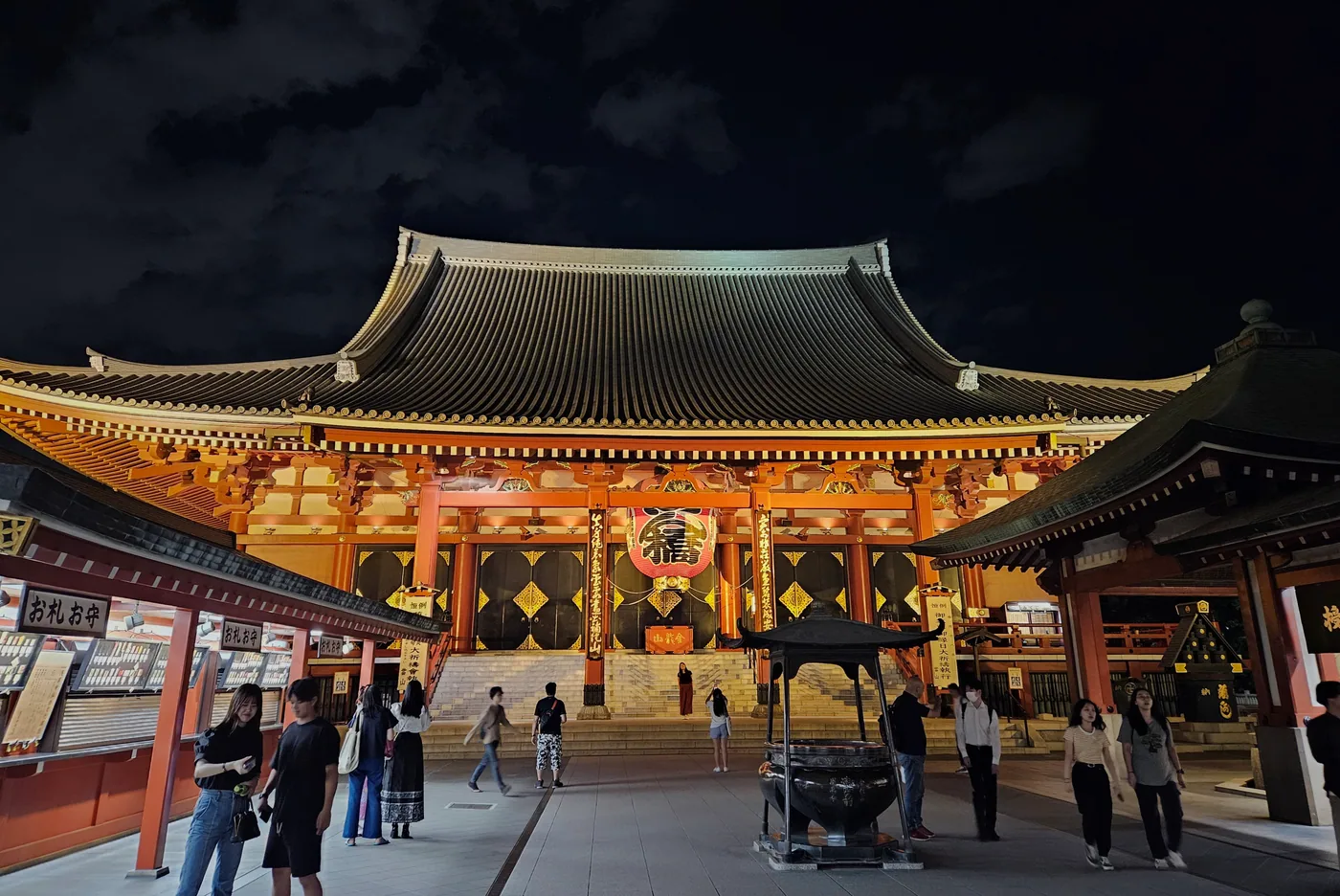

Asakusa and Kawagoe are the two main Edo-period environmental backdrops accessible from central Tokyo. They are different in character.
Factor | Asakusa | Kawagoe |
|---|---|---|
Distance from central Tokyo | 0-15 min (in city) | 35-50 min |
Era preserved | Mostly reconstructed post-WWII | Original late Edo / early Meiji |
Architectural style | Temple complex + shopping street | Merchant kurazukuri street |
Crowd density (midday) | Very high | High (weekends) |
Shrine option | Senso-ji (Buddhist temple) | Hikawa Shrine (Shinto) |
Best for | Recognizable Tokyo skyline imagery | Authentic merchant Edo |
For couples doing a single Tokyo shoot, Asakusa wins on logistics and broad name recognition. For couples who want a second, distinct environmental shoot or who are specifically researching "authentic Edo" rather than a Senso-ji backdrop, Kawagoe wins on architectural authenticity. See our full Asakusa shoot guide for direct comparison.
Tokyo Day-Trip vs Overnight Stay
For the large majority of clients, Kawagoe works as a day trip from a Tokyo base. The typical schedule: 6:30 a.m. hotel pickup with kimono dressing in central Tokyo, 7:30 a.m. transit to Kawagoe arriving 8:15 a.m., 8:30-11:30 a.m. shooting across three locations, 12:30 p.m. return to Tokyo. This keeps the couple's hotel base in central Tokyo where dining and post-shoot logistics are simpler.
An overnight in Kawagoe makes sense in one specific scenario: a couple shooting both a 5 p.m. blue-hour session (Toki no Kane illuminated against twilight sky is genuinely striking) and a 6:30 a.m. dawn session the following morning. Two ryokan and several boutique hotels in walking distance of the kurazukuri street can accommodate kimono storage and early-morning departures. Budget: ¥25,000-¥60,000 per night for couples-appropriate accommodation.
Crowd Timing Strategy
Kawagoe's crowd pattern is predictable and a major variable in shoot quality. The day-trippers arrive in waves from the morning Tobu Tojo trains, with most reaching the kurazukuri street between 10 a.m. and 11 a.m. From that point until roughly 3:30 p.m., the main street is consistently crowded with weekend density of 4-6 people per linear meter on the busiest stretches.
Wedding Planner's Notes: We schedule Kawagoe shoots in three time windows and rank them by quality:
- Best: 6:45-9:30 a.m. Empty streets, soft east light on Toki no Kane, no commercial traffic. Photographers and couple need to depart Tokyo hotel by 6 a.m.
- Good: 4:00-6:00 p.m. Crowds thin sharply after 4 p.m. as day-trippers head home. Golden hour from 5 p.m. (summer) or 3:30 p.m. (winter). Toki no Kane illuminated 6 p.m. onward.
- Avoid: 11 a.m.-3 p.m. Wide-frame photography is essentially impossible without dozens of tourists in shot.
Weekday shoots (Tuesday through Thursday) reduce midday crowd density substantially but do not eliminate it. Monday is closed-day for several Kashi-ya Yokocho shops, so the alley loses visual interest.
Photographer & Studio Availability
Kawagoe does not have a dedicated photography studio district. Most shoots are operated by Tokyo-based photographers who travel to Kawagoe for the morning, with kimono dressing handled either at a Tokyo studio before departure or at one of three rental-kimono shops in Kawagoe town. The pre-dress-in-Tokyo route is the standard for English-speaking couples because the Kawagoe rental shops are primarily geared toward Japanese day-trippers and casual yukata rentals rather than full bridal kimono.
Booking lead time: 2-4 months for weekend mornings in cherry season, 4-6 weeks for off-peak weekdays. Many Tokyo photographers offer Kawagoe as a package add-on (¥80,000-¥150,000 over a base Tokyo shoot) which often works out cheaper than a standalone session because the kimono rental and dressing are already covered. See our English-speaking photographers directory for Tokyo-based teams that work Kawagoe.
For couples building a fuller multi-day Tokyo itinerary, a Kawagoe morning pairs cleanly with an Asakusa afternoon or a Hikawa Shrine ceremony booking. For day-trip alternatives elsewhere in the Tokyo region, compare with our Kamakura and Karuizawa location guides.
FAQ
Do we need permits for the kurazukuri street?
No specific permit is required for the public street itself when shooting handheld with a single photographer and couple. Commercial-scale shoots with multiple assistants, props, or street obstruction require notification to the Kawagoe City tourism office. Most kimono shoots are treated as personal photography and do not need filings.
Can we use a tripod on the main street?
Tripods are technically permitted on the public sidewalk but actively discouraged during business hours due to crowd flow. Most Kawagoe photographers shoot handheld with off-camera flash or available light. Tripod use is more feasible during the 6:45-8 a.m. window before the street populates.
Is there a kimono rental shop in Kawagoe itself?
Yes, three kimono rental shops operate near the kurazukuri street, primarily renting day-tripper yukata and basic furisode at the ¥4,000-¥12,000 range. Bridal-grade rental (shiromuku, irouchikake, full hair-and-makeup) is generally not available in Kawagoe and should be arranged with a Tokyo studio before departure.
Can we do a Shinto ceremony at Hikawa Shrine as foreign couples?
Yes. Kawagoe Hikawa Shrine accepts foreign couples for ceremony bookings, with English-language assistance available through advance request. Booking lead time is typically 3-6 months, which is shorter than central Tokyo's major shrines. Ceremony fees and required documentation are similar to other Shinto venues — see our Shinto ceremony guide.
What about rain in Kawagoe?
The kurazukuri street's deep eaves provide partial cover, and several covered shop arcades give shelter for outfit changes. Kita-in temple's main hall and Kawagoe Festival Hall offer fully indoor backdrops. Rainy-season (June) shoots can actually benefit from softer light and dramatically reduced crowds; budget for a few rain-specific frames using clear vinyl umbrellas.
Is Kawagoe doable as a same-day add-on to Asakusa?
Same-day combination is possible but logistically tight. A workable schedule: 6:30 a.m. Asakusa dawn shoot, 8:30 a.m. transit, 9:30 a.m.-12 noon Kawagoe shoot, return for late-afternoon Tokyo dining. The couple should expect to be in kimono for 6-7 hours, which is taxing. We more often split into two separate days.
How does Kawagoe compare to Kurashiki for "preserved old town" aesthetic?
Both are preserved merchant towns, but visually distinct. Kawagoe is black-plastered Edo merchant warehouses with tile roofs. Kurashiki is white-walled storehouses along a canal with willow trees. Kurashiki feels Mediterranean in light and palette; Kawagoe feels darker, more urban-Edo. Kurashiki is a 3-day Kyoto/Osaka combination; Kawagoe is a Tokyo half-day. See our Kurashiki guide for direct comparison.
Are there food options for the couple between shooting locations?
Yes, but most of Kawagoe's specialty food (sweet potato sweets, unagi, traditional confections) is served street-side and difficult to manage while in full kimono. Most clients prefer a sit-down rest at a tea house with seating before resuming. Two ryokan-style tea rooms near Toki no Kane accommodate kimono-clad guests comfortably.
Plan Your Kawagoe Kimono Shoot
Kawagoe is an efficient Edo-merchant backdrop accessible from central Tokyo, and it pairs cleanly with the shrine, studio, or Asakusa work that anchors most Tokyo trip itineraries. The variables that matter most — early-morning crowd timing, pre-dress-in-Tokyo logistics, and proper season alignment — are not negotiable, but they're manageable with the right team.
Browse our directory of English-speaking kimono photographers in Tokyo who service Kawagoe as a half-day add-on, or read our Okayama Korakuen Garden shoot guide for couples building a wider Japan itinerary beyond the Kanto region. For broader Tokyo-area planning, our Asakusa kimono shoot guide covers the central-Tokyo Edo backdrop most often combined with a Kawagoe morning.
Related guides
 Location deep dive
Kawaguchiko Kimono Photoshoot: Mt Fuji's Iconic Vista
Illustrative image · Unsplash. Not a photo of the specific people, places or services discussed.
Plan a kimono photoshoot at Lake Kawaguchi with honest clear-Fuji probability guidance, Chureito Pagoda and Oishi Park location logistics, seasonal trade-offs, and access from Tokyo via the Fujikyu Express.
Read the guide Location deep dive
Mt Aso Kimono Photoshoot: Asia's Largest Caldera Guide
Illustrative image · Unsplash. Not a photo of the specific people, places or services discussed.
Mt Aso Kumamoto kimono photoshoot guide: 25km active caldera, grassland plains, Aso-Gogaku peaks, susuki silver grass season, Aso Boy! train access.
Read the guideLocation deep diveHagi & Tsuwano Kimono Photoshoot: Samurai Castle Town Guide
Illustrative image · Unsplash. Not a photo of the specific people, places or services discussed.
Hagi and Tsuwano in western Yamaguchi offer samurai-residence lanes and a 1,000-torii shrine path with a fraction of Kyoto's crowds. A practical guide to seasons, access, and the very limited photographer availability.
Read the guide