Mizuhiki: The Japanese Wedding Cord Decoded
A planner-led guide to mizuhiki — the knotted paper cord on Japanese wedding envelopes. Learn the awaji-musubi knot, color conventions, envelope tiers, and how foreign couples are now using mizuhiki in kimono shoots, welcome signage, and tablescapes.

Illustrative image · Unsplash. Not a photo of the specific people, places or services discussed.
Check current prices, availability and venue rules with the relevant studio or venue before booking.
Mizuhiki is the most visible decorative element on a Japanese wedding gift envelope, and the knot you choose carries a clear cultural signal. We coach foreign couples on this for two reasons. First, if you are attending a Japanese friend's reception, the envelope you hand over at reception sends a message before you say a word. Second, mizuhiki is showing up more often in foreign couples' own kimono shoots — in hair ornaments, on welcome boards, around stationery. Get the knot right and the meaning works for you. Get it wrong and a Japanese guest will quietly notice.
What Mizuhiki Is — Material, History
Mizuhiki (水引) is a decorative knotted cord made from thin twisted paper, often coated with starch and finished with foil, silk thread, or lacquer. The base material is washi paper sliced into narrow strips, twisted tightly, and stiffened so it holds its shape when bent into a knot. Inexpensive everyday mizuhiki uses a paper core; high-end ceremonial pieces wrap silk or metallic thread around it. The cord is commonly sold in standard lengths and worked dry, with the loops shaped and tightened gradually so the finish does not crease.
The history reaches back to the 7th century. Court records describe a Japanese envoy returning from Sui-dynasty China with gifts wrapped in red-and-white hemp cord, and the convention of marking ceremonial offerings with knotted cord stuck. By the Edo period (1603-1868) mizuhiki had become a formalized vocabulary: specific knots for births, deaths, weddings, seasonal gifts, even apologies. The two production centers that survive today are Iida in Nagano and Iyo-mishima in Ehime, both of which still supply most of Japan's ceremonial mizuhiki cord. Iida-mizuhiki is the more recognized name and the one most premium stationers source from.
For a couple planning a Japan wedding or photoshoot, the practical takeaway is that mizuhiki is not generic ribbon. Each knot is a sentence in a coded language, and the language is still actively read by Japanese guests.
The Wedding Knot — Awaji-Musubi (and Why Cho-Musubi Is Wrong)
The wedding knot is awaji-musubi (淡路結び), sometimes written awabi-musubi. Three interlocking loops form a flat oval shape, and the cord ends point outward like fish fins. The defining feature is that once tied, the knot cannot be loosened without cutting — pull both ends and it only tightens. That property is the entire reason it became the wedding knot. Marriage is a one-time, non-repeatable event, and the knot you choose has to symbolize permanence.
The wrong knot is cho-musubi (蝶結び), the butterfly bow you see on birthday gifts and seasonal greetings. Cho-musubi is the everyday ribbon bow — pull one end and it comes undone, then you can retie it. That undo-and-redo property makes it suitable for repeatable happy events (a child's birthday, year-end gifts) but completely wrong for a wedding. Handing over a wedding envelope tied with cho-musubi reads, to a Japanese guest, as "I hope you do this again" — a divorce-and-remarriage implication that is jarring enough to be remembered.
The third knot worth knowing is musubi-kiri (結び切り), a simpler tight square knot that also cannot be untied. Musubi-kiri appears on funeral envelopes and on get-well-soon gifts (events you do not want repeated) and is acceptable but plain for weddings. Most wedding shugi-bukuro use awaji-musubi because it is the more elaborate and celebratory of the two non-repeatable knots.
Wedding Planner's Notes
If you are buying a wedding envelope in a Japanese stationery shop or convenience store, look at the cord knot on the front. If you see three interlocking loops, it is awaji-musubi and safe for weddings. If you see a tied bow with loops on either side and trailing ends, it is cho-musubi — put it back. Konbini envelope racks in residential neighborhoods often stock both, and the wrong one is right next to the right one.
Color Conventions — Red-and-White / Red-and-Gold
Wedding mizuhiki uses two color schemes, both centered on red as the auspicious "celebration" color.
Red-and-white (kohaku) is the default. Five-strand or seven-strand cord with alternating red and white strips, sometimes with the red leaning pink-red and the white leaning cream rather than stark contrast. Red-and-white reads as the safe, expected, classical wedding palette. You see it on standard shugi-bukuro and on most ceremonial wrapping (noshi paper, gift wrap, sake bottles for engagement gifts).
Red-and-gold (kinginbiki) is a step up in formality and is used for higher cash gifts or for ceremonial pieces from senior family. The gold strand replaces the white, signaling extra prestige and resource. This is the convention for engagement gift mizuhiki (yui-no, the formal exchange of betrothal gifts between families) and for larger goshugi from grandparents or company seniors.
Avoid: black-and-white (used for funerals — the worst mistake), yellow-and-white (Kyoto funerary convention), and any pastel color combinations sold under "modern mizuhiki" branding — those are decorative craft mizuhiki, not ceremonial mizuhiki, and a Japanese guest will read them as not-quite-right for a wedding envelope.
Strand count also matters at the formal end. Five strands is standard. Seven strands is more formal. Ten or eleven strands is used for engagement-gift display pieces, not for everyday envelopes. You will not generally encounter strand-count confusion on a store-bought envelope, but if you commission a custom piece, more strands signals more formality.
Mizuhiki on Shugi-Bukuro (Gift Envelope) — How Money Amount Determines Decoration
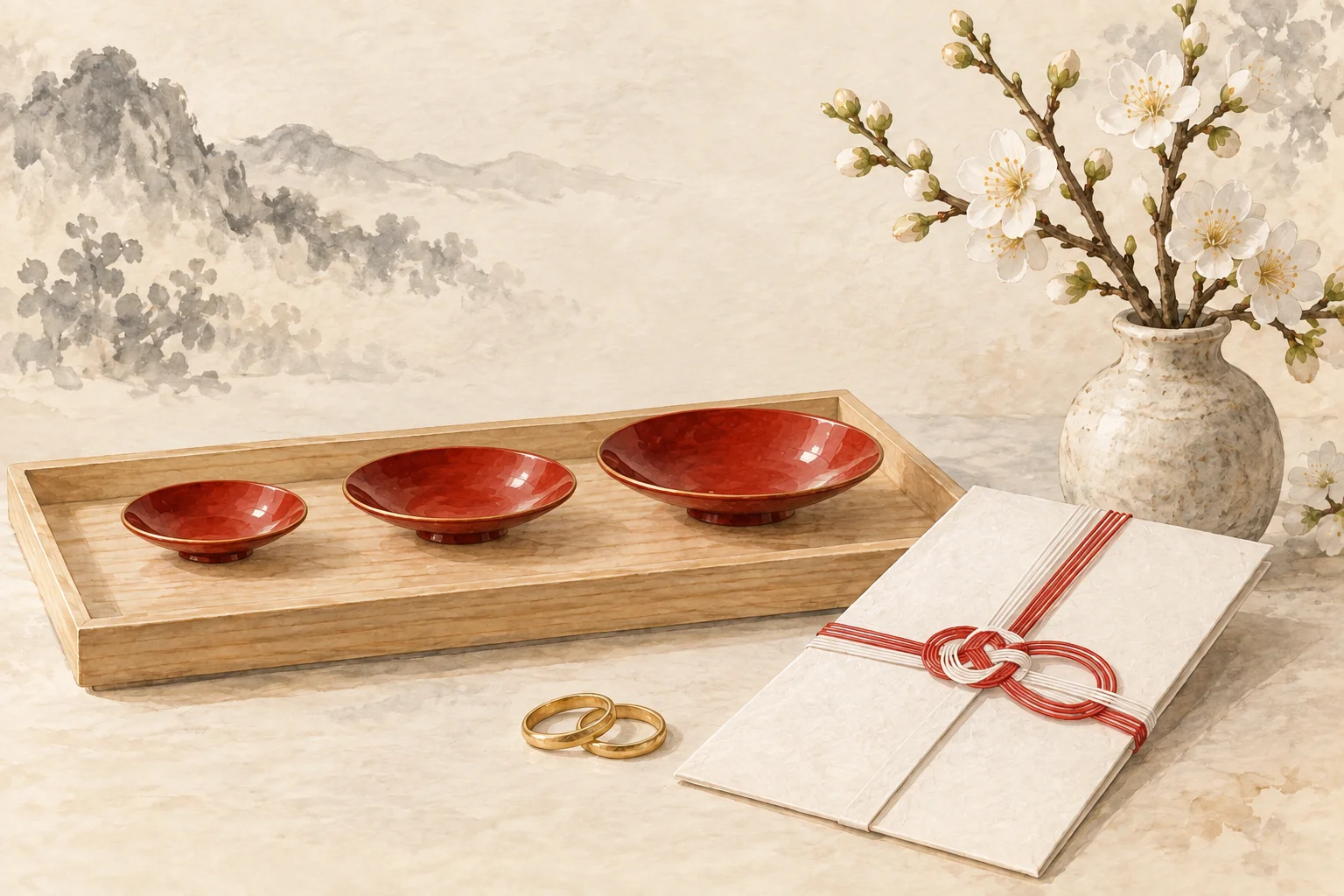
Shugi-bukuro (祝儀袋) is the cash gift envelope you bring to a wedding reception. The mizuhiki cord on the front is not just decoration — it tells the recipient roughly how much money is inside, and matching the envelope to the cash amount is part of the etiquette.
Cash amount (yen) | Envelope style | Mizuhiki |
|---|---|---|
¥10,000-¥30,000 | Simple printed shugi-bukuro | Printed mizuhiki design, red-and-white |
¥30,000-¥50,000 | Standard ceremonial envelope | Real awaji-musubi cord, 5 strands red-and-white |
¥50,000-¥100,000 | Premium envelope | Awaji-musubi or elaborate variants, 7 strands red-and-gold |
¥100,000+ | Hand-crafted ceremonial envelope | Custom mizuhiki including crane (tsuru) or pine (matsu) motifs in red-and-gold |
Using a hand-crafted ¥100,000-level envelope to hold ¥10,000 cash is bad form (showy without substance) and the reverse is worse (the receiving family will assume you missed the etiquette). Convenience stores stock the lowest tier; large stationery shops (Itoya in Tokyo, Kyukyodo in Kyoto) carry the middle and upper tiers; department-store gift counters and dedicated mizuhiki shops carry the top tier.
The standard goshugi amount from a friend attending a reception in Tokyo is ¥30,000, which means a real-cord awaji-musubi envelope is the right buy for most foreign guests. Avoid even-numbered amounts (¥20,000, ¥40,000) — even numbers can be split in half, which carries a separation implication. ¥30,000 and ¥50,000 are the safe brackets. We cover this in detail in our goshugi guide.
Beyond the Envelope — Mizuhiki Hair Ornaments, Wedding Decor, Tablescapes
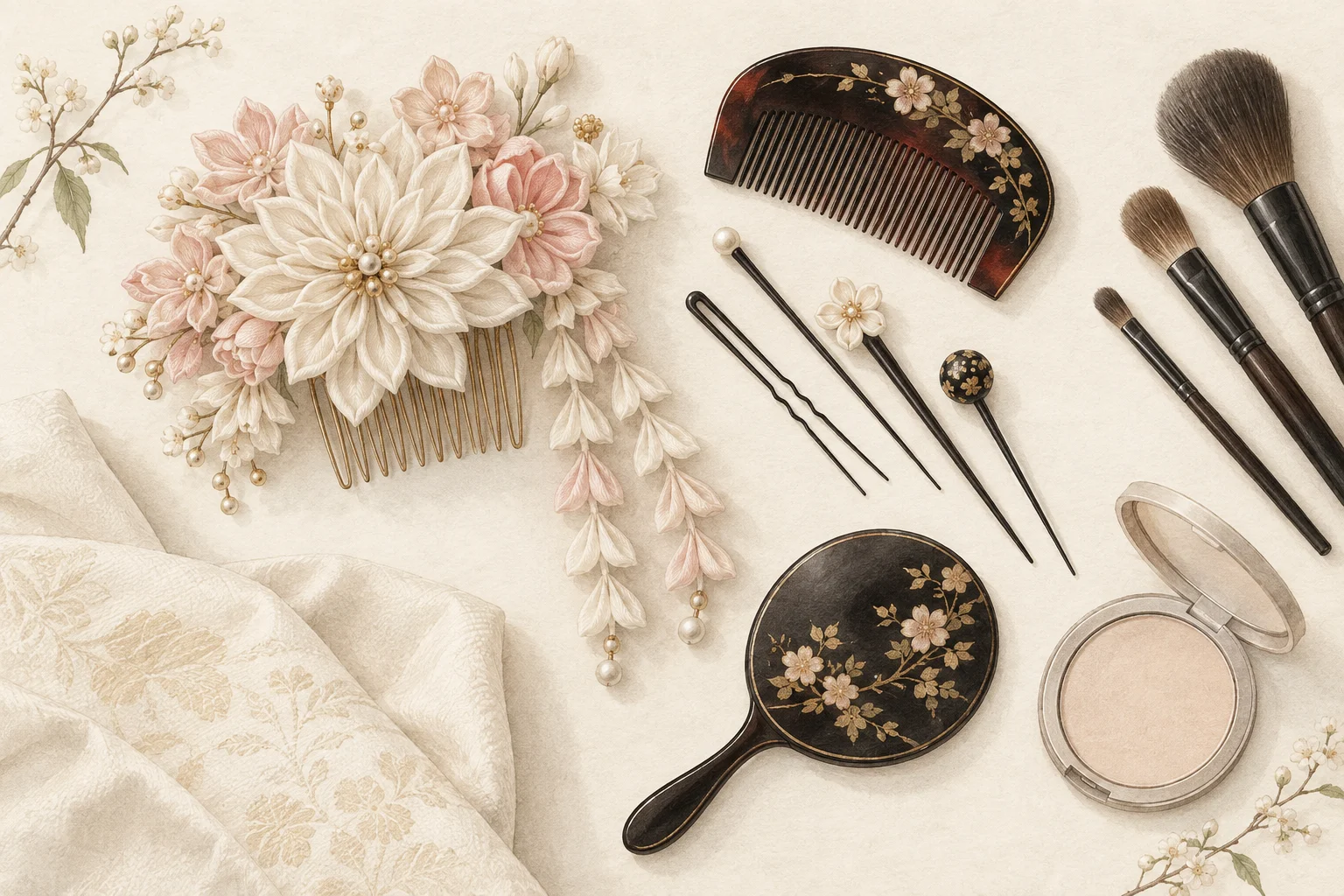
In the last five years, mizuhiki has migrated off the envelope and into the wedding aesthetic itself. Three uses are now common in foreign couples' Japan kimono shoots and small ceremonies.
Hair ornaments. Mizuhiki kanzashi — pre-tied mizuhiki shaped into crane, plum-blossom, or floral motifs and mounted on a kanzashi pin — pair well with shiromuku and iro-uchikake. The color (red-and-white or red-and-gold) ties to the kimono palette, and the knot motif (awaji-musubi or stylized auspicious forms) reads as visibly Japanese in photos without being heavy. Studios in Kyoto and Tokyo carry these as styling add-ons for around ¥3,000-¥10,000 rental, or you can buy a piece for ¥10,000-¥30,000 and keep it. Our guide to kanzashi hair ornaments covers the full bridal-kimono pin vocabulary.
Welcome board and signage decor. Couples commission mizuhiki monograms — their initials shaped from mizuhiki cord and mounted on a wooden board — as welcome signage for receptions or as decorative wall pieces for the photo session. A custom monogram from an Iida-mizuhiki workshop runs ¥15,000-¥40,000 depending on cord count and complexity. Lead time is typically 3-6 weeks.
Tablescape and place cards. For small private receptions, mizuhiki napkin rings, place-card holders, and centerpiece accents replace Western ribbon. The visual is restrained — small clean knots in red-and-white against the table — and reads as deliberately Japanese without going full-traditional. We see this often paired with seasonal florals in Karuizawa and Kyoto private receptions.
If you are also planning the broader reception aesthetic, see our notes on Japanese wedding lanterns and decor for the chochin lantern conventions that pair with mizuhiki.
How to Make a Mizuhiki Knot (Brief Guide)
The awaji-musubi knot has a learning curve but is teachable in about 30 minutes with a single cord. We sketch the basic sequence so you know what to expect at a workshop.
- Take a single mizuhiki cord and bend it in half so you have a U-shape with two equal ends.
- Lay the U flat on the table with the bend at the top. Cross the right end over the left end about one-third of the way down, forming an oval loop at the top.
- Take the left end and pass it up through the oval loop from underneath, then bring it down and over to the right.
- Take the right end and weave it: over the first cord, under the second, over the third. This forms the three-loop interlocked pattern.
- Gently tighten by pulling both ends evenly while shaping the three loops with your fingertips. Do not yank — the cord will kink. Tighten in small increments, checking that the three loops stay symmetrical.
- Trim the ends to equal length, usually about 5-7 cm of trailing cord on each side.
The hardest part is step 4 (the weave) and step 5 (the even tightening). Mizuhiki cord has memory — once kinked, the kink is visible — so the rhythm is patient, slow, and steady. Single-color cord costs about ¥50-¥100 per length; bulk practice packs are sold at craft shops in Asakusa and Sanjo (Kyoto).
Mizuhiki Workshops in Tokyo and Kyoto for Foreign Couples
If mizuhiki interests you as more than envelope etiquette, several workshops in Tokyo and Kyoto run English-friendly sessions for foreign visitors. We do not endorse specific operators, but we describe what to look for.
Format. A single-session workshop is 90-120 minutes and teaches one knot (usually awaji-musubi) plus a simple finished piece — a chopstick rest, a small ornament, or a card decoration. Fees run ¥3,000-¥6,000 per person and include materials. Larger workshops in studio settings teach multiple knots over a half-day for ¥8,000-¥15,000.
Location. In Tokyo, workshops cluster in Asakusa, Yanaka, and Kappabashi — neighborhoods with traditional craft culture. In Kyoto, they cluster around Higashiyama and Nishijin. Some kimono shoot studios in Kyoto bundle a short mizuhiki session as a pre-shoot cultural add-on, which we recommend if you want the experience without booking a separate day.
English support. Confirm in writing before booking. Many traditional-craft workshops are run by senior artisans whose English is limited, and a translator is added for foreign guests. Quality varies — ask the booking agent to confirm a translator will be present, not just "English-speaking welcome."
Take-home. A workshop is a souvenir activity, not a craft mastery course. You will leave with one finished piece and basic familiarity with one knot. If you want a custom mizuhiki monogram or wedding piece, commission it from a workshop studio separately — the workshop is for learning, the commission is for output.
Pair a mizuhiki workshop with our broader cultural-integration suggestions in the Japanese wedding traditions and customs guide, and review reception flow in our notes on sekiji seating chart conventions and shukuji speech etiquette.
Frequently Asked Questions
Can I reuse mizuhiki from a wedding envelope as a keepsake or decoration?
Yes, and many recipients do. The cord is the work-intensive part of the envelope and is often saved, mounted in a shadow box, or used as a Christmas ornament base in later years. There is no taboo against keeping it; the etiquette concern is only about the original gift, not what happens to the cord afterward.
Are there regional mizuhiki conventions I should know about?
Mostly minor. Iida-mizuhiki (Nagano) and Iyo-mizuhiki (Ehime) differ slightly in finish — Iida cord is glossier, Iyo cord is matte — but the knot conventions are uniform nationwide. The exception is Kyoto, where some traditional families still use yellow-and-white cord for non-Buddhist memorial events, so avoid yellow on any envelope you bring to a Kyoto-area wedding to prevent ambiguity.
If I forget to bring a shugi-bukuro envelope, can I just hand over cash in a regular envelope?
Cash without ceremonial wrapping is read as quite informal — acceptable from a foreign friend at a small casual reception, awkward at a formal reception. The fix takes five minutes: convenience stores near the venue (Family Mart, Lawson) stock printed shugi-bukuro for ¥100-¥500. Buy one on the way and transfer the cash.
Can mizuhiki be incorporated into a Western-style wedding ceremony?
Yes, and we see this often with couples doing fusion ceremonies. Mizuhiki monograms on welcome signage, mizuhiki napkin rings, or mizuhiki ring-pillow accents bring a Japanese visual element into an otherwise Western reception. Stick to red-and-white or red-and-gold for celebratory tone, and avoid the funerary colors. See our notes on Japanese-themed weddings abroad for fuller integration ideas.
What does the crane (tsuru) motif on premium mizuhiki envelopes mean?
Cranes symbolize 1,000-year longevity in Japanese folklore and pair with turtles (10,000 years) as the standard longevity pairing. A mizuhiki envelope shaped or decorated with a crane motif carries the wish for a long marriage. Pine (matsu), bamboo (take), and plum (ume) — the "three friends of winter" — are the other auspicious motifs you may see on top-tier envelopes.
How early should I commission a custom mizuhiki piece for my wedding?
Workshop studios typically need 3-6 weeks for a custom monogram or large decorative piece. Tight timelines (under 2 weeks) are sometimes accommodated for surcharge. If you want a custom mizuhiki kanzashi for your kimono shoot, book it at the same time you book the shoot to allow for lead time and to coordinate the color with your kimono.
Do all Japanese wedding guests notice the mizuhiki knot?
Older guests and traditional families almost certainly. Younger urban guests are less likely to consciously check, but the etiquette is still well-known enough that a wrong knot is noticed by someone in the room. Treat it as a low-effort, high-signal detail to get right rather than a hidden concern.
Plan Your Japanese Wedding
Mizuhiki is the smallest piece of the wedding aesthetic that carries the most coded meaning, and a foreign couple who handles the knot, color, and envelope tier correctly gets read as serious about the culture. Browse our curated directory of kimono wedding photographers — many of our featured studios in Kyoto and Tokyo can coordinate mizuhiki styling and pre-shoot workshops alongside your kimono session.
For your next read, continue with our companion guides to Japanese wedding seating charts (sekiji) and wedding speech etiquette and taboo words.
Related guides
 General guide
Post-Shoot Revision Rounds & Edit Policy: Japan Studio Rules
Illustrative image · Unsplash. Not a photo of the specific people, places or services discussed.
One round of color and exposure tweaks is included; further rounds run ¥10,000-¥30,000 each with a 5-10 photo cap; full re-grades are priced as new edit jobs (¥50,000-¥150,000). Lock your color grade at contract time to avoid expensive post-delivery revisions.
Read the guide General guide
Dietary Restrictions Japanese Wedding Meal: Vegan, Halal Guide
Illustrative image · Unsplash. Not a photo of the specific people, places or services discussed.
Dietary restrictions at a Japanese wedding meal: halal venue gaps, vegan kaiseki tiers, allergy protocols, and the 3-4 week notification timeline planners require.
Read the guideGeneral guideMultilingual Wedding Photography Japan: Beyond English
Illustrative image · Unsplash. Not a photo of the specific people, places or services discussed.
A planner's audit of which languages — Korean, Mandarin, Spanish, French, JSL — Japanese kimono studios actually support, plus interpreter costs and when to hire one.
Read the guide