Couple Pose Guide for Kimono Photography: What Works
Couple pose guide for kimono photography: how kakeshita weight, 30-40cm step length, and obi knots reshape what works — and what to skip.

Illustrative image · Unsplash. Not a photo of the specific people, places or services discussed.
Check current prices, availability and venue rules with the relevant studio or venue before booking.
Kimono restricts couple posing in specific, measurable ways that Western wedding dress does not. The bridal kakeshita is heavy at the shoulders, the hem limits forward step to roughly 30-40cm, and the obi knot prevents free rotation of the torso. The posing vocabulary that works has had to adapt over generations, and understanding it before the shoot is what separates an album that flows from one full of stiff, near-miss frames. This guide walks through the five categories experienced kimono photographers actually use.
How Kimono Restricts Movement
Before discussing what poses work, it helps to understand precisely what the garment will not let your body do. Almost every awkward kimono couple photo traces back to a pose being attempted against one of four physical constraints. A photographer who has shot kimono for years works around these without thinking. A photographer used to Western dress who has not adjusted yet will keep asking for poses that look fine in a viewfinder but break the kimono silhouette.
Shoulder and Neck (Heavy Kakeshita)
A formal bridal kakeshita with full embroidery weighs between 4 and 7 kilograms — most of it concentrated at the shoulder seam and the lower hem. This shifts your natural posture: shoulders pull back and slightly down, the chin lifts, and the neck has roughly half its usual range of side-to-side rotation. Tilting your head playfully toward your partner — a default Western pose — will either look forced or pull the collar (eri) out of alignment. Working photographers ask for chin and eye direction shifts, not full head tilts.
Step Length (30-40cm Limit)
The kakeshita hem ties around your ankles in a way that limits forward stride to 30-40 centimetres — about half a normal walking step. Two consequences follow. First, walking shots have to be choreographed; you cannot stride normally. Second, anything that requires moving distance quickly — running, jumping, climbing steps in sequence — is off the table without significant garment lift, which itself ruins the silhouette.
Hem Lift (Both Hands Needed)
When you do need to lift the hem — to climb a shrine step, to walk on uneven ground, to clear a wet stone path — the gesture is two-handed and deliberate. You gather a small bunch of the kakeshita at hip height with both hands and lift maybe 5-10cm. This is fine in photos; it can even be elegant. But it means your hands are committed. Holding your partner's hand, holding a fan, or holding flowers must wait until you are stationary again.
Back Rotation (Obi Knot)
The fukura-suzume bridal obi knot sits at the small of your back and is structurally rigid. It restricts how far you can twist your torso — roughly 20 degrees in either direction, against the 60-90 degrees most poses assume. Quarter-turn poses where the bride angles her body toward the groom work; full pivots where she turns to look behind her shoulder do not.
The Five Standard Pose Categories
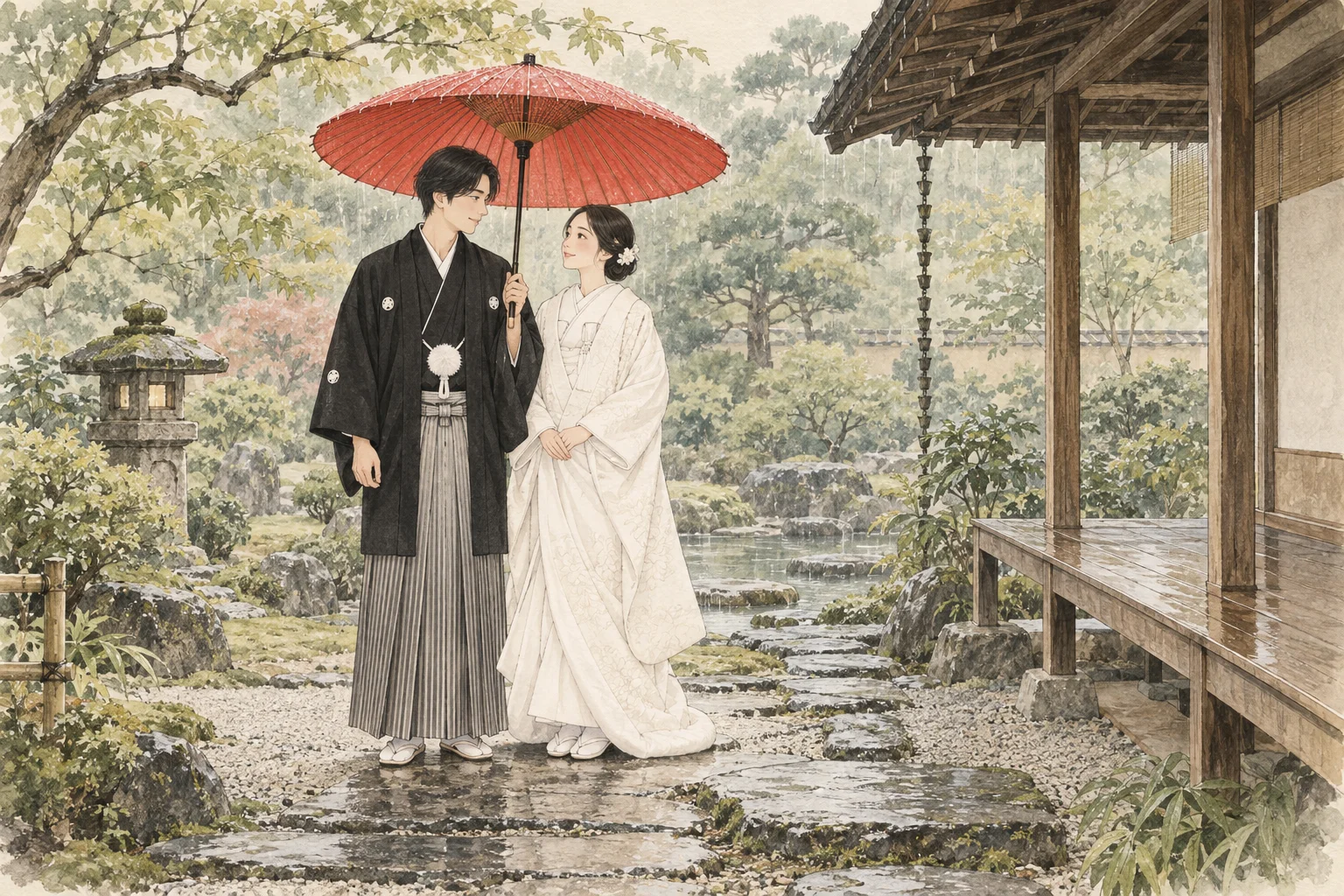
Japanese bridal photographers work from a vocabulary of five basic pose categories. Almost every frame in a finished album is a variation on one of these. Knowing the categories in advance helps you and your partner relax — you are not improvising, and your photographer is not inventing. You are building from a shared shorthand.
Standing Portraits (Kakei Kimi-Tachi)
Formal standing portraits — what Japanese photographers call kakei kimi-tachi, roughly "ceremonial standing arrangement" — are the foundation of any kimono album. Both partners stand, facing the camera or each other, with weight evenly distributed and hands placed in specific positions. The bride often holds a folded fan; the groom rests his hands at the seam of his hakama. These are not casual; they are composed, and they read as a tribute to the formality of the garment.
Walking Shots (Aruki)
Walking shots, called aruki, are the closest kimono gets to candid energy. The bride takes 30-40cm steps, the groom matches her pace, and the photographer captures the rhythm at a slow shutter that softens motion just slightly. Done well, these are some of the best frames in a kimono album. Done without rehearsal, they look like two people stiffly marching in place.
Seiza Seated
Seated poses in formal seiza — kneeling with feet folded under — are central to Shinto wedding portraits and are physically demanding. Most Westerners can hold seiza for 5-10 minutes before circulation in the legs becomes a problem. The bridal kakeshita makes the posture harder because the hem must be arranged carefully around your knees. Photographers schedule seiza frames in short bursts and give you a chance to stand and walk between them.
Looking at Each Other (Mitsume)
The mitsume pose — literally "looking [at each other]" — is the close-up where both partners face inward, eyes meeting, often at three-quarter profile to the camera. This is one of the few poses where the kimono's physical restrictions actually help: the limited shoulder rotation forces a natural, slightly formal head turn that looks composed rather than theatrical.
Reaching for Object (Ikebana, Sake Cup)
Reaching poses involve one or both partners interacting with an object — a sake cup during the san-san-kudo ritual, an ikebana arrangement during a reception setup shot, a folded fan being opened. These are favourites of editorial photographers because the prop gives the hands something to do and breaks the symmetry of standing portraits.
Standing Pose Variations
Within the standing category, three sub-variations cover most album frames. Knowing which one your photographer is asking for makes communication on the day significantly faster.
Side-by-Side Formal
Both partners face the camera squarely, shoulders aligned, with maybe 10-20cm between them. The bride's hands hold a folded fan at waist height; the groom's hands rest at the front of his hakama. This is the pose that anchors the formal section of every kimono album — typically the cover image or the centrepiece spread. It is also the easiest to get right, which is why photographers shoot it first while you are still warming up.
Quarter-Turn Engagement
One or both partners angle their bodies 30-45 degrees toward each other while keeping their heads turned partly toward the camera. This is the most flattering standing variation for the bride because the slight turn slims the visual silhouette of the kakeshita without forcing torso rotation past the obi's limits. Couples who feel stiff in full-frontal poses usually loosen up here.
Hand-on-Obi Adjustment
The bride brings one hand up to lightly touch or adjust the front of her obi while the groom watches from a half-step behind. This is a quiet, intimate variation that reads as the moment before the formal pose settles. It works particularly well in studio portraits where lighting can isolate the gesture.
Walking Pose Mechanics
Walking poses look effortless in finished albums but require the most rehearsal of any kimono pose category. Three mechanics matter. First, both partners step with the foot closest to the camera first — this keeps the kimono hem from twisting in frame. Second, the bride's free hand should rest lightly on the groom's arm or be held in his; trying to walk hand-in-hand with arms swinging will throw off her balance. Third, the photographer typically asks you to walk past a marked point rather than toward the camera — this lets the focal plane stay sharp without you having to judge distance.
Wedding Planner's Notes. A practical trick we coach foreign couples on: take three or four steps, stop, look at each other naturally for two seconds, then take three or four more. The photographer is shooting during the brief pause, not during the walk itself. This breaks the "I am being photographed mid-stride" awkwardness that ruins so many walking frames.
Seiza Pose Physical Demands
Seiza is the hardest standard pose for couples not used to floor seating, and it is unavoidable for any shoot that includes a Shinto ceremony recreation or a tea-house interior. Five practical points to know in advance. First, kneel from a standing position by lowering one knee at a time, not both at once — the kakeshita hem will not let you drop straight down. Second, your feet should be folded flat under your seat with the tops of your feet pressed to the floor, not curled. Third, your hands rest on your thighs with fingertips meeting at the centreline. Fourth, the groom kneels in hakama with knees slightly wider than the bride's. Fifth, hold the position for 3-5 minutes maximum at a time before standing and shaking out your legs; the photographer can compose the next setup while you recover.
For couples concerned about knee comfort, ask the studio about a hidden cushion — most can provide a thin pad that goes under the kakeshita hem and is invisible in frame. See also the kimono photoshoot day timeline for how seiza segments fit into a typical day.
Mitsume Close-Up Composition
The mitsume close-up is where many couples take their favourite frame from a kimono shoot. The composition is tight — typically a shoulders-up frame with both faces close to centre — and the directing question is always how close the heads should come. Two conventions help. First, foreheads should not touch; this works in Western dress but with kimono it crushes the bride's hair ornament (kanzashi) and looks awkward. Second, the photographer composes for a 10-15cm gap between cheeks, which reads as intimate without disturbing the hair styling. The bride's chin lifts very slightly toward the groom; the groom's chin lowers very slightly toward her. Eye contact is held for two to three seconds — long enough for the photographer to fire a sequence, short enough that the expression stays natural.
What NOT to Try in Kimono
A short list of poses we routinely steer foreign couples away from. None of them are bad ideas in Western dress; all of them break the kimono silhouette in ways that show up in the final album.
- The dip. Bending the bride backward over the groom's arm is unworkable — the obi knot prevents the back arch and the kakeshita hem swings wildly out of frame.
- The lift. Picking the bride up requires lifting the kakeshita with her, which is heavy enough that most grooms cannot manage it gracefully.
- Twirling. Spinning the bride for a fabric-flare shot works with a wedding gown skirt; the kimono is structurally tubular and does not flare.
- Running shots. The 30-40cm step limit makes this physically impossible without lifting the hem with both hands, which removes any candid quality.
- Over-the-shoulder back glances. The obi limits the necessary torso rotation; the result looks stiff rather than playful.
- Forehead-to-forehead. Crushes the kanzashi and disturbs the wataboshi or tsunokakushi headpiece.
- Hand-through-arm walking. Pulling on the groom's arm tugs the bride's sleeve, which then drapes wrong for the rest of the shoot.
If you have favourite Western-dress engagement photos you want to recreate in kimono, send them to your photographer in advance and ask which translate. A good photographer will say no to roughly half of them and propose kimono-native equivalents for the rest. See also Western dress vs kimono photoshoot for the broader trade-offs.
Pre-Shoot Pose Rehearsal
Many studios include a brief pose rehearsal at the start of the shoot — usually 10-15 minutes after dressing finishes but before formal shooting begins. Use this. Walk a few steps, practise the quarter-turn, kneel briefly into seiza and stand again, hold the mitsume position for the photographer to check sight lines. The point is not to memorise choreography. It is to feel how the kimono moves with your body so that when the photographer calls for a pose, you can find it in one try rather than three.
If your studio does not include this by default, ask. Most will accommodate it without adding cost, and the time investment pays back many times over in the quality of the resulting frames. For more on what your shoot day looks like, see how long a kimono photoshoot takes.
Foreign-Bride Specific Considerations
A few notes specific to non-Japanese brides. First, height: the kakeshita is cut for an average Japanese bride of around 158-162cm. Taller brides will find the hem slightly short and the obi proportions slightly low — both of which affect pose composition. The photographer compensates by framing tighter and avoiding full-length walking shots from low angles. See body type kimono fitting for foreign brides for detail.
Second, shoulder width: Western shoulder structure is often broader, which makes the kakeshita pull slightly tight across the upper back. This is not visible from the front but shows in side angles, so photographers favour three-quarter and frontal compositions over profiles.
Third, hair styling: foreign hair textures interact differently with traditional kanzashi placement. If your hair is being styled by the studio, the trial run that some studios offer is worth the half-day investment — the resulting compositions are noticeably more confident when the hair sits as planned.
For couples planning both photo and video coverage, the pose vocabulary above applies equally to prewedding video versus photo — though video adds its own constraints around extended hold times that you should discuss with your team in advance. And once the shoot is finished, the detail shot checklist covers the secondary frames that round out a complete album.
Frequently Asked Questions
How long can I realistically hold a seiza pose during shooting?
Most foreign brides comfortably hold seiza for 3-5 minutes at a time before circulation becomes uncomfortable. Plan for the photographer to shoot a seiza setup in two or three short bursts rather than one long sitting. If you have knee issues, mention this before booking — most studios can accommodate a half-kneeling alternative.
Can my partner and I hold hands in walking shots?
Yes, but the photographer will usually ask the bride to rest her hand lightly on the groom's forearm rather than full hand-in-hand with swinging arms. The 30-40cm step limit makes synchronised arm-swing walking nearly impossible without one partner pulling on the other.
What if I can't get into seiza at all?
Tell your photographer at booking. Several alternatives exist: agura (cross-legged seating with kakeshita arranged around it), a low-stool seated pose with the hem covering the stool, or a kneeling pose with one knee up. All produce usable formal frames; the choice depends on which traditional setting you want to recreate.
Should we practise poses at home before the shoot?
Not in the kimono — you almost certainly will not have access to one. But you can rehearse the standing-and-walking rhythm in normal clothes. Practise taking small steps in coordinated pairs, pausing every few steps to look at each other for two seconds. The muscle memory carries over.
How do we handle pose direction if the photographer's English is limited?
Most directing happens through demonstration rather than verbal instruction — the photographer or assistant will model the pose first, then mirror you into it. If you book a fully English-capable studio (see our directory of English-speaking photographers), verbal direction is no obstacle. For non-English studios, expect more physical demonstration; the result is often clearer than verbal direction anyway.
Can we incorporate our own pose ideas into the shoot?
Yes, with the caveat that some Western pose ideas do not translate (see the "what not to try" list above). Send 5-10 reference images to your photographer at least two weeks before the shoot. They will tell you which translate directly, which can be adapted, and which simply will not work in kimono. A photographer who says "yes" to everything without comment is less experienced than one who pushes back on half your ideas.
How many poses should we expect to do during a half-day shoot?
A typical 3-4 hour shoot covers 15-25 distinct pose setups, plus dozens of micro-variations within each. The variation within a setup matters more than the count of setups — a skilled photographer will shoot 30-50 frames in a single standing portrait position, adjusting micro-expressions and head angles.
Find a Photographer Who Directs Couple Poses
Pose direction is one of the clearest tells between an experienced kimono photographer and a generalist who shoots kimono occasionally. Ask any photographer you are considering to walk you through their standard pose categories and which Western pose conventions they actively adapt away from. The answers will tell you more than any portfolio review. Browse our directory of kimono wedding photographers — every listed studio has been vetted for pose-direction fluency with foreign couples. Then read our prewedding video versus photo comparison and the detail shot checklist for kimono albums to round out your shoot plan.
Related guides
 General guide
Detail Shot Checklist for the Kimono Wedding Album
Illustrative image · Unsplash. Not a photo of the specific people, places or services discussed.
A 15-25 frame detail shot checklist for kimono wedding albums: obi knots, kanzashi, han-eri, family crests, paired hands. Coordinate the list with your studio 7-10 days pre-shoot and block 30-60 minutes on the day timeline.
Read the guide General guide
Reading a Japanese Photographer Portfolio: Signals & Red Flags
Illustrative image · Unsplash. Not a photo of the specific people, places or services discussed.
Learn the five quality signals and red flags when reading a Japanese photographer portfolio — vetting kimono studios before you book from abroad.
Read the guide General guide
Cinematic vs Editorial vs Documentary Kimono Photography
Illustrative image · Unsplash. Not a photo of the specific people, places or services discussed.
Compare cinematic, editorial, and documentary kimono photography styles. Planner guide to matching aesthetic, pacing, and album feel to your Japan shoot.
Read the guide