Yakushima Kimono Photoshoot: Ancient Forest UNESCO Setting
A Yakushima kimono photoshoot — UNESCO cedar forest, 4-10 m annual rainfall, ferry-and-flight access. Wedding planner's notes on compositions, weather buffers, photographer sourcing, and Kagoshima logistics.

Illustrative image · Unsplash. Not a photo of the specific people, places or services discussed.
Check current prices, availability and venue rules with the relevant studio or venue before booking.
A Yakushima kimono photoshoot is one of the more logistically demanding location plans we run in Japan, and also one of the most visually distinct. The island sits 60 km off Kagoshima Prefecture, designated UNESCO Natural Heritage in 1993 for the surviving stands of 1,000+ year-old sugi cedars. Couples come here because no other Japanese setting produces this kind of frame: a bride in shiromuku against moss-skinned granite, a groom in montsuki haori beside a cedar wider than three people can encircle. Almost everything else about the shoot — weather, transport, photographer sourcing — is harder than a Kyoto or Tokyo plan. This guide covers what you trade for the image.
Why Yakushima for a Kimono Photoshoot
The argument for Yakushima is short: the island contains primary forest of a type that has been removed from most of mainland Japan. Yakusugi (the Yakushima cedars) grow slowly in the granite-and-rain environment, producing trees with denser grain and longer lifespans than mainland sugi. Jomon Sugi, the best-known specimen, is dated between 2,170 and 7,200 years old depending on the methodology; the conservative number still makes it the oldest documented tree in Japan.
For kimono work, this changes the visual register. A shiromuku reads as a ceremonial object against shrine architecture; the same garment against a 1,500-year-old cedar reads as a small human figure in geological time. Photographers who work here — most of them based on Kyushu rather than Yakushima itself — describe it as the closest Japanese equivalent to working in Iceland or Patagonia, where the landscape carries the frame and the subject becomes scale reference.
Wedding Planner's Notes: couples typically choose Yakushima for one of two reasons. The first is animation reference — the island's mossy interior was a primary visual source for Hayao Miyazaki's Princess Mononoke, and Studio Ghibli fans want to stand inside that frame. The second is honeymoon overlap with a Kyushu onsen trip. We rarely see Yakushima chosen as a couple's first or only Japan kimono shoot; it almost always follows a Kyoto or Tokyo session as a second, more adventurous location.
Top Compositions
Yakushima's photographable interior breaks into roughly five zones with different access difficulty. We rank them below in order of visual draw, not ease — the headline setting is also the most difficult to reach in kimono.
Jomon Sugi Approach (Difficult but Striking)
Jomon Sugi sits on the Arakawa Trail in the Yakushima interior. Round-trip from the trailhead at Arakawa-tozanguchi is 22 km on foot, 10 to 11 hours of walking, including a 2 km section along a disused railway tie bed. The tree itself is enclosed by a viewing platform installed in 2012; you cannot approach the trunk.
For kimono photography, the full hike is impractical. Couples who want a Jomon Sugi composition typically photograph at viewpoints earlier on the trail — Wilson's Stump, a hollowed-out stump roughly 4 km in, is the more realistic compromise. Wilson's Stump is the heart-shaped opening visible in most Yakushima travel imagery, large enough for two people to stand inside in formal dress. Reaching it still requires a 3 to 4 hour round trip from the trailhead, in hiking footwear, with kimono carried in protective garment bags and changed at the location.
This compositions tier is for couples who are comfortable hiking and willing to invest in porter or guide assistance for the kimono itself. Plan a separate day; do not stack other shoots on the same date.
Shiratani Unsuikyo (Mononoke Hime Setting)
Shiratani Unsuikyo is the ravine-forest commonly referenced as Miyazaki's visual source for Princess Mononoke. The Taikoiwa Trail is the most accessible route — 4 hours round trip, with the famous Mononoke moss forest reachable in 90 minutes from the parking area.
In practice, this is the kimono location we book most often on Yakushima. The trail is wide enough for a small two-person team (photographer plus light assistant), and the moss density on Mizukoshi-zaka stretch gives the green-glow palette that defines the Yakushima look. Couples can photograph here in a half-day, return to lodging, and travel onward the next morning.
Yakusugi Land (Easier Access)
Yakusugi Land is a developed forest park with four trail loops ranging from 30 minutes to 150 minutes. Several major yakusugi specimens — Buddhasugi, Kigensugi, Sennensugi — stand within the 30 to 80 minute loops. The boardwalks are constructed enough to walk in zori sandals with care.
For couples who want Yakushima imagery without the hike commitment, this is the standard choice. The compositions are less dramatic than Shiratani's moss forest, but the trees are individually larger and the lighting is easier to control with the more open canopy. Many couples combine a 90-minute Yakusugi Land morning session with a Senpiro waterfall afternoon.
Senpiro no Taki Waterfall
Senpiro no Taki is a 60 m waterfall in the southern part of the island, viewable from a designated platform 15 minutes' walk from the road. The waterfall drops through a V-shaped granite gorge; the kimono frame here is platform-side rather than waterside.
The composition is graphic rather than intimate — wide negative space, the bride's red iro-uchikake reading as a single saturated point in a grey-green landscape. We recommend this as a 45-minute session rather than the day's main shoot.
Mt Mocchom Trail
Mt Mocchom (Mocchomu-dake, 940 m) anchors the southeast coast and is the granite peak visible from most south-island viewpoints. The full summit hike is a 10-hour technical climb and is not a kimono option. The Janokuchi-no-Taki viewpoint at the trail base, however, frames Mocchom's vertical granite face behind the waterfall — a single composition viewpoint reached by a 30-minute walk from the parking area.
This is a secondary stop, useful for couples who want a non-forest Yakushima frame to differentiate from their mainland sessions.
Best Season (April-May, October-November)
Yakushima has two viable windows for kimono work, both shoulder seasons.
April to mid-May: spring temperatures (15-22°C in the lowlands), reduced rainfall compared to June-July, fresh moss growth at peak green saturation. Sakura on the lower elevations peaks late March; by mid-April the upper trail forests show new-leaf green on the deciduous understory, contrasting with the evergreen sugi.
October to mid-November: autumn temperatures (16-23°C lowlands), the second-driest stretch of the year, and the brief autumn colour window. Yakushima's autumn foliage is subtle — the island is primarily evergreen — but maples and other deciduous species along trail edges add red and orange highlights. This window is also typhoon-free more reliably than September.
Month | Avg Rainfall (mm) | Temperature Range | Kimono Suitability |
|---|---|---|---|
April | 270 | 13-20°C | Recommended |
May | 360 | 17-23°C | Recommended early-mid |
June | 490 | 21-25°C | Avoid — rainy season |
July | 290 | 25-29°C | Possible, hot |
September | 410 | 23-27°C | Avoid — typhoon risk |
October | 270 | 20-25°C | Recommended |
November | 180 | 15-21°C | Recommended |
We do not book Yakushima in June, September, or December-February. Winter is technically possible but the upper trails close intermittently for ice, and the lowland weather pattern shifts to a low-cloud cycle that suppresses the green saturation that justifies coming here.
Weather Reality (4-7m Annual Rainfall)
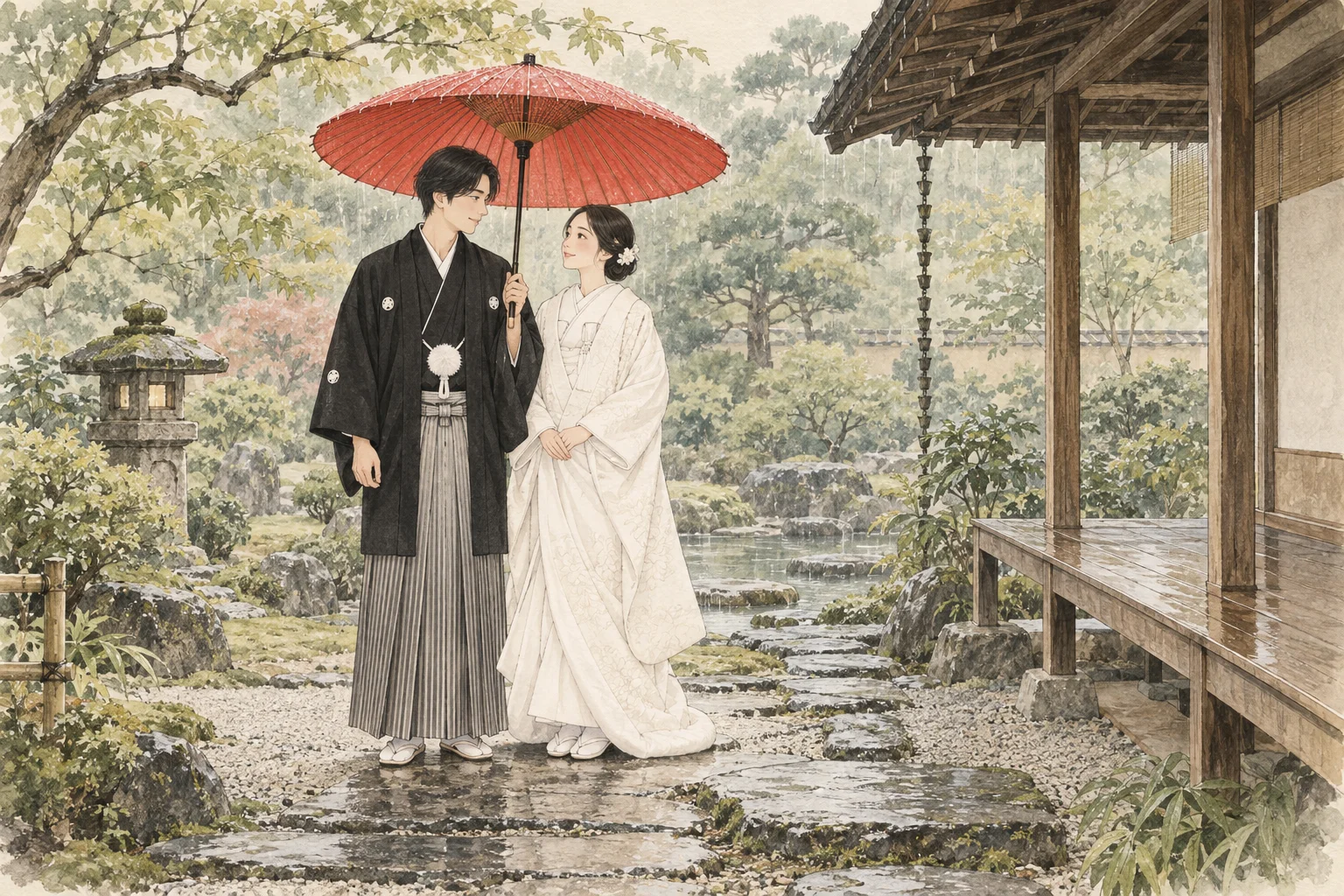
Yakushima receives between 4,000 mm and 10,000 mm of annual rainfall depending on elevation — the highest in Japan. The coastal towns get 4-5 m; the interior summits exceed 8 m. There is a Japanese saying that on Yakushima it rains "35 days a month."
For kimono planning, this means three operational principles:
- Build buffer days. A single-day Yakushima visit fails a substantial share of the time in the shoulder seasons. We plan minimum 3 nights on-island for a one-day shoot, allowing two backup mornings.
- Embrace the wet look. Yakushima's signature frames involve mist, low cloud caught in the canopy, and water-darkened moss. Photographers who specialize here actively prefer drizzle to bright sun — the canopy contrast is impossible in midday sun, and the moss-glow effect requires diffuse light.
- Protect the kimono. Rental shiromuku are silk and will be damaged by heavy rain. Most couples carry the kimono in waterproof garment bags to the shoot location, change at a sheltered point near the composition, and photograph for 20-40 minutes before changing back. We do not recommend wearing kimono on the trail hike itself.
The trade-off works because the result looks unlike anywhere else. A clear-sky Yakushima photo could be mistaken for any other Japanese forest. A misted Yakushima photo is identifiable instantly.
Access (Kagoshima Ferry 4hr / Flight 35min)
Yakushima sits 130 km south of Kagoshima City. Three routes:
By air: Japan Air Commuter operates 5-6 daily flights from Kagoshima Airport to Yakushima Airport, 35 minutes flight time, roughly ¥15,000-22,000 one way. This is the fastest option and the most weather-reliable, though small-aircraft cancellations occur in typhoon conditions.
By high-speed ferry (Toppy/Rocket): jetfoil service from Kagoshima Port to Miyanoura or Anbo, 2-3 hours, ¥9,500-13,000 one way, 5-7 daily sailings. The Toppy is faster but less reliable than the slower car ferry in moderate seas.
By car ferry (Yakushima 2): 4-hour passage from Kagoshima Port to Miyanoura, ¥5,500 one way, one or two daily sailings. This is the option for couples bringing significant kimono and equipment, as it allows a rental vehicle to make the crossing.
On-island transport requires a rental car. Yakushima has no train system and very limited bus service that does not connect to most trail heads at usable hours. Plan for ¥6,000-8,000 per day for a compact rental, plus fuel. The island ring road is 100 km; driving the full perimeter takes 3 hours without stops.
Photographer & Studio Availability (Limited)
This is the most important practical constraint and the one couples most often misjudge.
Yakushima itself does not have a kimono studio. The island has roughly 13,000 residents and a tourism economy focused on hiking, not wedding photography. Couples wanting a Yakushima kimono shoot must source two things separately: the kimono rental, and the photographer.
Kimono sourcing: the standard approach is to rent in Kagoshima City before crossing, transport the kimono to the island in protective garment bags, and return the rental on the return leg. Kagoshima has 4-5 wedding kimono studios that will rent for an off-site shoot, typically requiring a 2-night rental window (¥45,000-80,000 for shiromuku, ¥40,000-70,000 for iro-uchikake). Hair and makeup is done in Kagoshima on the morning of the crossing.
Photographer sourcing: photographers come from three pools. Kagoshima-based wedding photographers (3-5 specialists, most do 2-4 Yakushima sessions per year), Fukuoka or Tokyo specialists who travel for client work (8-12 photographers actively offering Yakushima as an option), and the small number of Yakushima-resident landscape photographers who occasionally take kimono commissions. Pricing for a Kagoshima or Fukuoka photographer for a Yakushima day runs ¥280,000-450,000 including their travel; Tokyo-based runs ¥350,000-550,000.
Wedding Planner's Notes: the trip is too logistically delicate to economise on the photographer. We routinely recommend couples spend meaningfully more on a Yakushima photographer than they would for a Kyoto session, because the photographer's island familiarity (which trailhead at which hour, which composition is reachable in light rain, which permit is required) is the difference between a successful shoot and a 3-night trip with no usable frames. Couples who try to source the photographer through Tokyo agencies for budget reasons often discover the agency has never run a Yakushima job before.
Permit-wise, photography for personal use is permitted across Yakushima's public trails without fee. Commercial photography in the Natural World Heritage zone (which includes Shiratani Unsuikyo and Jomon Sugi area) is subject to advance application to the Yakushima Forest Ecosystem Conservation Center; private wedding photography typically falls below the commercial threshold but the boundary is not always clear, and your photographer should confirm before the date.
Combining Yakushima with Kagoshima/Fukuoka Trip
We rarely plan Yakushima as a standalone destination — the access cost is too high for a single shoot location. The two standard combinations:
Yakushima + Kagoshima City (4-5 days): arrive Kagoshima, rent kimono and complete hair/makeup, ferry or fly to Yakushima, 2-night island stay with one shoot day plus one buffer day, return to Kagoshima for a Sakurajima or Sengan-en session, depart from Kagoshima Airport. This combination produces two visually contrasting sets — an active volcano backdrop and an ancient cedar forest — and uses the kimono rental efficiently.
Yakushima + Fukuoka + Kyoto (8-10 days): for couples doing a full Kyushu-Kansai loop. Kyoto for the temple-and-machiya frames most associated with Japan kimono photography, Fukuoka for Dazaifu Tenmangu, Yakushima as the wilderness contrast. We recommend this sequence (Kyoto first, Yakushima last) so the kimono fittings happen in the Kyoto studio environment that supports them, and the Yakushima crossing is the final adventure of the trip.
Couples interested in cultural contrast can also pair Yakushima with Koyasan, the Shingon Buddhist headquarters in Wakayama — the two settings represent two different Japanese conceptions of sacred landscape (Buddhist temple complex versus indigenous animist forest). For a less demanding "old town" alternative on the Setouchi coast, Onomichi in Hiroshima Prefecture offers hillside temple frames at a fraction of the access cost.
Background reading: our Japanese wedding photography guide covers the broader planning structure, and the 7-day Japan itinerary illustrates how Yakushima slots into multi-location trips.
Frequently Asked Questions
Can we wear kimono on the actual Jomon Sugi hike?
No. The hike is 22 km of mountain trail in technical hiking footwear, with sections of disused railway tie that require careful step placement. Couples carry kimono in waterproof garment bags to a composition viewpoint earlier on the trail (typically Wilson's Stump), change at the location with assistance from the photographer's team, and change back before continuing. The full Jomon Sugi viewing platform is not reachable in kimono.
Is there any indoor backup on Yakushima if it rains heavily?
Limited. Yakushima Environmental and Cultural Village Center in Miyanoura has a small indoor exhibition space, and a few traditional ryokan have tatami rooms that can be used with prior arrangement. Neither is comparable to a Kyoto studio backup. The standard backup plan for Yakushima is a buffer day, not a backup location — the island's value is the forest, and indoor alternatives do not serve the same purpose.
How many days should we budget on the island for a one-day shoot?
Three nights minimum. One arrival day (afternoon ferry or flight, dinner, rest), one primary shoot day, one buffer day in case of heavy rain, one departure day. Couples who book only two nights have a meaningful chance of losing the planned shoot day to weather; couples who book four nights essentially guarantee at least one usable window.
Are there any English-speaking photographers based on Yakushima?
Effectively zero who specialize in kimono. The English-speaking landscape photographers on the island work in hiking and adventure photography. For an English-speaking kimono shoot, the photographer travels in from Tokyo, Fukuoka, or occasionally Kyoto. Coordinator-interpreters are not typically required because the on-island staff couples interact with (lodging, rental car, possibly trail permits) is minimal.
Can we do a Yakushima shoot in October during the autumn foliage window?
Yes, and October is one of our two preferred months for the destination. Note that Yakushima's autumn foliage is more muted than mainland destinations — the island is predominantly evergreen, so the autumn note comes from maples and deciduous understory at trail edges rather than the broad colour palette of Kyoto or Nikko. If foliage saturation is the primary goal, mainland destinations serve better; if the Yakushima cedar forest is the goal, October delivers it at lower rainfall than spring.
Is Yakushima accessible for older parents or relatives who might join?
Partially. The forest interior is not accessible for limited-mobility visitors — even Yakusugi Land's shortest loop involves stairs, uneven boardwalk, and 30 minutes of walking. For older relatives wanting to see the island, Senpiro waterfall and the coastal viewpoints are roadside-accessible, and a few photogenic stops (Inakahama Beach, Nakama Banyan) are flat. We do not recommend Yakushima as the destination where parents accompany the couple through the shoot.
What does a typical Yakushima kimono budget look like all-in?
For a couple sourcing from Tokyo: ¥350,000-550,000 photographer with travel, ¥45,000-80,000 kimono rental from Kagoshima, ¥30,000-50,000 makeup, ¥120,000-180,000 lodging for three nights at a mid-range ryokan, ¥80,000-120,000 transport including round-trip flights to Kagoshima from Tokyo plus the Yakushima crossing plus car rental. Total commonly lands in the ¥650,000-980,000 range, before any mainland sessions stacked into the same trip.
Plan Your Yakushima Session
Yakushima rewards couples who are willing to build a real schedule around the weather and the logistics. We work with photographers across Kagoshima, Fukuoka, and Tokyo who specialize in island work, and the right pairing depends on which trail compositions you prioritize and which other Japan locations you stack into the trip.
Browse photographers and studios in our directory filterable by region and language, or read Koyasan Buddhist kimono photoshoot next if you want a sacred-mountain alternative on Wakayama mainland, followed by Onomichi old-town kimono photoshoot for a Setouchi coastal counterpoint.
Related guides
 Location deep dive
Kawaguchiko Kimono Photoshoot: Mt Fuji's Iconic Vista
Illustrative image · Unsplash. Not a photo of the specific people, places or services discussed.
Plan a kimono photoshoot at Lake Kawaguchi with honest clear-Fuji probability guidance, Chureito Pagoda and Oishi Park location logistics, seasonal trade-offs, and access from Tokyo via the Fujikyu Express.
Read the guide Location deep dive
Kagoshima Sakurajima Kimono Photoshoot: Volcano & Garden
Illustrative image · Unsplash. Not a photo of the specific people, places or services discussed.
Kagoshima Sakurajima kimono photoshoot guide: active volcano backdrop, Sengan-en Shimazu garden, ash-day strategy, seasons, photographer access from Tokyo.
Read the guide Location deep dive
Hikone Castle Kimono Photoshoot: Original Castle & Lake Biwa
Illustrative image · Unsplash. Not a photo of the specific people, places or services discussed.
Hikone Castle kimono photoshoot guide: original 1622 National Treasure castle, Genkyuen tea-garden, Lake Biwa vista, cherry moat, and permit process from Kyoto.
Read the guide