Goshugi-Bukuro Gift Money Envelopes: Patterns & Etiquette
Goshugi-bukuro gift money envelope guide: shochikubai vs awabi-musubi knots, odd-number amounts, crisp bills, calligraphy rules, and foreign guest etiquette.

Illustrative image · Unsplash. Not a photo of the specific people, places or services discussed.
Check current prices, availability and venue rules with the relevant studio or venue before booking.
The goshugi-bukuro (御祝儀袋) — the decorative envelope holding the cash gift at a Japanese wedding — encodes more etiquette than any single piece of stationery you will handle in Japan. Pattern, knot type, outer color, amount, calligraphy style, and even the freshness of the bills inside all signal social positioning to the host family. Pick the wrong knot and a Japanese aunt will notice within three seconds. This guide explains what each element actually means and what foreign guests should do.
What the Goshugi-Bukuro Is and Why It Matters
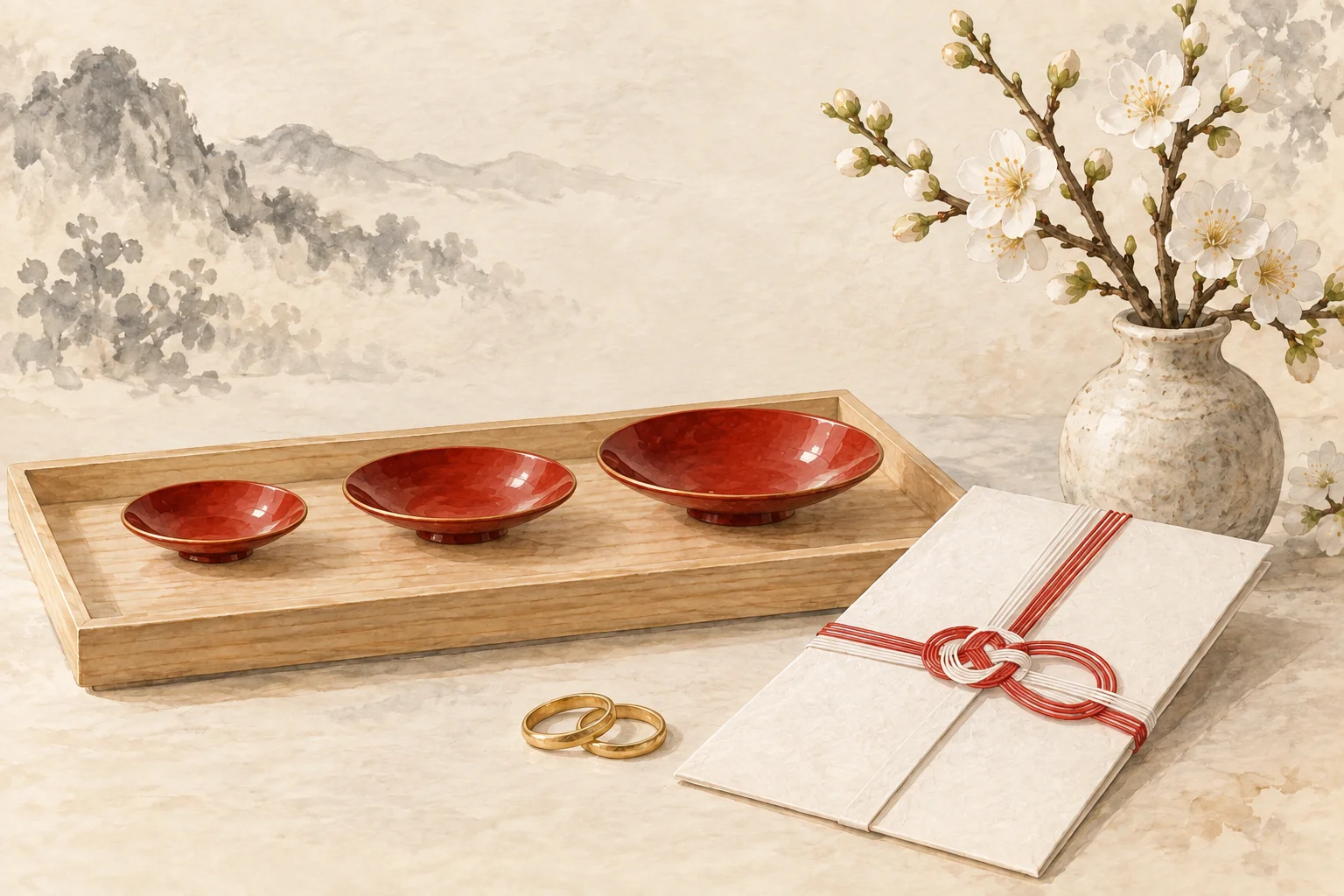
A goshugi-bukuro is the formal envelope used to present a cash wedding gift (goshugi) to the host couple. Cash is the standard wedding gift in Japan — there is no registry tradition, and physical gifts at the reception are unusual. The envelope is not just packaging. It is a layered object with a precise vocabulary: an outer wrapping (omote-bukuro), an inner envelope holding the actual bills (uchi-bukuro), a decorative cord (mizuhiki) tied in a specific knot, and brushwork on the front declaring the giver's name and the occasion.
For foreign guests, the goshugi-bukuro is often the most unfamiliar part of attending a Japanese wedding. Western friends typically bring a card and a registry-purchased gift. Japanese weddings expect a single envelope, presented at the reception desk (uketsuke) when you arrive. The reception staff will record your name and the amount — they will check both the calligraphy on the front and the inner label — which is why getting the envelope right matters more than the wrapping on a Western gift.
Wedding Planner's Note: Department store stationery counters (Isetan, Takashimaya, Mitsukoshi) and major bookstores all stock goshugi-bukuro in a wide price range — ¥300 for a simple paper version, up to ¥3,000+ for high-end silk-cord designs. The rule of thumb is that the envelope should look proportionate to the cash inside. Putting ¥30,000 into a ¥3,000 elaborate envelope reads as showing off; putting ¥100,000 into a ¥300 envelope reads as careless.
Pattern Coding
The most visible decision is the mizuhiki — the decorative paper cord tied across the front of the envelope. The knot style signals what kind of occasion the gift is for. Get the knot wrong and the envelope is reading the wrong celebration.
Shochikubai (Pine-Bamboo-Plum) — Highest Celebration
The shochikubai (松竹梅) motif — pine, bamboo, and plum — represents the three "auspicious friends of winter" in East Asian symbolism. Pine for longevity, bamboo for resilience, plum for renewal. Goshugi-bukuro carrying full shochikubai decoration (gold or silver paper sculpted into all three plants on top of the mizuhiki) are the highest tier of celebration envelope. Use these for weddings of close family, very senior relatives, or when the gift amount is ¥100,000 or higher.
Shochikubai envelopes typically cost ¥1,500-¥3,000 and run noticeably bigger than standard ones. A ¥30,000 gift inside a full shochikubai envelope is a mismatch — the envelope outweighs the gesture.
Awabi-Musubi (Abalone Knot) — Wedding-Specific
The awabi-musubi (鮑結び) or "abalone knot" is the wedding-specific knot you will see most often. It is a tight, intricate woven knot that cannot be easily untied — symbolizing a marriage that should not be undone. This is the standard for friends, colleagues, and most relatives attending a wedding reception.
Adjacent to awabi-musubi you may also see musubikiri (結び切り) — a flatter "tied-and-cut" knot with the same meaning of "this should happen only once." Both are appropriate for weddings. Awabi-musubi is the more decorative version and slightly more formal. Use either confidently for any reception gift between ¥30,000 and ¥100,000.
Hanamusubi (Flower Knot) — Everyday
The hanamusubi (花結び), also called chōmusubi (蝶結び) or "butterfly knot," is the everyday knot that should never appear on a wedding envelope. This is the loose, easily untied bow used for repeatable celebrations: birthdays, childbirth, school graduations, getting a new job. The whole point of hanamusubi is that it comes apart and can be retied — meaning the occasion can happen again. Wedding gifts must signal "this is a once-in-a-lifetime event," which is why hanamusubi is the wrong knot.
If you buy a generic "celebration envelope" (shukugi-bukuro 祝儀袋) from a convenience store, check the knot before purchase. Convenience store stock is sometimes hanamusubi-only — fine for a baby shower, wrong for a wedding.
Cash Amount Conventions
Odd Numbers Only (3, 5, 7, 10)
Japanese wedding gift amounts follow an odd-number convention. The traditional amounts are ¥30,000, ¥50,000, ¥70,000, and ¥100,000. The reasoning is that odd numbers cannot be split in half — symbolizing a marriage that cannot be divided. ¥100,000 is treated as an exception (technically even) because it is a major round number that signals close family or high-rank colleague status.
The standard friend/colleague amount in 2026 is ¥30,000. Relatives typically give ¥50,000-¥100,000. Bosses give ¥30,000 if attending in a courtesy capacity, ¥50,000-¥100,000 if attending as family-equivalent. ¥70,000 is rare in practice but valid if you want a number between ¥50,000 and ¥100,000.
Avoid Even Amounts (2, 4, 6)
Even amounts — ¥20,000, ¥40,000, ¥60,000 — are traditionally avoided because they can be split. ¥40,000 is doubly bad: the number four (shi) sounds identical to the word for "death" (死), making it inauspicious across all Japanese gift-giving contexts. ¥60,000 is occasionally seen but considered awkward.
One modern workaround: if you genuinely want to give ¥20,000, present it as one ¥10,000 bill plus two ¥5,000 bills — that makes the bill count three, which is odd. This is a known etiquette move used by younger guests who cannot afford ¥30,000.
Crisp New Bills Only
The bills inside the envelope must be brand-new, uncirculated notes (shinsatsu 新札 or pisatsu ピン札). Used bills signal that the gift was thrown together at the last minute. Banks in Japan will exchange used bills for new ones at the counter — request "shinsatsu ni ryōgae" (new-bill exchange). Major bank branches keep new bills in stock; smaller branches may take a day to order them.
If you only realize at the last minute, ironing used bills lightly with a low-heat iron can pass for new at the reception desk — this is a known fallback. Crumpled or folded bills, however, are never acceptable.
Outer Envelope Color (White for Wedding)
The standard outer envelope (omote-bukuro) for weddings is plain white washi paper, often with embossed silver or gold detail. White and silver signal celebration without being flashy. Avoid black-and-white or yellow-and-white envelopes — those are for funerals (kōden-bukuro 香典袋) and the difference is immediately obvious to a Japanese reader.
Modern goshugi-bukuro come in mild pastel variants (light pink, soft gold, pale lavender) for younger guests. These are acceptable at most weddings but read as "casual friend" rather than "family." For relatives or formal occasions, stick with white.
Writing on the Envelope (Calligraphy or Pen?)
The front of the envelope has two text areas. The upper center shows the occasion phrase — typically printed on a small detachable paper strip (tanzaku 短冊) included with the envelope. The two standard wedding phrases are 寿 (kotobuki, "longevity/celebration") or 御結婚御祝 (go-kekkon o-iwai, "congratulations on your marriage"). Either is correct.
The lower center is where you write your name. Tradition calls for brush-and-ink calligraphy (fude-pen brush pen is acceptable) using deep black ink. Ballpoint pen is considered too casual for a wedding envelope. Brush pens cost ¥200-¥500 at any stationery store and are sold specifically labeled for ceremonial use. The brushwork does not have to be artistic — a confident plain hand is fine — but the medium itself signals formality.
Couples attending together typically write both names side by side, with the husband's name on the right and wife's name on the left, both in the same brush hand. Foreign couples can write Romanized names: "John Smith" on the right, "Sarah Smith" on the left, in clear block letters with a brush pen.
Inner Amount Label (Uchi-Bukuro)
Inside the outer envelope is a smaller envelope — the uchi-bukuro (内袋) — that holds the actual bills. The front of the uchi-bukuro has a space to write the amount in traditional kanji numerals: 金参萬円 for ¥30,000, 金伍萬円 for ¥50,000, 金壱拾萬円 for ¥100,000. These archaic kanji forms are used because the modern simple forms (三, 五, 十) can be altered after the fact, while the formal forms cannot.
The back of the uchi-bukuro has space for your address and full name in regular characters. This is what the reception desk uses to track who gave what, and what the couple uses later to send their thank-you gift (hikidemono) and the post-wedding thank-you note. Skipping this step means the couple cannot properly thank you — a meaningful etiquette failure.
Wedding Planner's Note: If the formal kanji on the uchi-bukuro intimidates you, regular numerals are accepted in practice ("¥30,000" or "30,000円"). The couple will still know what you gave — they will not penalize a foreign guest for skipping the archaic kanji. Skipping your name and address on the back, however, is a real problem.
Standard Gift Amounts by Relationship
Friends (¥30,000)
The default friend amount is ¥30,000. This covers the per-guest reception cost (typically ¥15,000-¥25,000 for food, drink, and hikidemono) and leaves a meaningful surplus as the gift itself. ¥30,000 is the floor — anything less is awkward. If you cannot afford ¥30,000, the correct move is to decline the invitation politely (citing schedule conflict) rather than give a smaller amount.
Colleagues (¥30,000-¥50,000)
Co-workers at the same career level give ¥30,000. A senior colleague attending the wedding of a junior may give ¥50,000 as a senior gesture. A junior attending a senior colleague's wedding typically still gives ¥30,000 — the senior would consider it inappropriate for a junior to overspend.
Relatives (¥50,000-¥100,000)
Aunts and uncles typically give ¥50,000-¥100,000 per attending adult (so a couple gives ¥100,000 jointly in one envelope). Grandparents giving to grandchildren typically give ¥100,000 or more. Cousins of similar age give ¥30,000-¥50,000.
Bosses (¥30,000-¥100,000)
A direct manager attending an employee's wedding typically gives ¥30,000-¥50,000 if they attend in a courtesy capacity, and ¥50,000-¥100,000 if they are a designated shukuji speaker or filling a ceremonial role like nakōdo. Company presidents giving to a junior employee tend toward ¥50,000 as a generosity signal.
For Foreign Guests — What to Do
If you are a foreign guest attending a Japanese friend's or colleague's wedding, here is the practical checklist:
- Buy the envelope in advance at a department store stationery counter or a stationery chain (Loft, Tokyu Hands, Itoya). Tell the staff "kekkonshiki no goshugi-bukuro" — they will direct you to the correct shelf. Buy one slightly above the minimum tier (¥600-¥1,000 envelope for a ¥30,000 gift).
- Confirm the knot is awabi-musubi or musubikiri, not hanamusubi. The shopkeeper can confirm.
- Exchange bills at a bank for crisp new ¥10,000 notes. Three notes for ¥30,000 is the standard friend gift.
- Use a brush pen (fude-pen) to write your name on the front lower center. Block-letter Romanization is fine. Ballpoint is too casual.
- Fill out the uchi-bukuro: amount on the front in any clear notation, your full name and home address on the back.
- Carry the envelope in a fukusa (silk wrapping cloth, ¥500-¥2,000 at department stores) — pulling a bare envelope out of a backpack at the reception desk looks rushed. The fukusa is unwrapped at the desk and the envelope handed over with both hands.
If you genuinely cannot get all of this done in time, a department store concierge can usually prepare a ready-to-give envelope while you wait, for an extra ¥1,000-¥2,000. Isetan and Takashimaya offer this service at their gift counters. Ask for "goshugi-bukuro no junbi" (goshugi-bukuro preparation).
Link to Wedding Gift Money Overview
The goshugi-bukuro is the physical object. The cultural and economic context around the cash gift itself — why cash, how the host couple uses it, the reciprocity expectations — is a broader topic. See our complete guide to goshugi (Japanese wedding gift money) for that wider picture, and the shōtaijō invitation card guide for the etiquette around the invitation that triggers the gift in the first place.
Frequently Asked Questions
Can I give a Western-style card and check instead of a goshugi-bukuro?
No. Personal checks are essentially unknown in Japan and the reception desk will not know what to do with one. A Western greeting card without an envelope of cash will register as "they did not bring goshugi," which is a real social problem for the host couple. The goshugi-bukuro format is the only widely accepted form.
What if I forgot to buy a goshugi-bukuro and only realize on the wedding day?
Major hotels hosting weddings often keep a small stock of generic goshugi-bukuro at the concierge desk for exactly this situation. Ask for "goshugi-bukuro arimasu ka" at check-in. Stationery shops in major train stations (Tokyo Station, Shinjuku, Kyoto Station) also stock them. Convenience stores carry basic versions but read the knot before buying.
If I bring my partner who was not personally invited, do we still give one envelope?
Bringing a +1 who was not on the invitation is generally not done at Japanese weddings — the headcount is fixed by the invitation. If you confirmed with the couple that a partner is welcome, one combined envelope at ¥50,000 (rather than ¥30,000) is the appropriate adjustment. Two separate envelopes from a couple at the same wedding is unusual.
What happens to the envelope after the reception?
The couple opens the envelopes after the reception (typically the next day), records every amount against the giver's name, and uses the totals to plan their thank-you gifts and post-wedding correspondence. Many Japanese couples keep a small notebook of "who gave what at our wedding" because they will reciprocate at the giver's future wedding.
Can I give more than ¥100,000 if I want to be generous?
Yes, but the next step up is ¥150,000, not ¥110,000 or ¥120,000 (still avoid even tens). At amounts above ¥100,000, you are signaling family-level closeness, which can feel out-of-step if you are a friend or colleague. Most Japanese guests who want to be generous will pair ¥100,000 in the envelope with a separate non-cash gift delivered before or after the wedding.
Is it acceptable for the bride and groom to receive my gift before the wedding day?
Yes — sending the goshugi-bukuro by registered mail or hand-delivering it in advance is a known practice if you cannot attend the reception in person. The envelope should arrive 1-2 weeks before the wedding. Include a short handwritten card explaining you cannot attend but wanted to send your congratulations.
Do destination weddings abroad still use goshugi-bukuro?
If the bride and groom are Japanese and the guest list is mostly Japanese, yes — the goshugi-bukuro convention travels with the couple. If the wedding is in Hawaii, Bali, or Guam, guests will still bring properly prepared envelopes. Mixed-nationality weddings tend to drop the convention or make it optional for non-Japanese guests.
Plan a Wedding Where the Details Land Right
The goshugi-bukuro is the kind of detail that can either glide invisibly into a wedding or stick out awkwardly for the host family. International couples planning a Japanese-style wedding or reception in Japan benefit from a planner-led team who can brief foreign guests on these conventions before they arrive — usually via a bilingual information packet that lands two months before the wedding. Browse our curated directory of bilingual wedding photographers and planners who work routinely with international clients and can help build that pre-wedding guest brief.
Read next: our shōtaijō invitation card guide for the etiquette that triggers the goshugi conversation, then the nakōdo matchmaker overview for the senior-couple role that traditionally bridges two families.
Related guides
 General guide
Hikidemono: Japanese Wedding Return Gifts Explained
Illustrative image · Unsplash. Not a photo of the specific people, places or services discussed.
Hikidemono japanese return gifts explained: three-item structure, catalog gifts, budgets, logistics, and what international couples and guests need to know.
Read the guideGeneral guideTipping Etiquette Japan Wedding: Don't Tip Vendors
Illustrative image · Unsplash. Not a photo of the specific people, places or services discussed.
Tipping etiquette Japan wedding: a planner's honest guide. Why you should not tip photographers, hair stylists, or kitsuke dressers — and what to do instead.
Read the guide General guide
Goshugi: Japanese Wedding Gift Money & Envelope Etiquette
Illustrative image · Unsplash. Not a photo of the specific people, places or services discussed.
Complete guide to the japanese wedding gift (goshugi): how much to give, the shugi-bukuro envelope, new bills, fukusa wrapping, and reception presentation.
Read the guide