Nakodo Matchmaker Japanese Wedding: Role and Modern Use
Nakodo matchmaker Japanese wedding role explained: omiai-era origins, modern o-nakodo-yaku ceremony, who fills the seat, and when foreign couples skip it.

Illustrative image · Unsplash. Not a photo of the specific people, places or services discussed.
Check current prices, availability and venue rules with the relevant studio or venue before booking.
The nakodo (仲人, matchmaker) was once the structural bridge between two families in arranged marriages — vetting backgrounds, carrying proposals, sitting at the head of the reception. That role has thinned dramatically. Industry surveys now place ceremonial nakodo inclusion at roughly 40% of Japanese receptions, with real matchmakers (the original function) below 5%. If you are a foreign couple marrying in Japan, you will likely skip the role entirely. But when a senior relative or your Japanese partner's boss is offered the seat, understanding the ceremonial form prevents awkward declines and embarrassing acceptances.
What the Nakodo Originally Did (Omiai Era)
In the pre-1960s omiai system, the nakodo was a genuine middleman with three concrete duties. First, background vetting: the nakodo confirmed family lineage, financial standing, health history, and the absence of inherited illness or scandal. This was investigative work, sometimes drawing on years of village knowledge or, in urban Tokyo and Osaka, on professional matchmaking offices that kept written records on eligible candidates.
Second, introduction logistics. The nakodo arranged the omiai meeting itself — typically tea at a traditional restaurant — chose the location, briefed both sides on conversation topics, and signaled to each family afterward whether the other side was interested. Direct contact between families before this stage was considered improper. Third, negotiation of the yuino (engagement gift exchange) and ceremony details. The nakodo carried offers and counter-offers, smoothed disagreements about dowry, and represented both families at the wedding itself.
Under this system, the nakodo couple was treated almost as a third set of parents. The bride and groom addressed them with the same honorifics used for in-laws, sent New Year greetings annually, and consulted them on major life decisions for years after the wedding. See our deeper omiai history article for how this system worked at scale.
The Two Modern Forms
Today the word nakodo covers two very different roles, and confusion between them is common — even among younger Japanese guests at receptions. Knowing which form you are dealing with determines almost everything else about etiquette.
Real Matchmaker (Now Rare)
A genuine matchmaker who introduced the couple still exists but is uncommon. You see it most often when the couple met through a professional marriage agency (kekkon sodansho) — the agency counselor sometimes takes the symbolic seat at the wedding. You also see it in arranged introductions through family friends, where the introducer is acknowledged as having directly caused the marriage. In these cases, the nakodo role is meaningful: the person actually did the work the historical role described, even if compressed into months instead of years.
O-Nakodo-Yaku Ceremonial (Most Common)
The far more common form today is o-nakodo-yaku (御仲人役, "honorary nakodo role"). This is a senior couple — usually with no actual involvement in how the bride and groom met — who occupy the nakodo seat at the reception as a ceremonial gesture of respect. The role is purely symbolic. Their duties are limited to a single speech, a brief family-introduction ritual, and sitting in honored positions during the reception meal.
Wedding Planner's Note: when a Japanese family member tells you "we'd like to invite my uncle to be the nakodo," they almost always mean o-nakodo-yaku, not real matchmaker. Foreign couples sometimes misread this as "they want us to pretend my uncle introduced us," which causes confusion. The Japanese side understands the ceremonial fiction; everyone in the room understands. No one is pretending.
Who Typically Plays the Ceremonial O-Nakodo-Yaku
Selection of the o-nakodo-yaku couple follows hierarchical conventions. The honor signals which person or family the groom (it is almost always selected from the groom's side) most respects. The choice itself is a public statement.
Senior Couple from Groom's Company
The most traditional choice is the groom's department head or senior executive, accompanied by their spouse. This selection signals that the groom's career and corporate relationships are central to his identity — and in turn, that the company's continued patronage matters to the new family. In older industries (banking, manufacturing, government ministries), declining to invite a company senior in this role can be read as a snub. Younger couples in technology, design, or freelance work increasingly avoid the corporate version.
Older Relatives
The alternative is an older relative couple — typically the groom's uncle and aunt, occasionally a grandparent pair if health allows. This selection signals family-centered values over career-centered values. It is the more common choice for inherited family businesses, traditional households, and rural ceremonies. Bride-side relatives in the role are rare but increasingly accepted, particularly when the bride's side has more senior figures or when the marriage is into the bride's family (mukoyoshi, where the groom takes the bride's surname).
Nakodo Speaking Position at the Reception
If your reception includes a nakodo couple, their place in the speech order is fixed by convention. The nakodo speech is the first formal address of the reception, delivered immediately after the couple's entrance and the kanpai (toast). It opens the speaking sequence and sets the tone.
The structure of a nakodo speech runs roughly: brief self-introduction explaining their relationship to the couple, formal congratulations on behalf of both families, a short character sketch of the bride and groom (typically dignified, occasionally mildly humorous), and closing wishes. Length is 3-5 minutes. The speech is delivered while standing at a microphone near the head table, with the couple seated. After the nakodo speech, the order moves to senior company seniors, then close friends, then family.
Wedding Planner's Note: foreign couples receiving a nakodo speech delivered in Japanese should ask the venue to provide a printed English summary in the program. Translating live is awkward and breaks the ceremonial pacing. A pre-written summary in the booklet that guests can read while the speech happens preserves dignity for both sides.
The Family-Introduction Ceremony
The second formal nakodo duty is the ryouke shoukai (両家紹介, family introduction). Held early in the reception — typically just after the nakodo speech — this is the moment when the two families are formally introduced to each other and to the guests. It is sometimes called shinzoku shoukai (親族紹介) when limited to extended family.
The format: the nakodo stands and introduces each family member by name, relationship to the couple, and role. The groom's side is introduced first, starting with the father and proceeding through mother, siblings, grandparents, uncles, aunts. The bride's side follows in the same order. As each name is read, the named person stands briefly and bows. The full sequence takes 8-15 minutes depending on family size.
For foreign-Japanese couples, this ritual requires advance coordination. The nakodo or the venue master of ceremonies needs a written list of all foreign family members in correct order, with name pronunciations in katakana or romaji. Surname spelling matters — Western middle names are typically dropped in the announcement to keep names short. See our invitation card guide for related naming conventions that affect this ritual.
Goshugi Gift Etiquette to the Nakodo
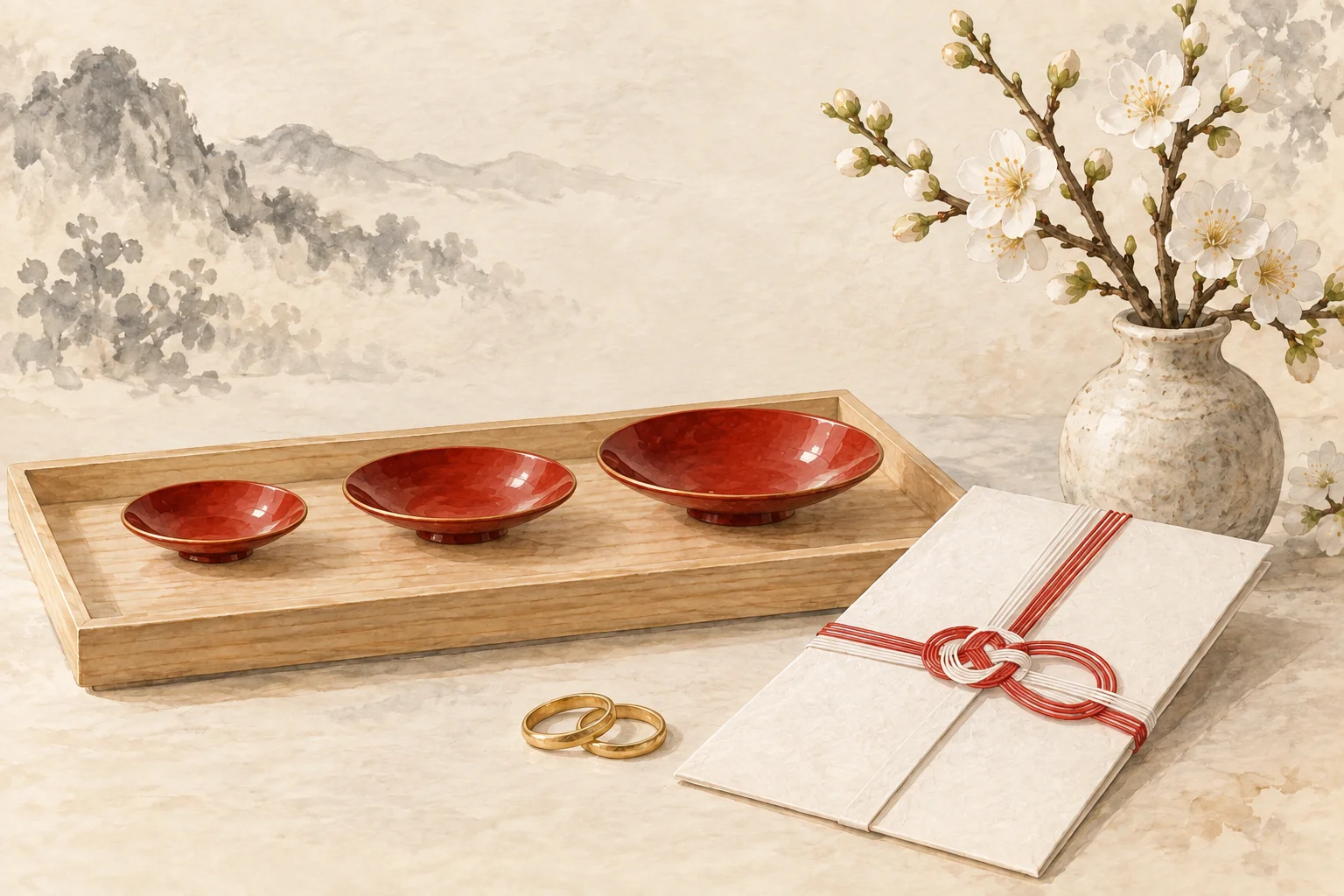
The nakodo couple does not give goshugi (cash gift) to the bride and groom — they are honored guests, not contributing guests. Instead, the bride and groom give a thank-you gift to the nakodo. This payment is called orei (御礼, formal thanks) and is delivered in a dedicated envelope similar to but distinct from goshugi-bukuro.
Standard amounts in 2026: ceremonial o-nakodo-yaku receive 50,000-100,000 yen (cash, in shochikubai pattern envelope), plus a substantial gift — often a piece of formal tableware, a high-quality kimono accessory, or a sweets box from a famous confectioner. Real matchmakers who actively introduced the couple receive 100,000-300,000 yen plus the gift. The payment is made by the groom's family, often delivered to the nakodo couple's home the week before the wedding rather than handed over at the venue.
Our goshugi-bukuro envelope guide covers the related envelope patterns and amount conventions in detail — orei follows the same visual rules but uses a different envelope label.
Why Foreign Couples Typically Skip the Role
Most foreign couples (or foreign-Japanese mixed couples) skip the nakodo role entirely. Several practical reasons drive this decision.
First, the foreign side rarely has an obvious candidate. A US groom's American boss has no cultural framework for the role and would feel awkward delivering a Japanese-format speech. Foreign uncles and aunts are unlikely to fly in for the role unless they were already traveling. Without a credible candidate on both sides, the asymmetry feels off.
Second, the ceremonial fiction does not translate. A Japanese audience accepts that a department head who never met the couple before is "introducing the families" — everyone understands the convention. A foreign audience reads this as strange. Either it requires explanation in the program (cumbersome) or it confuses guests who are already navigating an unfamiliar ceremony.
Third, modern Japanese receptions increasingly skip the role even for fully-Japanese couples. The trend among urban couples in their 30s and 40s is to drop the nakodo entirely and have the venue's master of ceremonies handle the family introduction. By skipping the role, foreign couples align with current Japanese practice rather than violating tradition.
When to Include / When to Skip
The decision logic for foreign couples planning a Japanese reception:
Situation | Recommendation |
|---|---|
Both partners are foreign, ceremony in Japan | Skip entirely. No cultural fit. |
Foreign + Japanese couple, modern urban reception | Skip is now standard. Use MC for family introduction. |
Foreign + Japanese couple, traditional rural family | Discuss with Japanese parents. Include if parents request. |
Marriage agency introduction | Consider real matchmaker form — the agency counselor. |
Japanese groom in conservative industry (banking, government) | Include company senior to honor workplace relationships. |
Mukoyoshi marriage into bride's family | Include bride-side senior couple to honor family transition. |
Wedding Planner's Note: the question of whether to include nakodo is almost always actually a question for the Japanese parents, not the couple. If the Japanese partner's parents request it, expect strong attachment to the convention; if they suggest skipping, the couple can comfortably follow their lead. The couple's own preference matters less than parental expectation here.
Link to Omiai History
The nakodo role does not stand alone — it is the visible ceremonial residue of an entire matrimonial system that organized Japanese marriages from the Edo period through roughly the 1960s. Understanding why ceremonial nakodo persist requires understanding the system they came from. Our omiai arranged marriage history article covers the full arc — how it worked, why it declined, and what survives in modern konkatsu (marriage-hunting) culture. Reading it before deciding on nakodo inclusion gives you the context to discuss the choice with your Japanese in-laws.
Frequently Asked Questions
Can the nakodo couple be unmarried, or a single person?
Traditionally no — the role is structurally a couple, mirroring the bride and groom they are honoring. In practice some modern receptions accept a single person (typically a widowed senior), but this is unusual. If you want a single mentor to play a ceremonial role, frame them as a "main speaker" or "guest of honor" rather than nakodo to avoid the awkwardness of the missing partner.
What if the nakodo couple cannot attend on the wedding day?
The role cannot be performed in absentia. If the nakodo couple cancels close to the date — health issue, family emergency — you have two options: invite a backup couple at short notice (uncomfortable but possible with very senior relatives), or remove the role and have the MC handle the family introduction. The orei (thank-you payment) is still sent to the originally-invited couple as a gesture of respect.
Do same-sex couples include nakodo?
Same-sex Japanese couples who hold receptions occasionally include the role, typically with a single same-sex senior couple from a mentor relationship rather than imposing a heteronormative format. The convention is still evolving. International same-sex couples nearly always skip the role.
Should the nakodo couple wear specific attire?
Yes. The nakodo wife typically wears tomesode (black formal kimono with family crest) or a formal Western suit dress. The nakodo husband wears a morning coat or formal black suit with white tie. They dress one tier more formal than typical relatives to signal their honored position. The wedding planner usually confirms attire with them 3-4 weeks before the date.
Is there a fee scale difference between ceremonial and real matchmaker?
Yes — and the difference is meaningful. Real matchmakers who introduced the couple receive 100,000-300,000 yen orei reflecting actual service rendered. Ceremonial o-nakodo-yaku receive 50,000-100,000 yen reflecting honor but not service. The amounts are not strictly graded by industry custom — your Japanese in-laws or wedding planner will advise the appropriate tier based on the nakodo's seniority and relationship.
What happens if both families want to nominate a nakodo?
The convention is a single nakodo couple — not one per side. If both families want to honor someone, you can include the second senior couple as kihinseki (貴賓席, honored guest seating) at the head table without giving them the nakodo speech or family-introduction duty. The first nakodo couple takes the ceremonial role; the second is honored by seating placement and program acknowledgment.
Can the nakodo speech be delivered in English for foreign-friendly receptions?
Technically yes, but rare. When the nakodo is the bride's foreign uncle or a foreign mentor, English delivery works. When the nakodo is a Japanese senior, requesting English delivery puts an unreasonable burden on someone doing you a favor. The standard solution is Japanese delivery with a printed English summary in the program — preserving dignity for the speaker while giving foreign guests access to the meaning.
Is the nakodo role used in Shinto shrine ceremonies or only at the reception?
The role is reception-centered. During the Shinto ceremony itself, the nakodo couple may be present as honored guests but has no liturgical role — the priest and the san-san-kudo ritual handle the ceremonial structure. The nakodo's duties begin at the reception. See our Shinto ceremony article for what the ceremony portion involves.
Plan Your Reception with the Right Cultural Frame
Including or skipping the nakodo role is a small decision with outsized symbolic weight in a Japanese reception. The right choice depends on which side of your family carries cultural expectations, what industry your Japanese partner works in, and whether your in-laws view tradition as defining or optional. None of these decisions need to be made before you book a photographer — but they shape the program, seating chart, and goshugi etiquette in ways that affect your final album. Browse our directory of Japanese wedding photographers with multilingual planner support who routinely coordinate around these family-structure decisions.
Next, read our guide to Japanese wedding invitation cards to handle the formal RSVP process — including how to list the nakodo couple on the invitation — and our goshugi-bukuro envelope guide for the related cash-gift conventions that apply to all reception guests and to the nakodo orei payment itself.
Related guides
 General guide
Shrine Permit Application Process: Japan Wedding Photo Guide
Illustrative image · Unsplash. Not a photo of the specific people, places or services discussed.
Shrine permit application process for Japan wedding photography: studio-handled timelines, Meiji Jingu and Kyoto fees, equipment restrictions, and lead times.
Read the guide General guide
Editing Turnaround Time: Japan Wedding Photographer Delivery
Illustrative image · Unsplash. Not a photo of the specific people, places or services discussed.
Editing turnaround time for Japan wedding photographers runs 4-6 weeks standard, with peak season delays, express options, and album binding adding more.
Read the guide General guide
Naorai Post-Ceremony Meal Japan: Sacred Sequel Guide
Illustrative image · Unsplash. Not a photo of the specific people, places or services discussed.
Naorai post ceremony meal japan wedding guide: the 30-60 minute shared kaiseki and sake ritual that closes a Shinto wedding before any reception begins.
Read the guide